Innovation Blog

In Praise of Failure:  Dyson, the Vacuum Cleaner Wizard, Speaks

By Shlomo Maital

 

Sir James Dyson & his “Cyclone” vacuum cleaner 

We all know James Dyson from the TV vacuum cleaner ads.  A faithful reader of my blog alerted me to Dyson’s recent piece in Wired Biz.  (Wired, of course, is a wonderful source of new ideas for any entrepreneur, worth tracking closely).     Dyson speaks “in praise of failure”.   Here are excerpts from his piece:

  “An inventor’s path is chorused with groans, riddled with fist-banging and punctuated by head scratches. Stumbling upon the next great invention in an “ah-ha!” moment is a myth. It is only by learning from mistakes that progress is made.     It’s time to redefine the meaning of the word “failure.” On the road to invention, failures are just problems that have yet to be solved.

  [Note: This is precisely what Thomas Edison said, as he struggled to develop a filament for the light bulb.  He failed thousands of times in his laboratory, but never regarded a failure as a ‘failure’ but as a step toward the final solution].

For me, it started with a vacuum. When my bagged vacuum lost suction, I came up with the solution — cyclone technology. But having an idea is just the beginning. With a few rudimentary materials I mocked up the first prototype. Crude, but it worked (sort of).

From cardboard and duct tape to ABS polycarbonate, it took 5,127 prototypes and 15 years to get it right. And, even then there was more work to be done. My first vacuum, DC01, went to market in 1993. We’re up to DC35 now, having improved with each iteration. More efficiency, faster motors, new materials. 

  [Note: prototyping is crucial.  If you have an idea, do a mockup, a rough version, no matter how crude – until you have a prototype, you don’t have a real product. And investors, by the way, love to see things they can touch and feel, instead of 200 Powerpoint slides].

   There are countless times an inventor can give up on an idea. By the time I made my 15th prototype, my third child was born. By 2,627, my wife and I were really counting our pennies. By 3,727, my wife was giving art lessons for some extra cash. These were tough times, but each failure brought me closer to solving the problem. It wasn’t the final prototype that made the struggle worth it. The process bore the fruit. I just kept at it.

Instead of being punished for mistakes along the way, learn from them. I fail constantly. And I wouldn’t have it any other way.

   By fostering an environment where failure is embraced, even those of us far from our student days have the freedom to make mistakes — and learn from them still. No one is going to get it right the first time. Instead of being punished for mistakes along the way, learn from them. I fail constantly. And I wouldn’t have it any other way.”

Global Crisis/Innovation Blog

Democracy? No – Dollarocracy: U.S. Elections Are About Money, Not Ideas

By Shlomo Maital

   President Obama has announced the launch of his presidential candidacy for 2012. According to USAToday,   the Democrat and Republican presidential candidates will each raise, and spend, $2 b. on the campaign!   It’s a bright new era — the Age of Dollarocracy!

   A stupid and disastrous Supreme Court decision has paved the way.  In Citizens United vs. Federal Election Committee,  the Court ruled in 2010 that independent groups not associated with political parties or campaigns can spend unlimited corporate and union cash on ads!  The Republicans used this ruling effectively to outspend the Democrats in the mid-term 2010 elections and thoroughly drubbed the Dems.  So the Dems are planning to try the same in 2012.

   Election spending has been rising exponentially in the U.S.  The elections have become a race to see who can raise more money for costly TV ads, not who can solve America’s myriad problems. 

   If you are really good at math, project these numbers into the future, and see where they lead. They definitely do not lead to an open democratic election where ideas compete, rather than corporate wallets:

     (President, and his total campaign spending, by election):  Clinton, 1992:  $100.6 m. ;  Clinton 1996, $108.5 m.; Bush, 2000, $172.1 m.; Bush, 2004,  $356.4 m.; Obama, 2008, $745.7 m.;  Obama, 2012, (est.), $2 b. 

    USAToday says Obama has asked 400 Democrat fundraisers to collect at least $350,000 each, by year’s end. 

     You may say that much of Obama’s money came from millions of small donations.  Close inspection reveals, however, that it is the big corporate donations that drive fund-raising. And now, thanks to the Supreme Court, these are nearly unlimited.

  Way to go, judges.  You’ve helped ruin American democracy for many years to come,  under the pretense that bankrolling candidates with unlimited millions is a constitutional right and part of freedom.  Where is the freedom to elect the best candidate even if he or she takes positions that anger the big-money corporate interests?

Global Crisis/Innovation Blog

“Thunderous” New Nuclear Energy Technology


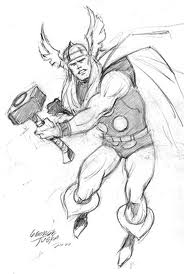
 Thor God of Thunder


 The current technology used to generate electric power from nuclear fission is a product of the Cold War.  The nuclear reactors are derived directly from technology developed to power American nuclear submarines, by generating steam through nuclear fission, based on Uranium 235.  This technology may be acceptable for nuclear subs, but after Japan’s disastrous mishap in Fukushima, it needs to be re-evaluated for civilian power stations.

   There is an alternative.  Kirk Sorensen, of Teledyne, and many top physicists,  predominantly Nobel Laureate Carlo Rubbia (CERN), note that one ton of thorium can generate as much nuclear energy as 200 tons of uranium.  But research on thorium reacts was halted in the 1950’s, when uranium reactors were built.

     How would a thorium reactor work?  Basically, if you use a small linear accelerator to bombard mined thorium (there is only one isotope, unlike uranium, which has several),  with slow neutrons, Thorium 232 absorbs the neutrons and becomes Uranium 233.  This fission reaction, which releases energy, creates heat that generates steam and turns turbines to make electric power.  And the process can be designed so that the byproducts cannot be used to produce nuclear bombs.  Moreover, the waste products deteriorate in a few hundred years, unlike thousands of years for plutonium waste.  And the process can be halted instantly, in the event of trouble, unlike the uranium process, which requires cooling rods and cooling water (which tsunamis can disable).  Just turn off the neutron-generating accelerator, and presto, the process halts.  In the event of a disaster, the process stops itself in milli-seconds. 

     This is not theoretical.  Pilot plants have been built in the U.S. and Russia, and China is currently engaged in large-scale research on thorium-based nuclear energy.

    Thorium gets its name from the Greek God Thor, the god of thunder.   A crash project to develop thorium nuclear technology could greatly help global warming, and alleviate the damage fossil fuels cause by generating carbon dioxide.   It could be literally a thunderous development.

Global Crisis/Innovation Blog

 Greece, Ireland,  now Portugal: Why the Poor are Bailing Out Europe, NOT Vice Versa

By Shlomo Maital


 Portugese People Protest!

  First, it was Ireland. Then Greece.  Now it is Portugal.  According to the press, the European Union, and its emergency fund, in cooperation with the International Monetary Fund, has arranged emergency loans for Portugal, amounting to between 75 and 110 billion euros.  Bailouts for Ireland and Greece were similar in size and terms.

   Portugal’s Prime Minister, whose name is Socrates,  fought hard against the bailout, but he had zero chance.  The global bond market kept raising the yields on Portuguese bonds, until the gap between Portuguese and German bonds exceeded 5 per cent, a level at which paying the interest and principal became nearly impossible.  Portugal fell, like Ireland and Greece before it.

   There is a fundamental misunderstanding about the bailout, and especially, about who is bailing out whom!   In Ireland, the Irish people will have to pay heavy new taxes for generations, to pay off Irish government bonds, so that Irish banks and those to whom Irish banks owe money (Germany banks) will not go bust.  So it is the Irish people who have bailed out German banks, not vice versa.  Of course, the Irish people know this, and threw out the incumbent government in recent elections for this reason. Now the new government wants to renegotiate the draconian terms of the emergency EU loan to Ireland.  This will happen eventually in Greece as well, and in Portugal.  The result is total chaos. 

    Greece is an especially difficult case, because the involvement of the International Monetary Fund always brings desperately strict measures (raise interest rates, slash spending) as a condition for providing the emergency funds.  And it is a self-fulfilling prophecy.  The tougher the loan terms, the lower the country’s growth rate, the bigger the hit government revenues take – and the tougher it is to pay back government debt. 

     Europe has badly mismanaged the bailout of Ireland, Greece and Portugal, endangering the future of the 27-nation EU and the 16-nation euro bloc.  And now, the outgoing head of the European Central Bank, Trichet, has begun raising interest rates, which will make it even harder for struggling peripheral nations in Europe to pay back their debts.  Why did he do this? To fight inflation?  Is there inflation in Europe?  There is no sign whatsoever of inflation – Trichet is fighting the phantom of future inflation, in economies that are still stagnating and fighting DEFLATION! 

     The situation in which the poor people of Ireland, Greece and Portugal are scalped into bailing out the wealthy banks of Germany, France, Belgium is unacceptable.  The result will continued social unrest and upheavals.  Let the wealthy banks take the hit, they can afford it far better than the unemployed struggling people of the peripheral European nations.

 Global Crisis/Innovation Blog

Power, War & The Power Law: We Need Double Loop Thinking Fast!

By Shlomo Maital


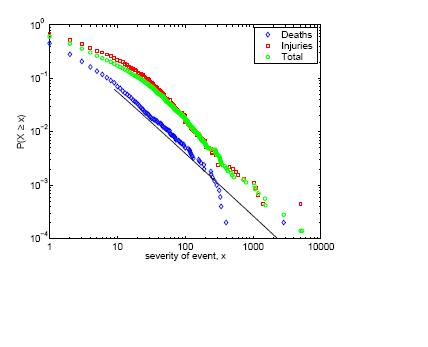
X axis: Casualties: Y axis: Probability


 Organizational psychologist Chris Argyris once coined the phrase “double loop thinking”, to define thinking that seeks to change entire SYSTEMS, by utterly different thinking, not just parts of the existing system with in-the-box more-of-the-same thinking.  In this he reflects Einstein’s “Law” that “you cannot solve a problem with the same thinking that created it”.

   Now we have evidence from mathematicians and physicists, who have analyzed centuries of data regarding war and bloodshed.  They have discovered the “Power Law” (originally noted by the physicist Lewis Fry Richardson)  (see diagram), which says that when the ‘severity of the (war) event’ increases by a factor of 10, the probability it will happen declines by a factor of 10.  In other words, the probability a terrorist attack will take 10 lives at a given point in time is 1/10, but an attack that kills 100 has a probability of 1/100.    Thousands of data points fall very close to this ‘power law’ inverse line.  and this “law” seems to have prevailed for centuries.

    Why?    According to one of the researchers working on this problem, Dr. Sean Gurley (Oxford U.):

  “The fact that the power-law distribution seems to be constant across all long-term modern wars suggests that the insurgencies have evolved to find an ideal solution to the problem of how to fight a stronger force.   Unless this structure is changed then the cycle of violence in places like Iraq will continue,” said Dr Gourley.” We have used this analysis to advise the Pentagon, the Iraqi government and the United Nations.”

  Here in the Mideast, events seem to constantly confirm the Power Law.  Recurring cycles of violence, revenge, counter-attack, revenge, etc. appear to create an endless Doom Loop of violence.   There must be some way to ruin the Power Law and implement Double Loop thinking. But the problem is, those whom we elect to solve our problems and conflicts actually seem to be trapped in the Power Law and confirm it rather than disprove it. 

Global Crisis/Innovation Blog

Stressed Out? Hard to Make Ends Meet? There Is A Simple Answer: Kick the Money Habit

By Shlomo Maital

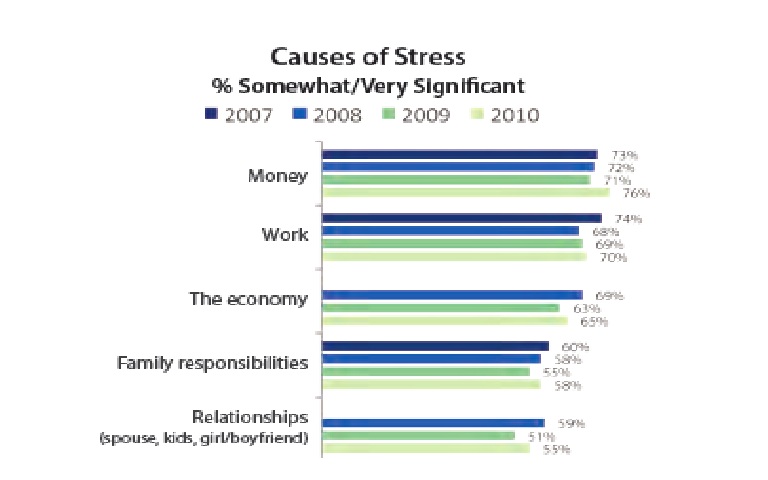
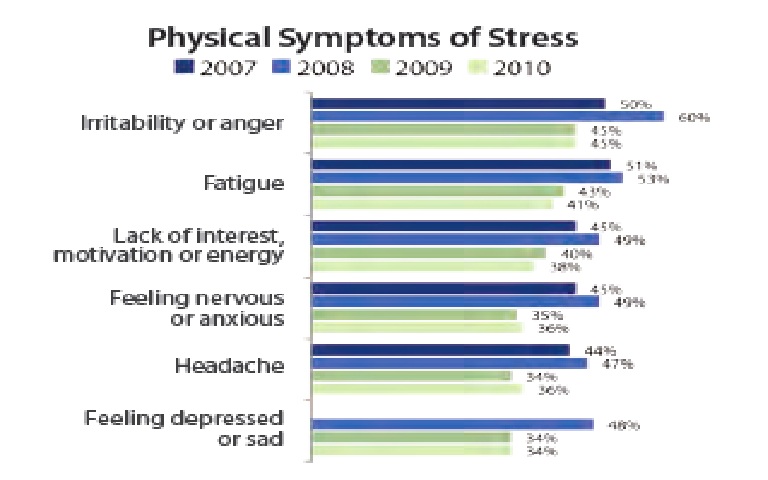
 The results of the American Psychological Association’s 2010 Stress in America survey are now out. *  The results compare a) the causes of stress yearly, from 2007 (pre-global-crisis) to 2010 (post-crisis, post-joblessness), and b) the physical symptoms of stress, yearly.  

  I am hugely surprised by the results (for reasons way different than the APA).  Despite the earthquake of the financial crash, recession, loss of jobs, loss of homes, foreclosures,  Lehman Bros., etc. – Americans are stressed by the same things in 2010 as they were in 2007, with insignificant differences.  And the symptoms caused by stress also remain the same. 

    Here are the results:   In order of importance for 2010:  76% are stressed by money issues (73% in 2007), 70% by work issues (74% in 2007 !);  58% are stressed by family issues (60% in 2007).  The results of stress:  45% show irritability or anger (50% in 2007), 41% show fatigue (51% in 2007 !), 38% lack of interest or energy (45% in 2007), and 36% feel nervous or anxious (44% in 2007).  Surprisingly: 24% in 2010 showed NO symptoms of stress, compared with only 16% in 2007. 


I have a modest suggestion.  If money is a cause of tension, and so is work (working at jobs we don’t like, so we can earn money and spend it on things we don’t need),  why not tackle the issue head on?  Kick the money habit.  Start to reduce your spending.  Cut it by 10 per cent (of course, on discretionary items) this month. See how you feel.  If you feel OK, do the same in six months. Make it like a permanent diet – not a one-time crash that leads to weight gain almost at once, but a permanent change in behavior, a GRADUAL one.  Attack the primal cause of tension  by learning to do with less money, almost as addicts kick the drug habit by doing without it, cold turkey.  

    What, you say, will happen to the economy if everyone starts doing this? We’ll have a Depression to end all depressions.

    Not at all.  The capital markets will be awash with savings.  The money will be borrowed and used to build infrastructure, technology, education, environment, alternate energy.  We will replace spending (selfish and self-defeating, for those now alive) with investment (selfless, for those who will live in future).  We will all feel much better.  Over time, we will work at jobs we love rather than jobs we work at, for the paycheck.  And then, man, will that APA stress survey take a hit!  

* APA Monitor Jan. 2011, pp.60-61.

 Innovation Blog

Hope for Alzheimer’s: Simply Collaborating Can Become Radical Innovation!

By Shlomo Maital


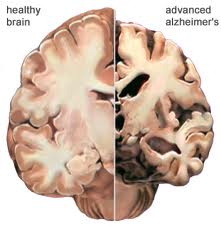
 Left: normal brain. Right: Alzheimer’s


As populations age in Europe, America and Japan, Alzheimer’s becomes a problem of immense dimensions.  Some 5 million Americans suffer from Alzheimer’s, many over the age of 75.  The growth rate is 10 per cent, meaning the number of those with Alzheimer’s doubles every seven years!    Japan has relatively fewer cases, but Europe may soon rival America.

  So far, research on Alzheimer’s has followed the standard scientific research model – small teams of scholars apply for competitive grants, and seek the genome evidence linking certain genes with Alzheimer’s.  This model has produced relatively disappointing results.

   Three years ago, according to the New York Times, Gerald D. Schellenberg, U. of Pennsylvania, went to the National Institutes of Health (main funding agency for medical research) with a major complaint.  He said:  Genome-wide association studies or GWAS’s (associating genes with Alzheimer’s) are not getting results, because each study does not have enough subjects.  To establish that a certain gene leads to a, say, 10-15 per cent predisposition to Alzheimer’s requires a big sample.  GWAS’s don’t have that.    

     Schellenberg acted.  He started to gather data, painstakingly calling up all those who had done small-scale GWAS’s, asking for the data. “I spent a lot of time being nice to people on the phone”, he recalls.    He wanted data for 50,000 people.  The magnitude of Schellenberg’s  research is staggering:  A million genetic scans on every person in the sample, times some 50,000 people, or 50 trillion genetic scans!  He got what he wanted. Nearly every Alzheimer’s researcher in the U.S. cooperated.    (A similar effort was underway in Europe, led by Dr. Julie Williams, at Cardiff Univ., Wales).   The American and European groups are now about to pool their data.

   Results?  Five new genes have been shown to cause a small predisposition to Alzheimer’s. The significant is not in early testing for those genes, but rather, what those genes do can lead to clues about the biological causes of Alzheimer’s – apparently, related to cholesterol.   

     Does cholesterol gum up our brains, like it gums up our arteries?  Stay tuned!

    Meanwhile, Schellenberg has shown that those who integrate existing knowledge can be radical innovators, just like individuals who make breakthrough discoveries. 

* Gina Kolata, “New studies identify genes tied to Alzheimer’s”,  Global NYTimes, April 4, 2011, p. 7.


Global Crisis/Innovation Blog

Parag Khanna Knows How to Run the World: From Medieval Disorder to a New Renaissance

By Shlomo Maital


Parag Khanna is Director of the Global Governance Initiative at the New America Foundation, and is an Indian-American and author of best-selling books.  His latest book is:  How to Run the World: Charting a Course to the Next RenaissanceParag’s main argument?  The world today is in disorder, much as it was in medieval times, with no country or city-state able to dominate or exert global control.   This book extends Khanna’s first book, The Second World, which was about  the disorder stemming from a multi-polar no-superpower world.  In this book, according to Publisher’s Weekly, Khanna claims “the “American Century” is over. …we are in for a fractured, fragmented, multi-polar  world, a new Middle Ages of decentralized power where “corporations, powerful families, humanitarians, religious radicals, universities, and mercenaries are all part of the diplomatic landscape.”   Here is an excerpt of Khanna’s own words, from an interview with Washington Notes blog

  “Instead of a world of just great and lesser powers, the emerging landscape looks a lot like the Middle Ages of a millennium ago. That was the last time in history when, like today, both East and West were powerful at the time same time. Song dynasty China invented paper money (of which they have plenty today!), the south Indian Chola empire ruled the seas from East Africa to Indonesia, the Arab-Islamic community was at its peak as the Abbasid caliphate stretched from Andalusia in modern day Spain to Central Asia, while the Holy Roman Empire marked an uncertain and unstable period in Europe.  The aftermath of the Crusades was a crucial turning point in history when Europeans began to focus on commerce to acquire commodities and spices, prompting voyages of discovery that created the first global trading system. Banking houses in Europe rose to finance long-distance naval expeditions, which were aided by the invention of the compass. Travelers such as Italian Marco Polo and the Moroccan Ibn Batutta covered tens of thousands of miles by land and sea, deepening understanding between East and West. Globalization was thus taking place on economic, strategic, and cultural levels just as it is again today. It’s also interesting that the participants in globalization were cities, corporations, churches, guilds, mercenaries, universities and humanitarians—very much like today.    America’s footprint in the world is much greater than that of its government alone.  American companies spread financing, technology and management know-how around the globe, American universities have set up campuses across the Middle East and Asia to educate the next generation of leaders, and American citizens and charities are the most generous in the world. So America needs to stay open and engaged in the ways that have made it the most respected leader in decades past. Where America builds relations among citizens and not just governments, such as with Europe, Japan and India, alliances are much more long-lasting and stable.”

    How will this new Renaissance occur?  The last Renaissance occurred when enlightened leaders liberally funded artistic creativity.  This Renaissance will occur when the real powers in today’s world, global corporations, become aware of their obligation to the wellbeing of the world, the planet, the environment, not solely their own stockholders, and act together to make the lives of ordinary people, and future generations, significantly better. 

Global Crisis/Innovation Blog

A Thousand True Fans:  YOU Can Do It!

By Shlomo Maital


By chance, I encountered a blog with a clever title and a powerful point.  [www.kk.org/thetechnium/].  Here is the main point:

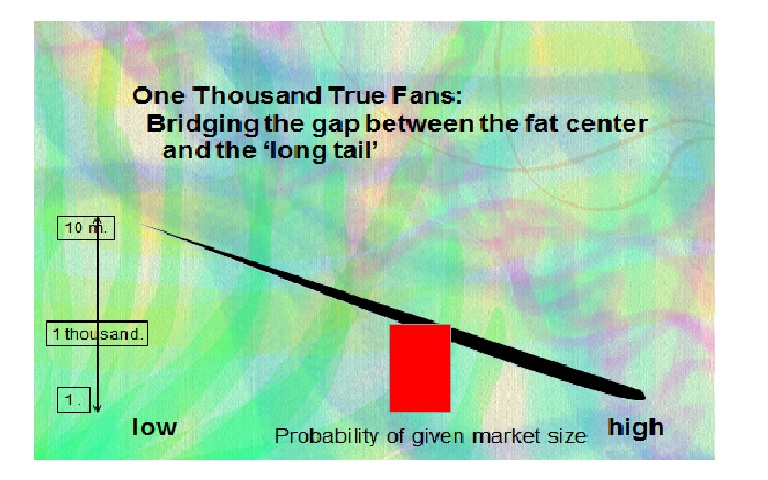
   There are two places innovators look for ideas. One is the ‘long tail’ – esoteric niche markets, on the long largely-unoccupied tail of the normal curve.  The density of users and buyers here is too low to support life, generally.  The second is the fat middle, where ordinary people reside.  Here, competition is fierce, advantages lie with incumbents and habit dominates (ever try to get people who love vanilla ice cream to try chocolate?). 

    The alternative, suggests the author, is to find 1,000 “true fans” (defined as people who will buy anything and everything you produce).  Here is the calculation:

    If a True Fan will spend one day’s wages per year supporting what you do, that comes to:  1,000 x $100 equals $100,000.  Presto – you have a business!

    If you are patient, if you add one true fan a day, it will only take you three years to build a real business.   But, you have to maintain contact with your True Fans.  Web 2.0 and 3.0 enables that.  And, the circle of True Fans is surrounded by Lesser Fans, who sometimes will buy what you sell. 

    You don’t need a hit to survive, says the author.  There is a place in the middle, not the fat middle, and not the long tail.  An ‘artist’ can aim for this spot, but I will add:  ON ONLY ONE CONDITION!  Be sure you are passionate about the offering you are making to your true fans.  If you are not, then you are doing it only for money, and that means YOU yourself are not a true fan, so you can’t expect a thousand others to  be one.   

Innovation Blog

Grow by Spending Less?  Grow by Spending More? Economists’ Silence of the Lambs

By Shlomo Maital


 silent lambs

In his latest New York Times column, Nobel economist Paul Krugman cites a recent report by “Republican staff members of the Congressional Joint Economic Committee   titled “Spend Less, Owe Less, Grow the Economy”. ***   They argue that “slashing government spending and employment in the face of a deeply depressed economy would actually create jobs.”

   Krugman acerbically trashes this report’s argument: “ ‘A smaller government work force increases the available supply of educated, skilled workers for private firms, thus lowering labor costs.’  Dropping the euphemisms, what this says is that by increasing unemployment, particularly of “educated, skilled workers” — in case you’re wondering, that mainly means schoolteachers — we can drive down wages, which would encourage hiring.”

    Slash wages to increase employment?  Keynes long ago noted there are ‘price’ and ‘income’ effects.  Lower wages cuts the price of labor and may boost demand for it. But lower wages reduce overall income, which reduces spending and demand and cuts demand for labor. And income effects almost always overwhelm price effects.

   Moreover, there is the ‘confidence fairy’, which the Republicans invoke.  Lower government spending will boost confidence, they say, and hence spending and employment. Really?  Thousands more of unemployed teachers will boost confidence? With millions more in doubt if they have a job tomorrow? 

  *  What is the evidence?  Britain tried austerity and lower spending, and it is seriously weakening the British economy.  GDP there fell by 0.5 % in Q4 2010, after a round of budget cuts by the new Conservative government. 

    The problem is, it is not crystal clear that HIGHER government spending will do the trick, either.  Higher spending worries people because they know they will be passing on massive debt to the future generation. 

    * What is the evidence? Japan. Japan tried to spend and borrow its way out of recession, and now its national debt is a huge 2.5 times GDP.  It didn’t work.  People simply saved more to set aside funds to pay off the higher future taxes needed to repay the debt. 

   So – lower government spending doesn’t work. Higher government spending doesn’t work.  What DOES work???    The silence of the economist lambs is deafening.  My profession divided between “Republicans” (spend less), with no evidence, and “Democrats” (spend more), with no evidence, and nothing even slightly creative to say to resolve the dilemma?

 ***    Spend Less, Owe Less, Grow the Economy.   Executive Summary March 15, 2011http://www.speaker.gov/UploadedFiles/JEC_Jobs_Study.pdf

Blog entries written by Prof. Shlomo Maital

Shlomo Maital

Pages