Global Crisis/ Innovation Management

A Rainbow of Honesty: How Alan Mulally Rescued Ford

 by Shlomo Maital
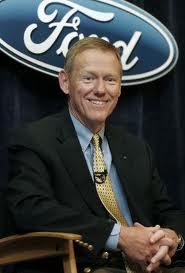


Alan Mulally  


After a 37-year career at Boeing, during which Alan Mulally helped design and build all the great Boeing aircraft – 707, 727, 737, 747, 757, 767, 777, 787 —  Mulally was asked to become President and CEO of Ford, in 2006.  In 2007, even before the onset of the global crisis, Ford was drowning in red ink, losing $17 b.!  Mulally’s leadership kept Ford out of bankruptcy, when GM and Chrysler were going bust, despite the fact that the global crisis came on top of Ford’s earlier problems —  and restored Ford’s profitability.  Here is a short excerpt from Peter Day’s (BBC Global Business) interview with Mulally, done at the Paris Auto Show.   Remember his phrase:  “Rainbow of Honesty’.

   ”   “The only way to change attitudes is to pull everybody together – engineering, manufacturing, product development,   We started meeting every Thursday, 7 a.m., everybody around the world, all netted in.  Details of the plan – then expectations; everyone would say where they are relative to the plan. Every Thursday.  Compelling vision. Stick to the plan.  Relentless implementation.  On the back of the card:   Foster   technological excellence,     Own working together, Role model Ford values,  Deliver results, [by coincidence, it spells FORD]…  everybody worldwide, color coded,   RED YELLOW and GREEN,   we say, you’re not red,  the issue you’re working on is red, so everybody can help….  Everyone on the same screen, color coded.”

   “Nobody would admit there were problems, even though we were losing billions.  We have all the data flowing.  All color coded, every issue, every launch, quality, productivity.  Up on the wall.   All netted around the world.  We lost $17 b. But — every chart is GREEN! I stopped the meeting, and I said to our team, is there anything that’s not going well?  We’re losing $17 b., is anything not going well?”  Eye contact, but– eyes to the floor!   Trust me. How’s it going?  Tell the truth. Reflect the reality. 

   “The next week, Mark Field, who runs the Americas, getting  ready for launch of an Edge model in Canada, up comes the launch, everything about it, everything is RED!  RED!  The room goes silent.  Everyone thinks, now we’re going to see what Alan the new leader will do. He said it was safe to tell the truth. Let’s see.

   “I started to clap!   Now all the eyes turn to me, that’s the sign, Marks’ gone!  He’s gone!

   “I said, Mark,  that was fantastic!  Fantastic.  Is there anything we can do to help you? Because we know you’re working hard.  Derek says, Mark I’ve seen that issue (actuator on tail gate),  Benny says, “I saw that months ago”,  manufacturing pipes up… etc.,      The team made suggestions!  That interchange took 12 seconds. And we moved on. That was absolute key to One Ford.

   “Next week it’s RED still. Everybody is helping. Next week it’s YELLOW. Next week it’s GREEN.  2,000 vehicles start shipping.  Next week:  The entire 320 charts look like a rainbow!  Everybody knew everything, everything for the first time. A RAINBOW OF HONESTY.   RED, YELLOW, GREEN, now we’re managing the business, because when everything was GREEN it was secret, and people were managing the secret, now they are managing the reality.”

  “You never want to let a crisis pass you by.  The real philosophy is, continuous improvement, every year, every quarter, is our commitment to improve the business, to improve the products, to improve our capability, quarter after quarter after quarter.” 
 

Innovation Blog

10 % Wild Friday Nights: Your Key to a Nobel Prize:

“Let’s Levitate a Frog And See What Happens”

By Shlomo Maital

   Recently ScienceWatch.com’s Gary Taubes interviewed fresh Nobel Prize winner Konstantin Novoselov.  Here is what Novoselov said in describing the interesting process that generated the breakthrough discovery of how to make a form of carbon, grapheme,  only one atom thick:

My background is in mesoscopic physics, studying fairly macroscopic objects that show some quantum effects. I did my Ph.D. with Andre Geim—first in Holland—and when he moved to the UK he invited me here as a post-doc. The style of Geim’s lab (which I’m keeping and supporting up to now) is that we devote ten percent of our time to so-called “Friday evening” experiments. I just do all kinds of crazy things that probably won’t pan out at all, but if they do, it would be really surprising. Geim did frog levitation as one of these experiments, and then we did gecko tape together. There are many more that were unsuccessful and never went anywhere (though I still had a good time thinking about and doing those experiments, so I love them no less than the successful ones).

This graphene business started as that kind of Friday evening experiment. We weren’t hoping for much, and when I gave it to a student, it initially failed. Then we had what you could call a stream of coincidences that basically brought us some very remarkable results quite quickly—within a week or so. Then we decided to continue on a more serious basis.

Part of every innovator’s time should be devoted to wild and crazy things (to quote comedian Steve Martin), that are fun, arouse laughter and are memorable.  Most of the time, nothing comes of them. I’m not sure whether the course of history, or the wellbeing of humanity, would be changed by successfully suspending a frog in mid-air.  But certainly,  the Friday night experiment with cellotape and a pencil, which began with low expectations, ultimately led to the Nobel-Prize-winning discovery of graphen and may well be world-changing. 

    There is great importance to doing this on a regular basis.  That way, the ‘wild’ muscle is regularly exercised and thus does not atrophy.    That ‘wild’ muscle sometimes creates explosive breakthrough discoveries – as in the case of Novoselov and Geim.

Innovation Blog

 America’s Space Shuttle vs. Russia’s Soyuz:  Simplicity Defeats Complexity

By Shlomo Maital


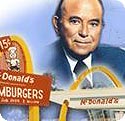
Ray Kroc

With the last flight of America’s space shuttle, probably next June or earlier,  America will officially be unable to send manned vehicles into space, for at least five years and probably more.  That leaves Russia’s Soyuz rockets, launched from the space station in Baikanur, Kazakhstan, as the only way to send and retrieve cosmonauts and astronauts from the Space Station. 

    There is a major lesson to be learned here.  It has to do with simplicity.

    America’s Space Shuttle, like most of the hardware designed by American engineers, is complex and sophisticated.   Some of that complexity may have contributed to the two Space Shuttle disasters, one of which killed an Israeli astronaut, Ilan Ramon.  The complexity also made it very very expensive.

     Russia’s hardware, in particular its military hardware, has always been very durable, rugged and ultra-simple.  The ubiquitous Kalashnikov automatic rifle is an example. So are the Sukhoi fighters and bombers.  Stories are told of Sukhoi aircraft making emergency landings on their bellies – and being still able to fly.  (American aircraft would all be destroyed).   But the prime example is its Soyuz rocket.  It was first launched in 1968. Since then there have been over 450 launches.  The rocket is simple, durable, tough, not expensive (in relative terms) and highly reliable.  Note that there have been Russian fatalities in space – but mostly involving Soyuz space capsules, not the Soyuz rockets. 

      It is actually an American who first succeeded big-time through simplicity. McDonalds founder Ray Kroc originated the phrase Keep It Simple Stupid KISS.  He had a big sign above his desk and applied the idea religiously. (RISDI President John Maeda wrote a wonderful short book on The Laws of Simplicity, about which I blogged some time ago).   Perhaps, in politeness, we can do away with the second “S” (people who complicate are usually super-smart, not stupid).  Or let the second S stand for “Smartie”.  

   But always, always, innovators should recall  the faithful rugged Soyuz rocket – and make simplicity part of their daily core practices.


Innovation Blog

Search Funds:  When It Comes to “Buy or Make”,  Some Entrepreneurs Prefer “Buy” !

By Shlomo Maital

    A former student has pointed out an interesting wrinkle in entrepreneurship,  tracked most carefully by Stanford Graduate Business School.  [1]   It is called a “search fund”.  My student is seriously planning to try it.

     The idea is simple.  Take highly-trained managers from top business schools, give them some money, and let them buy under-managed or poorly-managed companies with promise and potential, and apply all they’ve learned to scaling them up.  This model works in place of one where the same graduates raise money and start their own businesses.  Its appeal lies in the fact that it saves time, because you revitalize existing businesses rather than build new ones from scratch.   In other words,  “buy” rather than “make”.

    According to the search fund Case,

 ” Most Search Funds are started by entrepreneurs who are viewed as having high potential (many are recent graduates from top-tier business school programs), though they typically have limited operational experience and often no direct experience in their target industry.   Searchers tend to be drawn to the model for two principal reasons. First, the model offers relatively inexperienced professionals with limited capital resources a quick path to managing a company in which they have a meaningful ownership position.   Second, Search Funds have historically generated significant financial rewards for a small, but growing, number of principals. The core thesis of the Search Fund model is that placing well-educated, high caliber, strongly motivated managers into an environment that is under-managed or lacking a professional management approach will yield attractive risk-adjusted returns for Search Fund investors as well as compelling experience (owning and managing a business) and financial returns for Searchers.”

How well have the Search Funds done?  According to the Stanford Case:

   Since 1984, 129 known funds have raised search capital for the first time. Of those, 41 are currently still searching to acquire businesses, 33 are currently operating the companies they acquired and 55 are terminal.

  Innovator:  If you have a powerful entrepreneurial idea – go for it!  But if you do not, and you still dream of being an entrepreneur, consider the search fund model.  For example, in a previous blog I mentioned Fiskers’ purchase of a GM plant for pennies on the dollar, to build new hybrid cars.  By taking old assets and renewing them, wealth, jobs and income are created, at times just as powerfully as when totally new assets are created by conventional entrepreneurship.


[1] Stanford GBS,  CASE: E-386 DATE: 7/21/2010

Innovation Blog

Sam Gandy: Finding the REAL Cause of Alzheimer’s

By Shlomo Maital


Sam Gandy

 A superb short article in the September AARP (American Association of Retired Persons) Bulletin describes new research that is totally changing how we understand the underlying causes of Alzheimer’s.   For two decades, drug developers have been focusing their efforts on finding chemicals that target plaque – sticky gooey calcified stuff that clogs the brain and ruins our memory and cognition, plaque that has until now always been linked with Alzheimer’s (in post mortem studies of the brains of Alzheimer’s sufferers, some dating back a full 100 years).

  “Plaques are no longer where the action is,” notes Sam Gandy, M.D., researcher at the Mount Sinai School of Medicine in New York City.  Gandy has showed, using specially genetically-engineered mice (mice that develop Alzheimer’s even though their brains are plaque-free), that it may be clumps of amyloid beta protein (“oligomers”) that cause Alzheimer’s, and that plaque may actually be the brain’s way of defending itself against oligomers (in the same way that oysters wrap grains of irritating sand in pearl coatings, notes Robert Tanzi, head of Genetics & Aging Research at Boston’s Mass General).  In other words, plaque may be the brain’s ineffective solution to Alzheimer’s, not the cause.

     Andrew Dillin, researcher of Alzheimer’s at the famed Salk Institute in California, has pursued the oligomer theory of Alzheimer’s for years.  When he first presented his ideas at conferences, he notes, some scientists walked out of the room in disgust.  But he persisted. Today, drug companies may shift so-far futile efforts to battle plaque toward battling oligomers.  They may save billions of dollars that otherwise might have been invested in barking up the wrong plaque tree. 

    A report released by the World Alzheimer’s Association two weeks ago reveals these disturbing data:

The total worldwide costs of dementia, including Alzheimer’s disease, rose to more than $600 billion this year…   An estimated 35.6 million people were diagnosed worldwide in 2010 with dementia, notably Alzheimer’s disease, at a cost of $605 billion in care and treatment for patients, as well as lost productivity of those with the disease and caregivers.   According to the study, 46 percent of people with dementia live in high income countries, almost 40 percent in middle income countries and 14 percent in low income countries.  Experts say the number of Alzheimer’s cases will likely double during the next 20 years to 65.7 million in 2030 and to more than 115 million cases in 2050.

     As a personal note: I am 68 years old, and do not fear dying in the least, but frankly, greatly fear Alzheimer’s, perhaps the only thing I truly fear.  More than a few of my academic colleagues have already succumbed.  I have seen superb creative minds disintegrate, leaving only a hollow physical shell.  The effect on their loved ones can be devastating. 

    Let’s hope the bold innovative research of Gindy and Diller will bear fruit long before the disturbing doubling of Alzheimer’s victims occurs.


Innovation Blog

Nobel Physics Prize for Pencils & Tape..& Hutzpah

  This year’s Nobel Prize in Physics was awarded to two Russian physicists,  both at U. of Manchester,  Andre Geim (Dutch citizen, born in Sochi, Russia) and Konstantin Novoselov (British and Russian citizen, born in Nizhny Tagil, Russia).  The award is for their discovery of graphene, a carbon material that forms a lattice only one atom thick and useful for a wide variety of applications in  electronics and semiconductors.     

Graphene is a form of carbon. As a material it is completely new – not only the thinnest ever but also the strongest. As a conductor of electricity it performs as well as copper. As a conductor of heat it outperforms all other known materials. It is almost completely transparent, yet so dense that not even helium, the smallest gas atom, can pass through it. Carbon, the basis of all known life on earth, has surprised us once again.

According to published sources, “Geim and Novoselov extracted the graphene from a piece of graphite such as is found in ordinary pencils. Using regular adhesive tape they managed to obtain a flake of carbon with a thickness of just one atom. This at a time when many believed it was impossible for such thin crystalline materials to be stable.”

   Pencils?  Adhesive tape?  And a Nobel Prize, just for daring to do what everyone said could not be done, in a way everyone said would never work, by researchers who possess what in Yiddish and Hebrew is called “hutzpah”,  brash bold impudence.

    According to the Nobel Committee, 

   Since it is practically transparent and a good conductor, graphene is suitable for producing transparent touch screens, light panels, and maybe even solar cells.  When mixed into plastics, graphene can turn them into conductors of electricity while making them more heat resistant and mechanically robust. This resilience can be utilised in new super strong materials, which are also thin, elastic and lightweight. In the future, satellites, airplanes, and cars could be manufactured out of the new composite materials.

    Geim is 51 years old, young for a Nobelist  (this year’s Laureate in Physiology or Medicine is Robert Edwards, who developed in vitro fertilization decades ago).  But his colleague, Novoselov, is only 36, one of the youngest Nobelists ever.

   There seems to be a trend in the Nobel Prizes (expect announcements in the next week in Chemistry, Literature, Peace, and, deservedly last, Economics) to award prizes for scientists whose discoveries have led to life-changing technologies.  Last year, the Nobel in Physics went to scholars whose research led to fiber-optics and for an imaging semiconductor circuit, CCD sensors.    


Global Crisis/Innovation Blog

Birth and Death in the Auto Industry: The Difference Between America and Europe

By Shlomo Maital


Fisker’s NINA

A short piece by John Reed in the Financial Times, Oct. 4 (“startup to launch hybrid sports car”)  and in today’s Global New York Times by Bloomberg (“Unable to sell, Opel will close Antwerp plant”) reveals a key, vital difference between American entrepreneurship and innovation and that of Europe.

    John Reed reports that Fisker Automotive, a US startup launched by Henrik Fisker, will build rechargeable hybrid sports cars (Fisker “Nina”) at a former General Motors plant in Wilmington, Delaware.  Fiskers bought the plant for an amazing $20 m.!  He says it would have cost him $400 m. if he had to build the plant from scratch.  His company got two low-interest loans worth $529 m. from a US Dept. of Energy credit-line for low-emission vehicles. 

    Fisker’s competitor is Elon Musk’s Tesla Motors, already building $109,000 electric roadsters.  Tesla will produce its Model S mass-market car in 2012 at another former GM plant in Fremont, California.  Musk paid $42 m. for it.  He says: “We’re getting first-rate equipment for pennies on the dollar.”  Tesla, too, got a Department of Energy loan worth $465 m.

    In contrast, GM’s unprofitable Opel Division in Europe also tried to sell its large factory in Antwerp, Belgium.  “None of the potential investors was able to come forward with a sustainable business concept for the plant,”  GM Opel said.  “The process (for selling the plant) has come to an end.”  The plant opened some 43 years ago.  While 18 assembly plants have been closed in the US since the onset of the 2007-9 global crisis,  the only European automotive assembly to close is  Opel’s Antwerp operation, where some 1,300 workers are employed.

     What can we learn from this?

     Again, for the umpteenth time:  There is no birth, no innovation, no launching of new ideas and industries, without death, without closing old moribund ones.  If Europe cannot close old failed plants, it will not have entrepreneurs snatch them up to create and build wonderful new cars that the dinosaur firms like GM Opel should have, could have, would have – but never did.  The US Energy Dept. grants are helpful.  But the Fisker and Telsa startups would doubtless have built their cars in Asia had they not been able to buy the GM plants, and all those good jobs would have been lost to Americans.   

Global Crisis

Irish Crisis:  Is Alan Greenspan to Blame?

By Shlomo Maital


Alan Greenspan


Ireland is in the throes of a major crisis.  Losses of the nationalized Anglo Irish Bank mount daily and threaten a meltdown of Ireland’s whole economy.  As the Irish Government acts to bail out the bank, the amount of money this entails (some $50 b. and counting) will lead to an unbelievable, staggering Irish government deficit of about one-third of Ireland’s GDP.  True, this will be a one-shot one-off deal.  But it is still incredibly huge.  The cause?  Irresponsibly bad housing loans.  Ireland’s property bubble is worse by far than America’s.    

    Ireland’s finance minister Brian Lenihan said the other day,  “Any Anglo failure would bring down the sovereign. It is systemically important not because of any intrinsic merit in the bank.  But because of its size relative to the national balance sheet.   No country could contemplate the failure of such an institution.”   

    Who is to blame?  There is more than enough blame to share among many people.   Here are some data about the magnitude of the bubble:

Since 2000, approximately 75,000 housing units have been built every year as detailed by the Irish Department of Environment, Heritage and Local Government. However, a significant proportion of these new homes are unoccupied. Economic commentators give a figure of approximately 230,000 vacant properties. Of these up to 115,000 or so may be holiday homes. 

    Blame Ireland’s Central Bank, which saw the bubble explicitly in 2006 and took no action, and even hid its concern.  Blame Ireland’s planners, which actively encouraged massive overbuilding. Blame Ireland’s government, which insisted banks recognize financial losses up front instead of deferring them (as many US banks did). 

   But above all, blame Alan Greenspan, head of the US Fed for 19 years, from 1987 through 2006. 

   It was Greenspan who showed other nations like Ireland how to create a housing bubble, by slashing interest rates rapidly and irresponsibly from 6.5 per cent (Fed rate) to 1 per cent, in the wake of the 2000 dot com crisis.   No Central Bank should ever slash interest rates so far or so fast, to the point where ‘real’ (inflation-adjusted) rates are actually negative (“Here, borrow a ton of money! Please! We’ll pay YOU if you do”).   Then, when Greenspan woke up to what he had done, in 2005, he rapidly INCREASED interest rates, causing the bubble to burst with collateral damage greater than necessary had a wiser and gentler hand controlled the monetary spigot. 

    In a self-serving article published in Spring, [1] Greenspan argues:   1.  It was the fall of WORLD interest rates, not US interest rates, that created the property bubble.   It is easy to show that the fall of world interest rates was driven by enormous credit creation in the largest capital market, America. 2.  The excess leverage, or debt, incurred by banks was driven by failure to understand complex risk-creating financial instruments.  This led to a domino effect, with one bankruptcy or near-bankruptcy causing another.  It is the responsibility of the Fed to blow the whistle when it sees excessive leverage and debt.  It is the responsibility of the Fed to understand complex financial instruments that banks do not understand.  Under Greenspan, it failed. 3.  The property bubble collapse was inevitable, given the low capital requirements of banks (the amount of capital they held relative to their liabilities).  It is the responsibility of the Fed, charged with monetary stability, to raise the alarm if it sees capital requirements are too low, and above all, not to abruptly and disastrously raise rates if it understands that this will cause the excess leverage and debt to generate financial crisis.  The Fed, under Greenspan, failed.

      And Ireland?    Governments all over the world emulated and imitated America’s aggressive policy of stimulating housing and construction.   Some governments, like that of Ireland, outdid even Greenspan.  

     Mr. Lenihan?  Send the $50 b. bailout bill, which your suffering Irish taxpayers will have to pay (an enormous sum for a country with only about 4.5 million people, amounting to $10,000 per capita, man woman and child, just this one single bailout)  to Alan Greenspan.   Of course, he won’t pay it.  But perhaps he will stop inflicting his self-serving ‘analyses’ about how he is guilt-free,  on the world.

   To be fair, let me stress:  Greenspan saved the world in 1998.  When LTCM ran up debts of close to $1 trillion, Greenspan led a rescue effort even though he had no jurisdiction (LTCM was registered in the Cayman Islands), realizing the collapse of LTCM would lead to global financial meltdown.   Is there any example in history of someone who has in a relatively short space of time saved the world, and then nearly destroyed it?  I doubt it.    

   The Talmud quotes a Rabbi, Shimon ben Shatach (Ethics of Our Fathers)  who said, I have lived my life among the wise and found nothing better than silence.    Greenspan lived among the wise.  But alas, in 2000-2006, he was not one of them.  He should therefore in future, forever, remain silent.   


[1] The Crisis”, by Alan GreenspanBrookings Papers on Economic Activity, Spring 2010, pp. 201-246.

Global Crisis Blog

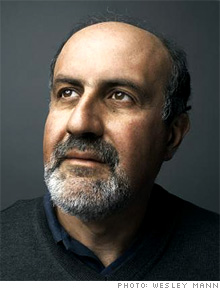
Black Swan Society: Nassim Taleb’s 10 Principles, or

“In French socialism 1980’s, the government takes over the banks; in the U.S. 2000’s, the banks take over the government….” – Nassim Taleb 

By Shlomo Maital


Nassim Nicholas Taleb is the author of The Black Swan: The Impact of the Highly Improbable, a New York Times bestseller published in 2007 just before the onset of the global crisis.  Taleb has now done a second edition with a new section titled “on robustness and fragility”.  It includes “The 10 Principles for a black-swan-robust society”, originally published as an editorial in the Financial Times in 2009.   In a footnote, Taleb notes that the FT editor changed his own original title to “Black-Swan-proof”, something which he says does not exist.

    Here is a brief version of his 10 principles that can help societies cope with the aftermath of crises that are inevitable and always will be:

  1. Let what’s fragile break early, while it’s small.  “Nothing should ever be too big to fail”.
  2. Do not socialize losses and privatize gains.  “Whatever needs to be bailed out should be nationalized”.
  3. Don’t let people wearing  blindfolds drive buses ever again.  “The economics establishment should be ignored [forever]”.
  4. Forbid people with ‘incentive’ bonuses from managing your financial risks. “Odds are they will cut corners to show ‘profit’ in order to gain the bonus”.
  5. Compensate complexity with simplicity.   “Complexity is a form of leverage”. Avoid it.
  6. Do not give children dynamite sticks.  “Ban complex financial procedures that nobody understands”.
  7. Governments should never ever need to ‘restore confidence’. 
  8. Don’t give addicts more drugs if they are in withdrawal. “Using leverage to cure excess leverage is pure denial. The debt crisis is not temporary, it is structural and requires rehab”.
  9. Citizens should not use financial assets as a repository of value and should not rely on fallible ‘expert’ advice for their retirement. “Economic life should be definancialized”.
  10. Make an omelet with broken eggs. “Remake the system before it remakes itself (through crisis).”   

 Innovation Blog

Secrets of the REAL Start-Up Nation: Inside Israeli Innovativeness 

by Shlomo Maital


   Start-up Nation is  a best-selling book about Israeli innovativeness by Dan Senor and Saul Singer.[1]   This  book has aroused enormous interest in the source of Israel’s boundless creativity, mainly in the U.S. but in other countries as well.  Thousands are reading the book to learn how Israel invented the cell phone, Copaxone, Azilect, a kind of heart pump, drip irrigation, the Given Imaging pill that ‘broadcasts’ your intestines’ condition,  the Pentium and Centrino chips,  drip irrigation, cherry tomatoes, and a thousand other life-changing inventions,  while fending off enemies and squabbling endlessly with one another.  Former NBC TV anchor Tom Brokaw wrote,  “There is a great deal for America to learn from the very impressive Israeli entrepreneurial model… START-UP NATION is a playbook for every CEO who wants to develop the next generation of corporate leaders.”

     “What is driving (Israeli inventiveness),” Senor recently told the cable network CNBC, “is a national ethos, resilience, the fight for survival.”   The book itself stresses two qualities embedded in Israeli culture:  Hutzpah (brash impudence, willingness to challenge anything) and leadership experience gained in the Israeli Army.

       Start-Up Nation’s stories about Israeli entrepreneurs are truly wonderful.  But can we dig deeper beneath these stories and find empirical research that illuminates this phenomenon?

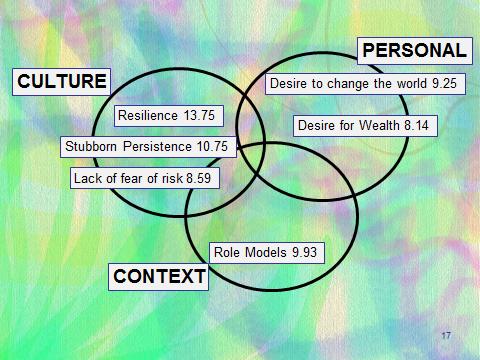
   With the aid of Shlomo Gradman, founder of the Israeli Semiconductor Club, we asked those who registered for the club’s inaugural event to answer a brief questionnaire: “”Invest” 100 shekels in  some 13 innovation factors (personal, cultural, contextual) according to their relative importance”.   We received nearly 50 responses, out of 200 registered participants.  They came from a slice of Israeli high-tech industry engaged in innovative chip design.   A summary of the responses is shown above in the diagram and below in the Table.

Table 1.   13 Innovation Factors, by Rank and Mean Score.

             RANK FACTOR     MEAN
1 Resilience   13.75
2 Stubborn Persistence   10.75
3 Role models   9.93
4 Desire to change the world 9.25
5 Lack of fear of risk   8.59
6 Desire for wealth   8.14
7 Willingness to break rules  6.7
8 Desire for independence 6.23
9 Willingness to challenge authority 5.45
10 Hutzpah     5.16
11 Army technology experience 4.93
12 Army leadership experience 4.32
13 Desire for fame   2.48

 Three of the top five innovativeness factors are “cultural” in nature, deriving from Israeli culture:  Resilience, stubborn persistence and lack of fear of risk.  One is contextual (role models – other Israeli entrepreneurs who have done great things), and one is ‘personal’ but with a strong cultural element (desire to change the world).  It is interesting that army experience in both technology and leadership, cited as strong factors by Start-Up Nation, ranked 11th and 12th out of 13. This may in part reflect that respondents are chip designers, a technology not central to IDF R&D efforts.   


[1] Dan Senor, Saul Singer, Start-up Nation: The Story of Israel’s Economic Miracle: Published by Twelve (Reed Elsevier), 2009.


Blog entries written by Prof. Shlomo Maital

Shlomo Maital

Pages