Capitalism Failed Us – Here is Why

By Shlomo Maital

      David Brooks’ latest NYT column has the fascinating title “Why More People in the World Are Feeling Hopeful (Except Us)”   The ‘us’ is of course the US. 

         Brooks cites results from the Harvard-led Global Flourishing Study published in Nature – Mental, April 30, 2025.  Flourishing measures the wellbeing of people, measured by happiness, health, meaning, character, relationships, and finance.  In other words, how countries measure up according to material, social and spiritual wellbeing.

      The US ranks 12th or 15th out of 22 leading nations.  The nations who have done well and risen in ‘flourishing’ are those that find a true balance between those three elements: material, spiritual and social.   The US has done poorly, especially among its young people, who report NOT doing well and NOT having much hope for the future.

          Why?   Brookins recounts:   “Why have rich nations lagged behind in this way? [Prof.] VanderWeele [who led the study]  theorizes that maybe it’s a question of priorities. “I tend to think you end up getting what you value most,” he told me. “When a society is oriented toward economic gain, you will be moderately successful, but not if it’s done at the expense of meaning and community.”

       Brooks continues:   “I’d add that we in the West have aggressively embraced values that when taken to excess are poisonous to our well-being. Over the past several decades, according to the World Values Survey, North America, Western Europe and the English-speaking nations have split off culturally from the rest of the world. Since the 1960s we have adopted values that are more secular, more individualistic and more oriented around self-expression than the values that prevail in the Eastern Orthodox European countries such as Serbia, the Confucian countries like South Korea and the mostly Catholic Latin countries like Mexico.”

        We sold our souls to capitalism. It gave us vast wealth, billionaires.  But it destroyed our souls.  Thank economists in part for that.   Mea culpa.

          Postscript:  My country, Israel, now a pariah among nations, vilified, owing to our disastrous leadership,  ranks second or fourth (with or without the financial variable).  In Israel, social bonds are very strong, especially during times of war and crisis.  And so are spiritual values, not necessarily formal religious ones.  Plus, our hi-tech has brought us material gain.  But we did not sell our souls to the Capitalist Devil.

 Noise You Stop Hearing

By Shlomo Maital

    I am writing this blog, in my office at my university.  Next door, huge jack hammers are busy pounding the ground to prepare the foundations for a new Computer Science building.  Whump whump whump….the noise goes right through the ground to the floor of my office.  Whump whump whump.  And this has been going on for many months. 

     But – surprise!   At some point, unbelievably, I no longer hear the whump whump whump of the jack hammers!  Repetitive noise is often filtered out by our brains, who instruct us to simply ignore it. 

     This is not always the case.  And if you let the whump whump upset you, your brain will continue to register it, because …that seems to be the instruction it is given. 

      There is a life lesson here.  Telling our kids repeatedly not to do something … gets filtered out.  Telling others too often is ineffective.  A sound that is repeated without change is by definition noise. 

       We all of us create noise.  Do not be surprised, then, if it is filtered out and ignored. 

         Have an important message for family?  Friends?   Colleagues?    Repeating it won’t help much.  Find ways to repackage, rephrase, retell it.  Add a bit of humor – that often helps. 

         I am surprised that I can continue to work and write, while the jack hammers next door serenade me.  Get into something, deep – and I don’t hear them. 

        Best not to become a jack hammer – and wonder why your screechy noise is not being heard.      

How Astronomer Turned Lemons into Lemon Meringue

By Shlomo Maital  

        What do you do, when your struggling startup is hit with a public relations catastrophe?  

         You turn lemons into lemon meringue pie – with creativity and with humor.

         Alisha Gupta, reporting in the New York Times, noted how “on Friday, Astronomer — the technology company whose married chief executive was caught on video at a Coldplay concert canoodling with a human resources executive at the firm who is not his wife — capitalized on the heightened attention when it released a video response featuring Ms. Paltrow as a “temporary spokesperson.”

         The CEO resigned, and later, so did the female HR chief executive.  Bad publicity, right?

         Astronomer sought out a known and loved actor  Gwyneth Paltrow, ex-wife of Coldplay front man Chris Martin.  

          In her video, she states: “Astronomer has gotten a lot of questions over the last few days and they wanted me to answer the most common ones,” Ms. Paltrow says directly to camera in a video posted on Astronomer’s social channels.

         The first question then appears onscreen: “OMG! What the actual f&^%”

        “Yes!” she responds, a hint of knowing and exasperation in her voice. “Astronomer is the best place to run Apache Airflow.” She adds: “We’ve been thrilled so many people have a newfound interest in data workflow automation.”

         Gupta notes:  “Viewers were given a peek at what Astronomer actually does, a move that was quite clever, I must say,” said Michel Pham, a business professor and marketing strategy expert at Columbia Business School. For companies that abruptly find themselves embroiled in scandal, he explained, using humor to capitalize on the spotlight requires a deft touch.”  It does not always work. It can backfire – treating serious issues as amusing.

         But many many people now know about little Astronomer, who previously had no clue.  Astronomer turned lemons into lemon meringue pie.

         Humor is a powerful weapon for messaging.  Especially satirical humor. 

         Take, for instance, Tom Lehrer, the Jewish math prodigy whose musical satire amused – and strongly attacked the negative trends in US politics and society.  He has passed away, age 97.  Consider his “national brotherhood week” song – so relevant today, when MAGA vengeance and hatred led by Trump dominates the news daily.

                “Oh, the Protestants hate the Catholics, And the Catholics hate the Protestants!  And the Hindus hate the Muslims. And everybody hates the Jews!”  sang Lehrer, himself Jewish.  “Be nice to people who are inferior to you, it’s only for a week, so have no fear, Be grateful that it doesn’t last all year!”

                If only it lasted all year…or forever.  Rest in peace, Tom Lehrer. 

Joyspan: Enjoying Life, Not Just Living It

By Shlomo Maital

  Today’s New York Times brings an interesting piece by Jancee Dunn, on “Joyspan”.  Joyspan is about living long, but not just counting the years but doing so in a manner that is enjoyable, fruitful, happy, productive and meaningful.  Joy Span, not just Life Span.

    Chase suggests four key elements of a Joy Span:

      Grow.  Keep doing new things, learning new things.  Trying new things.  Welcome change.  Become smarter, wiser, and yes, fitter.  It is possible.  I gave up running, after a long span of running daily, two marathons, and a pure love of jogging.  Instead, I walk, often uphill, to boost fitness.  It came in handy recently, during a conference in a hilly city in Portugal.

       Adapt.  If you can’t run, walk. If you have trouble walking, do chair exercises.  If you have trouble reading fine print, buy large print books or listen to podcasts.  As we grow older, many parts of our bodies don’t work that well.  Fix what you can, or what the doctors can, and move on….

      Give.   Often, we seniors focus on ourselves, our needs, our pains, our difficulties.  That does not contribute to a Joy Span.  Focus on others. Family, grandchildren, loved ones, friends, even strangers.  And give to them, whenever and whatever you can.  That is a real joy.

      And Connect.  Connect with others.  It is pretty easy as a senior to let the walls close in.  As best you can, connect with others.  The storekeeper. The cashier.  The cab driver.  Even fleeting connections bring joy. Maybe, a little extra tip to the cab driver…and a big thank you. 

        Here is the mnemonic:  G A G C.   Try it.  Probably you’re already doing it.  And even 2 out of 4 is a big help.    

 Key Future Technologies: The View from McKinsey

By Shlomo Maital  

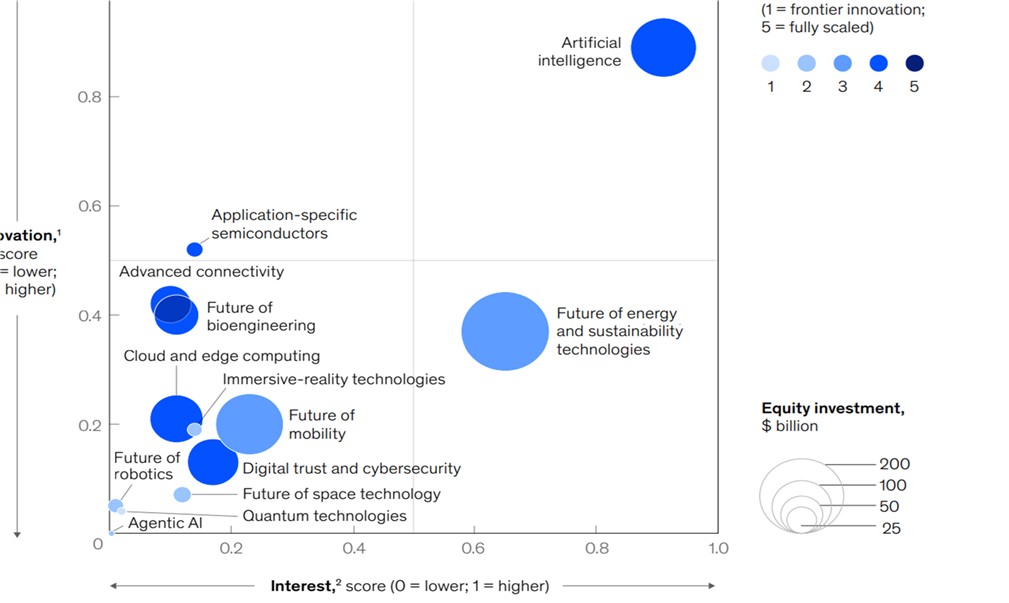
Innovation Score (Y axis) vs. Interest (Investment) (X axis)

    In the global consulting company McKinsey’s latest survey of technology trends for 2025, the above graph caught my eye.  On the X Axis:  a measure of interest, as measured by total investment.  On the Y axis, a measure of the degree of innovation.

    Normally, graphs for previous years showed a scattering of interest among several key topics.  This is natural.  Hi-tech is risky and businesses generally do not ‘play poker’ by putting all their chips on one single new technology.

       Except for now.  The graph shows Artificial Intelligence as leading by far in both innovation and in resource bets, globally.

       But take a look at #2.   Future of energy and sustainable technologies.  Less innovation, far more resources. Globally. 

       The cost of solar energy is today the cheapest of the varied forms of energy. 

        Can one understand how the Trump administration is single-mindedly revoking tax credits, laws, regulations, everything, designed to promote solar and wind energy?  Yes – as a short-sighted political deal based on the huge contributions of Big Oil to the Trump PACs.  Big Oil spent $445 million (nearly half a billion dollars) on contributions to Trump, in the last election.

           A terrific investment, given how Trump has repaid it.  The McKinsey graph for the US would show it as a backward, lagging outlier in energy. 

           In this, as well as in science, healthcare, social services, education, research, vaccines, and global aid programs, Trump has set America back decades, in a very short time.  The damage can be repaired – but the road to do so will be long and hard.

Instructions for Living a Life

By Shlomo Maital  

         I found this short poem by poet Mary Oliver, in a New York Times article. The title is “Instructions for Living a Life”. 

         With that title, philosophers would tend to write six encyclopedias.  And indeed they have. 

         But poets?  Seven words.  Here they are:

          Pay attention.

          Be astonished.

           Tell about it.

      OK – here is a small example.  My wife and I are at a School Psychology conference, in a university town in Portugal, called Coimbro.  At our final event last night, we gathered around a 700-year-old rubber tree!  Still alive and vital, with latex dripping down its amazing huge trunk. 

    Astonishing.  And… I’m telling you about it.

 Sharks Don’t Sink – Neither Must We!

By Shlomo Maital     

      Consider sharks.  They have been around on this earth for 400 million years – far older than dinosaurs, older than even trees.  And evolution has made them superbly adapted to their environment, to survive and thrive.   Sharks have survived five mass extinctions —  and are currently struggling with their sixth, as humans kill sharks with fishing nets and overfishing, depriving them of food.

        We can learn a lot from them – despite Steven Spielberg’s 1975 film Jaws, which inspired enormous fear of sharks. 

        First, consider fish.  They have swim bladders — gas-filled organs that provide them with buoyancy without having to expend energy by swimming.  Fish can sleep, thanks to swim bladders – watch your goldfish do it sometime.  Darwin wrote that lungs of some fish evolved from these swim bladders.

         Sharks, in contrast, have no swim bladders.  If they stop swimming, they sink – because they have negative buoyancy.  So, sharks cannot, may not, stop swimming.  Ever.  Sharks don’t sink – because they are continually moving forward.  They even sleep while swimming – though never with closed eyes.

          What does this have to do with people?

          Sometimes, people sink.  They sink into despondency and depression.  And they don’t have mental ‘swim bladders’ to keep them afloat.  

          We can perhaps avoid this – by learning from sharks.  Keep moving forward. 

           Keep learning new things.  Keep making new friends. Keep trying to bring value, create value, by helping friends and families and strangers.  Keep being curious.  Keep trying new skills.  New foods. New music.  Stagnate – and you sink.  All too common among us seniors.

            Sharks don’t sink.  Neither must we.   Human beings have been around for 50,000 years.  Sharks survived – and mostly thrived — around 80 times longer!     Maybe they know something we can use?!

          I recommend  Jasmin Graham’s new book Sharks Don’t Sink: Adventures of a Rogue Shark Scientist, just out – subject of an On Point podcast episode.

Learn Life, Live Life: The Dilemma

By Shlomo Maital

       The brilliant Danish philosopher Soren Kirkegaard once wrote in his diary: “life can only be understood backwards [learning life] but life must be lived forwards.”

         This appears in Chapter 6 of his book Either/Or.   Kirkegaard explains that life at any given moment cannot be fully understood.  Time never stops.  We never have time to fully stop and reflect on what we do and what is done to us.  And as time passes, more and more experiences accumulate… so, we have a ‘life learning’ debt almost from birth.

         Kirkegaard, ever a practical philosopher, tells how to resolve the dilemma.  We should approach our lives not as problems to be solved, but as realities to be experienced.  He wrote this around 1843.  He is known as the father of existentialism —  life lived as experienced realities. 

          I spent some 10 years working with senior hi-tech management. One tool I taught them was the art of the debrief – learning especially from a failure, something the military does especially well.  I think we can all embrace the debrief.  Follow Kirkegaard. Take a moment, maybe as your head hits the pillow. Debrief your day.  First – what are you super-grateful for?   Second – what have you learned?  What could you not have done or said, or done better, or done differently? 

           I am 82.  I learned the art of learning life (the art of the daily debrief) far too late.  For you, dear readers, there is still time.  It is possible to learn life more or less while we are living it.  And when you do, you benefit hugely. 

           And about the image above? Llama llama?   “Lama” in Hebrew is ..why?  A key question in our daily debrief.    

Intelligent Failure

By Shlomo Maital

Amanda Anisimova

     Amanda Anisimova, a Russian-born American tennis player, lost the Wimbledon tennis final, 6-0, 6-0,  in under one hour, to #1 Iga Świątek.   It was a humiliating, decisive failure. 

    Writing in the New York Times, Rustin Dodd explained why Anisimova’s response was a “master class” in how to lose gracefully. Anisimova “graciously complimented her opponent, thanked the fans — and apologized, too — and then broke down as she praised her mother, who had nurtured and supported her after the sudden death of her father in 2019 and during an eight-month sabbatical from tennis that began in 2023.  “I know I didn’t have enough today, but I’m going to keep putting in the work,” Anisimova said, wiping tears from her cheek. “I always believe in myself so I hope to be back here again one day.” “

     Anisimova was a dark horse competitor whom nobody expected to make the final.  Swiatek dominated totally; with Anisimova losing without winning a single game, losing ALL her services, it should have been crushing and humiliating for Anisimova.  She has been through hardship, quit tennis for a while – and seems to have it all together now. 

         “I didn’t have enough today,”  she said.  But one day, she will.

         Harvard Business School professor Amy Edmondson[1] has written brilliantly on failure.  Businesses don’t fail enough, meaning, they don’t engage in “intelligent failure” – high risk innovations that also bring even higher possible returns if they work.  But failing often requires a learning strategy from failure – simply, to ask continually ‘why’,  and not ‘who’ – who is responsible leads to hiding error, a disaster.  ‘why’ leads to learning, repair, and progress.  This is the strategy used by leading militaries, in debriefing operations.  Why, not who…and what should be done as a result.

     Fail often. But only if you do so intelligently, by learning from each failure.  Edison’s thousand attempts to develop a filament for the light bulb are an example.  He said, later, each failure was a step toward ultimate success.


[1] A. Edmondson. “Strategies for Learning from Failure. Harvard Business Review April 2004

Andre Geim: Scientist with a Sense of Humor

By Shlomo Maital      

         I have taught in a leading science and engineering university for many years. The brilliant people here work hard, do great research – and they take their work very very seriously – even when it’s not.

          Consider Andre Geim,  British-Dutch-Russian Nobel Laureate 2010 for discovering graphene, a form of carbon one atom thick, that forms a strong light lattice and has infinite uses.

           Andre Geim is the only person to have won both a Nobel Prize and an Ig Nobel Prize. He received the 2010 Nobel Prize in Physics for his groundbreaking work on graphene. In 2000, he received an Ig Nobel Prize for his work on magnetic levitation, specifically using magnets to levitate a frog.

            The Ig Nobel Prize is awarded annually at Harvard, and it recognizes research that…well, makes you laugh.  Geim won his Ig Nobel prize for ‘levitating a frog’!?  What is that?  It is based on diamagnetization – materials that have had their magnetic properties removed.  Here is how Google explains it:

        “By placing a frog in a strong magnetic field, Geim induced a weak magnetic field in the frog’s body that repelled the external field, causing it to float. This phenomenon is due to the diamagnetic properties of water, which makes up a significant portion of a frog’s body.”    Like poles repel, unlike poles attract. 

          The Harvard Ig Nobel people asked Geim if he would accept the prize.  He responded positively, with a smile.  Sure, why not?  Self-deprecation is not a known quality of Nobel scientists.  And his feat, levitating a frog, was very difficult and had important implications.  But – it does make us smile.  And Geim was happy with that.

               Let’s salute Andre Geim – and protest.

               Geim is Russian and emigrated to Netherlands where he became a professor.  He is / was a Dutch citizen.  He later moved to a British university. He now heads a UK Graphene Research Center. When England knighted him for his Nobel achievement, he was told he had to accept British citizenship to become Sir Andre Geim.  He agreed – unaware that Dutch law rescinds Dutch citizenship the moment a Dutch person accepts a foreign passport.  Netherlands revoked the Dutch citizenship of Andrew Geim, Nobel Laureate – and this greatly upset him, because he truly loves and is grateful to his Dutch adopted country.

               Andre Geim has a sense of humor.  The Dutch foreign ministry does not.  Nor does it have a sense of proportion.  The law is the law?  Do laws have exceptions?  Is this case worthy of an exception? You bet.

                Kudos to Andre Geim – the only scientist with both an Ig Nobel and a real Nobel Prize.             

Blog entries written by Prof. Shlomo Maital

Shlomo Maital

Pages