Walter Mischel: Marshmallow Man

By Shlomo Maital

Walter Mischel…

..and the marshmallow


On Sept. 12, psychologist Walter Mischel passed away, in New York City. He was 88.

Mischel became famous for what was known as the Stanford Marshmallow Experiment. He designed a series of studies, on “ability (or willingness) to defer gratification”.   In them, a child was offered a choice between one small reward provided immediately (a marshmallow) or two small rewards (two marshmallows) if they waited for a short period, approximately 15 minutes, during which the tester left the room and then returned.  

   Mischel and colleagues, in follow-up studies, found that children who were able to wait longer for the delayed rewards tended to have better life outcomes – better SAT scores, educational attainment, body mass index (BMI) and other life measures. The logic here is simple. Achieving good results later in life demands investing effort, sacrifice and pleasure now, today. Those good at this will excel.  It is a skill imparted, in part, by parents, and improves with practice.

     Mischel fled with his family from Austria, with the rise of the Nazis, at age 6. He taught at Stanford for years, and later at Columbia.   He joined the legions of scholars who came to America as immigrants and made huge contributions to America’s scientific research and academic excellence.

       Mischel’s research is hugely relevant for today’s society. Western nations have as a whole become unable and unwilling to defer gratification. Gas lines explode in Massachusetts; bridges collapse in Genoa, Italy. Western countries seem unable to save and invest in the future, preferring present gratification.   A majority of Americans could not scrape together $400 in cash, in an emergency. The Great Divide between have-nots and millionaire/billionaires is spurring a rise of anti-democratic extreme right-wing political parties and leaders. It is ironic that the forces that led Mischel to America, have in part followed him there.


Free Range Parenting: The Opposite of Helicopter Parenting
By Shlomo Maital   


  So, I guess I am more or less a dinosaur.  I was born in November 1942, grew up in Regina, Saskatchewan, in a quiet neighborhood, and I spent hours and hours outside, playing with friends and looking at bugs and frogs in the creek that ran through the neighborhood, a couple of hundred yards from my home.  I came home only toward dark, and in the long summer days   twilight lasted for hours.   
   My mother and father were concerned parents, and made me wear long scratchy wool underwear in the winter.  But guess what.  They let me play outside, unsupervised.  And that’s what all the kids did.   And it made childhood delightful.
    Today, this behavior is regarded as an aberration, and in some cases, illegal. On WBUR public radio, a mother reported being accosted by a police officer, for leaving her small boy in the car for a few moments while buying something in a store.  
    The approved parenting model is in many cases that of a helicopter parent, who hovers over children and protects them from any possible risk, injury, scrape or problem.    Children have arranged structured play-dates and activity circles.  
    A decade ago,  Lenore Skenazy wrote a  book,  Free-Range Kids: Giving Our Children the Freedom We Had Without Going Nuts with Worry.   An organization by that name today helps parents fight back against helicopter parenting, and make their children sturdy and independent.   One simple approach:  Give kids assignments or projects, and turn them loose to tackle them, after teaching them safety rules for using tools.  
    The world today is dangerous – probably more dangerous than in prehistoric times when I was a kid.  It is natural to react to it by trying much harder to protect our children. But in doing so, we are taking away a vital crucial life skill – independence, self-confidence, self-assurance. 
    There must be a way to keep kids safe, without robbing them of this skill.  And there must be a way of avoiding having police arrest parents who do this.   


 Draw Your Riskometer

By Shlomo Maital

Tina Seelig’s Riskometer

Tina Seelig is a Stanford University professor, who teaches creativity and innovation. In a TED salon talk, https://www.ted.com/talks/tina_seelig_the_little_risks_you_can_take_to_increase_your_luck

   She shows us how to change the way we relate to risk, and to luck. It all starts with leaving our comfort zone – being comfortable with being uncomfortable. And that, in turn, relates to taking risks…taking chances. But first, we need to look deeply into ourselves.

   So to do this, try Seelig’s riskometer. Draw a circle. Place on the circumference, six ‘realms”, or types of risk (financial, intellectual, social, political, emotional, physical.   On the spoke, mark the place where your risk appetite resides…’high’, close to the circumference, ‘low’, close to the center.

   Now – carefully consider, how you can improve your risk appetite, for realms where you are risk averse – and stuck in yourcomfort zone.

     Creativity is risky. It involves taking chances. The more comfortable you are with this, the more willing you will be, to come up with innovative ideas and, most important, to try them.

   By the way, the riskometer diagram above is Tina Seelig’s own. She needs some work on physical and financial risk. Tina – try sky diving. And,   buy a few Tesla shares….

Hidden Racism: Causes and Cures

By Shlomo Maital


   How do you measure racist attitudes? Certainly, not by asking people if they dislike blacks, Jews, Arabs, Muslims or gays. People mostly know there is social disapproval for such attitudes and answer according to the norm, rather than their own intrinsic belief.

   One approach is known as the IAT – implicit association test. How does it work? On an open website, people are asked to sort faces (black and white) according to descriptions pertaining to “good” and “bad”. The decision is taken quickly, without conscious thinking. It was developed by a social psychologist named Anthony Greenwald about 20 years ago.

   The implicit-association test (IAT) is a measure within social psychology designed to detect the strength of a person’s automatic association between mental representations of objects (concepts) in memory. …. the Race IAT shows that more than 70% of individuals have an implicit preference for Whites over Blacks. On the other hand, only half of Black individuals prefer Blacks over Whites.   Similarly, the Age IAT generally shows that most individuals have an implicit preference for young over old, regardless of the age of the person taking the IAT.

   The IAT is part of Harvard University Project Implicit, which investigates thoughts and feelings that are largely outside of active awareness or control.  The key point here is powerful: Racism and other forms of hatred and discrimination are based primarily not on conscious thought, as per white supremacists, but unconscious attitudes driven by the social milieu and context. Perhaps this is why racism remains endemic in most societies, long after laws have become more equal for all.

     If this is so – can such racism be overcome? Can an individual overcome it, if it is in the air we breathe?   The answer is, yes, given time. Decisions taken rapidly, are driven by the limbic brain. Decisions taken thoughtfully are driven by a cognitive conscious process. Research shows, if police (as in Dever, Colorado) can take even a few seconds to think, consider, and judge, actions driven by subconscious racism can be corrected and made more equal.

     I myself am an example. I consider myself liberal, and try hard every day to respect every single person I encounter, whatever their race, religion, creed or age. Yet, recently, in a workshop I led for high school teachers, I had a participant who wore a hijab, a Muslim head covering worn by women.   “Salima” (pseudonym), I assumed instantly, would not contribute much to the Workshop. This was my subconscious speaking. That wrong racist first impression was corrected rapidly. It emerged that Salima was a Technion graduate in chemical engineering, and was the most brilliant of my Workshop participants. She contributed immensely.

     Most enlightened people strongly deny they have racist beliefs. Yet, we live in society, and society has racist beliefs. So it is hard for individuals to escape them, especially when they are ‘underground’, subterranean. The IAT tells us to be aware of the underground forces and to use our cognition to control and alter them.

Good News for Bad Knees

By Shlomo Maital


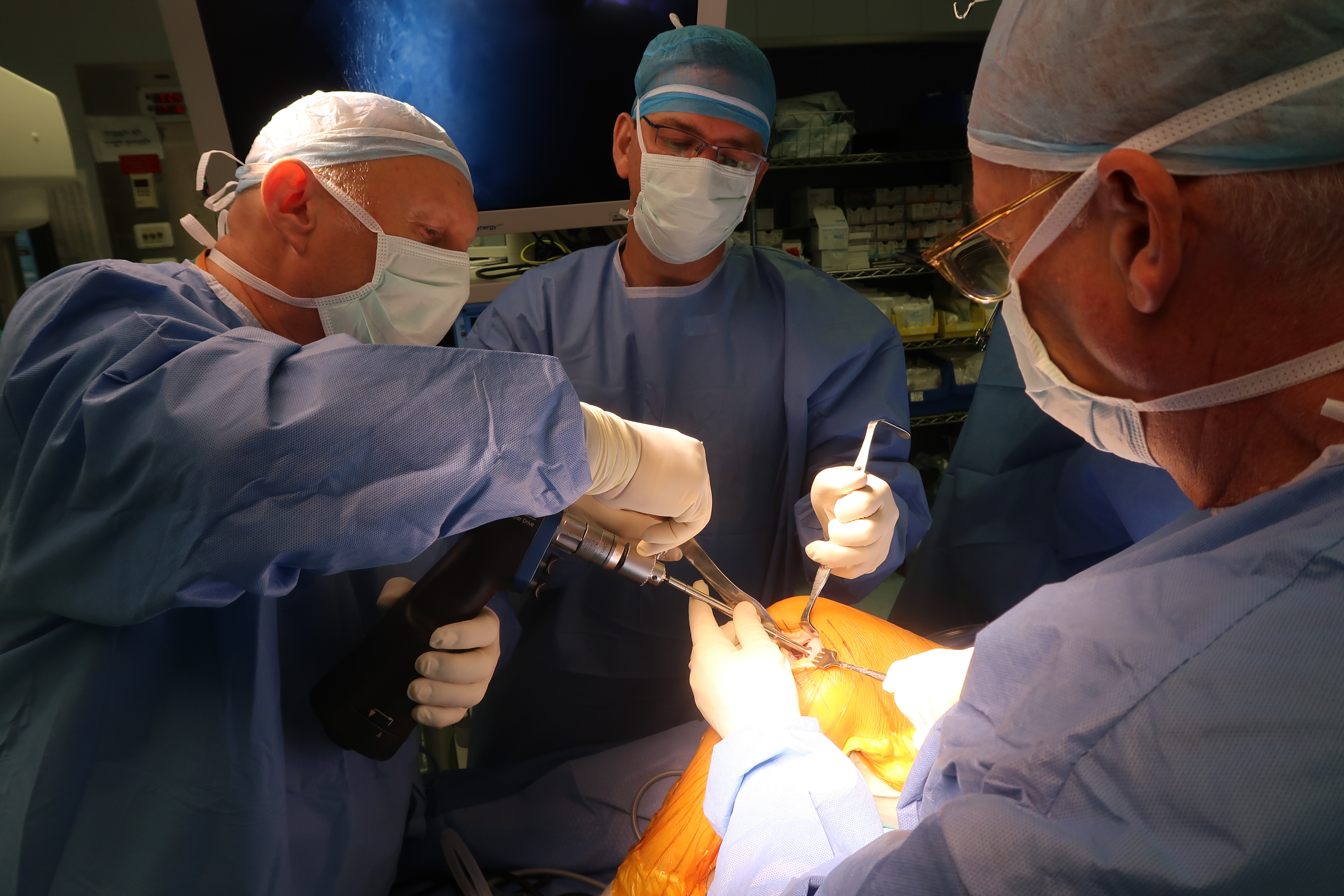
Surgeons Inserting a Cartiheal Device

   A great many people, especially the elderly, need hip and knee replacements. One million such replacements are done annually in the US. The operation has become common, ever since the May Clinic pioneered it in 1971. Some 7.2 million Americans are living today with knee and hip implants. Those numbers grow, as Americans age.

   There is no doubt that replacing worn knee and hip joints has given many far better quality of life. But there are also problems associated with implants. There can be infection, and the replacement joints can wear out, requiring another painful operation; many elderly people are not quite up to that.

     Now comes a team of creative Israeli researchers. A startup called CartiHeal has developed an implant known as Agili-C, that replaces human cartilage and induces torn and worn cartilage to rebuild and regrow. In the past few days, the first surgery in Israel to insert the implant was done at Hadassah Medical Center, Mt. Scopus, Israel (see photo). The surgery was done by Dr. Adi Friedman, head of arthroscopic surgery for sport injuries.   Friedman said:

     “The need for an implant that can foster regrowth of cartilage that has been damaged is a real medical need, the world of orthopedic surgery has been anxiously awaiting it. We hope our experiment will succeed, and that the implant will become a breakthrough that we have awaited for many years!”

     CartiHeal is an Israeli startup founded by Nir Altschuler in 2009, in cooperation with Ben Gurion University. The CartiHeal implant has CE approval in Europe (their equivalent of America’s FDA) and will soon begin clinical trials for FDA approval.

     The CartiHeal cartilage implant has been used widely in Europe, treating some 400 patients with success. By getting the knee or hip to regenerate its own cartilage, the need for a replacement implant (when the artificial knee or hip joint wears out) is obviated. And of course, the body’s own cartilage is far superior to that of an artificial implant.

       CartiHeal’s website opens the possibility of joining a clinical trial.


Why a Bloody Pogrom in 1903

Gave Me Life in 1942

By Shlomo Maital

   The word “pogrom” is a Russian word, usually applied to anti-Jewish violence in the Russian Empire in the late 19th and early 20th centuries.

     Today’s New York Times has a review of a new book by Stanford University historian Steven J. Zipperstein, Pogrom: Kishinev and the Tilt of History. The review reminded me that the reason I am alive, on this earth, is because of this horrendous pogrom.

      On Easter in 1903, mobs of anti-Semites tore through the Jewish section of Kishinev, a provincial town on the western edge of the Russian empire. In just 1 1/2 days, in a cluster of streets and alleyways, they murdered 49 Jews, raped scores of women and girls, ransacked stores and homes, and shredded the sacred Torah. Many children were killed. That event came to define “pogrom” — a word derived from the Russian for thunderstorm — and to represent the worst horrors perpetrated against Jews in Europe before the Holocaust.   Its reverberations would reshape the image of czarist Russia, alter U.S. immigration policy, bring Jews into the Russian revolutionary movement and even help launch the NAACP.   “It was a moment,” Stanford historian Steven J. Zipperstein writes, “that cast a shadow so deep, wide and variegated as to leave its imprint on Jews, on Jew-haters, and on wounds licked ever since.”

  My late mother was born in 1909, six years after the pogrom, in a small rural Jewish village, Dombroven, in Bessarabia, 300 kms. (180 miles) from Kishinev. (Bessarabia is now called Moldova, and It is the poorest nation in Europe). My father was also born in Dombroven, in 1904, just after the pogrom.

   The pogrom made it clear to the Jews of Dombroven that they had no future there. This, even though Dombroven had a small Jewish militia that circled the village at night and guarded it from the marauding Cossacks. My grandfather Israel, my father’s father, left for America. His mission: Raise money to bring the family over. (The Kishinev pogrom, as Zipperstein notes, did help open the immigration doors of both Canada and the US). He worked very hard, even though he was a Talmud scholar by nature, and made enough money to pay for the family’s passage. He missed his family terribly. He sent the money by mail – and it was lost in transit when World War I broke out, in 1914. My grandfather died in Pittsburgh in 1918, during the global influenza epidemic. I believe he simply died of a broken heart. I once searched for and found his grave, up on the old Jewish cemetary on Mt. Liberty.  I am named (Yisrael Shlomo) for him.  

   So, with my grandmother Rivka a widow, it was up to my father, the oldest, to make the journey to Canada. He left in 1920; he was only 16. Grandmother Rivka insisted that he take his sister, Dora, age 12 with him. The two young people were stranded for an entire winter in Antwerp, because Canadian immigration claimed my father had an eye disease (he didn’t). In the Spring, the Jewish community in Antwerp helped, arranged a visa, and the pair left for Canada by ship, landing in Montreal, and travelling by train to Regina, Saskatchewan, where relatives had settled earlier. My mother had emigrated earlier to Canada, with her mother and father, in 1910, when she was only a year old.

   Many Jewish people did not emigrate. They were wiped out by the Nazis during World War II.   So, my mother and father, grandmother Rivka, grandfather David, and grandmother Sassi Feige, and aunts and uncles, were saved because the pogrom made them desperate to migrate, and because Canada and the US welcomed them, partly as a result of the widely publicized bloody pogrom.

   How terrible was the 1903 Kishinev pogram? Israel’s national poet Haim Nachman Bialik, who at the time lived nearby, in Odessa, (now Ukraine), wrote a poem, The Slaughter, about the pogrom, including these striking last lines: “A curse on any who says, Avenge this! For revenge for the blood of a child, Satan himself has not yet invented”.

  I was born in Regina, Sask., in 1942. Had my father not made the perilous journey to Canada, with his little sister, and had he not survived that awful cold winter in Antwerp, I would not be here.

       Every time I read about migrants drowning in the Mediterranean, or children torn from their migrant mothers and fathers in Texas, or Syrians bombed and gassed, or Israel trying to expel Eritreans and Sudanese against their will, I feel deep physical pain. I can only believe that there is a punishment for those who mistreat hapless homeless migrants, and that one day, somehow, it will be meted out with justice.



Working Hypothesis That Changed My Life:

Every Problem Has a Solution

By Shlomo Maital

   I have written another book on creativity: Dismantle! How to Deconstruct Your Mind and Build a Personal Creativity Machine. It will be published by Harper Collins (India) in October. Why India? I’ve discovered Indian publishers are superb at editing and printing books and the market price is a fraction of that in the US. Besides, Indian people still do read books.

   Here is the opening prologue of my book. It makes a point that I learned from a former student and co-author Arie Ruttenberg: Creativity is widening the range of choice. You always have a choice. Every problem does have a creative solution. But only if you first believe that – and begin your search. This principle has changed my life. Perhaps it can change yours?

     If you are like me, you tend to skip through non-fiction books rather quickly, searching for the essence and picking the ripe ‘cherries’ from the tree, when most of the ‘fruit’ in the book is not yet ripe or relevant or interesting or non-obvious.

   Here, then, is a quick overview of this book. As you read on, please feel free to cherry-pick.

     But before we begin our journey to re-energized creativity, I’d like to emphasize a key point—literally, the key to unlocking your creative skills.

     Scientific research begins with a hypothesis—a supposition about what the research may reveal. For example, a scientist sought to find the number of neurons (brain cells) in the human brain, starting off with the assumption that the number was 100 billion; that was the commonly believed number. The assumption was false. It turned out that there are 86 billion neurons in the brain.  

     We all make assumptions. Most of the time they are hidden, ill-defined and below the threshold of our awareness.   When we tackle hard problems we often harbour a hidden assumption, such as, ‘there is no solution to this’, and come to the conclusion: Live with it, as is.    

       Humans are wonderfully resilient and are skilled at adapting and adjusting to difficulties and unmet needs. This resilience, or acceptance, is a highly positive quality. But it also can be harmful.

         I urge every reader to embrace a very different hypothesis. I would like my readers to assume that for every challenge, every problem, every unmet need and unsatisfied want, there is a solution—at least one. Every problem has a solution.   It is simply a matter of finding it and implementing it. By assuming there is a solution rather than that there is not one, we have taken a major first step towards effective creativity.

Try it. Tackle hard problems. Think creatively. Dive deep into the essence of the problem. Try wild ideas. You may fail. But the effort is glorious and praiseworthy. And you might just succeed.

p.s. the quote is by Donna Karan, who launched a wonderful creative fashion company. Louis Vuitton recently sold the DKNY brand for $650 million.

Why We Do What We Do – Putting it All Together

By Shlomo Maital

Sometimes things just seem to come together, naturally.

  1. I recently taught a Workshop for a wonderful group of high school science teachers. They all told me, their key problem is – motivating their students. Motvating them to learn.
  2. I recently received a research paper from McKinsey, titled “How to improve student educational outcomes: New insights from data analytics”. In this study McKinsey researchers used machine learning (an offshoot of artificial intelligence) to analyze a massive data set — the PISA surveys of 15 year old high school students and their understanding of science and math. The key finding: Student mindsets are twice as predictive of students’ PISA scores than even their home environments. Mindset means “a student’s sense of belonging, motivation and expectations”. This result is robust across the entire world.

The graph shows the % of predictive power of students’ performance. The top two rectangles (orange and purple) represent “mindset” (motivation), for the five different geographical areas.

  1. My wife’s copy of the American Psychological Association magazine Monitor just arrived. In it, 33 leading psychologists were asked, “What is the next big question psychology needs to answer?” The first person quoted was Stanford Psychologist Carol Dweck, whose work on growth mindsets (the idea that talent and talent can grow in a nurturing education environment) was seminal. She said we need “an integrative theory of motivation” and “a framework for …effective intervention [to boost motivation].

   These three circles converge. They teach us that how well we motivate ourselves, and those we work with, are THE crucial variables. Because motivated people can do anything (did you watch the Croatia soccer team at the World Cup?). And those without motivation can do nothing.

     Let’s look inward and ask, what lights our spark?   And then look outward and ask, how can we light the sparks of others who work with us?


Baby Bust – Why?

By Shlomo Maital

 Why are married couples in the West having fewer children? What is the underlying cause of the “baby bust”?  I was born in 1942, at nearly the bottom of the fertility decline driven by the Depression and World War. Good thing for me my mother and father believed in the future, however bleak it looked at the time. (The graph shows babies per 1000 persons, in the US, from around 1910 to 2010.)

       A study of 1,858 men and women aged 20-45, in the U.S., was published in the New York Times, July 7-8 (international edition).   For those who said they “expected to have fewer children than they thought ‘ideal’ “   here are the main reasons:

     Child care is too expensive (64%), want more time for the children I have (54%), worried about the economy (49%), can’t afford more children (44%), worried because of financial instability (42%), not enough paid family leave (39%).

     (Of course, the numbers add up to more than 100% — most respondents cited more than one reason).

     The conclusion is, as the heading of the article states, “Baby bust rooted in economics”. Somehow, couples in the US (and probably, in Europe and Japan, and China as well) feel that children are too costly.

     Demographers know that the ‘demographic transition’ (sharp fall in fertility as countries grow wealthier) happens everywhere. But the ‘baby bust’ has followed a huge baby boom, that brought economic growth to the US.   Baby busts do the opposite.

     I would not be on this earth, if my mother and father had said, times are tough, we just came out of a Depression, we can’t afford another child, and besides, there is terrible war, how can you bring babies into such a world?   Instead, they looked to the future with hope and optimism.

      My own country Israel defies the trend. We are having a baby boom. Fertility rates have risen, for nearly all segments of society. Israel has 180,000 babies yearly. They bring us happiness and hope for the future. Why? Our young people believe babies are ‘cool’.

   How is it, that today, when people are relatively affluent, they feel too poor to have babies, when in the past, when people were relatively poor, they felt affluent enough to have children, whatever the state of the world?

   I am puzzled.


An American’s Vision Healed – in India
            By Shlomo Maital

Kristos Stavropoulos
Kristos Stavropoulos is Chief Information & Technology Officer at Maguire Investments.  The only reason I mention this, is that I assume he has the resources to get top-flight medical care anywhere in the US. 
   Instead he went to … India.
   India?
   Stavropoulos recounts that he had a corneal scar – a scar on the thin transparent layer that covers the iris and pupil of the eye and refracts light.   A scar on the cornea can be a major problem.  Caused by an eye infection, the scar affected his vision – rather crucial in his line of work.  So he travelled all the way to Hyderabad, in southern India, to the L V Prasad Eye Institute.    (I have visited LVPEI several times, and recently met with its amazing founder, Dr. G. N. Rao,  in Israel).  
    At LVPEI   Stavropoulos consulted Dr. Sayan Basu.  She is an expert in a highly complex and revolutionary treatment, that uses stem cells to regrow and repair corneas.  Stem cells are human cells that have the ability to become whatever is needed – include corneal tissue – depending where they are.  But they are notoriously difficult to work with.   Here is what Stavropoulos said, after successful treatment:
     “My experience at LVPEI has been exceptional.  When you think of surgery, it’s scary, especially with eyes.  But the great thing about this institute is the positivity and expertise  that the doctors and the team have.  Most importantly, I trusted Dr. Basu and was assured about the success of the treatment that I was provided.”
    So far, over 1,600 innovative stem cell procedures have been performed at LVPEI, Patients from India, and from all over the world, have benefited from these innovative procedures.  At LVPEI,  wealthy patients pay for patients who have no money.  But everybody, EVERYbody, gets the same quality of medical care.  And the enormous scale of the medical care means that even experimental high-tech procedures can be tried, improved, studied – and made standard.
      At LVPEI I learned about an even more amazing technology under development – use of stem cells to regrow RETINAL cells (the retina is the kind of mirror, or light receptor, at the back of the eye, subject to retinal detachment, or macular degeneration [e.g. holes in the retina] ). 
    So, if you have eye disease, and if your doctors tell you they can’t treat it – check out LVPEI.   Because Indian people have so many eye diseases and problems,  LVPEI experts have vast experience – and creativity plus experience leads to innovative medical care that pushes frontiers to amazing places.  In the past 31 years, LVPEI has treated 28 million people, many of them from very poor villages. 
     By the way, Dr. Rao is now working to establish an LVPEI-type clinic in Monrovia, Liberia.  This,  despite Liberia’s strong links with the United States (it was founded by former American slaves).  It is hard for even top American doctors to understand how to establish medical care centers in very poor countries – but LVPEI knows how.  Liberia’s legendary former president Ellen Johnson Sirleaf,  who heard of LVPEI and whose close relative was successfully treated there, visited LVPEI, made the request – and LVPEI responded.
      

Blog entries written by Prof. Shlomo Maital

Shlomo Maital

Pages