Understanding Trump: Dunning-Kruger Cognitive Bias

By Shlomo Maital
     Having trouble understanding President Trump?   Read thousands of words and columns, blasting Trump, but you still (like me) do not understand who IS this guy?

     Read David Brooks (Op Ed, New York Times, May 15)….   He has figured it out. Trump has a syndrome. Dunning Kruger Cognitive Bias.

       What is it?   Here is the definition: *

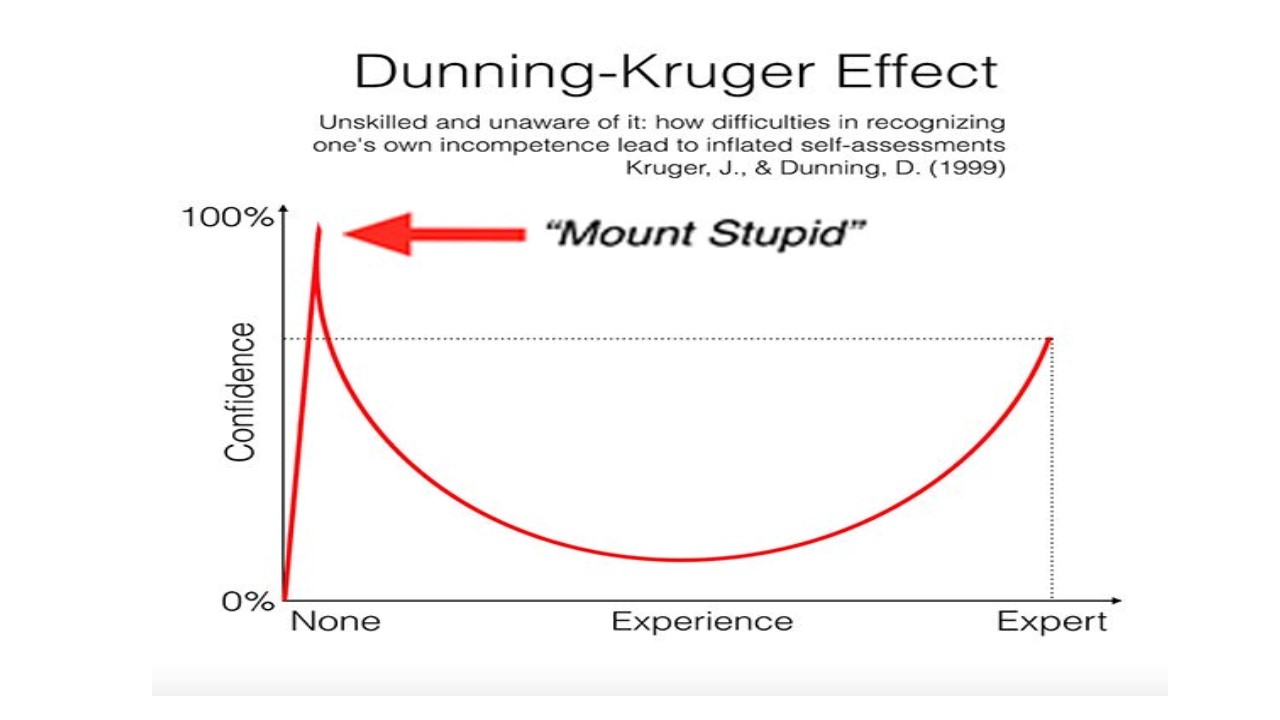
     Across 4 studies, the authors found that participants scoring in the bottom quartile on tests of humor, grammar, and logic grossly overestimated their test performance and ability. Although their test scores put them in the 12th percentile, they estimated themselves to be in the 62nd. Several analyses linked this miscalibration to deficits in metacognitive skill, or the capacity to distinguish accuracy from error.

     Meaning?   Incompetent people think they are more competent than they are, precisely because…they are incompetent. Trump highly overestimates his abilities (“best speech ever to Congress on healthcare”,   “how to fix America’s aircraft carriers”, etc.).

       People with Dunning-Kruger, who lead nations, are very very dangerous. Not knowing is one thing. Not knowing you don’t know is quite another. And when you lead the world’s most powerful, wealthy nation?   Disaster. Moreover, people around Trump cannot control him, and are fired abruptly when they oppose him, a corollary of Dunning-Kruger.  Trump is at the summit of Mount Stupid (see diagram), and since January 20, has proven to be there with blunders almost daily.

       What will happen?   Let’s see if America’s constitution and political institutions are capable and resilient enough to deal with this disastrous cognitive bias.


* Kruger, Justin; Dunning, David “Unskilled and unaware of it: How difficulties in recognizing one’s own incompetence lead to inflated self-assessments.” Journal of Personality and Social Psychology, Vol 77(6), Dec 1999, 1121-1134.
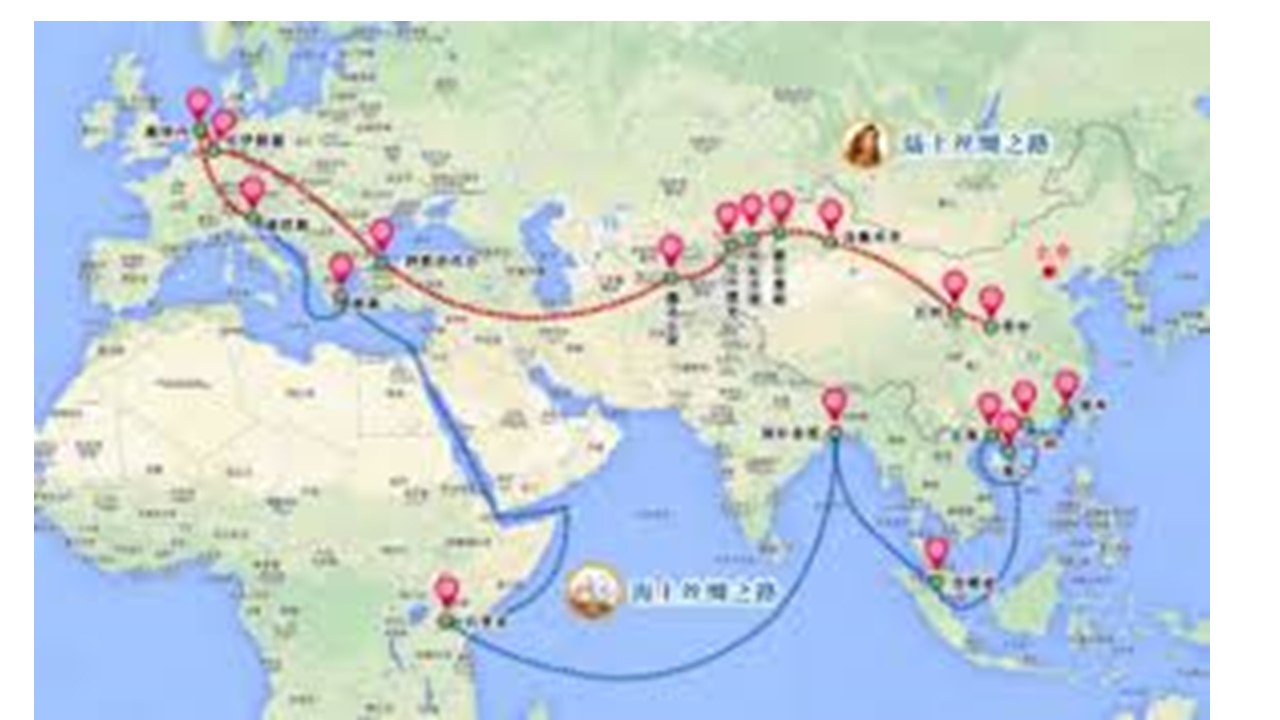


China’s New Silk Road: The New Global Vision

By Shlomo Maital

Chinese President Xi Jing Ping has announced a bold new Chinese plan to rebuild and reinvent the old Silk Road – a road and rail project, linking three continents, Asia, Europe and Africa, guided and funded by China. Major pieces of the new Silk Road are already in place.   (see diagram).   The first cargo train from UK to China has already made a maiden voyage.

   The cost is staggering: one trillion dollars. And the criticism has come thick and fast, much of it from the U.S.

     So let’s put some historical context on this issue.

     In July 1944, world financial experts met at Hotel Washington, in Bretton Woods, New Hampshire, to reinvent the world economy.   They succeeded. At the conference they created all the institutions that led to globalizations, world economic growth and helped Asia in particular grow and prosper.

     There were two competing visions there. One, that of J.M.Keynes, the world’s greatest economist, was to create a World Central Bank that would create a global currency, bancor, to fund world trade and investment. Great idea. The other was that of a US Treasury official, somewhat disliked, Harry Dexter White, who worked closely with Secretary of State Henry Morgenthau. White insisted that the global currency already existed, and was called, the “US dollar’.   But wait — what if American interests wanted more dollars, and global interests required, say, fewer?   Obviously US interests would prevail. That has been the Achilles heel of the global financial system for 70 years. It appeared with a vengeance, when the US printed vast amounts of dollars in the wake of the 2008 financial collapse, probably too many, and caused housing bubbles and instability abroad.

             Bretton Woods was a huge success.   And despite its fixation on the dollar, US leadership in shaping the new global ecosystem was crucial.   Now, 73 years later, it is time to reinvent the global system. America is nowhere to be seen or heard; it’s America First time. History will show this was a huge mistake for America and very costly.

   Now it is China’s turn. China is working hard to advance China’s interests. That is obvious. What country does not!   The US did this unabashedly in 1944.   But the new global ecosystem needs leadership and money, and China is offering both. America has neither. President Trump has no clue about what globalization really is, and his plan to rebuild American infrastructure will take years, leaving no energy, time or money for helping the world. If “America First” prevails, the world comes second. So, forget about America.

         We need to become accustomed to a world in which the global leader, architect and financier is China. It will not be ideal. But when American voters abdicate from the world and choose Trump, there is a vacuum – and China has moved to fill it. So let’s stop whining and make the best of it.


Prairie Dogs: Do You Speak “Chien”?

By Shlomo Maital

       Suppose you are a biologist, choosing a topic for research. Would you choose to study, say, how prairie dogs communicate?   Probably not. Well, a Northern Arizona University professor named Con Slobodchikoff did. And what he found is amazing, and may change how we think about, and relate to, animals in general. And it shows how crucial it is for scientists to choose freely what they study – you never know where a breakthrough will come from.

       Prairie dogs live in underground colonies. They come up to forage, and are vulnerable to predators. So they are alert for danger and signal danger vocally.   Here is what Slobodchikoff found (reported in the New York Times, Science section, May 17):

       Prairie dog “warning calls” can identify and communicate the type of predator they spot; they also specify its size, shape, color and speed; they use their calls to structure a ‘message’ informing about a predator they have never seen before; and their calls are rich, informative and flexible.   Slobodchikoff believes this qualifies the prairie dog calls as a language.   It probably developed through evolution — prairie dog colonies better able to signal danger and state its nature in detail survive longer to procreate than less verbal counterparts. 

   The French called prairie dogs “petits chiens” because they thought they sounded like their small pets back home. So, we could call the prairie dog language “chien”.

     And thanks to Slobodchikoff, if we learn their chien language well, maybe we could communicate with prairie dogs someday.   This, in turn, might be helpful, if some day we need to communicate with aliens, in their language.

     How did Slobodchikoff figure out the chien language? Mainly, by having different people and dogs walk through the prairie dog colony, record their warning calls and then study them. He had people wear different colored T-shirts and traverse the colony, and then on a wire, sent different shapes and sizes of figures through it.

     Again, we are learning how sophisticated animals are, and how well they make use of their very tiny brains.   We humans boast of our huge brains – but perhaps we could make better use of them?  


The World Economy: Upbeat

By Shlomo Maital

 “Ifo” is a German research institute that sends out regular questionnaires to experts, with two parts: the first, about global conditions, and the second, about local (country) conditions. I respond to the questionnaire regularly.

   Here is Ifo’s latest assessment:

       Munich, 11 May 2017 – The ifo World Economic Climate improved markedly in the second quarter, with the indicator rising from 2.6 points to 13.0 points. Experts’ assessments of the current economic situation were considerably more positive, making their sharpest increase since January 2013.

       Not only did the global economy improve, but so did expectations about the future:

   Economic expectations also improved. A further recovery was seen in the world economy in the second quarter. The ifo World Economic Climate improved in nearly all regions of the world. The main drivers remained the advanced economies, and especially the European Union. Both assessments of the current economic situation and expectations continued to follow an upwards trend in most countries.

   As usually happens, the upbeat outlook is not uniform. Latin America and Africa and the Mideast lag:

In Latin America assessments of the economic situation remained largely poor, but expectations brightened markedly. There was also a significant improvement in the developments and outlook for emerging and developing economies. Africa and the MiddleEast were the only regions in which the economic climate deteriorated. The outlook for Turkey also remained overcast.

     The common denominator? Politics. Politics in Turkey, the Mideast and Latin America are rather chaotic (checked out Venezuela lately?)   Politics in Europe seem more positive, with the voters rejecting the far right. In America, politics are chaotic but this is not new…

   So, despite Trump, and an anti-globalization anti-trade sentiment sweeping the world, the world economy seems resilient. A new China-US trade deal is in the offing.     One dark cloud on the horizon – Brexit. The EU seems in a vengeful mood, and some there want to teach Britain a lesson. This would be a huge mistake. Hopefully wiser heads will prevail.

North Korea: The Real Story

By Shlomo Maital

   The photo is NOT Kim Jong Un, North Korean leader, but a look-alike. But it conveys what the world perceives – a crackpot leader giving the world the finger.  

   But New York Times journalist Choe Sang Hun, based in Seoul South Korea, brings us a different perspective. Kim’s father Kimg Jong Il, son of Kim Il Sung, was decidedly anti free-market and worked hard to suppress any free-market activity in North Korea.

     His son, in contrast, Kim Jong Un, has taken another tack. Since 2010 the number of government-approved markets has doubled, to 440; the NYT reports that “satellite images show them growing in size in mot cities.   “In a country of 25 million, about 1.1 million people are now employed as retailers or managers in these markets, according to the Korea Institute for National Unification.”  

     “At least 40 % of the population in North Korea is now engaged in some form of private enterprise, a level comparable to that of Hungary and Poland shortly after the fall of the Soviet bloc, the director of South Korea’s intelligence service, Lee Byung-ho, told lawmakers in a closed-door briefing in February”.

       “This market activity is driven in part by frustration with the state’s inefficient and rigid planned economy”.   The result is an economy that is not doing so badly, despite strong world sanctions.

       So there is an alternate scenario to the one now causing the world to lose sleep – one in which North Korea assaults its neighbors and even the US with fearsome weapons. That scenario has North Korea shedding communism, like a snake sheds its skin, and joining the global economy and marketplace.

       The reporting on North Korea, overall, shows, I believe that the problem with modern journalism is not fake news, but bad news – bad shallow reporting that fails to convey what is really going on. There are a few exceptions, including the newspaper, NYT, Trump despises. With all the noise and clutter in the Internet, it is not easy to find insightful reporting. But it is still possible, with effort.

Key Disruptive Global Trends: The View from McKinsey

By Shlomo Maital

     “The trend is your friend.” Thus begins a terse McKinsey Quarterly (April) article on disruptive global trends.   The trend is your friend – provided you spot it accurately. It is your enemy if you miss or misread it. Here is McKinsey’s take on the nine key disruptive global trends.

   The first three: “ ● The globalization of digital products and services is surging, but traditional trade and financial flows have stalled, moving us beyond globalization. ● We’re also seeing new growth dynamics, with the mental model of BRIC (Brazil, Russia, India, and China) countries giving way to a regional emphasis on ICASA (India, China, Africa, and Southeast Asia). ● Finally, the world’s natural-resource equation is changing as technology boosts resource productivity, new bottlenecks emerge, and fresh questions arise about “resources (un)limited?”

   What do these trends mean to you, to your job or business or startup? Can you find opportunity in them?

   The next three tensions highlight accelerating industry disruption.    “● Digitization,            ● machine learning, and ● the life sciences are advancing and combining with one another to redefine what companies do and where industry boundaries lie. In the words of Alibaba’s Jack Ma, B2C is becoming “C2B,” as customers enjoy “free” goods and services, personalization, and variety. And the terms of competition are changing: as interconnected networks of partners, platforms, customers, and suppliers become more important, we are experiencing a business ecosystem revolution.”

   The final three forces: “● underscore the need for cooperation to strike a new societal deal in many countries. We must cooperate to safeguard ourselves against ● a “dark side” of malevolent actors, including cybercriminals and terrorists. ● Collaboration between business and government also will be critical to spur middle-class progress and to undertake the economic experiments needed to accelerate growth. This is not just a developed-market issue; many countries must strive for a “next deal” to sustain progress.

   Scary? Risky?   McKinsey strikes an optimistic note: “These tensions seem acute today because of fast-moving political events and social unease. But earlier times of transition provide encouraging precedents: the Industrial Revolution gave rise to social-insurance programs in Western Europe and the Progressive movement in the United States, for example.”   In other words, times of change and disruption always bring opportunities, for those who see clearly and act decisively.

     Are YOU among them?


New Thinking on Alzheimer’s: Time for a Paradigm Shift?

By Shlomo Maital

Scientific breakthroughs come from iconoclastic researchers who are not afraid to smash consensus paradigms. Take, for instance, Prof. Michal Schwarz, of Israel’s Weizmann Institute. Here is what she told this week’s Haaretz (Hebrew) reporter:

           The puzzle I pieced together is correct, and now I see the whole picture – how my research approach,  for years against the consensus, has become one of the central focal points for research on all degenerative (neural) diseases.

     The paradigm shift Schwarz has helped bring about is simple.   Many researchers follow the “I dropped a coin” model – they look for it under the corner streetlight, instead of in dark corners, where it fell, because…. “that’s where the light is”.   Alzheimer’s? Gooey proteins gumming up the brain and causing death?   Look for cures that eliminate or prevent the protein directly, in the brain.  Under the light.

       But Schwarz?     Let’s help the body’s own anti-immune system, outside the brain, fight those plaque accumulations that damage the brain. Last year the Daily Telegraph quoted Dr. Doug Brown, a leading Alzheimer’s researcher: “Repurposing drugs that already work for other conditions could provide us with a shortcut to new dementia treatments, and is a key aspect of our Drug Discovery programme.”  

         Here ‘s how the Daily Telegraph described Schwarz’s paradigm shift, in 2016:   “The drugs, known as PD-1 blockers, effectively prevent the immune system from switching off, allowing a continuous cascade of soldier cells to fight disease and clear out damage in the body. In the case of Alzheimer’s disease sticky amyloid plaques build up which stop brain cells communicating with each other. But when mice, engineered to have Alzheimer’s symptoms, were given injections of the drug the amount of amyloid in their brains halved, and the animals were able to complete a maze task in the same time as control mice.  Last year the first PD-1 blocker drug Keytruda was approved for use on the NHS by the National Institute for Health and Care Excellence so it is already known to be a safe treatment.

        “Lead author Prof Michal Schwartz of the Weizmann Institute of Science, Rehovot, Israel, said that in Alzheimer’s a weakened immune system could be preventing the body from repairing itself.    “We are extremely excited about our new study, we believe it is a game changer both conceptually and therapeutically,” she said.

      Her research was published in the leading journal Nature Medicine.

       Prof. Schwarz added: (in Hebrew):   “In contrast to veteran old-time researchers, students have no history of believing dogma (existing paradigms)…they are fresh ears and eyes, without preconceptions. They were especially excited, with me, at our results, and joined my research and contributed to moving it forward, and some of them are continuing in my wake.”

         As a (very) senior citizen, I have deep interest in breakthrough research on Alzheimer’s – half of those over 85 have it, at least early versions.   Congratulations to Prof. Schwarz for becoming a woman scientist and for leading a paradigm shift that may help millions – including those in countries that despise Israel.


The Age of Wonkery

By Shlomo Maital

   In his New York Times Op-Ed piece, April 11, David Brooks supplies a crucial insight.

     Once the thinkers of the world were intellectual foxes. In Isaiah Berlin’s metaphor, they had many many ideas and challenged all of them.

     Today? We have wonks.   They are hedgehogs. They have one BIG idea. And they sell it ferociously, regardless of the facts.  In truth — they have given up thinking. 

     As Goethe observed, thinking is better than knowing (i.e. foxes are better than hedgehogs),   but …looking is best of all. And wonks do not look (at the facts).   Nor think about their Pablum ideologies.

       So – we are doomed to live in the Age of Wonkery. Not too good for humanity.

       Here is how Brooks frames it:

“People today seem less likely to give themselves intellectual labels or join self-conscious philosophical movements. Young people today seem more likely to have their worldviews shaped by trips they have taken, or causes they have been involved in, or the racial or ethnic or gender identity group they identify with. That’s changed the nature of the American intellectual scene, the way people approach the world and the lives they live.   In his book, “The Ideas Industry,” Daniel W. Drezner says we’ve shifted from a landscape dominated by public intellectuals to a world dominated by thought leaders. A public intellectual is someone like Isaiah Berlin, who is trained to comment on a wide array of public concerns from a specific moral stance. A thought leader champions one big idea to improve the world — think Al Gore’s work on global warming.”

Brooks does not say this but —   not only is President Trump a super-wonk but – he has peppered his so-called administration with similar super-wonks, who are not troubled by facts.   And in upcoming elections in France, Germany and elsewhere, we see rising political parties featuring wonkery at its extreme (e.g. get rid of foreigners, anyone not like us, that will solve our problems).

     What does this mean for thinking people? Continue to fight. Challenge unsupported ideas. Build on facts. Dig up the facts. Think through issues. And above all embrace complexity.   Wonks simplify…violating Einstein’s rule, simplify as much as possible – but not more so.   Life is complex. Truth is complex. It cannot be reduced to a single variable, a single formula.    

   Wonks succeed because people are confused by complexity and want simple formulae.   Don’t give in.   Embrace complexity as a way of embracing truth – and fight back.

Creative Genius at 94: Here’s How!

By Shlomo Maital

John Goodenough and his team at University of Texas (Austin) “have just set the tech industry abuzz with his blazing creativity”, writes Pagan Kennedy, in the New York Times.   “He and his team filed a patent application on a new kind of battery that, if it works, as promised, would be so cheap, lightweight and safe that it would revolutionize electric cars and kill off petroleum-fueled vehicles.”

   This is not Goodenough’s first invention. At age 57 he co-invented the lithium-ion battery that shrank power into a tiny package; such batteries now exist in nearly all devices at home and at work.

     OK – another genius. Nice. But what is unusual about Goodenough???

     His age.

       He is 94 years old.

       I often speak to groups of senior citizens, and tell them to restart their creative brains… reject the idea that you have no ideas under gray hair. It’s false!!   I know a Technion colleague who invented an amazing cure for cancer after age 70.  

       Here is what Goodenough says:   He started in physics, meandered through different fields, picking up clues as he went along. He hopped sideways into chemistry and materials science, keeping his eyes on social nad political trends. “You have to draw on a fair amount of experience in order to be able to put ideas together”, he notes.

     PUT IDEAS TOGETHER!   That is creativity. And who can do it better than 94 year olds, who have seen and learned so much about life?

       Thanks John! I’m 74. So maybe in two decades I will still have ideas….that create value.

       Remember the name: Goodenough. What is,   was not good enough for Goodenough. Even at 94.


Thinking in the Bubble:   How to Detect Land Mines

By Shlomo Maital

Writing in the Hebrew daily Haaretz, today, Ruth Schuster reports on a clever creative invention by Hebrew University scientists.

   The problem: undetected land mines.

   “Land mines are the scourge of the survivor. They lurk in the soil for years and even generations after the fighting ends. Up to 20,000 people a year are wounded or killed after stumbling on hidden mines, and there has been no safe way for man or beast to detect them. According to Hebrew University, more than 100 million land mines remain buried around the world. Metal detectors do fine with traditional mines, but plastic ones elude them.”

A huge number of ideas to detect and clear mines have been tried. Here are a few:

Mine detection techniques have remained as pedestrian as they were in World War II: soldiers with sticks and serendipity; dogs, who do get killed; and pigs (a talent discovered by a kibbutznik in Israel). The most noteworthy advance in decades had been recognizing the mine-sniffing talents of the African pouched rat.

Now come Hebrew University of Jerusalem scientists, with a truly creative idea, thinking out of the box, or in the bubble or beads:   Bubbles with bacteria that glow blue when they detect vapors emitted by land mines.. even tiny amounts of the gas, and all mines emit such vapors.

       “Inspired by an idea that was first conceptualized in 1999, the scientists engineered   bacteria that fluoresce when they come into contact with these vapors. The human mine detectors don’t have to keep the bacteria on a leash: they can monitor and react remotely. Nor are the bacteria free-range: they are encapsulated in beads that are scattered across the suspect land. The scientists tested the system with a laser-based scanning system, and the mines were found.”

     Prof. Shimshon Belkin was responsible for genetically engineering the bacterial sensors.   The research was published recently in the leading journal Nature.

Blog entries written by Prof. Shlomo Maital

Shlomo Maital

Pages