Is America in Decline? The Economist’s View

By Shlomo Maital
daily-char

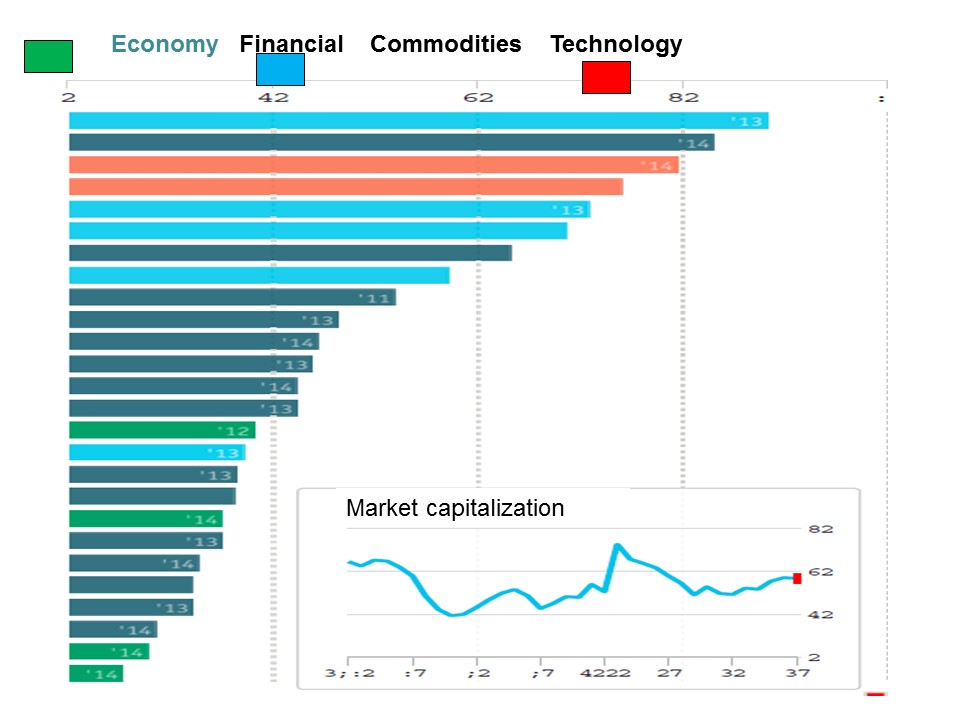
U.S. % of global total for various indicators…

Is America in decline?

   An excellent graphic by The Economist (daily chart) lists a variety of economic, financial and technological indicators for the U.S. as a share of the global total. America leads firmly in venture capital investments, and the U.S. dollar is still 60 per cent of total world forex reserves. In technology, the U.S. leads firmly only in “social media’ (which does not generate jobs, only wealth for a handful) and “cloud hosting” (similar to social media). Most of the indicators in which America dominates are financial in nature.   US dollar share of bonds, R&D spending, FDI stock, debt, etc.  

   So here we have it.  The U.S. is still the financial leader of the world, but not the technology or economic leader. There is a serious mismatch.

   So the question arises:   Can the U.S. remain the center of financial stability of the world?   Or will its flagging economy weaken the dollar and the whole world system? Are we due for another crisis?

   In history, no power has remained dominant in finance without remaining dominant in economics (note the decline of the British empire and its industrial power, and the decline of the pound sterling).




Touchstone School: “Magical Moments”

By Shlomo Maital

    Touchstone

My wife and I are visiting Touchstone Community School, here in Grafton, MA, about an hour from Boston.   In this and several following blogs, I would like to recount briefly some ‘magical moments’ I experienced there, in a pre-K to Grade 8 school where children do not take formal tests and where their imaginations and social skills are fostered.

   Background:   Thanks to the hospitality of Touchstone, I’ve brought a Chinese family from Shantou, Guangdong (where Technion has a joint venture program), to visit the school – Jin, my former Shantou U. student,   his wife Yuen, and 3-year-old daughter Yue, or Sophia.   Together we’re making a documentary film, hoping to bring the message of Touchstone’s “transformative schooling” back to China and to Israel.

  sophia and friend Sophia and her new friend…language is no barrier!


   Values: We joined a group of Grade 7-8 children discussing Touchstone core values. The class itself had earlier chosen core values:   all began with “C” — Confidence, curiosity, connection, creativity.   These values appeared on a ‘flag’ created by the children which included one square per child, where the square reflected the child’s own personality. This emphasis at Touchstone on being an individual is pervasive.

   I asked the students about rules.   If you have core values, and act on them, do you really need rules?   Rules are external, externally enforced; values are internal, internally enforced.   The discussion was interesting, the consensus was – values can replace rules.

   There followed a discussion about table arrangements.   Pairs? Fours?   One big square table?   The consensus was: One big table, more inclusive.   Inclusiveness is a school-wide core value. I suggested, maybe a oval or round table? But there is no such table at Touchstone. However, there is an oval carpet. Let’s sit around the carpet, the students suggested.   I came up with a round table that splits into four segments, so work in pairs and small teams can take place.   We need to have it built.

   One conversation at a time? This is an IDEO principle.   It is implemented in this class with Jupiter, a soft toy, tossed from one child (the speaker) to another (who raises their hands and wishes to speak).   One child was applauded, for actually catching Jupiter with one hand (apparently, a first! The students joked about it…not in a mocking manner).  

   I could not help but notice the huge developmental gap between the girls and the boys…the girls are way way ahead of the boys, which is common at this age.  

   There is a core issue here. Teachers who graduate from teachers’ colleges learn about the rules of pedagogy and the rules of schooling. They then implement those rules in the schools where they teach, and children learn about following an external set of rules, with punishments (and rewards, at times).   Children who follow rules well, do well in school. Rebellious kids don’t. But creativity demands rebellion. Are we eradicating it with our rule-based system?   Touchstone begins with values. Values are internal. Why not replace external rules with internal values? And make ‘confidence’, and ‘creativity’ core values?  

John Maeda: Unconventional Design Thinking

By Shlomo Maital

Maeda

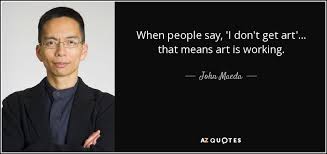
     John Maeda has had a remarkable career, in computer science at MIT, and MIT Media Lab, then as head of the famed Rhode Island School of Design, now as a partner in Kleiner Perkins. He is also a famed video artist Here are his views on design, as told to McKinsey’s Hugo Sarrazin.

     Design was once largely about making products attractive. Today it’s a way of thinking, a creative process that spans entire organizations, driven by the desire to better understand and meet consumer needs. Good design is good business. This came from T.J. Watson Jr., in a 1966 memo to all of IBM.   Moore’s law (computing power doubles every 18 months) is dwindling…   so now we have to buy [things] because of how they make us feel.

     Whenever someone has come to me asking for the ‘silver bullet’ (for great design), I say, “There’s only a silver ray…and you have to know where to point it, you might get lucky”.

     I was talking to a CEO startup —   I offered my opinion, “Just because you can do it doesn’t mean you should do it. If you think about design adding value, a lot of what people don’t understand is that sometimes the best design consultants will tell you NOT to design it.

     [Consulting for e-Bay companies]…   I observed that the designers were all spread out. …So I connected all of them together, some 380 of them, into one community that could see each other. And the CEO could see them. ..the CEO said, “oh, so design itsn’t about this pixels thing, it’s about systems thinking!”   He totally got it.   [Sarrazin: It’s getting the right people together, creating the sense of community. It’s also reframing what it is!].    

     Maeda: Reframing: Exactly!


Hot Hand: It Lives!

By Shlomo Maital

 Hot Hand

Tuesday (Sept. 20)’s Wall St. Journal Sports Page has an article titled “The ‘Hot Hand’ May Actually be Real”.   It’s about an old idea, that basketball players have ‘hot hand’ streaks, in which their scoring percentage is much higher than normal in a series of shots.   Basketball players KNOW this exists.   But scholars deny it. A famous article by Nobel Laureate Daniel Kahneman examined the data and debunked the ‘hot hand’ theory.

Now comes a new (unpublished) article by economists Joshua Miller and Adam Sanjurjo, with a new perspective. Hey! The hot hand lives! They begin their paper with a riddle.

      Toss a coin four times. Repeat this a million times. What % of the coins come up heads, after the first toss comes up HEADS?

50% ?   obvious?

   Wrong.   40%.     After an “H” on the first toss, there are 14 equally likely sequences in with at least one H (heads) in the next 3 flips. In the average sequence, there is a 60% chance it will be tails, and 40% chance it will be heads.   Work it out!

   Re-analysis of data shows there is a hot hand.   And I am relieved. Because in creativity research, the work of  Mihaly Csikszentmihalyi on “Flow” shows that when we are creative, we are in ‘flow’, we are in the zone….   And surely basketball players too get ‘in the zone’ sometimes. They certainly believe they do.

   The big question? How can you invite a ‘hot hand’? How can you create it? How can you get ‘in the zone’ when you seek ideas?   Best way:   Relax, have fun, enjoy, have idle time, and listen to your subconscience. For basketball? Relax, be confident, believe…and it will come.

Innovator: Visualize! It works!

By Shlomo Maital

Jake Arrieta Jake Arrieta

   What can one learn about innovation from the New York Times Sports section?

Well, it turns out, a great deal. Take for instance Chicago Cubs’ talented pitcher Jake Arrieta.   He just won his 20th game, first pitcher in the Major Leagues to do so.   And he did so even though the Cubbies, as fans call them, are not THAT strong a team, last I looked they were 7 games behind the leading team and not likely to make the playoffs.

   Jake Arrieta practices a powerful technique known as ‘visualization’.   Before you tackle a task, start a company, implement an innovation – visualize it. REALLY see it, in every detail.   Go through the motions, second by second, picture yourself as, say, Steve Jobs, announcing Macintosh in 1984. (He rehearsed that short talk, in which he introduces the Mac as a person, many many times, with a coach).   REALLY see it. Then, when you actually do it, it will be familiar, comfortable, you’ll be at ease, and perform at a very high level, like pitcher Jake Arrieta.

   Arrieta has a 20 wins, 6 losses record, with a 1.88 earned run average (fewer than 2 earned runs per game). Here is how he describes his ‘visualization’ technique:

   “You don’t think about something for the first time the day you do it. You think about pitching in the playoffs; you think about pitching in the World Series. And if you don’t, you should.” Arrieta pictures himself pitching on game day, the day he is scheduled to pitch, he seems himself pitching against the nine opposing betters, one by one, he strategizes, he throws his sinking slider, his fast ball…. Again and again.

     I am trying to apply this. I visualize myself in class, in a lecture hall, and lately, in front of a camera. I picture myself talking. I see my gestures, I see the audience, every detail, the water glass, the lectern….   You know it is working when you have a feeling of ‘déjà vu’, hey I’ve been here, done this, before, on the actual day.

     You can ‘visualize’ long range too. Think ahead backward. Picture where you want to be in 10 years. The room, the situation, the people around you, your team, everything. Picture it in detail. Maybe even draw it.   Then work backward. What are the many things you need to do to make it happen.

   Try it!   It works.

Laudato Si: Worth Careful Reading

By Shlomo Maital

“Our common home is like a sister with whom we share our life and a beautiful mother who opens her arms to embrace us.   This sister now cries out to us because of the harm we have inflicted on her by our irresponsible use and abuse of the goods with which G-d has endowed her. We have come to see ourselves as lords and masters, entitled to plunder her at will. … This is why the Earth itself, burdened and laid waste, is among the most abandoned and maltreated of our poor…she ‘groans in travail’.  

These are the eloquent opening words of Pope Francis’ new encyclical, Laudato Si, “Praise the Lord…”.   Yesterday was the Jewish holy day Yom Kippur, Day of Atonement.   My sister in law Rabbi Suri led a discussion of Laudato Si, as we read excerpts, and discussed the Jewish and Catholic views on ecology and ethics. I plan to read the entire document. Meanwhile, based on excerpts, I urge you to read it all.   Most Papal encyclicals are dense and scholarly. This one is written in Pope Francis style, clear, well-reasoned, with beautiful metaphors and sharp admonishments.

   We have indeed laid waste to our earth. The 15th COP Conference of Parties (the UN’s euphemism for impotent political gatherings) will take place in November in Paris. But there is a groundswell that holds out hope.   Rather than ineffective top-down political leadership to deal with global warming, we now are seeing increasing bottom-up activism, with each individual everywhere asking, what can I do to use less water, waste less, plunder less, in order to be a moral human being, as Pope Francis counsels?   If each of us acted on our beliefs, even in small ways, the aggregate effect would be immense.

   Perhaps Laudato Si will ignite such a groundswell of rebellion and action world-wide.  We will listen carefully to Pope Francis’ address to Congress today, and to the UN tomorrow.Laudato Si


Five Life Lessons: Learning Life Forward

By Shlomo Maital

Kirkegaard Kirkegaard

The great Danish philosopher Soren Kirkegaard once defined the tragedy of life: “We live life [looking] forward,   we learn life [looking] backward”.   My wife and I are visiting York University, in Toronto, Canada. I spoke to a class of young engineers, just beginning their studies, at the invitation of my host, Prof. Andrew Maxwell, who heads the BEST Bergeron Entrepreneurship for Science & Technology program in the Lassonde School of Engineering. I shared with them these 5 life lessons, that I have learned personally:

  • Take on BIG challenges:   challenge yourself hugely. If you fail, failure is glorious, and you learn a lot, so much that there really is no such thing as failure, when you’re tackling something enormous. If you succeed – well, your life takes on huge meaning.      
  • Start with WHY!         Find something you are deeply passionate about. This will be your rocket fuel. Start with this, and move on from this point.       Many of my young students do not yet know what their life passion is, because no-one has asked them, nor have they asked yourself. Use your passion to fuel your rocket – but first, be sure to find such a passion.
  • Be like da Vinci: in SOME ways.   Leonard da Vinci was immensely creative, he invented the submarine, tank, airplane, parachute, and vastly more things. He drew with left-handed in his notebook, and wrote notes in mirror writing, to keep them secret.       So in this – be UNLIKE him.       Don’t keep secrets. If you never share your ideas, you’ll never improve or find people to help you implement them.
  • Be truly expert in at least one thing, go deeply into it; and learn a little about everything you can, you never know. Steve Jobs studied calligraphy (handwriting) at Reed College. Why? It interested him. Because he did, the Macintosh, when launched, had beautiful fonts. This led to desktop publishing. DT publishing saved the Mac, created a huge market, and it was utterly unintended… simply because Jobs loved beautiful fonts.      
  • Become very comfortable with being uncomfortable. All great things emerge from people who are uncomfortable about something – they just HATE it, can’t tolerate it, want to CHANGE it.       Much of modern life is about becoming, and remaining, comfortable, free of thirst, hunger, pain, boredom, anything uncomfortable. So get uncomfortable about something, and be comfortable with it, because THIS is what will drive you to action.


Green Energy for the Poor: The M-KOPA Kenya Model

By Shlomo Maital

M-KOPA

   Innovation at its best helps the poor, and uses creativity in its business design, not just in technology.   Here is an example, by Ngozi Okonjo-Iweala, former Nigerian finance minister and World Bank official, writing in the International New York Times. He recounts the M-KOPA system in Kenya, Tanzania and Uganda, that brings cheap clean power to families:

     “It’s called M-KOPA. The “M” stands for ‘mobile’ and ‘kopa’ means “to borrow”. The company’s customers make an initial deposit, roughly $30, toward a solar panel, a few ceiling lights and charging outlets for cellphones – a system that would cost about $200. Then they pay the balance owed in installments through a widely-used mobile banking service….The solar units are cheaper and cleaner than kerosene, the typical lighting source and once they’re fully paid for after about a year, the electricity is completely free. More than 200,000 homes in Kenya, Uganda and Tanzania use M-KOPA’s solar system”.

       That to me is a “wow”.   The idea should spread to rural India and to rural China, to Myanmar, and throughout Africa.   Note how this system combines technology, business innovation (the mobile payment system), and sensitivity to the needs of the poor. Electric power is vital not just for quality of life, but also for education, so that kids can read and do their homework in the evening.

     Special congratulations to the M-KOPA innovators!   They could be candidates for a Nobel Peace Prize.

ISIL’s Return to Gold: Don’t Sell Them Short!

By Shlomo Maital

ISIS coin

From the start, the world has consistently underestimated ISIL. (the “L” stands for “Levant”, or, Mideast).   The American-led bombing campaign, for instance. America and its allies have conducted 6,000 sorties in total. (A sortie is a bombing mission by one plane). This is a drop in the bucket. The New York Times points out that Syria, the collapsing non-country does this number of bombing raids on its own civilians every few days.

   Now comes the 55-minute video, Return of the Khalifah, a video denouncing the fractional reserve banking system, and advocating (notes The Economist)  “the return of the ultimate measure of wealth for the world”: gold. The video shows the new ISIL gold coin.

   There is no risk that the gold coin will replace the paper dollar, as the video promises. But the economics in the video are very strong. America HAS over-expanded its dollar money supply, to the detriment of other countries. The gold standard, which lasted for 150 years, was indeed successful in keeping countries from excessive debt and excessive money creation.  If the dollar is the world currency, it must be stable — yet the U.S., to spur its own economy, has created massive excessive amounts of them.  

   The video strays into blind hatred, as usual, noting that “America has been able to avoid hyperinflation and maintain its military hegemony largely thanks to the petrodollar system. Islamic State hopes that with the introduction of what it is calling the dinar, all oil will be paid for with gold instead of being priced in dollars, which would “mark the death of this oppressive banknote” and bring America “to her knees” “. This will not happen. But the fact that oil prices are denominated in dollars, and largely paid for in dollars, has doubtless been a benefit for the U.S., though it is now becoming an energy exporter.

     The world today is awash in money, owing to QE (quantitative easing) practiced by the U.S. and European Central Banks. This mountain of money has created the seeds for the next global crisis. Neither the U.S. Fed nor the ECB know how to end QE and begin raising interest rates, without panicking capital markets and crashing in particular the huge bond market. Under a gold standard system, this could not happen.

   Let us stop underestimating, scorning, discounting ISIL. Their use of media is highly sophisticated. Their videos are professional. Their military tactics borrow from the tactics used by special forces of the U.S., Australia and Britain. They are not going away. And they do pose a threat. They are the prime cause of the massive wave of humanity now washing up on Europe’s shores. The longer ISIL survives, the harder it will be to eliminate it. It is time to wake up. Their gold coin campaign is just one more reason.

Pile-On Meetings: How to Fight ‘Stovepipes’

By Shlomo Maital

Finch

Kathleen Finch

Kathleen Finch is the chief programming officer for  several cable TV channels: HGTV (Home & Garden Channel), Food Network and Travel Channel.   Her job requires a great deal of creativity, in keeping programming fresh, relevant and lively for viewers.

   Interviewed in today’s International New York Times, she reveals some of her methods for maintaining creativity. One of them is called “pile-on meetings”.   I believe this is a remedy for stovepipe management – that is, narrowly defined management responsibilities, vertical ones, with very little interaction or overlap for creative ideas. Stovepipes are one of the reasons that big organizations with detailed vertical organizational charts   struggle to innovate.

   “I have a meeting every few months that I call a pile-on meeting,” she told the NYT. “I bring about 25 people into a room and go over all the different projects that are coming up in the next 6 months and the goal is that everybody piles on with their ideas to make those projects as successful as they can be. The rule walking into the meeting is that you must forget your job title. I don’t want the marketing person just talking about marketing. I want everyone talking about what they would do to make this better. It is amazing what comes out of those meetings!”

   Another key insight? “I love when things don’t go right, because it’s a good time to talk about taking smart risks. If everything worked all the time, that would mean we’re not trying anything crazy, and it’s the crazy ideas that end up being the really successful ideas.”

     Again, another reason big organizations fail to innovate. Who would attempt anything, in the corporate world, that could well fail?

Blog entries written by Prof. Shlomo Maital

Shlomo Maital

Pages