
You are currently browsing the tag archive for the ‘creativity’ tag.
The Key to Innovation in Big Companies: Work Together
By Shlomo Maital
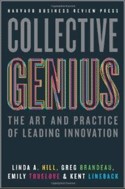
Generally I write blogs about books or articles that I’ve read. This time, I want to write about a book I intend to read soon, based on excerpts and interviews from Harvard Business School’s Working Knowledge magazine. The book is:
Collective Genius: The Art and Practice of Leading Innovation, (Harvard Business School Press) was written by Prof. Linda Hill, the Wallace Brett Donham Professor of Business Administration, with Greg Brandeau, former CTO of The Walt Disney Studios and current COO/president of Media Maker; Emily Truelove, a PhD candidate at MIT’s Sloan School of Management; and Kent Lineback, Hill’s cowriter on her earlier book Being the Boss: The 3 Imperatives for Becoming a Good Leader.
Here is the main point: “….. innovation is a “team sport,” not the act of a sole inventor. “Truly innovative groups are consistently able to elicit and then combine members’ separate slices of genius into a single work of collective genius,” the authors write. Or, as Hill puts it, “Conventional leadership won’t get you to innovation.” The authors identified organizations with reputations for being highly innovative, then found 16 leaders within those organizations and studied how they worked. …. the authors include narratives of executives within India-based IT company HCL Technologies, the German division of online auctioneer eBay, and the marketing division of automaker Volkswagen in Europe.”
Here is the ‘boldest’ example of innovative leadership and teamwork, according to Hill. It comes from India.
“Of the 16 leaders studied, Hill says Delhi-based HCL, under former CEO Vineer Nayar, might be the boldest. Nayar, who pulled the company out of a five-year slump, challenged the common belief that Indian companies provide low-cost products and services but don’t innovate. “That (assumption) made him crazy,” Hill says. “He said ‘We can and will compete that way.’ ” Nayar focused on changing the organization from within, starting by empowering employees. In 2005, he told a team of 30-something young employees called the “Young Sparks” to develop the brand and a plan to change how employees experienced HCL. The group started with an icon, Thambi, which means “brother” in Tamil, symbolizing “the importance of the individual and the value of the collective” at HCL. Nayar recast his role as leader. He pushed for more transparency, adding 360-degree reviews for all employees and 360-degree feedback of his own work—he promised to resign if his own review dropped to a certain level. He set up a portal that asked employees to solve “my problems” and reported getting incredible answers from workers. From 2005 to 2013, when Nayar led HCL as president and then CEO, the company’s sales, market cap, and profits increased six fold, according to the book. Fortune magazine wrote that the HCL had “the world’s most modern management” and the company was named one of Businessweek’s most influential companies. Nayar tells people, “I don’t know the answers,” which goes against the common belief in Indian business that the CEO should be a visionary. For Hill, Nayar shows the possibilities of what can be accomplished by an innovative leader who embraces a new style of leadership.”
Big organizations ALL have trouble innovating. Perhaps Linda Hill’s new book will help them figure out why and find a workable solution.
Yes, I Can! Why We Should Act, Not Gripe!
By Shlomo Maital
 Christophe & wife
In our new book Cracking the Creativity Code (forthcoming, SAGE India, late Fall), we offer 10 ‘exercises’ for stimulating the brain’s creative thinking. The very first, perhaps the most important, is “Act – don’t just Gripe!”. Once in a while, when there is a problem that angers or saddens us, we have to take action, and not just wring our hands and complain. Find a creative solution to a problem, then…do it! Adapt Obama’s slogan (which he stole from an African-American woman, who used it to empower black women) and transform it to first person SINGULAR: Yes I can! At least once in a while. A post on Facebook drew my attention to this: France’s parliament has passed a law allowing workers to give some of their days off to a colleague with a seriously ill child. The idea came from the case of a man whose colleagues donated 170 days while his son was battling cancer. The man is Christophe Germain. He works at the Badoit water plant, in France. When his son fell ill with cancer, his fellow workers ‘donated’ 170 work days to him, so he could be home with his dying son. Now, the Member of the General Assembly for Christophe’s district has sponsored a law in Parliament, to enable any worker to donate work days for a fellow worker who needs compassion leave. And the law passed! Congratulations to the French General Assembly! Congratulations to the Member of Parliament (from a right wing party, by the way!). And congratulations to France, a nation that has a heart and is unafraid to let it guide its legislation. Act, don’t just gripe. A handful of good people did, in France, and have changed their country, and perhaps the world. Yes, I can! Try it. The little boy died in 2011. Christophe attended the Assembly debate on the proposed law. The Socialists opposed it. Shame on them. If socialists oppose a law just because a right-wing party proposed it, they deserve our scorn.
How IBM’s Executive School Fostered Creativity
by Shlomo Maital
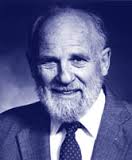 Louis Mobley
Almost 60 years ago, in 1956, Louis R. Mobley built the IBM Executive School to make IBM senior managers more creative. He used 6 key principles. They are highly relevant today – they made IBM a great company. I found this on a blog called Creativity at Work, in turn citing a Forbes article by August Turakk.
Try these principles on yourself. Build your own personal Executive School.
1. Traditional teaching methods (reading, lecturing, testing, memorizing) are worse than useless; they are counter productive, they build ‘boxes’.
2. Becoming creative is an UNLEARNINg process, not learning – you need to abandon, discard, destroy and trash beloved assumptions.
3. You don’t learn to become creative. Instead, you BECOME a creative person behaviorally, by your actions. You transform yourself. By action learning, constant effort and practice, you find solutions to problems that are totally unobvious. You become a creative person through practice, like a piano player learning to play the Minute Waltz.
4. The fastest way to become creative is to hang around with creative people. Creativity is infectious. If you hang around dullards, you will soon be one.
5. Creativity is highly correlated with self-knowledge. If you don’t know what your own inner biases are, you cannot overcome them. Mobley’s school was one “big mirror”.
6. Creative people give themselves permission, and others, TO BE WRONG. Fail fast to succeed early, is the principle. There are no bad ideas, only building blocks to good ideas, as Edison believes and practiced.
Should We Teach Kids to Break the Rules?
By Shlomo Maital
Library Lion
In Michelle Knudsen’s book for children, “Library Lion”, 2006, illustrated by Kevin Hawkes, the head librarian Miss Merriweather and Mr. McBee kick Library Lion out of the library, because he roared. And in the library, the rule is, you have to keep silent. They come to realize that by sticking to the formal rules, McBee and Merriweather have made a mistake.
Sometimes, to do a good thing, you have to break the rules. An Israeli theater group has now made a musical out of this story.
Here is a short passage: One day a lion came to the library. He walked right past the circulation desk and up into the stacks. Mr. McBee ran down the hall to the head librarian’s office. “Miss Merriweather!” he called. “No running”, said Miss Merriweather, without looking up. “But there’s a lion!” said Mr. McBee. “In the library!” “Is he breaking any rules?” asked Miss Merriweather. She was very particular about rule breaking. “Well, no,” said Mr. McBee. “Not really”. “Then leave him be.”
As parents and teachers, we teach our kids to become ‘socialized’, which means, to learn the rules of civilized behavior in society. Every society socializes its kids. Without that, we would have a crumbling society of sociopaths.
The question is, if creativity and innovation are about breaking the rules, can we teach kids to follow some rules and break others? And can they learn to know the difference? Can we raise good kids, well behaved, who at the same time rebel against rules, unwritten ones, and create wonderful new inventions? Can you be totally socialized, and extremely creative?
Perhaps “Library Lion” is a wonderful start at grappling with these tough questions. It is clear that doing so is long overdue. A lot of parenting, and a great deal of schooling, are one-sidedly focused on teaching the rules, and not on when they might be, and should be, broken.
Is Dissent A Necessary Condition for Innovation?
The Case of China
By Shlomo Maital

In this blog, I prefer to raise a question, rather than provide an opinionated answer
The question is: Can China become an innovation leader, without permitting open dissent and democratic debate?
In today’s New York Times, Stephen Sass, a Cornell materials scientist, argues, the answer is no. “I don’t believe China will lead in innovation anytime soon – or at least not until it moves its institutional culture away from suppression of dissent and toward freedom of expression and encouragement of critical thought.” He notes that almost all the paradigm-shifting innovations in the past few hundred years emerged “in countries with relatively high levels of political and intellectual liberty.” The reason? Free countries encourage people to be skeptical and curious. National innovation is the result of creative individuals who have the freedom to broach new ideas. And finally, free societies attract creative talent, oppressed societies push them out.
Here is a series of ‘yes’ arguments. China will innovate, by innovating its own approach to innovation. For instance, China excels at “design for value”, innovations in product design that create excellence in ‘manufacturability’. Chinese innovation will be far more team-based, rather than garage-based American Wild West individualism. China’s culture fosters discipline, and focused discipline is a key aspect of innovation. China’s huge growing internal market will make entrepreneurship much easier, as startups can sell at home rather than sell abroad, as in Israel. China has massive savings, which make availability of capital for startups much easier than in the West. China’s educational system generates enormous numbers of engineers; even if only 1 per cent of them are creative, that is sufficient to fuel a wave of innovation.
Can China become truly innovative? Don’t hold your breath for China to become democratic and tolerate widespread dissonance. The Chinese leadership believes this would blow the lid of China’s economy. Given the ‘in the box’ thinking of innovation without dissent — China will struggle to find its way. Time will tell if they succeed.
Making Eureka! Happen: On Inviting Ah-hah Insights!
By Shlomo Maital

All of us have experienced a “eureka” moment – a sudden flash of insight that yields a creative solution to a problem. Eureka is Greek for “I have found it!”, allegedly shouted when Archimedes discovered his famous displacement principle.
Can you do things that make ah-hah! moments more frequent and more powerful? Apparently you can. In researching neuroscience for an upcoming conference, I found an article, “The Aha! Moment: The Cognitive Neuroscience of Insight”, by John Kounios (Drexel U.) and Mark Beeman (Northwestern U.). [Recent Directions in Neurological Science, 2009].
The authors use EEG (electromagnetic imaging) and fMRI (functional MRI imaging) of the brain to physically map eureka moments. They give subjects a ‘compound remote association’ problem: e.g., Find a single word, that can form a compound word or familiar 2-word phrase with EACH of three words. E.g., crab, pine, sauce. One answer: “apple” (applesauce, crabapple, pineapple). They map brain patterns while subjects tackle the problem. They then ask the subjects to say whether the solution “popped into their minds” (eureka) or resulted from analysis (e.g. ‘cake’…crabcake, but pinecake no; reject cake; crabgrass…no, applegrass doesn’t work..etc.).
Here is what they, and others, have found: Eureka problem-solving “can be influenced by the prior preparatory state”. As Pasteur said, “chance favors the prepared mind.” Eureka comes to those who prepare for it. A relaxed, pleasant state of mind is far better for eureka than tension. (Attention, companies that put workers’ feet to the fire to develop ideas). Humor is very conducive to eureka. And most important: “individuals high in creativity habitually deploy their attention in a diffuse rather than a focused manner”. I.e., we get to eureka, not in a straight linear line, but zig-zag.
The authors believe you can organize ‘eureka’ thinking, as a ‘cascade of processes’ that generate aha! I agree. Zoom in! Think hard about a problem. Then let your mind wander. Soar into the clouds. Zoom out! Think of wild ideas that make you laugh. Bring a shopping cart with you, and dump all the possible ideas into it. At some point – pause. Zoom in again. Take your shopping cart and start to empty its contents. Choose one solution in it you think will work. Listen carefully to your gut. This could be a eureka! Or aha! Moment. If it is – listen to it! And then – get to work.
The Creative Brain: It’s NOT Left-Right!
By Shlomo Maital
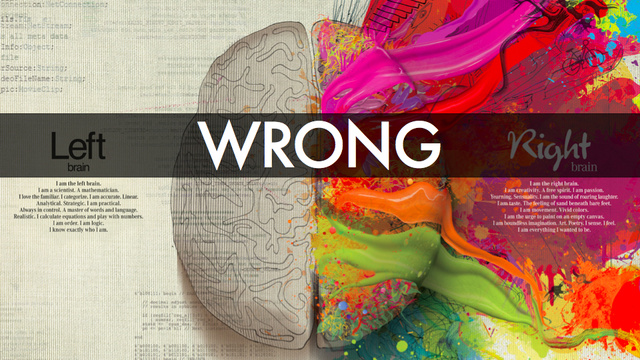
There is an amazing explosion of resources and people studying the brain these days, and new results are sure to come. Here is one, summarized in Scientific American (Aug. 19/2013) by Scott Barry Kaufman, “The Real Neuroscience of Creativity”.
Remember that left-brain-right-brain idea? Left brain, is “L”, logical analytic, organized, rational. Right brain is “R”, creative, passionate, sexual, colorful, poetic, even irRational?
Forget it. The L-R distinction is “not the right one when it comes to understanding how creativity is implemented in the brain”, notes Kaufman. “Creativity does not involve a single brain region or single side of the brain. Instead, the entire creative process – from preparation to incubation to illumination to verification — consists of many interacting cognitive processes and emotions.” Different brain regions are recruited to handle the task, depending on the stage of the creative process.
Many of these regions “recruit structures from both the left and right side of the brain”.
To simplify and summarize: There are thre large-scale brain ‘networks’ critical for creativity. 1. Executive Attention Network – recruited when a task requires that the spotlight of attention is focused like a laser beam. Active when you’re concentrating on a challenging lecture, or solving a problem. 2. The Imagination Network: used when “imagining alternate perspectives and scenarios”. 3. The Salience Network: monitors both external events and internal stream of consciousness and “flexibly passes the baton to whatever nformation is most salient to solving the task at hand.”
The key to understanding creativity, according to neuroscientists, is recognizing that “different patterns of [thinking] are important at different stages of the creative process.
So, what can we do with all this, to be more creative? According to Rex Jung: a) allow your mind to roam free, imagine new possibilities, and SILENCE THE INNER CRITIC! Reduce the Executive Attention Network a bit, increase the other two. Then, bring back the Executive Attention Network, to critically evaluate and implement your creative ideas. In other words: Zoom In, to understand the problem; Zoom Out, imagine, to seek many alternate possibilities; then, again, Zoom In, to choose the optimal alternative. Organizing these stages is important. Skipping a stage will damage the process.
I am amazed that this neuroscience model fits precisely the model of my friend, colleague and former student Arie Ruttenberg, known as Zoom In/Zoom Out/Zoom In, and presented in our forthcoming book The Imagination Elevator. Ruttenberg derived his model by simply intuitively taking apart, and reconstructing, the ways he reached his own creative ideas.
Nicholas Negroponte: Where Do Ideas Come From?
By Shlomo Maital
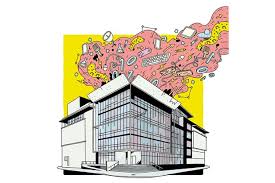
MIT Media Lab
MIT Prof. Nicholas Negroponte was the featured speaker at the 20th anniversary event of the MIT Enterprise Forum of Israel, an organization I helped found in 1994, and now run by Ayla Matalon. Negroponte spoke about how and why he started the Media Lab, together with MIT President Jerome Wiesner. His plan was to create a place for outsiders, for those whose radical innovative ideas would never be accepted in conventional MIT faculties. For 30 years the Media Lab has been a fountain of radically new ideas built on strong research foundations, with corporations lining up to pay fortunes just to gain access to those ideas.
“Where do new ideas come from?” Negroponte asked the audience, rhetorically. In one word: “From differences.” From people who think differently.
I think this explains why so few really new ideas emerge from universities, places where creativity is supposed to live but never does, and from big corporations, which pay lip service to innovation but do everything to stamp it out.
Universities reproduce ideas, by having students do research that in tiny incremental steps extends the research of their advisors, and generally affirms it. Imagine a thesis that disproved the central theories of the advisor! Tenure is gained fastest and easiest by publishing mainstream research that irritates no-one and ruffles the fewest feathers.
Businesses grow to global scale by operational discipline, in which people are well paid to do the same thing, again and again, with excellence and discipline. Imagine a manager who tells his CEO that the company’s most profitable product line is becoming commoditized and should be sold or closed.
Neither universities nor large multinationals want their people to think differently. Nor do they hire people who are different. This, despite the well-known finding that it is the most diverse teams that are the most innovative, and the rule that you should include a non-expert in every team, to ask the ‘dumb’ questions.
I strongly urge my students to respond to job interviews with their own interviews. Interview the interviewer. Find out if they really do want your creative ideas. Find out if they celebrate failure, and welcome diversity. Do this BEFORE you get put into the corporate blender and emerge as bland conventional porridge, instead of remaining a spicy jalapena pepper.
Destroying Our Most Precious Resource – (It’s Not Air or Water)
By Shlomo Maital

98% geniuses, age 5; 2% geniuses as adults
In an interview with the AARP (retired persons) magazine, Warren Buffett warns against investing in gold, and in doing so, informs us how much gold there is in the world: 170,000 tons, which if melted together would form a cube 68 feet on each side, worth $9.6 trillion (at $1,750 per ounce). Wow…that’s a lot of cash, more than half America’s annual GDP.
Now – imagine reverse alchemy: Irradiating that cube until it becomes…lead. $10 trillion in value disappears instantly. Gone forever.
Insanity? We are doing the equivalent every day to our children.
Studies show that nearly all (98%) 3-to-5 year-olds score as creative geniuses, when measured by their divergent thinking skills (ability to envision multiple solutions to a problem – matching the definition of creativity as ‘widening the range of choices’). [The test is used by NASA to measure creativity among its employees]. By age 10, only 32% scored at genius level. By age 15, 10%. And by adulthood: 2% ! *** [See Figure above].
We can only blame the way kids learn in schools for this. Rigid, regimented, this-is-the-right-way convergent thinking, my way or highway.
What is the value of this destroyed creativity? Far far more than that cube of gold. Imagine all the wonderful ideas we will never have, to enrich our lives and change the world, because our young geniuses have their creative sparks extinguished. And we can never get it back.
If only there were awareness of the problem. If only we could stop destroying creativity in our children, by a few simple ways to foster divergent thinking.
Is anyone listening?
*** Education researcher Y. Zhao notes, in a 2009 book: “In their 1992 book Breakpoint and Beyond: Mastering the Future—Today, Land and Jarman (1992) describe a longitudinal study on creativity beginning in the 1960s. Land administered eight tests of divergent thinking, which measure an individual’s ability to envision multiple solutions to a problem. NASA uses these tests to measure the potential for creative work by its employees. When the tests were first given to 1,600 three- to five- year-olds, Land found 98% of them to score at a level called creative genius. But five years later when the same group of children took the tests, only 32% scored at this level and after another five years, the percentage of geniuses declined to 10%. Figure 0.1 illustrates the sharp decline in one measure of creativity as children get older. By 1992, more than 200,000 adults had taken the same tests and only 2% scored at the genius level.”
Why You Must Not Trust Your Memories – Or Anyone Else’s
By Shlomo Maital

The writer Vladimir Nabokov once said, “ the more you love a memory the stronger and stranger it becomes.” Emphasize STRANGER. Because scientists at MIT have shown, each time we retrieve a cherished memory and relive it, we alter it. And if you do this 100 times, the memory itself can bear no relation with what actually happened. Humans are not elephants, which, as we know, never ever forget anything.
Writing in the July 25 edition of The New York Times, * James Gorman reports this:
“….scientists at the Riken-M.I.T. Center for Neural Circuit Genetics at the Massachusetts Institute of Technology say they have created a false memory in a mouse, providing detailed clues to how such memories may form in human brains. Steve Ramirez, Xu Liu and other scientists, led by Susumu Tonegawa, reported Thursday in the journal Science that they caused mice to remember being shocked in one location, when in reality the electric shock was delivered in a completely different location. The finding, said Dr. Tonegawa, a Nobel laureate for his work in immunology, and founder of the Picower Institute for Learning and Memory, of which the center is a part, is yet another cautionary reminder of how unreliable memory can be in mice and humans. It adds to evidence he and others first presented last year in the journal Nature that the physical trace of a specific memory can be identified in a group of brain cells as it forms, and activated later by stimulating those same cells.
How was this scientific magic done? Dr. Tonegawa’s team first put mice in one environment and let them get used to it and remember it. They identified and chemically labeled the cells in the animals’ brains where that memory was being formed. The mice were not shocked in that environment. A day later, in a completely different environment, the researchers delivered an electric shock to the mice at the same time that they stimulated the previously identified brain cells to trigger the earlier memory. On the third day, the mice were reintroduced to the first environment. They froze in fear, a typical and well studied mouse behavior, indicating they remembered being shocked in the first environment, something that never happened. The researchers ran numerous variations of the experiment to confirm that they were in fact seeing the mice acting on a false memory. The tools of optogenetics, which are transforming neuroscience, were used to locate and chemically label neurons, as well as make them susceptible to activation by blue light transmitted by a fiber optic cable. With these techniques the researchers were able to identify and label which neurons were involved in forming the initial memory of the first environment, and to reactivate the labeled cells a day later with light.
Dr. Tonegawa said that part of the importance of the research is “to make people realize even more than before how unreliable human memory is,” particularly in criminal cases when so much is at stake. That unreliability, he said, prompts a question about evolution: “Why is our brain made in such a way that we form false memories?”
His answer: “No one knows, he said, but he wonders if it has to do with the creativity that allows humans to envision possible events and combinations of real and imagined events in great detail. That rich internal experience fuels work in the arts and sciences and other creative activities, he said. “Unless you have that kind of ability, there is no civilization,” he said.
In a previous blog, I reported on Dan Ariely’s research, showing that creative people are less honest. Dr. Tonegawa’s theory fits well with this. Creative people simply invent things – in the past, as well as in the future.
Precisely because we can re-imagine the past, we can also imagine the future.
Personally, I find it very helpful to re-imagine the past. If you are troubled by a memory, simply reinvent it. Soldiers suffering from post traumatic stress disorder (PTSD), and there are many thousands of them, relive the traumatic event precisely as it happened, again and again and again. Perhaps we can help them reinvent it…. Or simply get the neurons that fire up the memory to turn off.
Also, many thousands of innocent persons have been sent to jail by testimony of witnesses which proved wrong. We now understand why. They are not liars. They simply remember events differently than they actually happened. The legal system will now have to take this into account.
* New York Times, July 25, 2013 “Scientists Trace Memories of Things That Never Happened”. By JAMES GORMAN

 TIMnovate