
You are currently browsing the tag archive for the ‘death’ tag.
Ashes to Ashes, Dust to Dust: “Recompose”
By Shlomo Maital
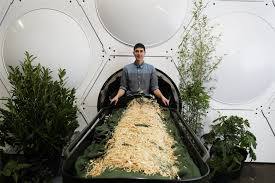
Katrina Spade is an architect, who co-founded Recompose. It’s about human composting. If you’re put off by the very idea – best not to read on. But trust me – it makes sense. This is based on Katrina’s TED talk.
So, what’s wrong with cremation? Half of all US funderals today are cremations, and that is forecasted to rise to 75% or more.
“Cremation destroys the potential we have to give back to the earth after we’ve died. It uses an energy-intensive process to turn bodies into ash, polluting the air and contributing to climate change. All told, cremations in the US emit a staggering 600 million pounds of carbon dioxide into the atmosphere annually.”
What’s wrong with ordinary burial in a plot/cemetery?
“All told, in US cemeteries, we bury enough metal to build a Golden Gate Bridge, enough wood to build 1,800 single family homes, and enough formaldehyde-laden embalming fluid to fill eight Olympic-size swimming pools. In addition, cemeteries all over the world are reaching capacity. Turns out, it doesn’t really make good business sense to sell someone a piece of land for eternity.”
So, how does “Recomposing” or “Recomposting” work?
“Inside a vertical core, bodies and wood chips undergo accelerated natural decomposition, or composting, and are transformed into soil. When someone dies, their body is taken to a human composting facility. After wrapping the deceased in a simple shroud, friends and family carry the body to the top of the core, which contains the natural decomposition system. During a laying in ceremony, they gently place the body into the core and cover it with wood chips. This begins the gentle transformation from human to soil. Over the next few weeks, the body decomposes naturally. Microbes and bacteria break down carbon, then protein, to create a new substance, a rich, earthy soil. This soil can then be used to grow new life. Eventually, you could be a lemon tree.”
Katrina’s company has the family come with a pickup truck, and gather the decomposed soil. That’s how it becomes a lemon tree, pecan tree… or a lovely flower bed of petunias. Would you like to visit your departed loved one, at a bed of smiley-face petunias? Rather than at a cemetery, rows on rows of cold stones?
So, hand on your heart. Wouldn’t you like to become a lemon tree after death? And your loved ones pluck lemons and say, thanks, Dad! Every year. And then make lemon meringue pie.
By the way: I found this stat startling. A cremated body puts a quarter-ton of CO2 into the atmosphere. Really!
Reflections on Death
By Shlomo Maital

This blog is about a subject most of us prefer to avoid. How does one react to the passing of a loved one? During the past year, our family lost at least one close friend, close enough to be family. How does one react to such loss, and also, to one’s own eventual passing?
Here is what I think. Our own lives are gifts. All too little, do we say thanks for the gift of life. This is why I love Mercedes Sosa’s wonderful song Gracias a la Vida (thank you for life).
Suppose the Louvre Museum were to call me up one day and say, hey, Shlomo, we’re lending you the Mona Lisa, on long term lease. Hang it in your living room. Enjoy. One day, we’ll ask for it back. Would I be incredibly grateful? And would I complain when they asked for it back one day?
No. And that is how I think we should relate to our own lives and those of loves ones. They are given to us not for good, but on long (and at times, painfully short) leases. They are to be returned. They are all Mona Lisa’s on loan.
And when they are returned — We should say, thank you, just as you would say on receiving any sort of gift, even one involving a loan.
My mother Sally passed away in 2012. At her funeral, we had family members and friends come up and tell “Sally” stories, many of them humorous. She was larger than life, a woman with a huge heart and sometimes a sharp tongue. There was considerable laughter at the funeral. Afterward, some people expressed deep horror at the levity. But, I explained, Mother lived to 105! And most of those years, she was in good health, and for all of it, in sharp mind. What a gift! How can we show ingratitude by complaining! Of course, we miss her a lot. But so would we miss the Mona Lisa when asked to return it.
Let us all remind ourselves to say, gracias a la vida. For ourselves, and for loved ones. Thank you for the wonderful lives we are given. We celebrate them, in life and also in death. And in doing so, we show respect for life and true understanding and appreciation of life as an incredibly precious gift.
One of my friends, a career officer, spent years, informing loved ones that a son, husband, grandson, nephew, had alas died during army service. She recounts that it helped people greatly when they could see finality in the death, and recognize the loved ones were gone. Some could not, and daily worked to keep memories alive, perhaps out of guilt. The strategy of closure was far healthier and better than the strategy of non-closure, she recounts. Fond memories always remain. You don’t need to work to retain them. They are there. When you say ‘thank you’, I am returning the gift that I received, there is some solace.
Many will disagree with this view. For me personally, when my time is up, I hope those I leave behind will celebrate my life, tell stories about it, and express gratitude to the Creator of all life.

 TIMnovate