
You are currently browsing the tag archive for the ‘diet’ tag.
Gum Disease & Alzheimer’s: A Surprising Connection
By Shlomo Maital

A study led by Prof. Gabriel Nussbaum, Faculty of Dental Medicine, Hebrew University of Jerusalem, reveals a curious connection between gum disease and Alzheimer’s. It is reported by the daily Jerusalem Post.
Here is the story.
Porphyromonas gingivalis, the microbe that causes gum disease (e.g. gingivitis) is a germ that thrives in inflamed oral tissue in our mouths. Unlike most microbes, that thrive on sugars, it lives on proteins and on the iron in red blood cells. It feeds on the plaque and on the bleeding gums that arise when our gums are infected and ailing. Bleeding gums are like lunch or supper for it.
This insidious little bug has a magical trick. It uses a protein to fight the body’s immune system. The protein is called CD47. When the body has an infection, anywhere, e.g. our gums, it sends white blood cells to fight – part of our immune system. But this sneaky microbe, porphyromonas, has figured out how to defeat the white blood cells, and moreover, actually make them worsen the infection and gum bleeding, worsening the inflammation.
Sneaky! Gosh, what evolution can come up with!
But – what in the world does this have to do with Alzheimer’s?
Alzheimer’s is characterized by sticky plaque that gums up our brains and ultimately shuts it down. It seems likely that the microbes that infect our gums spread to our brains, and “drive macrophage cells into a pro-inflammation stage, generating plaque rather than preventing it.”
Macrophage cells are cells in our brain that comprise our active immune defense to protect our brains from microbes and other bad things. They make up fully 10% of the total number of cells in our brain. Makes sense — Evolution has evolved to protect our brains – but porphyromonas gingivalis may have figured out a defense against the defense.
What is the action item here? Seniors — healthy teeth and gums are really important for overall health. We’ve known this for ages. But now, we may see some real science that connects our gums and teeth with our brains.
Have your teeth cleaned regularly by a dental hygienist, so plaque doesn’t form and cause gingivitis. Maybe every six months or so. If your gums do bleed, see a periodontist. Your brain will say, thank you.
How to Change:
Will Power vs. Habit
By Shlomo Maital
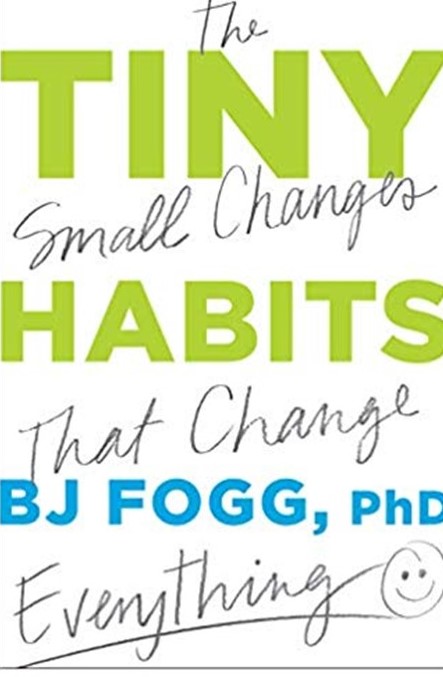
Do you want to change? Do you want to lose weight? Exercise? Sleep more? Be more social? Be a better spouse? All of the above?
Then, you need to watch this heavyweight title fight. In the right corner, weighing in at 300 pounds: Will Power, the champion. In the left corner, weighing in at 138 pounds, the challenger, Habit. Wait! Wait a minute! This is unbelievable. The fight hasn’t started yet and…and… Will Power is throwing in the towel. Habit wins. Habit is the undisputed Change Your Behavior champion.
Ok, agreed. That’s kind of hokey. But true.
B.J. Fogg is a Stanford University faculty member and runs a behavioral design lab. His new book is Tiny Habits: Small Changes that Change Everything. And his proven core principle is very simple: Will power in general is not enough, despite what we may think. If you want to change what you do and how you behave, it’s not enough simply to …will it! There is a better way.
Change your habits!
But how?
Here is one proven method, used by 40,000 of Fogg’s subjects. Small changes.
Sunscreen? Crucial to prevent skin cancer? But – do we forget often, or simply can’t be bothered?
Put on one single tiny drop. Just one. Do it every time. It takes just a second.
Why? That drop doesn’t make any difference.
No – but it creates a sunscreen habit – going out in the sun, put on sunscreen. One drop. Later, two. Then – slather it. And the habit will persist. Fogg proves it.
Flossing your teeth? You forget, or are in a hurry? Floss one tooth. Just one. Do it every time. Takes a second. Do it regularly. Eventually, expand it…and you have a habit that will not be broken.
Fogg’s idea here is based on proven psychology, and widespread testing. It works. If you want to change your behavior and are really serious about it, design a habit. Start it small. And grow it. And persist.
Use Fogg’s simple formula: B=MAP. In Fogg’s own words: : “Behavior (B) happens when Motivation (M), Ability (A), and a Prompt (P) come together at the same moment.” Don’t forget the Prompt. The thing that triggers an action.
In other words: Motivation – I want to exercise more regularly. Ability – I have committed to walking to my bus connection, rather than riding. And Prompt – I am putting on my Brooks running shoes rather than dress shoes in the morning.
Give it a try. And remember Fogg’s advice: Simplicity, simplicity! The simpler your change habit design, the better! Don’t beat yourself up if you break your diet. It’s not a lack of will power. It’s bad design.
As Fogg suggests: When the waiter brings you the basket of delicious hot bread rolls, make it automatic to say, ‘no bread please’. Temptation, get thee away! If you get in the habit, lots of calories can be saved…

 TIMnovate