
You are currently browsing the tag archive for the ‘evolution’ tag.
Evolution at its Strangest: The Glow-worm Cave
By Shlomo Maital
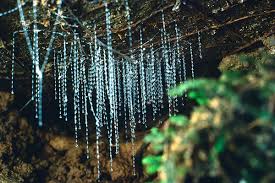
Those strange luminous ‘fishing lines’ in the picture are actually — strange luminous fishing lines. They are created by glow-worms, weird creatures that live clinging to the roof of the Waitomo Cave, here in New Zealand. Evolution has taught these creatures to attract their food – bugs and mosquitos that breed in the river below, that runs through the cave — by fluorescent luminosity. When the lights are turned out in the cave, there is a spectacular sight – the entire ceiling glows, with a thousand points of light, just like the heavens on a clear starry night. And the older the glow-worm, the more luminous it is. The ‘butterfly’ form lives only a day or two, and has no mouth (because it has no need to feed, its only job is to mate, reproduce, and die), but the worms live quite long. And it dangles those strange strings down, to trap its food.
Evolution has created creatures that are superbly adapted to every possible environment – deep under the sea, in steam vents, and here, in deep dark caves. Give Nature enough time, and it will solve any problem.
I think we can learn from these tiny glow-worms. They emerged because Nature tried experiments. By accident, one weird glow-worm was luminescent. His friends all laughed at him/her. Hey, look at Wormie there, he glows. Let’s sing him a song– Glow little glow-worm, glimmer, glimmer…. But Wormie caught loads and loads of bugs, enough to reproduce successfully. And then Wormie’s kids, too, glowed…and down the generations.
This too is how humanity can crack its toughest problems. Have enough creative people running around trying weird things, trying to ‘glow’, with bright ideas – and some of them may work. Some of them may one day light up the world.
How a Tiny Butterly Does the Impossible…So Can You!
By Shlomo Maital

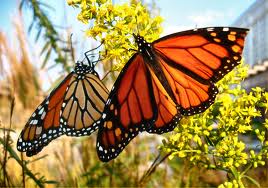
Consider the amazing Monarch butterly, shown above. They weigh only 0.4 grams each, on average. This is a bit more than one one-hundredth of an ounce! Yet they are able to engage in an annual migration of some 8,000 kms. (4,800 miles!). The trip north to coastal California and Washington from Mexico each spring requires three to four generations, as eggs are laid on the way in spots where milkweed grows, caterpillars emerge, spin chrysalises, and become butterflies.
How in the world do light-as-air butterflies manage to fly so far, even through three or four generations? They are very clever at using updrafts of warm air and air currents. How do they avoid being eaten, as they fly in large butterly clouds? Simple. They eat milkweed. Milkweed contains a toxic poison. So birds avoid Monarch butterflies, easily identifiable by the coloration, because eating them gives them a stomach ache, which birds learn the hard way. The toxic poison is called cardiac glycosides, steroids that act like digitalis and stop the heart. Not only do Monarchs have poison, they concentrate the poison in their wings, where birds tend to attack. Monarchs have also evolved to mimic the viceroy butterly, in coloration, which is even more poisonous.
Monarch butterflies live only for about 30 days. But what a 30 days! They are the only butterfly to do a north-south migration, flying north in the spring and south toward winter. They migrate in huge clouds of millions of butterflies, an amazing sight.
Monarch butterflies evolved through evolution, and are proof of how wonderfully Nature does experiments that generate incredible creatures. There are endless miracles like Monarch butterflies. They should all, together, make us far more respectful of the wondrous planet in which we live, which alas we seem intent on polluting and ruining. How much we can all learn from a tiny fragile creature that weighs nothing yet has learned to survive by making an impossibly long journey every year.

 TIMnovate