
You are currently browsing the tag archive for the ‘innovation’ tag.
Guy Kawasaki’s 10 Innovation Rules
By Shlomo Maital

Guy Kawasaki is the psychology grad, in the jewelry business, who became the marketing guru for Apple’s Macintosh and led it to massive success. He has since become a successful venture capitalist and author, (“Art of the Start”) and speaks effectively on startup entrepreneurship.
Here are the 10 rules for successful innovation, given in an address to a conference of educators in Boston, Nov. 16-18: Innovator – on a scale of 1 to 5 (1 = out to lunch on this one, 5 = implement it always and with perfection), score yourself on each of the 10. 35-40 points gets you a high success rating on the Kawasaki scale.
- Make Meaning – Great innovation is motivated by the desire to make meaning and to change the world. Companies that are successful started because they want to make the world a better place. If you are just trying to make money, then you attract the wrong kind of people.
- Make Mantra – You should have a two or three word explanation of why your school or class should exist. Mission statements are too long and not memorable
- Jump to the next curve – The problem with most businesses is that they define innovation as what they do in their business. Define yourself not as what you do, but as the benefit you provide. Great innovation begins in jumping or creating the next curve. Kawasaki cited Western Union as an example of a company that did not do this by refusing to see the benefit of telephones. There are certainly a large number of companies that became irrelevant due to their failure to see the next curve.
- Roll the dice – Don’t be afraid to take a chance and put out something unique to your market. Kawasaki cited Ford’s My Key that allows you to program the top speed into the key.
- Don’t Worry Be Crappy – Kawasaki who was a member of the development team for the first MacIntosh computer, admitted the first MacIntosh was a piece of crap, but he added that it was a revolutionary piece of crap due to some of the revolutionary aspects of the device. “Ship stuff that jumps to the next curve,” he encouraged. If you wait until it is perfect you may miss your opportunity.
- Let 100 Flowers Blossom – As an innovator you may think you have an exact customer and an exact use for what you do. You may encounter a situation where unintended people use your product in unintended ways. If this happens we need to embrace it and let this unintended use blossom.
- Polarize People – Great innovation polarizes people , it is one of the consequences. Anyone who has asked teachers to make the switch to Google docs can identify with this one. (If you have people who truly HATE your product, but also those who truly LOVE your product – your polarized, and you’re on the right track).
- Churn, Baby, Churn – This is the hardest thing about innovation, you need to be in denial and refuse to listen to naysayers.
- Niche Thyself – If you are designing a new product then you need to make sure that what you are doing is both unique and valuable. Find your niche. Be the best in it.
- Perfect your pitch – Customize your introduction to show that you know where you are and who you are talking to. Find out information about who you are talking to.
Chinese Innovation: On the Rise
By Shlomo Maital
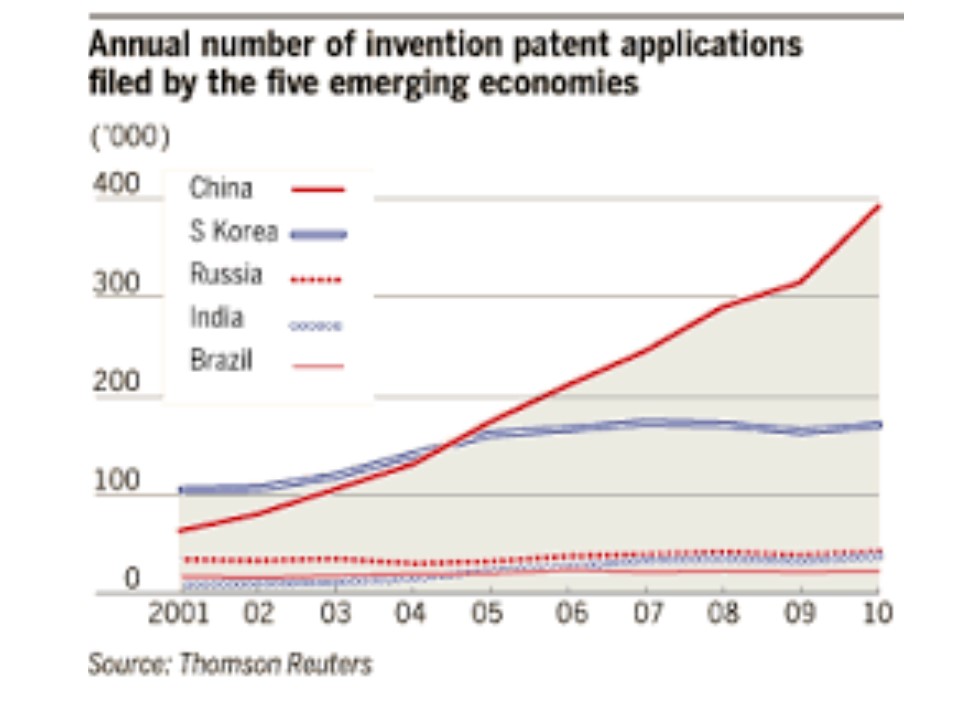
An insightful new report by McKinsey Global “China’s Innovation Imperative” sheds important light on China’s massive effort to become more innovative.
Here are some of the report’s key insights:
* “to realize consensus growth forecasts—5.5 to 6.5 percent a year—during the coming decade, China must generate two to three percentage points of annual GDP growth through innovation”. In other words up to half of China’s GDP growth must come from innovation. This is no easy task.
* “…about 40 percent of the increase in total factor productivity could come from innovations in higher-level manufacturing and services enabled by the Internet. Other innovations could come from catch-up activities that bring Chinese enterprises up to global best practices as well as breakthroughs yet to emerge. China will have evolved from an “innovation sponge,” absorbing and adapting existing technology and knowledge from around the world, into a global innovation leader.”
* “China has become a strong innovator in areas such as consumer electronics and construction equipment. Yet in others—creating new drugs or designing automobile engines, for example—the country still isn’t globally competitive. That’s true even though every year it spends more than $200 billion on research (second only to the United States), turns out close to 30,000 PhDs in science and engineering, and leads the world in patent applications (more than 820,000 in 2013).”
* “…we identified four innovation archetypes: customer focused, efficiency driven, engineering based, and science based. We then compared the actual global revenues of individual industries with what we would expect them to generate given China’s share of global GDP (12 percent in 2013). As the exhibit shows, Chinese companies that rely on customer-focused and efficiency-driven innovation—in industries such as household appliances, Internet software and services, solar panels, and construction machinery—perform relatively well.”
In general, China has strengths in process innovation, as it proves each time it takes production blueprints from a foreign firm and quickly produces the product. China also appears strong in incremental innovation. Perhaps a new focus should be placed on radical innovation – game changing new ways to create value and to do business.
The mantra of China’s 13th 5-year-plan is “China dreams”. Dream big, China.
Innovator: Visualize! It works!
By Shlomo Maital
 Jake Arrieta
What can one learn about innovation from the New York Times Sports section?
Well, it turns out, a great deal. Take for instance Chicago Cubs’ talented pitcher Jake Arrieta. He just won his 20th game, first pitcher in the Major Leagues to do so. And he did so even though the Cubbies, as fans call them, are not THAT strong a team, last I looked they were 7 games behind the leading team and not likely to make the playoffs.
Jake Arrieta practices a powerful technique known as ‘visualization’. Before you tackle a task, start a company, implement an innovation – visualize it. REALLY see it, in every detail. Go through the motions, second by second, picture yourself as, say, Steve Jobs, announcing Macintosh in 1984. (He rehearsed that short talk, in which he introduces the Mac as a person, many many times, with a coach). REALLY see it. Then, when you actually do it, it will be familiar, comfortable, you’ll be at ease, and perform at a very high level, like pitcher Jake Arrieta.
Arrieta has a 20 wins, 6 losses record, with a 1.88 earned run average (fewer than 2 earned runs per game). Here is how he describes his ‘visualization’ technique:
“You don’t think about something for the first time the day you do it. You think about pitching in the playoffs; you think about pitching in the World Series. And if you don’t, you should.” Arrieta pictures himself pitching on game day, the day he is scheduled to pitch, he seems himself pitching against the nine opposing betters, one by one, he strategizes, he throws his sinking slider, his fast ball…. Again and again.
I am trying to apply this. I visualize myself in class, in a lecture hall, and lately, in front of a camera. I picture myself talking. I see my gestures, I see the audience, every detail, the water glass, the lectern…. You know it is working when you have a feeling of ‘déjà vu’, hey I’ve been here, done this, before, on the actual day.
You can ‘visualize’ long range too. Think ahead backward. Picture where you want to be in 10 years. The room, the situation, the people around you, your team, everything. Picture it in detail. Maybe even draw it. Then work backward. What are the many things you need to do to make it happen.
Try it! It works.
Green Energy for the Poor: The M-KOPA Kenya Model
By Shlomo Maital

Innovation at its best helps the poor, and uses creativity in its business design, not just in technology. Here is an example, by Ngozi Okonjo-Iweala, former Nigerian finance minister and World Bank official, writing in the International New York Times. He recounts the M-KOPA system in Kenya, Tanzania and Uganda, that brings cheap clean power to families:
“It’s called M-KOPA. The “M” stands for ‘mobile’ and ‘kopa’ means “to borrow”. The company’s customers make an initial deposit, roughly $30, toward a solar panel, a few ceiling lights and charging outlets for cellphones – a system that would cost about $200. Then they pay the balance owed in installments through a widely-used mobile banking service….The solar units are cheaper and cleaner than kerosene, the typical lighting source and once they’re fully paid for after about a year, the electricity is completely free. More than 200,000 homes in Kenya, Uganda and Tanzania use M-KOPA’s solar system”.
That to me is a “wow”. The idea should spread to rural India and to rural China, to Myanmar, and throughout Africa. Note how this system combines technology, business innovation (the mobile payment system), and sensitivity to the needs of the poor. Electric power is vital not just for quality of life, but also for education, so that kids can read and do their homework in the evening.
Special congratulations to the M-KOPA innovators! They could be candidates for a Nobel Peace Prize.
Pile-On Meetings: How to Fight ‘Stovepipes’
By Shlomo Maital

Kathleen Finch
Kathleen Finch is the chief programming officer for several cable TV channels: HGTV (Home & Garden Channel), Food Network and Travel Channel. Her job requires a great deal of creativity, in keeping programming fresh, relevant and lively for viewers.
Interviewed in today’s International New York Times, she reveals some of her methods for maintaining creativity. One of them is called “pile-on meetings”. I believe this is a remedy for stovepipe management – that is, narrowly defined management responsibilities, vertical ones, with very little interaction or overlap for creative ideas. Stovepipes are one of the reasons that big organizations with detailed vertical organizational charts struggle to innovate.
“I have a meeting every few months that I call a pile-on meeting,” she told the NYT. “I bring about 25 people into a room and go over all the different projects that are coming up in the next 6 months and the goal is that everybody piles on with their ideas to make those projects as successful as they can be. The rule walking into the meeting is that you must forget your job title. I don’t want the marketing person just talking about marketing. I want everyone talking about what they would do to make this better. It is amazing what comes out of those meetings!”
Another key insight? “I love when things don’t go right, because it’s a good time to talk about taking smart risks. If everything worked all the time, that would mean we’re not trying anything crazy, and it’s the crazy ideas that end up being the really successful ideas.”
Again, another reason big organizations fail to innovate. Who would attempt anything, in the corporate world, that could well fail?
Innovators: Are You Comfortable with being Uncomfortable? Are Your Kids?
By Shlomo Maital

Comfort: “a state of physical ease and freedom from pain or constraint”.
The purpose of much of modern life seems to be to annihilate all sources of discomfort from our lives. Pain? Pop a pill. Hungry? Thirsty? You’re never more than 5 minutes away from fast food that gives you bulges in ugly places. Frustrated? Well, if you can’t leap over the bar, hey, just set it lower.
The problem with this is, things that truly create immense value for human beings happen, only when creative people become uncomfortable with the current state of affairs – with what exists. Without this divine dissatisfaction, and discomfort, we would have no progress at all. If everyone was satisfied with everything as it is…? If everyone shunned prolonged discomfort? Nothing would change. And heaven knows, there is a lot that MUST change. When Jack Ma, founder of Alibaba, launched the company in 1999, he told the team of 17 that he assembled, that the next 3-5 years would involve a great deal of pain. And it did, beginning with the NASDAQ crash of March 2000. But led by Ma, his team was comfortable with being uncomfortable, because there was a reason, rationale, vision and goal.
I think this issue begins with raising our kids. As parents, we want the best for them. We want them perhaps to avoid the hardships we ourselves experienced. We smooth their paths. We make them comfortable, as much as we can. And our schools do the same, avoiding the tension and frustration that occurs when kids are challenged to do better, far better, in math and reading. We want our children to avoid failure. But failure is part of life. Resilience after failure is one of the most important skills one can have. How can you acquire it, and strengthen it, if you never are in a situation where resilience is needed?
The Jewish Talmud requires every parent to teach their children to swim. It’s common sense – what if they fell into a river or lake? By the same logic we also must prepare our kids for life’s challenges. Meeting those challenges may involve prolonged discomfort. If you cannot face any discomfort, how can you achieve greatness, for yourself and for others? How will you ever invest the 10,000 hours that Malcolm Gladwell says is the difference between mediocrity and greatness, in anything? If you only do things that you know will be comfortable, successful, you will miss many many wonderful opportunities for adventure and innovation.
I recall jogging with each of our children. They didn’t always love it. But our boys have all done marathons (I’ve done two, NY and Boston), and all have taken on, and surmounted, major physical challenges that led to important achievements. I think that running with them when they were young may have helped.
So my message is: Get comfortable with being uncomfortable. Help your kids do the same. New and strange things by definition are uncomfortable, in general. If you welcome the risk, the uncertainty, the angst, that comes with trying the unfamiliar, the challenging, the unknown, even the frustrating, if you welcome discomfort, soon you become comfortable with it. And then, you can go on to invent great things and change the world.
What I Learned in China
By Shlomo Maital
I try to write a blog almost every day – knowing this keeps me ever alert for new ideas to share. In this sense, blogs are as much for the benefit of the writer as for the reader.
I’ve been in Shantou China, for a week, teaching entrepreneurship to 43 eager young undergraduate business majors at Shantou University. Shantou is in the northern part of Guangdong Province, north of the provincial capital Guangzhou, close to the coast, and two hours by fast train from Shenzhen, which is opposite Hong Kong, on the mainland. My university, Technion, has a joint venture with Shantou Univ., to establish GTIIT – Guangdong Technion Israel Institute of Technology, now headed by Technion Nobel Laureate Dan Shechtman. The initiative arose from a generous grant by Li Ka Shing and his Third Son Foundation; Li Ka Shing, a Hong Kong billionaire, was born in Shantou and his foundation is active in supporting the city and its university. His investment company has invested profitably in Israeli startups.
Supposedly you cannot teach entrepreneurship to undergraduates because “they are too young and lack experience”. But Babson College does it highly successfully, using the method developed by my late friend Ted Grossman, an action learning approach in which teams of students form a real company, make a real product and learn the tools of business through running their company, under the guidance of mentors like Ted (who first launched a successful software company before joining Babson).
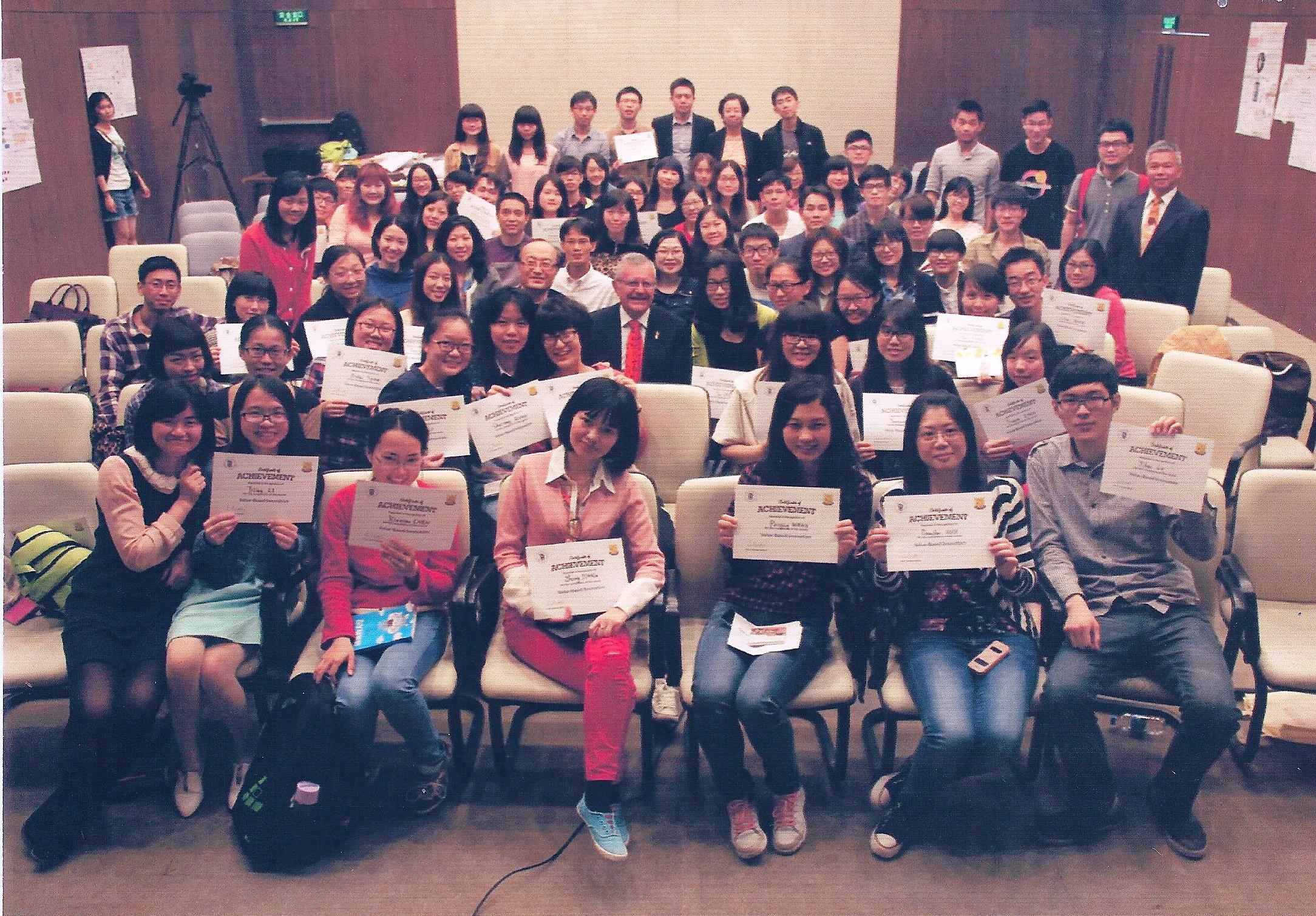
I use the same method in Shantou. And in one intensive week, the young students do amazing work; some of their ideas become reality, though not all. The photograph shows last year’s class.
Wages in China have risen dramatically, from about $100 a month in 2000 to $650 today (this is still only one-fourth the average wage in America, and Chinese productivity is in many cases even higher). But Philippines, for instance, has average wages of only one-sixth that of China. So China in principle should be losing its manufacturing to low-wage countries like Vietnam, Indonesia, and Philippines. And indeed it is, with shoes and textiles, low value added products, moving to those countries.
But China is keeping its high value-added jobs and enhancing them. How? China is the world’s biggest market for production robots, buying 20 per cent of worldwide production. Labor productivity rose by 11 percent yearly (!) on average during 2007-12 (it barely budged in the West). China uses its network of highly efficient suppliers to keep factories in China. China has become the hub of a complex ecosystem, in which Asian countries specialize, make components and ship them to other Asian countries. Asia now accounts for nearly half of all world manufacturing output, compared with 27 percent (about one quarter) in 1990.
Bottom line: China’s strategy is: Made in China 2025 (its official name) – boost productivity to keep competitive. If wages rise by 12 percent year but productivity does too…the cost advantage stays. But at the same time: Created in China. China is working to invent more of the products it makes. Like Xiaomi, the innovative smartphone company. And this is where I come in… teaching innovation to the young undergrads at Shantou University, not even a tiny drop-in-the-bucket in huge China, but – China is all about scale, and good ideas spread with lightning rapidity.
I truly love my annual one-week courses in Shantou; the students are fiercely eager to learn and highly creative once their creativity machines are turned on. These young people are literally eating our (Western nations’) lunch. If we don’t wake up, China’s living standards will continue to grow by 11 or 12 per cent a year, the rate of growth of productivity, and our living standards will simply stagnate (the rate of growth of OUR productivity). We need to save more, invest more, build better infrastructure, educate our young people better, and become more productive. This is what I learned in my classroom from 43 eager young Chinese business-major undergraduates.
The Desperate Search for Good Jobs
By Shlomo Maital

Writing in the recent issue of Scientific American, the Swedish-British economist Karl Benedict Lund raises an issue at the core of our economic woes, and not sufficiently discussed: Where in the world will we find well-paying jobs for young people, jobs that can sustain and help the middle class to endure?
The problem is, in the past, new industries that were born out of innovation created jobs to replace the industries that were obsolete and dying. Sunrise industries’ new employment offset the lost jobs of sunset industries.
But no longer. Frey notes: The video-streaming startup Twitch, bought by Amazon for almost $1 billion, employs only 170 people. In the past a $1 b. company would employ many times that. Google has annual revenues of $66 b., and employs only 53,000. IBM, with roughly similar revenues, employs 8 times that (431,000 in 2013). Dell employs 108,000. But Dell and IBM are shedding huge numbers of workers. Once, Dell came along to absorb many of the 250,000 (!) workers that IBM shed in 1993-5. No longer.
And Facebook? Facebook employed only about 9,500 employees in 2014, with $8 billion in revenues. When Internet companies like Google, Twitter and Facebook can generate a million dollars in revenue per employee, the founders and shareholders rejoice, but ordinary folks who seek employment do not.
Frey’s research reveals this fact: only 0.5 per cent of the U.S. labor force was employed, in 2010, in industries that did not exist 10 years ago. And there are quite a few such industries.
How will society deal with innovation that creates wealth, products, services, and in general wellbeing, without actually producing many new jobs? Will we have to accept a bifurcated society, where a fortunate handful become millionaires and the rest of us scrounge for handouts? What happens when the old pattern of new industries creating jobs to replace ones lost by dying industries fails, and new industries simply don’t create jobs?
One possible solution: A great many more of us will need to become independent business persons, creating our own job by starting small businesses. This will take a whole new approach to the way we educate our young people, and a new support system that, for instance, can supply micro-credit to such businesses.
WIX: Playfulness & Innovation
By Shlomo Maital

WIX: Reception Desk
I have the privilege of visiting startups and writing about them. Yesterday I visited WIX, an Israeli company which, with over 60 million users, leads the world in services for building beautiful websites. It is the first such company that has done an IPO (on NASDAQ). It is based on North Tel Aviv.
The first thing I notice at such startups is the physical ambience. WIX chose to locate not in Tel Aviv’s high-tech area, in North Tel Aviv, but near Tel Aviv Port, which is a playground for thirty-somethings. The reception desk is the first thing you notice (see photo). It conveys playfulness. This is crucial. WIX is not a startup but is in the scale-up stage. It has strong revenues and a gross profit margin of over 80 per cent. But it retains its atmosphere of creativity and playfulness. You encounter this from the outset, when you check in at the reception desk.
In its crowded bulding on Namal St., it has a rooftop area with a stunning view of the Mediterranean, where events are held. Like Google’s Mountainview campus, food is readily available, and coffee. WIX employs 800 people, 600 of whom are based in Israel; but despite its size, it tries to retain the feeling of being small, lively and playful.
Recently at a seminar at Tel Aviv University, participants told me about the difference between “play”, “playing”, and “playfulness”. The latter is a kind of mindset that nearly always disappears in large organizations, when manuals, handbooks, protocols and procedures are set up. WIX has so far retained it. I hope it will continue to do so.
Larry Page: As Innovator Role Model
By Shlomo Maital

Fortune magazine has chosen Larry Page (Dec. 1 issue) as Business Person of the Year. The feature article begins with a revealing joke, told often around Google. At Google’s “moon shot” Google X center, where self-driven cars, high-altitude wind turbines, and stratospheric balloons for Internet access are developed, a ‘brainiac’ creates a time machine. As the scientist reaches for the power cord to start a demo for Larry Page, Page says: “Hey! Why do you need to plug it in!?”
For a decade Page was one member of a triangle – Sergei Brin, Eric Schmidt, and Page – that led Google. In 2011 Page took over as CEO. Turns out he is a good manager. In the past three years, Google has grown 20% annually, and has quarterly revenue of $16 b. It has $62 billion in cash. Page invests heavily both in Google’s core business (he says he argued with Steve Jobs, who said, ‘you guys are doing too much’) and in far-flung new projects. According to Fortune, in the past year, Google has invested in artificial intelligence, robotics and delivery drones. It has expanded its venture unit, which invests in startups and is a kind of scouting team. It bought Nest, a smart-home startup. It invested in Calico, a biotech firm.
Originally Google set out to “organize the world’s information and make it universally useful and accessible”. Today that vision is too narrow. Page says he wants Google to change the world in ways most of us cannot imagine.
Some say Google is too narrowly focused on advertising revenue. But YouTube now brings in $6 billion in annual revenues. Page continues to invest in bold ventures, to ensure the company’s future. He is making ‘credible bets’ on the home, the car, and wearable devices.
Most amazingly, Google has a secret facility where a team of scientists are working on a project that will chemically ‘paint’ tiny nanoparticles, with a protein, so they bind to things like cancer cells. And then concentrate them through magnetized wearable devices, so they can be ‘queried’. This would enable constant monitoring and detection of a whole host of devices. Outside Google’s core competence? Not at all.
Page regards some of his bold bets as a portfolio bucket. Some will pay off. Many won’t. He doesn’t think the risk is high. By the time you want to put large sums of money into something, you pretty much know whether it will be profitable, he says. For him, not taking risks is the biggest risk of all.

 TIMnovate