
You are currently browsing the tag archive for the ‘innovation’ tag.
Too Big to Succeed? Carve it up.
By Shlomo Maital

Over the years, in working with big companies, I’ve learned how difficult (impossible?) it is for huge organizations to sustain creativity and innovation. In a recent magazine column, I wrote about Intel, and how a young rather junior Israeli engineer kept Intel from abandoning its CISC technology, leading to the highly successful Pentium. This occurred only because Andy Grove, then CEO, was willing to listen to those below him. Many CEO’s of huge MNC’s simply are not able or willing. Creative people get lost in the swamp of organizational bureaucracies.
A new fashion is developing to grapple with this problem. Split huge companies, elephants, into smaller pieces, rabbits. Like on Thanksgiving (always the 4th Thursday in November – Nov. 27, this year, in America), big companies are being carved up like turkeys, in the hope the pieces will be tastier than the whole bird.
eBay is divesting PayPal. Now, HP is splitting into two. HP stock soared on the news. Shareholders are delighted. It’s an act of creation – making something out of nothng.
I am very doubtful. Many industries have seen a wave of ‘consolidation’ – mergers. A merger is when two sick companies merge, to create one really BIG sick or sicker company. This is what happened in the airline industry.
Now this is being reversed. Reverse mergers. Very very profitable for Wall St. investment banks that shepherd the process, for a huge fee. HP is a company that lost its way, under very poor management, until Meg Whitman. But it will not solve its problems by splitting them into small pieces. You cannot make a company healthy by combining it with another; nor can you make a company healthy by carving it up like a turkey. The pieces are still turkey.
Long ago, management educators taught that ‘structure is not strategy’. The way you structure the pieces of a company is NOT a strategy. Companies that seek innovation by restructuring rarely succeed. Because the DNA, the company culture, remains.
Let’s wish HP success. But I’m very skeptical.
Think B I G
By Shlomo Maital

Yesterday I spoke to a group of entrepreneurs, at University of Sao Paulo, hosted by Prof. Fabio Kon. The gathering was initiated by students, and it was organized in an interesting manner. Each participant identified himself or herself in one of three categories, using colored badges: criacao (creative ideas); negocios (manager or business person); and desenvolvedor (developer, or entrepreneur). There were very few “criacao’s”, but lots of negocios and desenvolvedor.
My main message to them was “think big”. If you’re going to invest years of your life in working on implementing an idea, it should be a big one, not an 8 per cent improvement in something that already exists.
There are three avenues for ‘thinking big’. I illustrate it using diagrams:
X axis: number of people you affect. Y axis: amount of value you create for each, on average.
One: Make a huge improvement in life, create huge value, for a huge number of people. Example: Jack Noyes inventing the integrated circuit. Or a cure/preventative for malaria.
#########################
#########################
#########################
#########################
Two: Make a huge improvement in life, create huge value, for a relatively small number of people. Example: Vaccine for a rare disease.
$$$$
$$$$
$$$$
$$$$
$$$$
$$$$
$$$$
Three: Create fairly small value for a very large number of people. Example: iPhone.
****************************************************
****************************************************
In other words: a huge fat rectangle; a thin tall rectangle; or a short wide rectangle.
But somehow – SOMEthing needs to be big, either the value you create or the number of people you affect, or both. Why?
Because big ideas attract people with big abilities. Because big ideas generate energy and passion you need to implement them. Because we need big ideas to fix big problems, when small ideas will just not do the job.
Persuaded? Do you have a big idea?
Can You Come Out to Play? WILL You?
By Shlomo Maital

I’m married to a very smart psychologist, who is an expert on children and play; as a result, I get to read many interesting, sometimes wonderful, articles. The latest is one published in 2007, by L.A. Barnett, titled “The nature of playfulness in young adults”. The purpose of the article was to see if the term “playfulness” could become a valid “construct”, i.e. a clear, well-defined concept recognizable by all and useful for further research. To this end, the author used focus groups of adults.
The result: A rather long, but insightful, definition of “playfulness” in adults.
Here it is. Read it. See if you have these qualities. Why? Because, as the author notes, “playful people are uniquely able to transform virtually any environment to make it more stimulating, enjoyable and entertaining.” Want an extreme example: Roberto Benigni’s Life is Beautiful, a film about a father who made life in a Nazi concentration camp into a game, for his young son (Academy Award, Best Actor 1999).
Playfulness is the predisposition to frame (or reframe) a situation in such a way as to provide oneself (and possibly others) with amusement, humor and/or entertainment. Individuals who have such a heightened predisposition are typically funny, humorous, spontaneous, unpredictable, impulsive, active, energetic, adventurous, sociable, outgoing, cheerful, and happy, and are likely to manifest playful behavior by joking, teasing, clowning, and acting silly.
Do any of those adjectives describe you? Yes? No? If no – do you want them to? If so, you can definitely change. Just remember how you played when you were a child, and copy yourself as you once were.
What does this have to do with innovation? “Reframing” (seeing the same thing differently from others) is a key part of playfulness, and a key aspect of creativity. If you can ‘reframe’ to play, you can reframe to create.
- L.A. Barnett. The Nature of Playfulness in Young Adults. Personality and Individual Differences, 43 (2007), pp. 949-958.
The Key to Innovation in Big Companies: Work Together
By Shlomo Maital
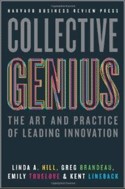
Generally I write blogs about books or articles that I’ve read. This time, I want to write about a book I intend to read soon, based on excerpts and interviews from Harvard Business School’s Working Knowledge magazine. The book is:
Collective Genius: The Art and Practice of Leading Innovation, (Harvard Business School Press) was written by Prof. Linda Hill, the Wallace Brett Donham Professor of Business Administration, with Greg Brandeau, former CTO of The Walt Disney Studios and current COO/president of Media Maker; Emily Truelove, a PhD candidate at MIT’s Sloan School of Management; and Kent Lineback, Hill’s cowriter on her earlier book Being the Boss: The 3 Imperatives for Becoming a Good Leader.
Here is the main point: “….. innovation is a “team sport,” not the act of a sole inventor. “Truly innovative groups are consistently able to elicit and then combine members’ separate slices of genius into a single work of collective genius,” the authors write. Or, as Hill puts it, “Conventional leadership won’t get you to innovation.” The authors identified organizations with reputations for being highly innovative, then found 16 leaders within those organizations and studied how they worked. …. the authors include narratives of executives within India-based IT company HCL Technologies, the German division of online auctioneer eBay, and the marketing division of automaker Volkswagen in Europe.”
Here is the ‘boldest’ example of innovative leadership and teamwork, according to Hill. It comes from India.
“Of the 16 leaders studied, Hill says Delhi-based HCL, under former CEO Vineer Nayar, might be the boldest. Nayar, who pulled the company out of a five-year slump, challenged the common belief that Indian companies provide low-cost products and services but don’t innovate. “That (assumption) made him crazy,” Hill says. “He said ‘We can and will compete that way.’ ” Nayar focused on changing the organization from within, starting by empowering employees. In 2005, he told a team of 30-something young employees called the “Young Sparks” to develop the brand and a plan to change how employees experienced HCL. The group started with an icon, Thambi, which means “brother” in Tamil, symbolizing “the importance of the individual and the value of the collective” at HCL. Nayar recast his role as leader. He pushed for more transparency, adding 360-degree reviews for all employees and 360-degree feedback of his own work—he promised to resign if his own review dropped to a certain level. He set up a portal that asked employees to solve “my problems” and reported getting incredible answers from workers. From 2005 to 2013, when Nayar led HCL as president and then CEO, the company’s sales, market cap, and profits increased six fold, according to the book. Fortune magazine wrote that the HCL had “the world’s most modern management” and the company was named one of Businessweek’s most influential companies. Nayar tells people, “I don’t know the answers,” which goes against the common belief in Indian business that the CEO should be a visionary. For Hill, Nayar shows the possibilities of what can be accomplished by an innovative leader who embraces a new style of leadership.”
Big organizations ALL have trouble innovating. Perhaps Linda Hill’s new book will help them figure out why and find a workable solution.
Can Facebook Innovate?
By Shlomo Maital

This cartoon ran in a German newspaper; it was accused of anti-Semitism, because its portrayal of Mark Zuckerberg, Facebook founder, who is Jewish, with a long hooked nose, recalls anti-Semitic literature.
Actually Facebook and Zuckerberg do have a problem. But it is NOT anti-Semitism. It is innovation – how to remain innovative, even though Facebook is not that old. When startups grow to global size, almost invariably they lose the creative spark. And Facebook is no exception. Facebook has been forced to acquire its innovation, rather than initiate it internally. Its innovations like Home and Graphsearch failed; and it paid huge sums for Instagram and WhatsApp.
In an interview with New York Times writer Farhad Manjoo (April 17, “Can Facebook Innovate?”), Zuckerberg describes Creative Labs, an effort to unbundle the “one big blue app” that migrated Facebook to mobile phones. Creative Labs will try to create a wide variety of Facebook spinoffs, with specific features users seek, some of them not even branded as Facebook. It should not be that hard. People spend 20 per cent of their mobile time, on average, on Facebook. This is amazing, considering Facebook migrated to phones not that long ago. But – how to sustain this 20 percent? It already seems to be eroding.
Why is it so hard for companies to innovate, as they grow large? Zuckerberg’s answer:
“Understanding who you serve is always a very important problem, and it only gets harder the more people that you serve,” says Mark Zuckerberg.
Big companies become isolated from their customers. Senior management sits in their 30th floor corner offices, and never speak to a real customer from one year to the next. And when customer preferences change rapidly, daily, hourly, this isolation from customers and clients is almost fatal. Zuckerberg is struggling to keep in touch with Facebook users.
Will he succeed? Stay tuned. Meanwhile, let’s learn from Facebook. As your startup grows, do everything possible to keep decision-makers in touch. Have them make sales calls. Get them out of their offices at least two days a week. Have them answer the customer service phones for a few hours a week. and have them bring regional executives and sales personnel back home frequently, for informal chats. It is the sales people who really know what is going on with customers.
Another key issue: Wealthy senior management live lives totally different from those of their customers, and soon grow out of touch with reality. Zuckerberg says: “ .. my life is so different from the person who’s going to be getting Internet in two years. One of the things that we do is ask product managers to go travel to an emerging-market country to see how people who are getting on the Internet use it. They learn the most interesting things. People ask questions like, ‘It says here I’m supposed to put in my password — what’s a password?’ For us, that’s a mind-boggling thing.”
Startup entrepreneurs must make a point of trying to live more or less ordinary lives, if they are to remain in contact with real people. Pretty hard, when your net worth is several billion dollars.
Microsoft’s New CEO: Asking the Right Questions
By Shlomo Maital

Satya Nadella
Microsoft has a new CEO, to replace veteran CEO Steve Ballmer. He is Satya Nadella, 47 years of age, born in India, and he has been on the job for 17 days. He’s been with Microsoft for 22 years; previously he worked for Sun Microsystems. He’s a computer engineer.
Nadella was interviewed by the New York Times’ Adam Bryant (Feb. 21). In the past, Microsoft has never missed an opportunity to miss an opportunity. MS, Gates and Ballmer missed the Internet, smartphones, you name it, they missed it. Only flexibility and alacrity, the ability to recover, kept Microsoft alive. Gates was able to mobilize his forces, tell them up front we missed this one, then engage them in catching up. Microsoft is great at catching its foes from behind…usually.
Nadella’s interview shows he understands what the key questions facing Microsoft are. And by the way, any large organization, competing in global markets. Here are some his observations. They are right on the mark.
“We (MS) have operated as if we had the formula figured out, and it was all about optimizing. ..Now it is about discovering the new formula. [What he means here is, MS was great at operational discipline, ‘optimizing’, but now it needs some radical innovation, ‘the new formula’.] So the question is, how do we take the intellectual capital of the 130,000 people and innovate, where none of the category definitions of the past will matter? Any organizational structure you have today is irrelevant because no competition or innovation is going to respect those boundaries.”
Take note, organizational experts. Don’t waste your time on your company’s organizational structure. It is irrelevant. You are being attacked by innovative startups that don’t even have one.
“Everything now is going to be much more compressed in terms of both cycle times and response times.” MS is a huge elephant. It has to learn to dance, in Lou Gerstner’s phrase, because its competitors salsa, rather than waltz.
“You have to be able to sense those early indicators of success, and the leadership has to really lean in and not let things die on the vine. When you have a $70 b. business something that’s $1 million can feel irrelevant. But that $1 m. business might be the most relevant thing we are doing.”
He gets it! MS has ignored important innovations in the past, because they were too tiny to merit attention or managerial time. But they were the disruptive innovations that changed the world.
“What people have to own is an innovation agenda, and everything is shared in terms of the implementation.”
“One of the things that drives me crazy is …”this is how we used to do it.” Or….this is how we do it”. Both are dangerous traps. The question is: how do you take all of that valuable experience and apply it to the current context and raise standards.”
Those indeed are the issues, Satya. Good luck to you. Now let’s see if you can deliver. You don’t have a whole lot of time.
Is Dissent A Necessary Condition for Innovation?
The Case of China
By Shlomo Maital

In this blog, I prefer to raise a question, rather than provide an opinionated answer
The question is: Can China become an innovation leader, without permitting open dissent and democratic debate?
In today’s New York Times, Stephen Sass, a Cornell materials scientist, argues, the answer is no. “I don’t believe China will lead in innovation anytime soon – or at least not until it moves its institutional culture away from suppression of dissent and toward freedom of expression and encouragement of critical thought.” He notes that almost all the paradigm-shifting innovations in the past few hundred years emerged “in countries with relatively high levels of political and intellectual liberty.” The reason? Free countries encourage people to be skeptical and curious. National innovation is the result of creative individuals who have the freedom to broach new ideas. And finally, free societies attract creative talent, oppressed societies push them out.
Here is a series of ‘yes’ arguments. China will innovate, by innovating its own approach to innovation. For instance, China excels at “design for value”, innovations in product design that create excellence in ‘manufacturability’. Chinese innovation will be far more team-based, rather than garage-based American Wild West individualism. China’s culture fosters discipline, and focused discipline is a key aspect of innovation. China’s huge growing internal market will make entrepreneurship much easier, as startups can sell at home rather than sell abroad, as in Israel. China has massive savings, which make availability of capital for startups much easier than in the West. China’s educational system generates enormous numbers of engineers; even if only 1 per cent of them are creative, that is sufficient to fuel a wave of innovation.
Can China become truly innovative? Don’t hold your breath for China to become democratic and tolerate widespread dissonance. The Chinese leadership believes this would blow the lid of China’s economy. Given the ‘in the box’ thinking of innovation without dissent — China will struggle to find its way. Time will tell if they succeed.
Toyota’s Innovation Process:
What We Can Learn from the Prius
By Shlomo Maital

Prius 2014
How did Toyota develop and build the Prius in record time? How has Toyota developed and sold 40 million Corollas? (We have one, it has over 300,000 kms. or 180,000 miles and is going strong).
I learned a lot from an advertisement, perhaps the first time an ad in TIME was more interesting than the editorial copy. The ad was an article by Mitsuhisa Kato, Toyota’s VP for R&D. Here is a summary of what he said:
* Get your R&D people out into the world and out of their darn labs: “Seeing people drive so fast on rough roads where I would have slowed to a crawl [front-wheel drive Corollas in nations with unpaved roads] was eye-opening. It highlighted for me the importance of venturing out into the marketplace to see things firsthand.”
* Organize around technologies, not features: “We launched the first-generation Prius in 1997. That was only two years after we formally initiated the development process! (Project head) Takeshi Uchiyamada (now Chair of Toyota) got inspiration from NASA’s Apollo program. Its managers identified the technologies they needed, and assigned a development team to each technology, enduring each team met its target and deadline. We adopted a similar tack.
* Get your engineers to talk across disciplines: “We moved the mechanical engineers and the electrical engineers onto the same office floor. Their face-to-face interchange raised our technical discourse to a new dimension and brought important progress.”
* Innovation is not rigidly bound by tradition but driven by it: “A renowned Japanese potter quote Auguste Rodin to me — Tradition is not inheriting the skeletons of the past, it is inheriting the SPIRIT of the past. We at Toyota honor the spirit of the joy of mobility.
Is Intel Making a Big Mistake?
By Shlomo Maital

Israel’s President Shimon Peres (left) with Intel Israel President Muli Eden and CEO Maxine Fassberg
Israelis love Intel, for two major reasons. One, its fab in the south of Israel is exceptionally efficient and generates billions of dollars in exports for Israel, as well as creating thousands of well-paying jobs; its R&D center in Haifa, near where I live, is a collection of exceptionally creative engineers. Two, an Israeli, David (Dadi) Perlmutter, Intel’s Executive VP, is Israel’s most senior executive working for a large global company. The Pentium and the Centrino were his idea.
This is why I read with distress this morning’s Financial Times report, that 52-year-old Brian Krzanich was appointed Intel’s next CEO, succeeding Paul Otellini. Krzanich, an engineer, comes from the production side of Intel, rising through the ranks to manage a fab. Otellini came from Marketing.
Here is FT’s take on the appointment: “His appointment will increase speculation that Intel could focus on growing this side of its business (manufacturing) to become more of a foundry for outside companies, given its lead in the miniaturization of chips….”
A financial analyst commented: “One of the things that Intel really needs to look at is how it can tie up with some of the key fabless chip suppliers, which are Arm-based companies like Apple and Qualcomm, in order to leverage its manufacturing strengths, even if it doesn’t get to leverage its processor design strength.”
To me, this means Intel is giving up on innovation and focusing on its operational excellence. I think this is a wrong decision. History shows that those who make products – the middle of the value chain – lose profit margins to those who design the products, and those who market them. Why else would Nike forego having its own factories, and invest solely in back-end and front-end activities?
Intel chips have lost the battle to ARM chips. This doesn’t mean, however, that Intel has lost the war. The hasty retreat is premature and does not do justice to Intel’s history of bold innovation and risk-taking.

 TIMnovate