
You are currently browsing the tag archive for the ‘Nobel’ tag.
Nobel Prize for Economics: Jean Tirole Takes on the Giants!
By Shlomo Maital
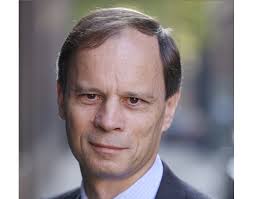
Jean Tirole
The Nobel Committee that selects winners for the Economics Prize has sent a message. This year (today, actually) they announced the winner is Jean Tirole, a French economist, who teaches at Toulouse, and who studied at MIT. He is honored for the following (according to the London Guardian):
“This year’s prize in economic sciences is about taming powerful firms,” Staffan Normark, permanent secretary of the Royal Swedish Academy of Sciences, said as he named Tirole the winner of the 8m kroner (£700,000) prize.
Tirole, 61, began his work on regulation and oligopolies in the 1980s and published an influential book in 1993 with the late Jean-Jacques Laffont on regulation. The judges said Tirole is “one of the most influential economists of our time”.
They added: “He has made important theoretical research contributions in a number of areas, but most of all he has clarified how to understand and regulate industries with a few powerful firms.”
The panel said Tirole had shown the “deep and essential differences” between regulating companies in different sectors, such as telecom companies or banks. Imposing caps on prices could reduce the influence of monopolies in some sectors, but not in others, the judges said, pointing to Tirole’s use of game theory and contract theory.
“In a paper last year, Tirole scrutinised, with Roland Bénabou, the pay and motivation structure in industries such as banking. They write about a “bonus culture that takes over the workplace, generating distorted decisions and significant efficiency losses, particularly in the long run”.
Tirole did not share the prize but won it alone. It is the first time since 1999 that an American has not at least shared the Economics Prize.
Will policymakers and politicians listen to Tirole? Yesterday I spoke with a family friend, a lawyer, who is leading a class action suit against a Detroit mortgage bank. He affirmed that the U.S. Justice Dept. has never prosecuted a single criminal case against Wall St. offenders, who nearly destroyed the world. They’re just too powerful, he said. Some groups spend $400,000 A DAY on lobbyists in Washington. Apparently, it’s a good investment. I am fantasizing a court case, criminal case, in which Jean Tirole is called as a witness for the prosecution.
Too Small to See? A Nobel for 3 Who Pioneered
By Shlomo Maital
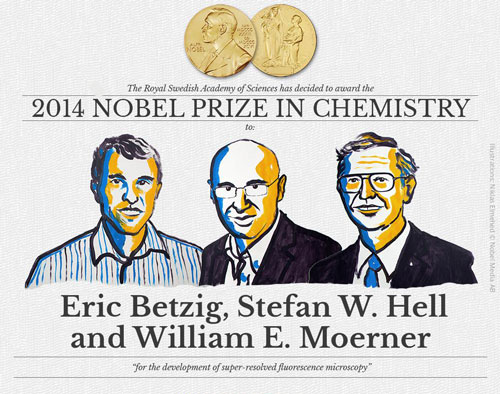
The 2014 Nobel Prize for chemistry was won by two Americans and a German: Eric Betzig, Stefan Hell and William Moerner. Their work greatly extended our vision into the smallest of molecules, in part enabling nanotechnology.
Hell, born in Romania, heads a Max Planck Institute in Gottingen, Germany. Moerner is from Stanford University; and Betzig, from the Howard Hughes Institute in Virginia.
According to CNN: “Back in 1873, science believed it had reached a limit in how much more of a detailed picture a microscope could provide. At the time, microscopist Ernst Abbe said the maximum resolution had been attained.” As with so many Nobel prizes, the three winners simply did not accept the statement, “we’ve reached the limit — no more can be done.”
The three scientists, according to the Nobel Prize Committee, did this: “….Due to their achievements, the optical microscope can now peer into the nanoworld,” the committee said. “The importance can’t be overemphasized: Now, scientists can see how proteins in fertilized eggs divide into embryos, or they can track proteins involved in Alzheimer’s or Parkinson’s diseases.”
Betzig and Moerner found a way to make single molecules ‘glow’ using fluorescent microscopy. Hell found a way to use two laser beams to make the molecules glow. This is creative thinking. Rather than conventionally illuminate molecules with photons, why not make the molecules themselves into little ‘lamps’?
“Guesswork has turned into hard facts and obscurity has turned into clarity,” the Nobel Committee added. The work of the three has “blurred the boundary between chemistry and biology”, by enabling us to see right inside single molecules.
Thank you, scientists!
Lighting Up Our World with LED: 2014 Nobel in Physics
By Shlomo Maital
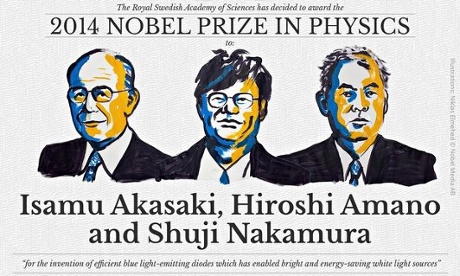
Three Japanese scientists have won the 2014 Nobel Prize for Physics, for their contribution – lighting up the world with LED – light emitting diode technology.
According to today’s New York Times: The three scientists, working together and separately, found a way to produce blue light beams from semiconductors in the early 1990s. Others had produced red and green diodes, but without blue diodes, white light could not be produced, the Royal Swedish Academy of Sciences said in its prize citation. “They succeeded where everyone else had failed.” The Nobel committee said that light-emitting diodes, or LEDs, would be the lighting source of the 21st century, just as the incandescent bulb illuminated the 20th.
The New York Times noted: “The LED lamp holds great promise for increasing the quality of life for over 1.5 billion people around the world who lack access to electricity grids,” the Nobel committee said. “Due to low power requirements, it can be powered by cheap local solar power.”
According to Wikipedia, “a light-emitting diode (LED) is a two-lead semiconductor light source: basic … diode, which emits light when activated. When a voltage is applied to the leads, electrons are able to recombine with electron holes within the device, releasing energy in the form of photons. This effect is called electroluminescence, and the color of the light (corresponding to the energy of the photon) is determined by the energy band gap of the semiconductor.”
The three Japanese scientists managed to achieve “the invention of efficient blue light-emitting diodes, which has enabled bright and energy-saving white light sources.” Previously, light was created with LED technology, but in colors that did not enable replacement of the Edison incandescent bulbs.
Nakamura worked for a time for a Japanese company, Nichia. Nichia awarded him…$200 for his invention. Nakamura left the company in 1999 to join U. of California, Santa Barbara, and sued the company for a fair share of the immense royalties. He settled for $8.1 million.
The ORIGINAL GPS: Our Brain
By Shlomo Maital

The 2014 Nobel Prize for Physiology & Medicine has been announced. It is shared between John O’Keefe, American-born scientist at University College, London; and a husband and wife team, May-Britt and Edvard Moser, at the Norwegian University of Science and Technology in Trondheim, Norway.
Here is what they discovered:
O’Keefe: How do we know where we are? How can we find the way from one place to another? And how can we store this information in such a way that we can immediately find the way the next time we trace the same path? This year´s Nobel Laureates have discovered a positioning system, an “inner GPS” in the brain that makes it possible to orient ourselves in space, demonstrating a cellular basis for higher cognitive function. In 1971, John O´Keefe discovered the first component of this positioning system. He found that a type of nerve cell in an area of the brain called the hippocampus that was always activated when a rat was at a certain place in a room. Other nerve cells were activated when the rat was at other places. O´Keefe concluded that these “place cells” formed a map of the room.
In other words: many many centuries before GPS technology was invented, our BRAINS developed their own internal GPS mapping system. Amazing?
Moser’s: More than three decades later, in 2005, May-Britt and Edvard Moser discovered another key component of the brain’s positioning system. They identified another type of nerve cell, which they called “grid cells”, that generate a coordinate system and allow for precise positioning and pathfinding. Their subsequent research showed how place and grid cells make it possible to determine position and to navigate.
The discoveries of John O´Keefe, May-Britt Moser and Edvard Moser have solved a problem that has occupied philosophers and scientists for centuries – how does the brain create a map of the space surrounding us and how can we navigate our way through a complex environment?
For those who are religious and believe in the Creator, this amazing capability of the brain to orient us using specialized brain cells, and creating grids, GPS coordinates and maps, is a fine example of the miraculous nature of the human brain. Congratulations to these scientists for helping us understand how this works!
Bob Shiller’s Nobel: Finance IS a Force for Good!
By Shlomo Maital

Together with Eugeme Fama (U. of Chicago) and Lars Hansen, 67-year-old Yale U. Prof. Robert Shiller won this year’s Nobel Prize in economics for ‘contributions to our understanding of asset pricing’.
Those laconic words don’t begin to do justice to Bob’s contributions. He was among the few lone voices who warned that America was in a housing bubble, that would soon burst. He knew this, because he had developed a reliable, accurate measure of housing prices, the Case Shiller Index, that is widely used. Earlier he warned that the stock market was in a buble, in his 2000 best-seller Irrational Exuberance (the dot com bubble burst in March 2000).
I encounter many MBA students (some here at EDHEC) who are fascinated by the world of finance, but who are pondering whether to remain in the field, because of the downsizing and layoffs in finance, and because finance was given a bad name after the 2008-12 financial crisis, owing to a handful of scoundrels. I urge them to remain in finance, and to innovate and reform the industry, and reinvent it. And I always recommend that they read Shiller’s new book, Finance and the Good Society (Princeton U. Press, 2012). Here is how Shiller frames his pitch:
“… finance should not be viewed as inherently or exclusively elitist–separating people into different income groups, or as an engine of economic injustice. Finance, despite its flaws and excesses, is a force that can help us create a better, more prosperous, and yes more equal society. In fact, finance has been central to the rise of prosperous market democracies and is unimaginable without them. Beyond headlines incriminating bankers and financiers as self-aggrandizing perpetrators of economic dislocation and suffering, finance remains an essential social institution, necessary for managing the risks that enable society to transform creative impulses into vital products and services, from improved surgical protocols to advanced manufacturing technologies to sophisticated scientific research enterprises to entire public welfare systems. The connection between Wall Street and Main Street is as fundamental for society as is the connection between the brain and the nervous system in the human body.”
Finance specialists: Stay the course! Innovate, create, seek blue oceans. Finance needs you, Nobel Laureate Shiller says, and I strongly agree.
Memo to Every Country: Keep Your Bright People!
By Shlomo Maital
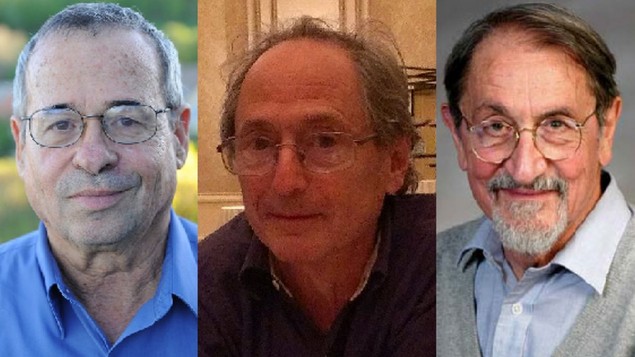
Nobel Winners Warshel, Levitt and Karplus
This year’s Nobel Prize for Chemistry was won by three scholars, two of whom were Michael Levitt, Stanford Univ., and Ariel Warshel, U. of Southern California. The latter two are Israelis; Levitt studied and did research at Israel’s Weizmann Institute, and Warshel studied at Technion-Israel Institute of Technology. Both did their Nobel research abroad. Levitt told the press that he would have preferred to remain at Weizmann, but it was “not his decision”. The three winners did research that used software algorithms to simulate and predict chemical reactions, now widely used in drug development. Like many Nobel breakthroughs, their work combined fields not often combined: in this case, classical physics and quantum physics. One of the winners was French: Martin Karplus, of Univ. of Strasbourg.
Both Levitt and Warshel studied in Israel; Ariel studied at my university and won awards. Both say they would have preferred to make their careers in their home countries, but could not get academic positions.
I believe that one of the key ways we should judge our political leaders, is whether they do everything possible to keep our bright young people at home, and to attract those who have left to come home. This is our future; to do less is to damage our future. I don’t see how Israel’s government is doing anything serious to stem the massive brain drain, or attract home those who left in earlier years. It is very small comfort to see an expat Israeli win a Nobel Prize, for Stanford or Southern Cal. We see an exodus of brainpower from Greece, and from Spain, and other nations in fiscal trouble. The cost of this is simply immense.
Source:
http://online.wsj.com/article/SB10001424052702304520704579127683358228854.html

 TIMnovate