
You are currently browsing the tag archive for the ‘self-awareness’ tag.
OpenAI: Who Am I?
By Shlomo Maital

Who am I? Can we find out about ourselves with AI?
Posting on the Medium website, Mohammed Bakry proposes the following prompt, to ask AI about someone and dig through the Internet for information:
“Do intensive research on XXXXXX and give me a massive report on everything you find. Find the needle in the haystack — something unexpected — so I can reach out with a surprising personal connection.”
So I tried it on myself. Here is the result (with my annotation):
Shlomo Maital is a renowned figure, [false; beware of AI obsequious flattery] primarily recognized for his contributions in the field of economics and innovation management. As a professor and senior researcher at the Technion – Israel Institute of Technology, he has influenced both academic circles and industry practices significantly. Maital’s work often emphasizes the practical application of economic theory in fostering innovation and entrepreneurship.
One of his noteworthy roles has been as the Academic Director of the TIM-Technion Institute of Management, which focuses on executive training and development. His research and teachings often explore the intersection of economic theory and real-world applications, striving to make complex concepts accessible to practitioners and policymakers.
Maital is also an accomplished author, having published several books and numerous articles on innovation management, creativity, and entrepreneurship. His writings frequently address the challenges organizations face in cultivating innovation and the strategies they can employ to overcome them.
An unexpected angle to explore when connecting with him could be his interest in the psychological and social aspects of economics. Maital has often focused on how behavioral insights can enhance economic policies, a topic that diverges from the traditional economic narratives and showcases his interdisciplinary approach. [Failed to mention my wife Dr. Sharone Maital, psychologist, who is and was an essential collaborator]. Engaging with him on how behavioral economics can drive sustainable innovation might serve as an unexpected yet impactful point of connection.
To reach out with a surprising personal connection, you might consider referencing his involvement with societal and educational initiatives, reflecting shared interests in how education can drive economic development and societal well-being. His emphasis on the human aspects in economic systems could provide a unique personal touch to your outreach.
[Missing: Our grandchildren and great-grandchildren, light of our lives; our synagogue Ve’ahavta, and Rabbi Elisha Wolfin, with whom I do a weekly podcast on the Bible – a deep and meaningful activity; my column in Jerusalem Report, also a huge focus for me; the think tank where I now work, S. Neaman Institute, my second family].
OK — bottom line. Who am I? AI will not help much. Who is XX? AI won’t help much.
That’s a big relief.
Who am I? Montaigne & Self-Awareness
By Shlomo Maital
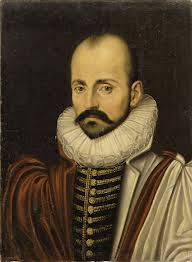
Michel de Montaigne was one of the most influential writers of the French Renaissance, b. 1533, d. 1592, a short 59-year life. He wrote thoughtful essays that investigated his own thoughts, and personality.
Writing in his New York Times column, David Brooks tackles Montaigne, along with another great essayist, Samuel Johnson. I doubt there is another columnist alive who would dare to make a column out of two authors who have been dead for hundreds of years. As a high school French student in Regina, Canada, I once impetuously wrote an essay on Montaigne – but the truth is, I didn’t understand a word of what he wrote.
Brooks quotes Montaigne: “If others examined themselves attentively as I do, they would find themselves, as I do, full of inanity and nonsense. Get rid of it I cannot without getting rid of myself. We are all steeped in it, but those who are aware of it are a little better off.”
In others words, as Nietzsche counselled, “become who you are”. But first, understand who you are.
I teach young people in many countries. Increasingly I find that Generation Y, those born after 1980, lack an understanding of who they really are, and what their passions are. The reason seems to be the connectedness of the smartphone. Why bother to know what you really think, if you can ask others instantly? If you are permanently instantly linked to others, how can you ever build self-awareness, when your own self disappears in the swamp of ‘connected socially-networked others’? How can you become who you are, if you do not ever really know who you are?
There is a kind of serenity that comes with self-awareness. I deeply regret that many troubled people I encounter never achieve that serenity. It starts with recognizing our own faults, our own flawed character. If you are constantly looking outward, at what others are tweeting and posting, you will never have time and space to look inward. And that’s a real shame.

 TIMnovate