
You are currently browsing the tag archive for the ‘stock market’ tag.
World Economy: Best in Years
By Shlomo Maital
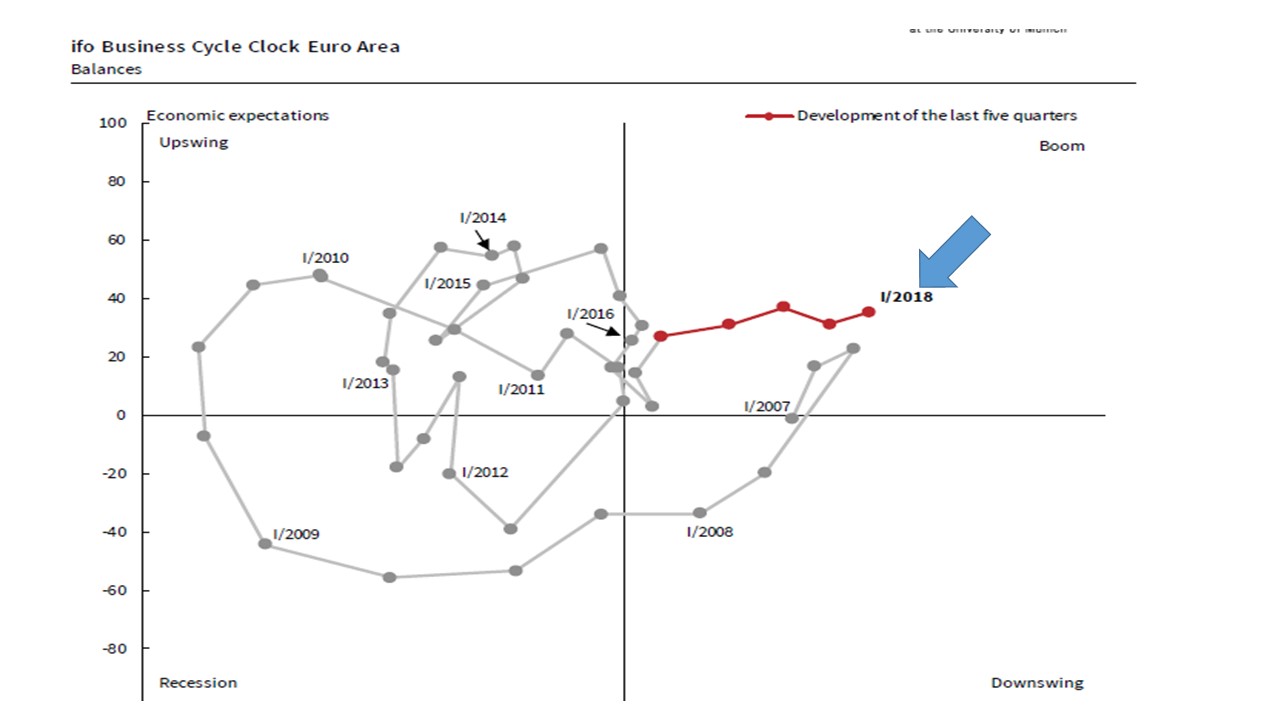
The recent one-day dramatic drop in the US stock markets, about 6%, has brought panic to investors – especially to every-day ones who manage their 401K accounts. It embarrassed President Trump, who speaks daily of the booming stock market and the “$8 trillion in new wealth” that it has created. He has ignored the drop, and his spokespersons revert to speaking about the strong economy.
So here is the basic truth. The global economy, for the first time in over a decade, since the onset of the global financial crisis of 2007-8, is expanding everywhere – United States, Europe, Asia. This synchronous expansion is of course amplifying economic growth and employment and job creation in each of the three key regions.
The graph above, from Ifo Munich, shows “actual” on the x-axis and “expectations” on the y-axis, for the EU region, which is about the same size as the US economy. It indicates that the EU economy is squarely in the upswing upper right quadrant, after a very long time being remote from it. The economy is growing, and people expect it to continue.
I hope small investors do not panic and bail out of their stocks, giving unwarranted profits to the sharks, and that they take into account this global synchronous acceleration, which I think will continue for a while. I hope also nobody will attribute this to what politicians, including Trump, are doing or have done. This is simply a cyclical pattern, as people and businesses expand their spending after years of belt tightening. It will end some day — but hopefully not too soon.
Stories and Feelings: Powerful Tools for Creative Thinking
By Shlomo Maital

My last blog was posted nearly two months ago, on March 30. Shortly after, I left for China, for teaching and lecturing. WordPress was not accessible in China. Then, on returning home, I somehow found it hard to restart the blog machine. I deeply regret this, because knowing I have blog readers keeps my eyes and ears open for ideas…. So, this is a ‘restart’, hopefully with no more long regrettable silences…
Nobel Laureate in Economics Robert Shiller (Yale) wrote a wonderful piece in the New York Times, Jan 22, 2016, “How stories drive the stock market”. Shiller is the author of a fine book, Finance and the Good Society, about how finance could be (but alas, sometimes is not) part of the solution, not part of the problem.
In his NYT piece, Shiller refers to psychologist Jerome Bruner, who showed how popular narratives (human interest stories) are “fundamental drivers of motivation”.
Shiller discusses the sharp decline in the U.S. stock market since early January, and describes the ‘stories’ that explain it. First, the slowdown in the Chinese economy – “gross exaggeration” of its importance for the U.S. Second story: “record for poor performance of the stock market in the first week of the year”… Third story: low oil prices. Fourth: tripling of the US stock market from 2009-14, and its “unwinding this year”. Many missed the big tripling, owing to pessimism and fear after the 2008 crash. This created heightened sensibility about a possible fall, after such a surprising precipitous rise.
Shiller cites a fine book by fellow Yale professor Ransay MacMullen, Feelings in History: Ancient and Modern, (2003), in which he writes, “History is feeling. It is feelings that make us do what we do. And feelings can in fact be read. But the reading of them requires writers and readers to join their minds in ways that have long been out of fashion among students of history”.
History, financial markets, consumer spending, virtually everything in our economy is driven by feelings. And feelings are evoked by stories about people, challenges, conflicts, crises and how they deal with them.
Conclusion? When you invest, try to analyze the prevailing ‘narrative’ or story that is driving human behavior, including the emotions underlying it. Is it valid? Is it evidence-based? Or is it superstition and empty guesswork? If the narrative is groundless, sooner or later (it might well be much later!), the story will change and reverse. Consider a contrarian (buy when everyone is selling) strategy.
What is the TRUE story? The real narrative? How do you know? What stories are people telling themselves?
In your startup business – what is YOUR underlying story, the story about how you create value for your clients? Is it powerful? What emotion does it evoke?
Feelings drive behavior. If you’re investing, a buyer, analyze which feelings are at work, and why, by identifying the dominant stories. If you’re an entrepreneur, a seller, shape your stories, by identifying clearly the motion you want to create with your innovation, then build everything you do around it, with a powerful narrative.
Hold Stocks? Time to Sell?
By Shlomo Maital

There are a thousand good reasons why I never give advice on the stock market, and why, if I did, you should ignore it. I myself hold no shares at all, in anything.
But here are some facts worth pondering. Thanks to New York Times journalist Gretchen Morgenson for her insights. Note that the NASDAQ exchange is reaching new record highs.
“This is the third longest bull market in 80 years, and we are starting to see some deterioration develop.” (a money manager Morgenson quotes).
“We are at an inflection point.” (co-chief investment officer).
“Many investors may be quick to sell their shares in a swoon, amplifying a downturn… [especially] investors who have bought shares on margin, using borrowed money, and those who have been pushed into the market in search of returns because of low interest rates.” (Note: The bull market is fueled almost exclusively by the latter two groups).
“Money borrowed to buy stocks tends to be nervous money.”
“The Federal Reserve will always be there to save the day”. This is a wrong assumption.
“Apple shares have lost 11.3 per cent despite the fact that earnings per share were up 45 per cent over last year”.
Morgenson counsels, “It’s probably not a bad idea to be watchful for [distinct market shifts]…”. I agree. Be careful!
When Is Good News Bad News? When It’s the Stock Market
By Shlomo Maital

Love that stock market! It goes up on bad news, down on good news. Can we understand why?
I belong to a panel of the German Ifo Institute, that quarterly surveys experts around the world to assess the global economic situation. The latest report? “world economic climate deteriorates, economic expectations less positive, inflation expectations remain low, US dollar expected to rise (it has), interest rates look set to remain stable (maybe not).”.
The U.S. stock market has risen sharply in the past year. But it recently declined. Why? Good news on the American economy – U.S. job creation and GDP growth are stronger than expected.
Run that by me again? How can good news be bad news for the stock market?
It’s simple. Wall St. is incurably addicted to cheap money and low interest rates, and plentiful credit. When the economy gets stronger, it increases the likelihood that Janet Yallen and the Fed will raise interest rates, ending the era of cheap money, and denying Wall St. from its daily/weekly fix of low-interest cash, used to speculate and earn billions. So the stock market drops, because good news for the economy is bad news for Wall St.
Does this show a sharp conflict of interest between the general population and the moneybags who run Wall St.?

 TIMnovate