
You are currently browsing the tag archive for the ‘tennis’ tag.
Life Lessons from Roger Federer
By Shlomo Maital
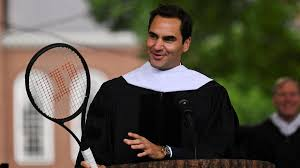
On June 9, 2024, a year ago, tennis great Roger Federer gave the commencement address at Dartmouth University, an Ivy League school. Rustin Dodd recently wrote about it in The New York Times. Federer’s address has become viral, like the late Steve Jobs’ commencement address in 2005 at Stanford.
“Now, I have a question for you,” Federer said, looking out across a sea of umbrellas at the commencement ceremony for Dartmouth College. “What percentage of points do you think I won in those [career] matches?” (He played a total of 1,526 singles matches during his career. He won 1,251 of those matches).
Federer won 80% of his 1,526 matches.
He paused.
“Only 54 percent,” he said.
It was one of those statistics that at first seemed incorrect. Federer was one of the most dominant athletic forces of this century. That guy lost nearly half of his points? He won 80% of his matches and only won 54% of his points? ?????
“When you lose every second point, on average, you learn not to dwell on every shot,” he told the crowd. “You teach yourself to think, ‘OK, I double-faulted. It’s only a point.’ When you’re playing a point, it has to be the most important thing in the world, and it is. But when it’s behind you, it’s behind you. This mindset is really crucial, because it frees you to fully commit to the next point and the next point after that, with intensity, clarity and focus.”
I think this is a powerful lesson. Bad things happen to everybody. At times, our brains insist on replaying them, There is value in learning from failure. But – only to a point.
Federer explains that past failures should be time-dated, like prescription drugs. Figure out what can be learned. And move on. Focus.
Federer appears to have practiced his own version of a psychotherapy technique known as focusing, developed by Eugene Gendlin. It is “a quality of engaged accepting attention”, a kind of focused mindfulness about where we are at this present moment, with past memories, troubles, worries, anxieties, etc., distilled out of our thoughts.
Think about the wonderful women’s final at Rolain Gros, the French tennis championship. American Coco Gauff vs. world #1 Sabalenka. Here is one account:
“Sabalenka overpowered the American in the early stages, breaking her serve to love amidst a run of nine unanswered points, while Gauff looked spooked, spraying misses to all parts of the court. But suddenly an inspired drop shot, a Sabalenka double-fault and a flashing forehand winner brought up a break point which Gauff converted. Sabalenka was now rattled and let a push from Gauff drift past her, thinking it was going long only for it to bounce four inches inside the baseline, as the second seed levelled the set at 4-4. It was a jaw-dropping mistake from a player who had gone 4-1 up against defending champion Iga Swiatek in her semi-final and let that lead slip.”
Sabalenka later explained that she indeed became unsettled. My hunch is she let those past mistakes dwell in her mind, and lost what Federer had in his career: Extreme focus. In contrast, Gauff appears to have mastered it, at least for this match.
The expression “water under the bridge” expresses the idea that what’s past, is past. Can we emulate Federer? We’re not pro tennis players – but we are all in the complex game of life, where focus is essential.
The world is in a huge mess. Let that not keep you from seeing the incredible beauty of Nature, and beauty of the human spirit, all around us, every minute.
Learning from Federer: Just Go For It
By Shlomo Maital

At the ripe old age of 36, Roger Federer has again won Wimbledon. Not only that – he won it without losing a single set — a feat last done decades ago by Bjorn Borg.
What’s his secret? He’s happy to reveal it. From his teens, he says he was careful to take care of his body. Fitness, eating right…. Pro tennis puts enormous strain on the body, and it has to be given tender loving care except when you’re on the court, when the start-stop violence rips ligaments, tendons, muscles and everything else.
This year, Federer was careful to ration the events in which he competed, pacing himself and his body. He may well regain his #1 position this year.
But Chris Clarey, who covers tennis for the New York Times, reveals another Federer secret. Federer plays it safe when it is wise to do so, regarding fitness, scheduling, and lifestyle. But on court? He’s a risk-taker.
“I wish we’d see more players and coaches taking chances at net [i.e., rushing to the net, and volleying], because good things happen at net, but you have to spend time up there to feel confident up there,” Federer said. At Wimbledon, Federer did ‘serve and volley’ (serve and then rush to the net) 16% of his service points – in other words one serve in six – and that doesn’t seem like much, but in fact it is more than double the 7% tournament average (i.e. servers rush the net one time out of every 14 serves].
A key point here is: You have to serve and volley a lot, to get good at it. And you might lose points initially as a result. But – take risks, stick to it – and you will win.
Now, I admit – Federer has totally out-of-this-world eye-hand coordination. And this is vital at the net. But his wisdom applies to us in life. Practice taking calculated risks, as General George S. Patton once said, especially when everyone else is playing it safe. Over time, you get better at it. Nothing ventured, nothing gained.
What We Learn from Ivo Karlovic’s 156 mph Serve!
By Shlomo Maital
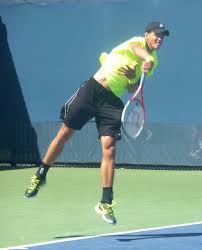
Ivo Karlovic, serving
If you like tennis, and perhaps even if you don’t, you can learn a lot from a Croatian pro tennis player named Ivo Karlovic.
Karlovic was a 15-year-old teenager living in Zagreb, Yugoslavia, during its bitter civil war. He practiced his tennis daily at the Salata tennis club, but could find no-one to play with him. (Tennis balls hurt when they hit you, but bullets hurt a lot more).
So he gathered 200 balls and practiced his serves, for hours, imitating his role model, the Croatian pro Goran Ivanisevic. He would serve 200 times, go to the opposite court, and serve again 200 times… to no-one.
Ivanisevic holds the world record for “aces” (serves that win a point outright, without being returned), at 10,183. Karlovic is getting close. He has 10,004 aces and will soon break the record.
Karlovic is 6 feet 11 inches tall, the tallest pro player on the tennis circuit. His serve comes from 11 feet high, screams across the net at speeds averaging 132 mph, and is clocked at times at 156 mph. So – try hitting that! His big serve enables him to win 96 per cent of his service games. And though he’s in his mid 30’s, he is getting better, rising in the pro ranks.
What can we learn from Ivo? Leverage your advantages (his height). Accept your constraints (practicing during civil war). Make the best of what you have. Practice hard. And excel.
Thanks to David Waldstein for his excellent profile of Karlovic in the New York Times.
Is there a Limit to Impatience?
By Shlomo Maital

Ah, the younger generation. The kids. We older people all know, the kids want it NOW! They are impatient and they have very short attention spans. The MTV generation loves super-fast images, that for us seniors are blurry and annoying.
But hey! This time they have gone too far. It’s time to draw a line in the sand.
Today’s New York Times (March 3) reports that John McEnroe and Patrick Rafter, tennis greats of the past, played an exhibition match in Australia. Rafter won. 4-3, 4-1.
Wait. Run that by me again? 4-3, 4-1? Don’t tennis matches go to six sets? Always have, for over a century? And at Wimbledon, they can go to 17 sets, or more?
Well, no. “It’s whatever the crowd wants, what TV wants,” Rafter said. “If this is what the fans want, this is what we should be playing.”
Four-set matches mean a match can be finished in an hour and 45 minutes, ideal for TV. And of course, TV dominates sport, because TV brings the money.
Actually, it’s a great idea. Let’s shorten everything. Let’s shorten prison sentences by half. Let’s cut the 12-month year to 10 months (at the same pay). Uh, let’s shorten life by a decade or so, those last 10 years are a bummer anyway, and the working youth (if there are any) can’t afford to support all those old guys.
The “me” generation is actually the “now” generation. Watch the Australian Fast4 format spread like wildfire to all aspects of life. With the future looking so bleak for so many, why not just live for the moment?
We seniors have an answer. Cultivate patience. Give value to the future because, somehow, the future does arrive, and when it does, it helps if we can work now to make it better, more desirable. “I want it now” is a losing formula. “I want a better future” is a whole lot more appealing. We should try it some day.
Wawrinka and Samuel Beckett: On Failure
By Shlomo Maital
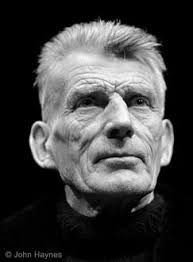

Samuel Beckett Stan Wawrinka
There is a very interesting connnection between Swiss tennis star Stan Wawrinka, #3 in the world and winner of the Australian Open, and author and playwright Samuel Beckett, Irish-French, author of Waiting for Godot.
Wawrinka just won the Australian Open Grand Slam, unexpectedly defeating Rafael Nadal, to whom he had repeatedly (at least 12 times in Grand Slam events) lost in the past. His win was decisive, in four sets, and Wawrinka at times (according to the New York Times) bullied Nadal, something that Nadal usually does himself with fierce ground strokes and serves.
Wawrinka himself found it hard to believe; and it is rare that a number 8 ranked player wins over the Big Four (Murray, Federer, Djokovic, Nadal).
What is his secret? According to Greg Bishop (Global New York Times, Jan. 28), last March Wawrinka had the following words, written by Beckett, tattooed on his left forearm: “Ever tried. Ever failed. No matter. Try again. Fail again. Fail better!” (from his play Westward Ho!, 1983).
Before Sunday’s Australian Open final, the Big Four players had won 34 of the 35 major titles. That means, if you’re not one of the big four, you have a one in 35 chance to win, or less than three per cent. But, if you try to fail better (that means, try your absolute best, facing huge odds, battle with everything you have, leave it all on the court, and walk off with dignity and pride even if you lose), one day you will win. Or, you will “fail to fail”, as Bishop puts it nicely, which means you will succeed.
Wawrinka offers us a big lesson in life. And it was fun to see how he himself could hardly believe he had won.

 TIMnovate