
You are currently browsing the tag archive for the ‘wealth’ tag.
Capitalism Failed Us – Here is Why
By Shlomo Maital

David Brooks’ latest NYT column has the fascinating title “Why More People in the World Are Feeling Hopeful (Except Us)” The ‘us’ is of course the US.
Brooks cites results from the Harvard-led Global Flourishing Study published in Nature – Mental, April 30, 2025. Flourishing measures the wellbeing of people, measured by happiness, health, meaning, character, relationships, and finance. In other words, how countries measure up according to material, social and spiritual wellbeing.
The US ranks 12th or 15th out of 22 leading nations. The nations who have done well and risen in ‘flourishing’ are those that find a true balance between those three elements: material, spiritual and social. The US has done poorly, especially among its young people, who report NOT doing well and NOT having much hope for the future.
Why? Brookins recounts: “Why have rich nations lagged behind in this way? [Prof.] VanderWeele [who led the study] theorizes that maybe it’s a question of priorities. “I tend to think you end up getting what you value most,” he told me. “When a society is oriented toward economic gain, you will be moderately successful, but not if it’s done at the expense of meaning and community.”
Brooks continues: “I’d add that we in the West have aggressively embraced values that when taken to excess are poisonous to our well-being. Over the past several decades, according to the World Values Survey, North America, Western Europe and the English-speaking nations have split off culturally from the rest of the world. Since the 1960s we have adopted values that are more secular, more individualistic and more oriented around self-expression than the values that prevail in the Eastern Orthodox European countries such as Serbia, the Confucian countries like South Korea and the mostly Catholic Latin countries like Mexico.”
We sold our souls to capitalism. It gave us vast wealth, billionaires. But it destroyed our souls. Thank economists in part for that. Mea culpa.
Postscript: My country, Israel, now a pariah among nations, vilified, owing to our disastrous leadership, ranks second or fourth (with or without the financial variable). In Israel, social bonds are very strong, especially during times of war and crisis. And so are spiritual values, not necessarily formal religious ones. Plus, our hi-tech has brought us material gain. But we did not sell our souls to the Capitalist Devil.
Wealth Creation: Creativity Beats Oil
By Shlomo Maital

A brilliant long-view analysis of capital markets is provided by the New York Times (Karl Russell).. The graph above shows “years publicly traded since 1926” on the X axis, and “total wealth creation since 1926” on the Y axis. The area of the circle shows the annualized stock return (capital gains and dividends). So this lovely graph shows us 3 pieces of information in two dimensions.
The 90-year old companies are mainly resource-based (oil, e.g. Exxon, Conoco, ), consumer products (Pepsi) and Pharma.
The newer companies are high-tech and digital.
Most striking: Apple has, in 2017, overtaken Exxon as a wealth creator, even though it is half Exxon’s age. This is because of Apple’s astonishing 30% + annual return. And Microsoft has created more wealth than, say, General Electric or IBM, with over 40% annual return. The tech stocks (the fat circles) have generated much higher annual returns than the traditional old-line companies (fairly slim circles).
What this means for individuals, companies, small businesses, and whole countries, is simple. The digital revolution is real. If you haven’t got on board yet, you’ve missed the boat. But maybe it’s not too late. If your country is still resource-based (oil nations, like Russia, Chad, Gulf States, Iran), you are out to lunch. Your leadership has be asleep.
What will this graph look like ten years hence? Fifty years hence? I’d give a lot to know.
2016: Two Key Inflection Points
By Shlomo Maital
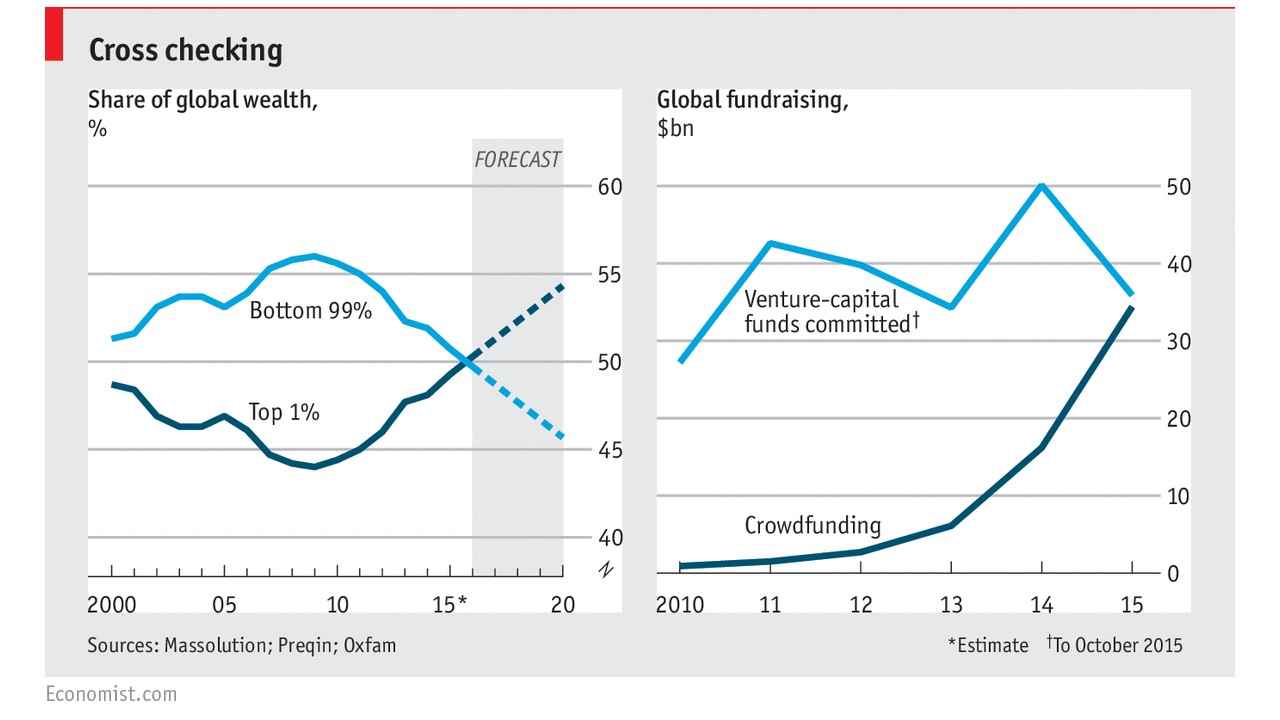
Two key inflection points (points implying major change) will occur in 2016, according to The Economist’s very interesting graphic. (see above).
First, for the first time, in a very long time, the world’s wealthiest one percent will hold a larger share of total world wealth than the bottom poorest 99 percent, and by 2020, that share of the wealthy will grow rapidly, to 55 per cent! This is a key ‘inflection point’ (point at which major changes occur), because I cannot imagine that it will bring anything but unrest and instability in the world, as the wealthy leverage their wealth to tilt political decisions and policies in their favor. Indeed the graph’s sub-text is precisely that – wealth perpetuates itself.
Second, also for the first time, crowdfunding, as a source of funds for startups and new ventures, will catch and exceed conventional venture capital. This is a major disruptive change for the large VC industry, and it is a change that has happened with incredible rapidity – from zero crowdfunding, essentially, in 2010, to $35 billion in 2015. It implies a different business model for startups, which now must tailor their messages more toward “crowds” than toward perspicacious (and sometimes, supercilious) venture investors. Along with the rise in crowd-funding comes the rise in angel investments, funded by wealthy people who are willing to take bigger risks with their money (and achieve higher returns) than with conventional financial assets.
These two changes have each occurred with great rapidity and will change our world, one perhaps for the better, one for the worse. They are worth watching closely.
What other inflection points have you noticed in 2016?
Piketty: The #1 Amazon Bestseller Nobody Really Reads
By Shlomo Maital
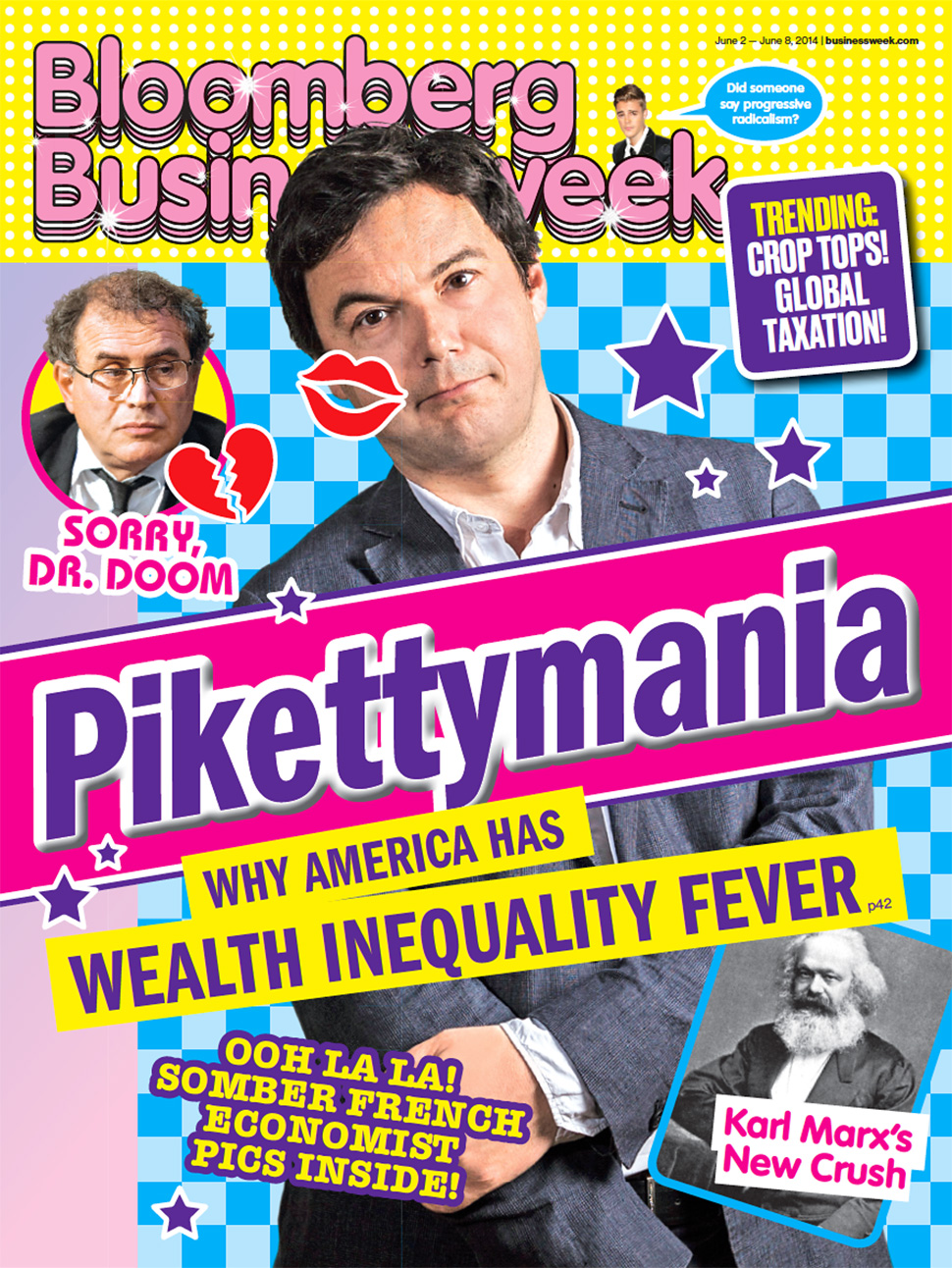
Can you believe a 696-page boring economics book, Capital in the 21st C., is the #1 Amazon best-seller, and one of Harvard University Press’s (Belknap) all-time best-sellers? And can you also believe very few people have actually ploughed through this tome? And that people constantly mispronounce the author’s name: He is French, and his name is toh-MA pi-ke-TTY, rhymes with bring me TEA!
Bloomberg Business Week has devoted an entire issue to Piketty, his arguments and his criticics, including Chris Giles (Financial Times) and two respected macro-economists, Per Krusell and Tony Smith. (See: http://www.businessweek.com/articles/2014-05-29/pikettys-capital-economists-inequality-ideas-are-all-the-rage ).
As a service to my readers, and to prevent a widespread narcolepsy epidemic (the malady that causes people to fall asleep in daytime), here is a very short summary of the ongoing debate.
What does Piketty claim? Simply – that “Beta” (the ratio of capital to income, for nations) initially fell, but in recent decades has risen. This is because the fraction of income saved (which is what leads to capital accumulation) exceeds the rate of growth of income or GDP.
So what? People who own capital can earn high return on their wealth, averaging 8 %; this doubles their wealth every 9 years. People who spend their income (most of us working people) fall into debt and fail to accumulate wealth.
So what? People with great wealth gain control of the democratic system, to perpetuate their wealth through tax breaks.
The growing concentration of wealth in fewer and fewer hands cannot be corrected by the democratic system (the vast majority, who have no wealth), because the super-rich use their wealth to manipulate the democratic system.
That last paragaph is NOT in Piketty. It comes from an article by John Cassidy, “Is America an Oligarchy?”, The New Yorker, April 18. He quotes two political scientists, Gilens and Page, who claim that: “Our analyses suggest that majorities of the American public actually have little influence over the policies our government adopts”:
Americans do enjoy many features central to democratic governance, such as regular elections, freedom of speech and association, and a widespread (if still contested) franchise. But …in the United States, our findings indicate, the majority does not rule—at least not in the causal sense of actually determining policy outcomes. When a majority of citizens disagrees with economic elites and/or with organized interests, they generally lose. Moreover … even when fairly large majorities of Americans favor policy change, they generally do not get it.
On many issues, say the authors, the rich exercise an effective veto. If they are against something, it is unlikely to happen.
So here is where things stand. Wealth grows faster than income. Wealth concentrates in fewer and fewer hands. Wealth corrupts democracy.
Marx predicted that the concentration of wealth would grow so intolerable, that the proletariat would revolt.
If the democratic system cannot repair itself – what other solution is there?

 TIMnovate