
I am reading a fine new book by Elizabeth Haas Edersheim, The Definite Drucker (McGraw Hill, 2008). She knew Drucker personally, and followed up on his idea (Drucker was always incredibly original and creative) to write a biography, not of his life but of his ideas. The book is about Drucker’s landmark ideas on how to build and run a business.
My own book, published last year, focused on why innovation is really about focused disciplinedmanagement, not about ideas. But of course, Drucker was there first. He began teaching that in 1954.
He was born in Austria on Nov. 19, 1909, worked as a journalist, and emigrated to the U.S. just before World War II. He became a US citizen in 1943, taught at Bennington, later was an NYU professor for 21 years, from 1950-71, and then went to Claremont College in California, where a business school has been built carrying his name.
Drucker was invited by General Motors’ senior management to become a consultant. He participated in board meetings, executive committee meetings, and in 1942 wrote a landmark book called the Future of the Industrial Man. All the solid ideas we teach today about good management are in it. And it was published 66 years ago. If you want to understand why GM has collapsed, read this book, and identify everything they have done and not done, against Drucker’s wisdom. In 1946 he published The Concept of the Corporation, a management handbook still relevant today.
Drucker, in his lifetime, wrote 39 books. And he never ever repeated himself. He died on Nov. 11, 2005, still in harness, still working and writing, one week short of age 96.
Drucker began teaching innovation at NYU in the 1950’s, decades before management professors realized how crucially important it was. He taught how vital it is to have a disciplined innovation process and to manage implementation of new ideas with systematic operational excellence. He consulted companies about their strategies, using the term ‘strategy’ when business schools told him strategy was about war, not about business. (Michael Porter’s 1980 book Competitive Strategy simply repeats what Drucker had been saying and writing for decades).
Drucker said there are seven places to find innovations. They are: 1. The unexpected 2. Industry-market gaps; 3. Process vulnerabilities; 4. Incongruities; 5. Demographic change; 6. Changes in perception; 7. New knowledge.
Can you find innovative ideas in one of these areas? Read Edersheim, or better yet read Drucker. I recommend: Managing in Turbulent Times (1980) and Innovation and Entrepreneurship (1986).
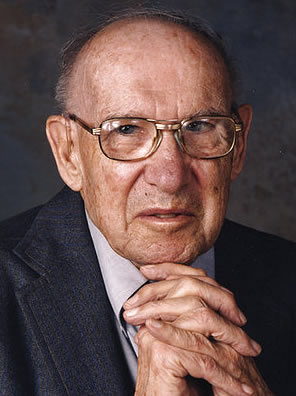 Peter Drucker



1 comment
Comments feed for this article
November 23, 2010 at 2:59 pm
Pat
It’s unknown what Drucker would have said about the current trend of using human droidism of China and India to replace American jobs, but no doubt, he might have seen a silver lining somewhere.
The truth is that there will always be market gaps, and innovative crevices that the world has not yet used to make profits. That doesn’t necessarily imply they should be used.
Commerical ethics relies upon ethical management and ethical consultants to find ideal solutions for problems. Callous disregard for humans as humans does not fit into the ethical scheme as one of the them.
Human rights violations can only succeed if humans are willing to ignore the fact that humans are humans, and thus, deny them the right to be human. Selective preference of deciding what person, race, class, or age will be permitted to be viewed as human, and which are not, is also a flaw of humanity that ought not to be encouraged, but instead, prevented – even if global laws are required to implement the philosophy of protection.
Recognizing that China and India offer low wage jobs (as a substitue for American jobs) is little more than recognizing that those nations have so many people that human automation has become an option, perhaps a necessity for them. Whether American companies are helping them or not is a matter of perspective that deals squarely with the topic of ethics in the obligation not to treat humans as automated machinery, despite the popular term of human capital as the economist’s favorite phrase to identify them.
When human capital do not have human rights, they are little more than droids. For maximum efficiency, nothing replaces robots, but turning humans into human robots is very much an ethical issue of major importance – in any language, and in any nation. Overlooking human rights for profits has not been the accepted paradigm for commerce since the days of slavery. But that hasn’t stopped American companies from adopting and using the model of slavery/droidism in modern commerce.
There has always been the distinction of honorable profits, and those that are dishonorable. Achievement does not necessarily bespeak success when it is human rights that is the focus of the debate.