
Here is a headline, from Feb. 27:

Personally, I hate headlines about a 150-year-old Colorado newspaper going bust and closing, throwing journalists and other workers into unemployment.
So, I am appoint myself Chief Copy Editor. Here is my new headline.
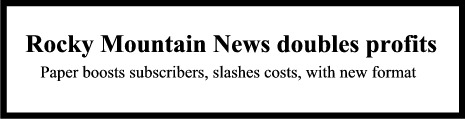
Now, how can I change reality to make the headline true?
Quite simple.
In the sharp downturn, which saw the U.S. economy contract by 6.2 per cent in the last quarter of 2009, advertising revenues have plummeted. Newspapers and magazines everywhere are losing fortunes, and some are closing their doors. To keep Rocky Mountain News alive, we must slash its costs by half.
How in the world can that be done?
By ‘printing’ a paperless paper. Deliver the paper every morning, at 4 a.m., to each subscriber, electronically, downloaded to an electronic book (say, Amazon’s Kindle 2) provided free of charge by the newspaper, in return for a year’s subscription. Every newspaper in the world that is printed on paper can instantly cut its costs in half, and save the world’s forests, by becoming paperless and digital. Even when Kindle 2 is priced at $399, Rocky Mountain News could still make money if it gave them away in return for a multi-year subscription. A supplementary business could be selling downloaded books, music and movies. In time this business could grow far bigger than the newspaper.
Why, then, don’t papers do it?
They will. The global crisis may not always be the direct cause of paradigm shifts in industry, but it is always a force multiplier that accelerates the speed such shifts take place. The necessity to slash costs radically, as revenues dive, will force newspapers to abandon paper. And in every single industry, there will be equally radical shifts in business designs.
What is the paradigm shift for your industry? And what actions are you taking to prepare for, and implement, it?

 TIMnovate
1 comment
Comments feed for this article
March 1, 2009 at 3:31 pm
Mike
Just passing by.Btw, your website have great content!
_________________________________
Making Money $150 An Hour