
Norman Borlaug passed away on Sept. 12, at the age of 95. Borlaug was the innovator, an agronomist, who created the Green Revolution. He developed strains of wheat that had short stalks and were disease resistant. When the wheat puts its energy into its kernel, not into the straw, yield improvements of 100% (double) resulted.
As a boy I grew up in Milestone, Saskatchewan, amidst fields of waving wheat higher than my head. Today that same wheat no longer waves. It is only a foot or so high. A simple yet powerful idea, that according to the Nobel Institute has saved hundreds of millions from hunger in India and Pakistan, primarily. Mexico became a wheat exporter in 1963 as a direct result. Borlaug was awarded the Nobel Peace Prize for his efforts in 1970.
Borlaug was the great grandchild of Norwegian immigrants to America. He worked as a boy and teenager on the family farm in Iowa, and came to know farming at the ground level. Borlaug’s grandfather encouraged him to leave the farm and study at college. “If you want to fill your belly,” he told Norman, “go fill your head!” A Depression-era program that enabled low-income students to afford college made it possible for Borlaug to enroll at University of Minnesota. He failed the entrance exams, but persisted, and eventually ended up in the College of Agriculture.
Here is how Wikipedia describes just one of his innovations: “dwarfing”.
Dwarfing is an important agronomic quality for wheat; dwarf plants produce thick stems and do not lodge. The cultivars Borlaug worked with had tall, thin stalks. Taller wheat grasses better compete for sunlight, but tend to collapse under the weight of the extra grain—a trait called lodging—and from the rapid growth spurts induced by nitrogen fertilizer Borlaug used in the poor soil. To prevent this, he bred wheat to favor shorter, stronger stalks that could better support larger seed heads.
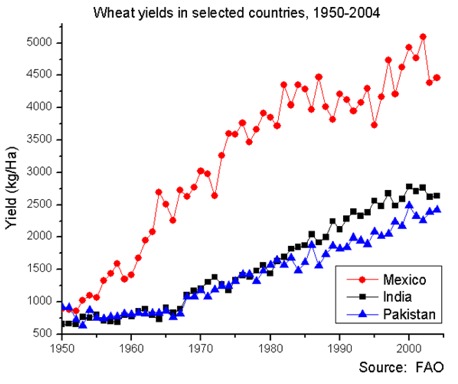
The graph below shows the dramatic rise in grain yields Borlaug achieved. He developed the Green Revolution wheat varieties in remote Mexico, finding suitable strains of wild wheat, in difficult conditions, with low budgets and oppositions from those who directed his work. Few innovators can claim, as Borlaug could, that they saved hundreds of millions from starvation.

 TIMnovate
Leave a comment
Comments feed for this article