
Global Crisis Blog: Dollar Weather Forecast: Calm Before the Storm — The Cassandra Syndrome
By Shlomo Maital
In Greek mythology, Cassandra, the daughter of King Priam was cursed — Cassandra was left with the knowledge of future events, but could neither alter these events nor convince others of the validity of her predictions.
I sympathize with Cassandra. While I believe a sharp deep fall in the value of the dollar is imminent and inevitable, the markets disagree. US Q4 GDP growth will soon be reported, and it will be very high. The Economist reports, in its latest issue:
America’s economy began growing in the middle of 2009 and seems to have accelerated sharply in the final months of the year. Initial GDP estimates for the fourth quarter are due on January 29th, and many analysts expect annualised GDP growth to have shot up to 5.5% or more.
You will not be surprised that Dr. Cassandra has an explanation. Much of this astonishing growth in GDP represents restoration of inventories, depleted during the previous two years. Actual final demand (GDP production that was purchased by someone) grew far more slowly. When inventories are replenished, GDP growth will adapt to final demand, and will fall sharply.
Why has the dollar not fallen, and instead risen? Writing in The New York Times (“Off the Charts”, IHT Jan. 24), Floyd Norris explains it clearly.
* China bought only $62 b. of US Treasury bonds in the first 11 months of 2009. Since some of China’s bonds matured during 2009, China’s total holdings actually fell, to $790 b.
* Since China’s Treasury bond purchases are its main avenue for supporting the dollar (vis a vis the renminbi), why did the renminbi not appreciate, instead staying constant at about 6.8 per dollar? Simple. China’s export surplus to the US declined sharply, leaving far fewer excess dollars splashing around in forex markets. And —
* America’s budget deficit soaring, owing to “stimulus” spending, and borrowing also soaring (in 2009 public holdings of US Treasury bonds rose by a staggering 23 per cent, or $1.4 trillion), to $7.8 trillion (!). But according to Norris, China bought just 4.6 per cent of the bonds the US Treasury sold in 2009, compared to nearly half of them in 2006. So who is funding America’s debt?
* The answer: Americans. With enormous amounts of money sloshing around in capital markets, and with investors traumatized by losses and risk, US Treasury bonds are newly popular. Moreover, large capital gains have accrued to savvy bond investors, as interest rates fell and bond prices rose. Norris reports that Americans bought 61 per cent of new Treasury bonds in 2009, while foreigners (China, Japan, Hong Kong, UK, etc.) bought only 39 per cent.
(Please see the graphs below).
======================================
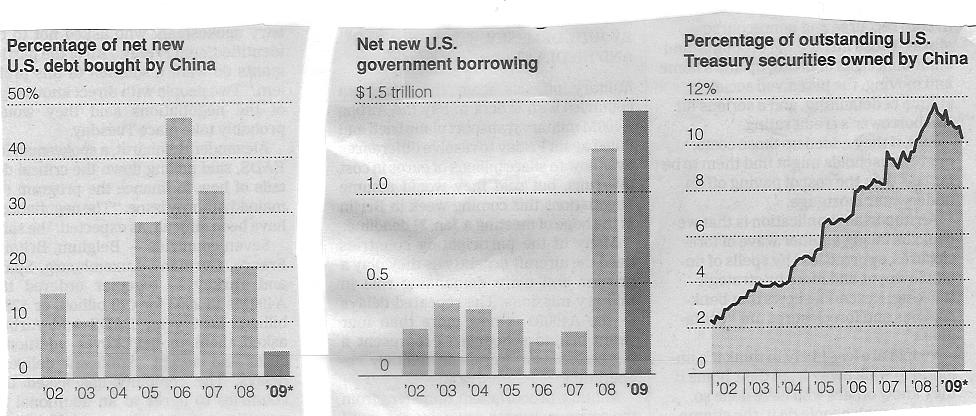
Caption: China bought far less US debt in 2009 (graph1) ; US govt. new borrowing soared (graph 2) in 2009, but more US investors bought Treasuries, hence China’s Treasury holdings as a percentage of total US Treasury Securities declined to about 10 per cent. Source: NYT
=========================
Conclusion: US institutional investors have temporarily ‘parked’ their money in low-yield safe Treasury Bonds. This took up the slack from China and kept the dollar strong.
What happens when these investors return to looking for more substantial rates of return, and dump Treasury bonds? Will Ben Bernanke raise interest rates to make Treasuries attractive? If so, bond prices will fall, causing capital losses. Moreover, higher interest rates may stifle the recovery.
America is still painted into its corner, and the dollar is still, in Cassandra’s opinion, very very shaky. Only a substantial increase in personal saving will generate stable demand for Treasury bonds. But if that happens, GDP growth will suffer. I don’t know what the solution is, nor does Fed Chair Ben Bernanke.
The strength in the dollar is the calm before the storm.

 TIMnovate
2 comments
Comments feed for this article
January 24, 2010 at 8:32 pm
Brian
Is there any way to tell *which* Americans are responsible for that extra $1.4 trillion investment in T-bonds?
If it is the banks (and I’d bet it is), then wouldn’t a pullback in the “stimulus” or Fed policy cause a reduction of these holdings, or at least a drawdown in a manner similar to China’s behavior?
A change in policy would probably only occur with a pickup in economic activity; would this lead to a greater trade deficit with China and hence a recovery in China’s net buying of T-bonds?
It’s so very hard for this American to figure out how his beloved country is going to escape this mess. Looks to me like you’re right that the dollar will slide, and this might happen concurrently with a rise in borrowing costs.
January 25, 2010 at 7:08 pm
timnovate
Brian,
Here is the core dilemma for America:
America needs to spend more (to create jobs).
Equally crucially: America needs to save more (to pay off old debts and avoid creating new ones).
How in the world do you both save more and spend more, at the same time? When both are urgent and vital?
Beats me. Where are all those economics Nobel Laureates?