
Innovation Blog
Nature as the Great(est) Innovator
By Shlomo Maital
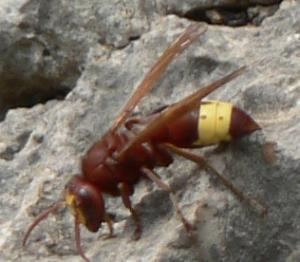
HORNET and its “photovoltaic” cell
The stories I recount below confirm, I believe, that the greatest innovator remains…Nature. Nature, and the enormous power of natural selection, have the patience to try experiments and select only those that work. And some of the results are quite incredible. The free-market paradigm of economics is only a weak imitation of Nature’s innate innovation process.
* Gulf oil spill: Enormous quantities of methane spilled into the Gulf of Mexico, after the BP Deepwater oil spill, because methane is a major component of natural gas. Now, scientists find, most of it has disappeared. Where did it go?
Apparently, there are microbes that feast on methane. They are mainly dormant in the oceans, because they have no food supply. But suddenly, when the Good Fairy arrives with millions of tons of methane, they feast, reproduce, feast…and so on. A Christian Science Monitor report reveals that “bacteria took fewer than four months to finish off the methane, and it appears that at no time did oxygen levels in the area the team studied fall to levels dangerous to marine organisms there.” Hey – chalk one up for Nature.
* Carmel Forest fire: A disastrous fire destroyed many acres of lovely forest in Israel’s Carmel Forest. A walk through the area reveals that after winter rains, green shoots are everywhere, as the forest struggles to renew itself. It will take years – but it will happen. A type of orange mold has been discovered, which feasts on charcoal, created by the forest fire. Another one for Nature.
* A team of Texas A&M scientists has studied leaf-eating farmer ants, which chew up leaves, make a paste, use it to grow fungus, then eat the fungus. They found that when the ants whose job it is to cut leaves find their mandibles have grown dull, too dull to effectively cut leaves, they simply switch jobs, and become carrier ants – ants whose job it is to transport the leaves cut by younger ‘sharper’ ants. Remember how Prussian diplomat Bismarck, who invented the Old Age pension system, picked the age of retirement as 65? It was an age so old, then, he felt very few would live to collect their pensions. Today, nearly everyone does. So in many nations pension funds are actuarially bankrupt. Solution? Follow the ant, as the Bible says. Abolish retirement. Simply reorganize to shift careers – as the ants do. Ever heard of an ant on pension? Yet another for Nature.
* Hornet’s nest: A study described in ScienceDaily, done by a team of Tel Aviv U. interdisciplinary researchers, has discovered that the hornet’s striped body captures and transforms solar energy, much as plants do in photosynthesis. In the course of their research, the Tel Aviv University team also found that the yellow and brown stripes on the hornet abdomen enable a photo-voltaic effect: the brown and yellow stripes on the hornet abdomen can absorb solar radiation, and the yellow pigment transforms that into electric power. “The team determined that the brown shell of the hornet was made from grooves that split light into diverging beams. The yellow stripe on the abdomen is made from pinhole depressions, and contains a pigment called xanthopterin. Together, the light diverging grooves, pinhole depressions and xanthopterin change light into electrical energy. The shell traps the light and the pigment does the conversion. The researchers also found a number of energy processes unique to the insect. Like air conditioners and refrigerators, the hornet has a well-developed heat pump system in its body which keeps it cooler than the outside temperature while it forages in the sun.” The team is now trying to mimic the hornet’s energy innovation with ‘bio-engineering’.

 TIMnovate
1 comment
Comments feed for this article
January 9, 2011 at 1:12 pm
Vijay Rao
Beautiful snippets that put the best schemes of man to shame 🙂 Thanks for putting them all together at one place to give the right perspective Professor !!