
Innovation Blog
The REAL IQ: How Creativity and Intelligence Combine
By Shlomo Maital
“Teach boys and girls nothing but facts! Facts alone are what is wanted in life.”
– Thomas Gradgrind & Mr. McChoakumchild, “Hard Times”, Charles Dickens
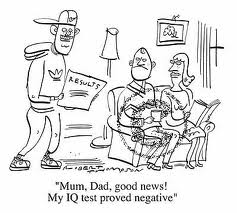
Mom, Dad, great news, my IQ test came back negative!
Psychologist Robert Sternberg, a pioneer in cognitive psychology and now an educational innovator, has used his remarkable life story to blaze new trails in the concept of IQ. After he suffered from text anxiety and failed an intelligence test. Sternberg realized that this score did not predict his intelligence. Just one year later, in the seventh grade, Sternberg developed his first intelligence test: the Sternberg Test of Mental Ability, or STOMA. Because he was a perpetual ‘outsider’, Sternberg never feared challenging the prevailing paradigms in psychology, such as conventional IQ.
Writing in School Psychology International,* Sternberg outlines his own concept of intelligence, called WICS, an acronym for “Wisdom”, “Intelligence”, “Creativity” and “Synthesis”. “The basic idea is that citizens of the world need creativity to form a vision of where they want to go and cope with changes in the environment, analytical intelligence to ascertain whether their creative ideas are good ones, practical intelligence to implement their ideas and to persuade others, and wisdom to ensure the ideas will help achieve ethically-based common good. Then, ‘synthesis’ is needed to combine the W, I and C.
The WICS theory is remarkably similar to what innovators need, in my view, to achieve marketplace success: Creativity, for vision, Intelligence for analysis and implementation, Wisdom, to create value for everyone not just the inventor, and then Synthesis, to combine the three seamlessly. I would prefer to call the ‘innovation’ version of the model, CIWS.
Sternberg has created a Rainbow Project to measure WICS and complement the standard terrifying SAT tests for college entrance. At Tufts U., where he served as Arts & Sciences Dean, he developed Kaleidoscope, which asked applicants to write stories on such creative topics as “The End of MTV”. Kaleidoscope scores did not correlate at all with SAT’s.
Sternberg’s WICS teaching method encourages students to: a) create, b) invent, c) discover, d) imagine if… e) suppose that, and f) predict. Teaching for creativity is very hard for teachers used to teaching ‘facts’.
These six stages match closely stages the inventors follow, in particular, d) e) and f), imagine, suppose, predict. They also match what parents and teachers often call ‘dreaming’, for children and students whose vision wanders far away from blackboard ‘facts’.
* R.J. Sternberg. “WICS: A new model for school psychology”. School Psych. International, Dec. 2010.

 TIMnovate
2 comments
Comments feed for this article
February 13, 2012 at 4:39 pm
Iqs Blackboard | TagHall
[…] . Centro Universitario IQS | iqs.edu . National IQs, immigration « Occidentalist . The REAL IQ: How Creativity and Intelligence Combine « TIMnovate . June | 2011 | Chaos_Manager […]
September 30, 2013 at 3:05 am
Aayden
I understand the references, outline and content of this post, but where is the actual material in basis of the title, “How Creativity and Intelligence Combine” ? This is a sincere inquiry as it is something I have a lot of difficulty with. I’ve shown to rank highly in both categories as well as EQ, but due to forceful influences directly addressing and demanding I compartmentalize them from an early childhood, I don’t know how to combine them naturally as I ever presently feel is natural.