
Global Crisis/Innovation Blog
Poor Economics
By Shlomo Maital
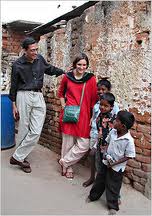
Banerjee, Duflo and friends
Yes, lately, economists have indeed been doing very poor economics. My discipline has few answers and at times seems not even to know what is the core question. For instance, why are young people all over the world so upset with bankers? But that is not what Poor Economics, a wonderful new book by MIT Economics Professors Abhijit Banerjee and Esther Duflo, is about. Their book has just been selected by the Financial Times as Business Book of the Year. Their topic is the Economics of the Poor — How best to help the poor, in poor countries. They seek to bridge the gap between those who claim that aid to the poor is wasted, fruitless and encourages addictive dependency, and those who claim that aid to the poor works wonders. The truth, they show, lies in between. Best of all, they show the world how to do economic research that is powerful and relevant – not by scribbling imaginary models portraying life on Mars, but by doing field research that studies life on Earth.
It is no accident that both Duflo and Banerjee are not U.S.-born. As immigrants to the U.S., they bring new perspectives to their discipline. Like Kahneman and Tversky before them, they have imported the language and logic of other disciplines to make economics useful and relevant. In this case, they have applied the randomized experimental approach of scientific medical research, to field test poverty programs, much in the same way that scientists run clinical trials of new drugs. Rather than do what economists normally do – let’s assume that… — they go directly to the ‘coal face’, where the poor live and work, and run experiments to find out where the truth lies. * They examine why the poor under-consume insurance, and test, for instance, how you can get poor farmers to buy rainfall insurance. * They study whether local elections in China, where they are held, produce more accountable responsive leaders. * They examine creation of social capital through micro finance (their work reveals deep flaws in micro finance). * They examine why 9 million children die yearly from preventable diseases that could be forestalled at low cost (e.g. malaria, and mosquito nets).
Esther Duflo recounts that she was six years old, when she read a comic book about Mother Theresa and the poor of Calcutta, noting they had only 10 sq. ft of space in which to live. She imagined them living in little squares, like chess pieces on a chessboard. Later, at the age of 24 and now an MIT student, she visited Calcutta, to study the misery and found large open spaces (which, of course, they could not afford). Her co-author Abhijit Banerjee, when he was 6, grew up in Calcutta and played with poor children who lived behind his house. They always beat him at sports and at marbles, and made him deeply jealous. Together, they built a laboratory at MIT that does randomized field research – and proves what I learned 40 years too late, that the place to do economic research is not in a cozy office but where the people whom economists try to understand actually live and work. I wonder if economists would still be teaching ‘efficient markets’ theory (the price of an asset embodies all the existing relevant information available), if they actually spent time trading and observing in capital markets.
The poor of the world, Banerjee and Duflo write, are incredibly resilient, able to survive conditions that would quickly vanquish the rest of us. This world experience does not always create behavior that matches standard economic theory or pure rationality. But, this is obvious. Everywhere economists do field research, and test their rationality assumptions, they find those assumptions fail. Belatedly, 235 years after Smith’s Wealth of Nations, economic research is getting a stiff dose of reality. It makes this economist wish he were 40 years younger.


Leave a comment
Comments feed for this article