
You are currently browsing the category archive for the ‘Global Crisis Blog’ category.
Innovation/Global Risk
Are Creative People Dishonest?
By Shlomo Maital
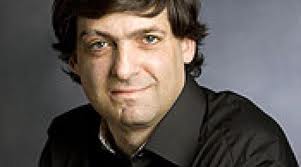
Dan Ariely
The latest (Dec. 7) issue of Harvard Business School’s publication Working Knowledge has a piece by editor Carmen Nobel that I found disturbing. According to Nobel:
In a series of studies, Francesca Gino and Dan Ariely found that inherently creative people tend to cheat more than noncreative people.
● Inherently creative people tend to cheat more than noncreative types.
● Furthermore, inducing creative behavior tends to induce unethical behavior.
Gino and Ariely surveyed 99 employees across 17 departments at an American advertising agency, where some jobs—copywriting, for example—required much more creativity than others. In the anonymous survey, on a seven-point scale, the respondents indicated how likely they were to engage in various ethically questionable work behaviors such as “take home office supplies from work” and “inflate your business expense report.” Respondents also evaluated scenarios describing a hypothetical person who has the opportunity to behave dishonestly, and then indicated, again on a seven-point scale, how likely they would be to behave unethically in each instance. Finally, the respondents reported how much creativity was required in their respective jobs, with three managers in the executive office rating the creativity level required in each department, as well. Overall, the researchers learned, the higher the creativity required for the job, the higher the level of self-reported dishonesty.
Gino and Ariely note: “As a manager, if you’re highlighting the importance of being creative and innovative, it’s important to make sure that you’re stressing the presence of ethics, too,” Gino says. “Dan and I are of the hope that managers will start thinking about how to structure the creative process in such a way that they can keep ethics in check, triggering the good behavior without triggering the bad behavior.”
I teach my management students that innovation is breaking the rules. I don’t mean, of course, breaking the law. But, are those able and willing to break the ‘rules’ or ‘conventions’ also more able and willing to break the law? This seems to be the simplest explanation of the phenomenon discovered by Gino and Ariely.
Perhaps we need to redouble our efforts to to find effective ways to teach ethics in management courses, along with innovation. I myself intend to do this.
Maybe there is some comfort in the fact that creative people are very honest about self-reported dishonesty. Maybe creative people, who break rules all the time, are simply more honest about being dishonest than less creative people.
Innovation/Global Risk
Titanic’s Lesson for the World
By Shlomo Maital
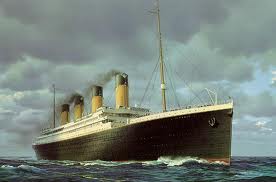
The RMS Titanic sank almost a century ago. Since then she has served as a sad lesson for innovators, on the consequences of arrogance. Built to carry 3,500 people, Titanic had 2,223 people on board during its maiden voyage, and sank at 2:20 a.m., on April 14, 1912, with 1,517 people perishing in the frigid Atlantic waters. The reason: There were lifeboats only for 1,178 people, because the Titanic was “unsinkable”.
But I believe there is another key lesson the Titanic conveys: Strategic agility. Nations need to constantly evaluate where their competitive advantage lies, and adapt and reinvent it when technology and markets change and shift.
Titanic was built in the shipyards of Harland and Wolff for the Cunard Lines, in Belfast, Ireland. It was the only shipyard in the world capable of building the advanced vessel, which weighed 45,000 tons (a modern aircraft carrier weighs over twice that, but recall that it has a large steel deck for launching and landing planes). It was built by a highly skilled workforce of 15,000 workers, all men (no women were allowed to do the hard physical work). But women also had good jobs created by Titanic – they wove the textiles needed for the 45,000 napkins and 12,000 sheets, and thousands of tablecloths used on Titanic. One of the key skills in building Titanic was riveting. It took a riveter five years to learn the craft, driving white-hot rivets into steel plates, so that they could contract when they cooled and tighten the joints. Many millions of such rivets went into the Titanic. Riveters were paid according to the number of rivets they drove.
At the time, Ireland had a global competitive advantage in shipbuilding. As the world changed, and as shipbuilding evolved and moved to places like Korea, Ireland lost jobs, income and exports. In part, Ireland was preoccupied with its struggle for independence from Britain (in the end, Belfast remained in what became Northern Ireland, a part of the United Kingdom). It took Ireland some 75 years, until a few clever officials from the Irish Industrial Development Agency figured out how to attract American companies to Ireland, to generate quality jobs like those the Titanic once supplied. During those 75 years, many Irish emigrated abroad, because they found no work at home. Ireland itself became not unlike the Titanic – it sank, becoming one of the poorest countries in Europe.
Ireland again finds itself in trouble. After a hasty government bailout of its troubled banks, the Irish people drown in debt, and the new Irish budget announced today (actually, the budget is so tough, the government will reveal it over a two-day period, to soften the blow) is severely austere. The Prime Minister’s tough address to the nation backfired, as the Irish people seek solutions, not statements of the problem. Unlike the Titanic, Ireland seems to be sinking ever so slowly – but surely. The people of Ireland deserve better.
Today nations are sinking, in Europe and elsewhere, like Titanic. They are unable to adapt to changing geopolitical realities. As we mark a century since Titanic’s launch and tragic sinking, let us recall what Titanic teaches.
Innovation/Global Risk
How to Win a Nobel Prize II
By Shlomo Maital

Prof. Avram Hershko, Technion
In my Oct. 7 blog, I told the story of how Prof. Dan Shechtman won the Nobel Prize, for his discovery of quasi-crystalline matter. The formula he used was: 1. Read Jules Verne and dream, and 2. Believe in yourself, and maintain your integrity, if you see something strange, insist that you saw it, despite the nay-sayers, famous ones, who tell you, that you didn’t, couldn’t, wouldn’t.
I recently had the privilege to interview another Nobel Prize winner from my university, Technion-Israel Institute of Technology, Prof. Avram Hershko, who won the Nobel Chemistry Prize in 2004 for his discovery of ubiquitin, which holds the key to understanding why cells die. Based on his discovery, a new drug, Velcade, was developed, which has saved the lives of many thousands of cancer sufferers (including a close American friend of Prof. Hershko).
Here is Prof. Hershko’s formula for winning a Nobel, which is somewhat different from Dan Shechtman’s.
1. For your research, pick a problem you believe is important, but that is NOT in the mainstream of scientific research. On his post-doc in the U.S., Hershko found that he was joining a 25-person team, who were mostly focusing on cell division (i.e. cell growth). He chose to study why cells die, because he thought it was important and because no-body else was interested in studying it. This is the scientific equivalent of ‘blue oceans’ – seek areas that are not crowded, because research topics already crowded are competitive and likely to be dominated by those with massive resources.
2. Be patient and persistent. If you choose a hard problem, Hershko notes, you will need to be very patient in understanding the phenomenon under study. Hershko is a true bench scientist. When I interviewed him, he was gracious, but in the midst of an experiment… and he confessed to deeply loving bench work, which the Nobel Prize did not in any way interrupt (except for 6 months of travel on behalf of Technion).
3. Be lucky. Scientific breakthroughs come often through lucky breaks. But, Hershko cautioned, you need to be prepared for the luck. When you get unexpected results, often they are tossed out. Don’t! Recognize your luck, and look into why those results occurred, against your expectations. As Pasteur affirmed, “chance favors the prepared mind.” Prepare your mind. And keep it open. Do not allow ‘perceptual blindness’ to prevent you from seeing what really exists. Shechtman saw something that could not possibly be there. Hershko saw results that were highly unexpected. Both had minds open enough to see what was there.
4. Stay small. Nobel Prizes often (though not always) bring the possibility of a flood of new research money. Prof. Hershko has purposely, and doggedly, kept his lab research small and intimate, so that he can maintain control and his own active leadership. Size and scale often are bitter enemies of innovation. By keeping his lab small, Hershko maintains its agility, flexibility and manageability. He also has maintained his own active bench research, rather than become a ‘manager’ whose name appears on scientific papers but who is not really involved.
Global Risk/Innovation Blog
Systems Thinking: A Short Eulogy
By Shlomo Maital
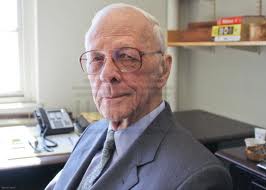
Prof. Jay Forrester, inventor of systems dynamics
You can argue that the world got into trouble for one key core reason: Lack of systems thinking. Risk managers failed to consider systemic risk. Policymakers failed to take into account systemic interaction. European officials failed to realize the euro’s rot can destroy the global economy.
The fact is, we know a lot about systems thinking. We just don’t use what we know. Here is a short history, inspired by an inspired BBC documentary, “Machines of Loving Grace”, about how humanity has been ‘colonized’ by machines.
● A British botanist, Arthur Tansley, invented the term ecosystem in 1935. He was inspired by Sigmund Freud, pioneer of psychoanalysis, and actually visited Freud, seeing an analogy between the interactive system of the brain and the interactive global ecosystem.
● Systems thinking then moved in two directions. Norbert Wiener developed ‘cybernetics’, the study of self-regulating systems. Cybernetics was embraced by the U.S.S.R. as well. And MIT Professor Jay Forrester developed the SAGE early warning system, whose early computers based on vacuum tubes had nearly zero downtime, because they were self-diagnosing (each of 80,000 vacuum tubes could signal its imminent failure, and its location). ● Forrester developed system dynamics as a discipline at MIT, when he moved from Electrical Engineering to MIT’s business school, and showed how businesses, economies, even the world, are all systems of feedback loops that can be modeled with computers.
● His pupils Denis and Danielle Meadows wrote Limits of Growth, for the Club of Rome, showing how global persistent economic growth is unfeasible (because eventually, we overpopulate ourselves, or pollute ourselves, to death, or run out of key resources and starve..there is no happy scenario with permanent growth). All we can strive for is stability, which all ecosystems seek.
● Buckminster Fuller’s 1968 book Operating Manual for Spaceship Earth makes the key point that we are all ‘astronauts’ on a spaceship (Earth) and we “must operate exclusively on our vast daily energy income from the powers of wind, tide, water, and the direct Sun radiation energy”.
If you believe the world is one big ecosystem, then you should believe a) we need to better understand all the complex interactions and feedbacks in it, b) we have to stop placing human beings at the center of the system, because we are not, and c) we must stop striving for perpetual growth, because by definition exponential growth can never be sustained in any stable system, but rather seek balance, harmony and collaboration among the parts of the global system. And this is precisely what we are NOT doing today, as segments of the world try to face up to (or escape from) the current global collapse.
Global Risk/Innovation Blog
Day Dreams without Day Doing = Unhappiness
By Shlomo Maital
A report in Science last year shows the following:
People spend 46.9 percent of their waking hours thinking about something other than what they’re doing, and this mind-wandering typically makes them unhappy. So says a study that used an iPhone web app to gather 250,000 data points on subjects’ thoughts, feelings, and actions as they went about their lives. The research, by psychologists Matthew A. Killingsworth and Daniel T. Gilbert of Harvard University, is described in the journal Science.
In other words: we spend nearly half our time day dreaming, thinking about things other than what we are doing – clearly because what we are doing is uninteresting or boring – and then become unhappy, because the virtual world we dream about is far more wonderful than the real world we live in.
“A human mind is a wandering mind, and a wandering mind is an unhappy mind,” Killingsworth and Gilbert write. “The ability to think about what is not happening is a cognitive achievement that comes at an emotional cost.”
Human brains are different from animal brains, because humans can imagine what does not exist. This, however, as novelists and philosophers have noted endlessly, can make us both visionary and very unhappy.
I believe there is a fairly simple solution. Continue to dream. But do more to implement your dreams and to create the virtual world that your dreams envision.
Global Crisis/Innovation Blog
History DOES Repeat Itself, Only Losers & Winners Change Sides
By Shlomo Maital
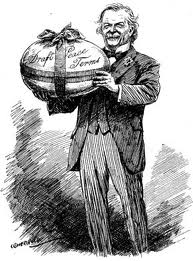
British PM Lloyd George, after Versailles
It is not only those who forget history who are doomed to repeat it, as Santayana warned. It is also those who remember history who repeat it.
On June 28 1919, the Treaty of Versailles was signed, imposing on Germany the responsibility for World War I and with it, the demand to pay (in 2011 dollars) the staggering sum of $442 billion in war reparations. Germany could not possibly pay this enormous sum, with its post-war economy depressed. So it simply printed marks, paid the reparations with worthless paper, created hyperinflation that destroyed Germany’s economy, and set the stage for the rise of Hitler in 1933. Hitler’s war machine created jobs, income and employment, and ultimately destroyed Europe in WWII.
After Versailles, the British economist J.M. Keynes, who attended it as British PM Lloyd George’s advisor, went home to Cambridge and wrote a book, The Economic Consequences of the Peace, protesting the war reparations and predicting accurately that the result would be to destroy Germany and set the stage for a second world war.
Fast forward. Nov. 29, 2011. It is now GERMANY that is imposing ‘reparations’ on Greece, only they are not war reparations, but penance for overspending. Germany’s psyche has a deep scratch from the 1920’s hyperinflation and hence Germany utterly refuses to allow the European Central Bank to print money and bail out Greece, Ireland, Portugal, Spain and Italy, nations that overspent and overleveraged. Germany remembers history – all too well.
The problem is, just as Germany could not possibly pay $442 b. in 1919, in war reparations, so Greece cannot possibly pay all the debt it has accumulated, especially when bond traders are betting against Greece and raising the interest rates on new Greek borrowing to astronomical heights – a doom loop that is inexorable and fatal.
So history is repeating itself. A rich nation is imposing a huge tax on a poor nation, in the name of justice. And the result? It will be ruinous for Europe, just as WWI and WWII were. As Joseph Nocera points out in today’s Global New York Times, Germany too will suffer, because when Greece and perhaps other nations leave the euro block, the resulting turmoil will greatly hurt German exports. Nobody benefits from chaos.
Treated unfairly in 1919, Germany now does the same to the profligate nations of “Club Med”, as the Germans call them. History does repeat itself. Everyone will lose as a result.
Global Crisis/Innovation Blog
How Strong Minds Raced So Weak Legs Could Walk
By Shlomo Maital
ReWalk!
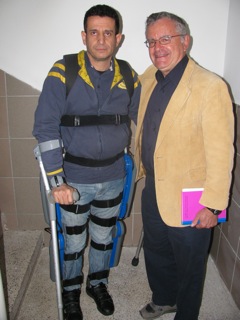
A U.S. National Football League charity campaign once used the slogan, “strong legs run so weak ones can walk”. I recalled this during a visit yesterday to an Israeli startup named Argo, launched by Dr. Amit Goffer. Argo’s product is called ReWalk, and it is an exo-skeleton (outside-the-body skeleton) which, with electronics, enables those who cannot walk to stand on their own two feet and walk at 2 km. per hour, a good clip. ReWalk can also enable people to climb stairs. You might call it, “strong minds race so that weak legs may walk”.
Dr. Goffer told us that following a terrible accident, which left him paralyzed and confined to a wheel chair, he asked an audacious question: How can I create a device that enables people who cannot walk, to walk by themselves? Dr. Goffer has three degrees in electrical engineering, and worked for years at Odin Medical Technologies, which he started (real-time MRI images for brain surgery) and at Elscint (medical imaging). In 1998/9 he conceived of ReWalk and built a prototype himself. He described his approach to entrepreneurship: “not succeeding is not in my vocabulary. You create a corridor…you see a light at the end of it, and there are no exits, once you start you have to go all the way to the end, until you succeed.”
Goffer estimates there are 2 million persons in the U.S. alone who are in wheel chairs, and of them, some 500,000 could use ReWalk. He is marketing the device to U.S. Rehabilitation Hospitals, including the Veterans’ Administration. There are two models: one for institutions, like hospitals, and the other, for purchase by individuals. Argo has venture funding and employs 15 people in Israel, one in Europe and four in the U.S. It has several patents.
We saw a demonstration of ReWalk. Attached to a disabled person’s legs, it uses an electronic sensor device on the person’s wrist to move each leg forward, when the person (on crutches) leans forward. The battery power is carried in a small backpack. The device makes a whirring noice, that is not unpleasant or loud. The price is currently $90,000 per device, in the U.S., and 90,000 euros in Europe. This price will decline as large-scale manufacturing occurs. It finds use both as a ‘walker’ and as a rehabilitation device to help those who have been injured. By putting those confined to wheelchairs on their feet, erect, it essentially moves them from ‘disabled’ to ‘enabled’. Goffer himself cannot use his device, as he is quadriplegic. But he nonetheless wants to get his device to market quickly. I told him I thought a great many people are waiting for it. “I know,” he said. This is why he and his team are working very hard. Production currently takes place at the company’s offices in Yokneam, a northern suburb of Haifa.
Check out www.argomedtec.com; this device is quite amazing.
Global Crisis/Innovation Blog
Understanding How the 1% Duped the 99%:
Why Russian Roulette Does Not Enhance Wellbeing
by Shlomo Maital

Thick fog covers the current reportage on the global crisis. Here is my brief attempt to slash through it, in 197 words.
Commercial banks, investment banks, hedge funds and other financial firms deceived themselves and duped the world. They believed they were making high financial returns, justifying bloated compensation for themselves and their shareholders. But it was a fake. There was no real value. Financial returns must be adjusted for risk. When you subtract risk from return, their investments were massively in the red. Why? They failed to take into account systemic risk – collapse of asset prices when the bubble they created bursts. None of the risk assessment models sufficiently accounted for systemic risk. If there were real economic value in this deception, then everyone in the world could grow wealthy by playing Russian Roulette, as one wag observed. There is inherent built-in deception in financial services. Investment firms trumpet their historical rates of return. But they never advertise or quantify their risks. No investment can be evaluated, without knowing those two key numbers: return and risk. Never invest when you are told only the historical return. The entire world did. And look where it got us. And guess what – we are doing it again. This is how some (not all) of the 1% in finance duped the 99% who do real work.
It now looks like the intransigent European Central Bank, which insists on fighting phantom inflation during a terrible deflation, will utterly fail (or not even try) in rescuing the euro. Look for a ‘haircut’ in the Euro nations, down from 17 to about 8, mainly the northern high-saving countries, and a prolonged period of recession as Europe reorganizes its Single Market into North and South segments. Belgium’s sovereign debt has now been down-graded and it looks like Spain, too, needs a bail-out. America, too, continues to drown in debt, and personal saving, which rose to 5 per cent, is now down to only 4. Black Friday (the day after Thanksgiving, when mobs storm the shopping malls to waste money on useless trinkets) is indeed Black, for America and the world.
Global Crisis/Innovation Blog
How to Spread a Small Idea Into a Big Deal
By Shlomo Maital
I love public transportation, and ride Israel’s excellent trains and buses all the time. Lately, at several bus stops, I noticed something rather strange. There were improvised book shelves, and books on them. Why? Who? When?
I discovered the answer the other day. Here is the story. Dr. Danny Shoshan, and Amit Matalon, of Technion’s Architecture Faculty, devised an experiment to see how the city and its residents interact. They placed two sets of bookshelves at bus stops in a Haifa neighborhood. They stocked them with books and monitored what happened over a 3-week period. “A miracle took place,” Shoshan says. “People took over the role of stocking and returning the books”. They then expanded the project to six more locations. The same thing happened. Technion students began to put their theses and textbooks on the shelves for sharing. In religious Orthodox neighborhoods, residents put religious books and CD’s on the shelves.
“Our motivation for the project was art,” Shoshan says. “Public space is the place to bring Art!” Similar “libraries” have been built in other Israeli cities – Tirat HaCarmel, Kfar Saba and even Tel Aviv. Others will soon be added. There have even been orders from abroad. The Mayor of Kfar Saba notes, “with minimal investment and very very creative thinking, we can make municipal libraries available to the general public.”
Innovator – why not try this in your city? Just put a few books on the bench at a bus stop. See what happens. Or in general: Put something in a public place, that arouses curiosity, interaction and conversations. This is what ‘art’ is truly meant to be.
- Source: Technion FOCUS magazine, Oct. 2011.
Global Crisis/Innovation Blog
Steve Keen on HardTalk: Write off the Debt!
By Shlomo Maital
Steve Keen, “the merchant of gloom”, an Australian economist who predicted the global financial crisis, was interviewed on the BBC program HardTalk, on Nov. 25. Here is what he said. In short: The banks have created enormous unsustainable amounts of debt, and we have no choice – either endure two decades of Japanese-like stagnation, while the debt slowly winds down to sustainable levels, or write it off, start fresh, and avoid the ‘lost generation’ of youth who find no jobs.
“We’re already in a Great Depression, in the last one people did not call it that until it was over, always hoping change, improvement is just around the corner.. Great Depression wasn’t called that until the late 1930’s. The situation now economists call transient may be like Japan, which had a lost two decades, this is the best we can hope for under the current situation, slow grinding process to wind the debt down.
“When you have a growing population and economy used to growth, people expect jobs when they leave school but find none, even if you grow a bit less than population change, that means we create a lost generation – which has one outlet, frustration and violence. This is not how to manage an effective society, to be caught in such a trap. Hitler rose, because he reversed the conventional economic behavior of his time and turned Germany away from 25% unemployment (by building a war machine), leading to the catastrophe of WWII. He would never have risen were it not for the Depression. You can get very bad social outcomes from the current situation. The Tea Party was a visceral reaction, right wing. Occupy Wall Street is progressive, it’s been broadly-based, youth-based, people who are laid off, people you would not expect to sit in a tent on Wall St. …a major part of their attitude is that they’ve had their trust in society betrayed. They want a harmonious society. They are not socialists. They believe society should be something we can trust in, destroyed by the financial sector. They want to rebuild that trust. They don’t know quite how. I’m opposed to capitalism “parasiting” itself and living off other sectors.
“ I think Occupy Wall St. should occupy economic departments of universities..you don’t get into this fix without extraordinarily bad thinking among economists. I think economic departments in universities should be closed.
“We have to change the political power balance. The financial sector, the creditors of the world, are dominant politically for 30 years. The debtors are at the bottom. We need to resverse that, turn the power back to the debtors. Politicians won’t listen until they have to. Politicians are reactive, not leaders. They go along with the general trend that a larger financial sector without regulation is a good thing. And they get their campaign contributions from it. Banks created more loans than they should have, then bundled them and sold them to pension funds and institutions. So we can’t have a ‘jubilee’ (50-year debt forgiveness). The debt is too widely owned. We have to see where debt is good and where it is bad. Good debt finances investment in technology. Bad debt finances gambles on rising asset prices. THAT is what did the damage. In America’s economy, good debt is sustainable at 50-70% of one year’s GDP. Current level of debt? 300% of GDP. Not sustainable. The debt caused a house price bubble. Write off debts of people like you and me. We have to look at the situation, what do we face if we honor debts that should never have happened? Best example is Japan, a cohesive society, and their GDP growth is lower than population growth, even with a falling population. We face two decades of that.
“We must admit something – the credit system has failed. Historically, in Australia, 10% of GDP went to pay for housing. Today it is 100%. That 90% financed the bubble. But if we forgive debt on an individual basis it will take forever. We need a systemic approach. Households did not make the bad decisions. The banks did. So we have to write off the debt. As someone has said, debt that CANNOT be repaid, WILL NOT be repaid. Let’s face it. There are two sources of money: banks through lending and government through deficits. Banks over-lent. Let’s stop this and reduce private debt, while letting government create credit exclusively. In the past 3-4 years, the rescues have been to create money and give it to the banks, believing the banks will lend. That is bizarre, because they’ve lent too much already. So all this money has been ineffective. What we have to do, not easy, the working model is – give the money to the public, to pay off their debt level, not spend it. Per capita. Pay the debt down. It is not a tax cut. If you give the money to everybody, and require debt reduction — we reward those who over-borrowed, but, we must do this, because there is a system failure, and there has to be a system solution. EVERYBODY gets a boost, and the scale of my solution is extreme, but normal policy allowed a 40-year buildup of unsustainable debt. We need a sophisticated approach to eliminating an unsustainable systemic level of debt. If we keep the parasitic banks alive, the economy dies. If we did my solution, banks would get money in loan repayment. Their cash flow would decline. So the bank would struggle, and the financial services would decline – but most already are insolvent, we just haven’t recognized this.
“Banking behavior is positive when it provides working capital for business. It is negative when they finance Ponzi schemes to gamble on asset prices, where the money itself is causing that asset price bubble. This is parasitic. Instability in capitalism is created. It gets to technological breakthroughs. This is creative. That also includes financial instability. So I am trying to promote creative instability, and control financial instability. We have to control the Frankenstein. Banks make money by creating debt. Most of us decline that debt, because it is dangerous. In Latin the word ‘mortgage’ means ‘death contract’ (mort = morte, death). In the past 40 years, we were encouraged by economic theory to take on more debt than we should. We have to prevent the possibility of asset bubbles financed by leverage from happening again, and it might. Countries have rising sovereign (govt.) debt because much of the private debt has been made public by governments. My Eureka moment: in 2005 I looked at the data for Australia, and saw debt growth in Australia rising exponentially, relative to income. I plotted the data – perfect exponential curve, 1964-2005. I thought, this has to change! When debt starts to fall, we will have a financial crisis. I had to raise the alarm.
“People were not worried about private debt. Because economists have a mythical view of debt – money goes from the patient people who have money, to those who are impatient and need and want to borrow money. This is a myth. Max Planck failed to convince his Maxwellian colleagues about quantum mechanics, and said, the old physicists have to die off before the young physicists will lead to the triumph of quantum physics. The same applies to economics. The old Keynesians will have to die off. Unconventional economics has been derided, but it knows the current version of capitalism doesn’t work. And after the global crisis, this is being recognized. I see no politician bold enough to do what I recommend. “


