
You are currently browsing the category archive for the ‘Global Crisis Blog’ category.
Global Crisis Blog
Stop the Hypocrisy: The Emperor Has No Dollars (Clothes)
By Shlomo Maital

The famous Hans Christian Andersen’s story “the Emperor’s New Clothes” is about two weavers who promise the emperor a new suit of clothes invisible to those who are stupid or incompetent. Only a small child is honest enough to call out, “but he isn’t wearing anything at all.”
The modern-day equivalent of that child is economist Cristina Romer, formerly head of President Obama’s Council of Economic Advisors. Cut the bull, she says. America’s current fiscal and monetary policy are both aimed squarely at depreciating the dollar. And it has worked. The dollar has dropped sharply. However, for political reasons,everyone from Obama, to Geithner (Treasury Secretary) to Bernanke (Fed Chairman), to Republican Members of Congress, to Democrat Members of Congress, all bleat the same refrain, like sheep:
American wants a strong dollar! America wants a strong dollar!
It gets worse. America insists that China revalue its currency and let it appreciate relative to the dollar. That means, necessarily, a lower value of the dollar. But if this is a good idea for U.S.-China trade, notes Romer, why not for America’s trade with all nations? Why not let the dollar drop relative to all currencies? Why
isn’t a WEAKER dollar good for America, rather than a strong dollar?
The hypocrisy of U.S. appointed and elected officials is increasingly unbearable. Economics at Grade One level says: If you dump huge amounts of dollars into the marketplace, through enormously expansive monetary policy and so-called ‘quantitative easing’ (printing money), and through huge unprecedented fiscal deficits, then the supply of dollars will ultimate lower the price and value of dollars. It’s that simple. Yet Americans consistently support this policy while denying its implacable result – a lower dollar.
Cut the bull! America needs a cheaper dollar to dig itselfout of the current economic hole. Everyone knows it. Admit it. Stop the hypocrisy. But also admit that a weakened dollar will hurt other countries, export some of America’s economic woes, and possibly help create a new global crisis, because the global economy cannot run well with an unstable world currency (the diving dollar).
Tell the truth, America. A weaker dollar is good for America, bad for the rest of the world. Guess which America will favor — while, all the while, denying it?
*Cristina Romer, “It’stime for frank talk on the dollar”, Global NY Times, May 21/22, 2011
Innovation Blog
Innovating Economics: How to Do Research on Alleviating Poverty the RIGHT Way! Or
How to Keep Poor Kids in School with only a Few Pennies.
By Shlomo Maital
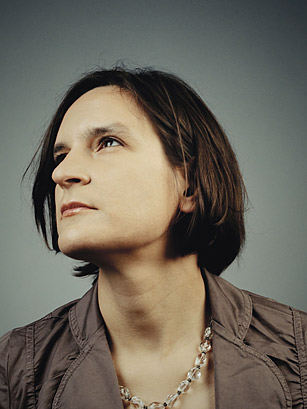 MIT Professor Esther Duflo
Many people have been inspired by Greg Mortenson’s book Three Cups of Tea, about how he stumbled into an Afghan village after failing to summit K2, leading him to launch a huge project that built many schools in Afghanistan. The CBS program 60 Minutes attacked Mortenson, debunking many of his claims and claiming misuse of his funds, and he later responded.
In his New York Times Op-Ed column Nicholas Kristof, who covers the developing world, says the Mortenson affair raises a deeper issue – “how best to make an impact”. Increasingly Generations Y (the generations that followed the baby-boom generation) want to change the world as their life mission. But how best to doit? Do we know?
In my blog, I’ve been highly critical of my fellow economists for their narrow, greed-ridden detached-from-reality view of the world, shown in their mathematical equations that portray no recognizable human societies. But there is an exception. Today young economists are getting out into the field, applying the rigorous methods of scientific research (randomized sampling, control groups) to study how best to alleviate poverty. The two leading proponents of this approach are MIT Professors Abhijit Banerjee and Esther Duflo. Their new book * documents how their Poverty Action Lab uses randomized trials in countries from from Chile to India, Kenya to Indonesia, to show how to use resources efficiently to change the lives of the poor. A second new book, by Dean Karlan (a behavioral economist) and Jacob Appel (an aid workers), More Than Good Intentions: How a New Economics Is Helping to Solve Global Poverty, tackles the same topic.
Among Duflo’s key findings: ● microfinance, the poverty-reduction solution du jour, isn’t all it’s cracked up to be; ● the value of foreign aid is greatly overblown; ● entice parents to get their kids immunized by giving them free food. All these findings are tested in carefully-controlled experiments.
Karlan and Appel use psychology to assess aid initiatives . They recommend “small fixes with outsized payoffs”: ● “commitment” savings accounts that make depositors accumulate a fixed amount before they can
withdraw; ● well-side chlorine dispensers to purify water; ● paying parents to take kids for checkups; ● increasing the application rate to a microloan program by putting photos of beautifulgirls on the brochure.
Kristof supplies another powerful example: Deworming. “Prof. Michael Kremer, a Harvard economist, helped pioneer randomized trials in antipoverty work. In the 1990s, Kremer began studying how to improve education in Africa, trying different approaches in randomly selected batches of schools. One intervention he tried was deworming kids — and bingo! In much of the developing world, most kids have intestinal worms, leaving them sick, anemic and more likely to miss school. Deworming is very cheap (a pill costing a few pennies), and, in the experiment he did with Edward Miguel, it resulted in 25 percent less absenteeism. Even years later, the kids who had been randomly chosen to be dewormed were earning more money than other kids. Kremer estimates that the cost of keeping a kid in school for an additional year by building schools or by subsidizing school uniforms is more than $100, while by deworming kids, the cost drops to $3.50. (In a pinch, kids can usually go to “school” in a church or mosque without a uniform.)”
Bill Gates has put billions of his wealth dollars into health initiatives for the poor. He would do well to speak to
these researchers. Why not apply the same standards to philanthropy that are used in scientific research? The aid dollars would go much farther if we did.
* Abhijit Banerjee & Esther Duflo, Poor Economics: A Radical Rethinking of the Way to Fight Global Poverty. PublicAffairs (2011).
** Dean Karlan and Jacob Appel . More Than Good Intentions: How a New Economics Is Helping to Solve Global Poverty. Dutton (2011)
Innovation Blog
Innovation That Shoots Blanks
By Shlomo Maital

Blank Cartridge
Despite America’s ongoing economic crisis, weak currency and massive debt, the U.S. comforts itself that it is still the world’s most innovative, entrepreneurial nation. Most of its hopes for emerging from the crisis are pinned on its innovation.
There is new evidence this hope is misguided. America’s innovation cannon is firing blanks. This is the view of 2001 Nobel Laureate Michael Spence, from Columbia U., who in a new study with a colleague has explained why American innovation creates no gains for American working people.* The syndrome he describes afflicts Israel as well. The gains from Israel’s innovative high-tech sector accrue to a very small fraction of the work force.
It is not true that the U.S. economy fails to create jobs. Some 27 million jobs were created between 1990 and 2008 (the year the global crisis began). The problem is, all but two per cent of those jobs were in services. And most of service jobs were low-paying ones, such as Wal-Mart clerks, hotel maids or low-paid government jobs.
Almost no job growth at all occurred, according to Spence, in manufacturing, where high-paying jobs for workers once existed. The reason: outsourcing. And the few remaining American manufacturing jobs are threatened, because emerging markets are moving up the value chain. Moreover, though America has cut its trade deficit by half between 2007 and 2009, all of that gain came from import reduction, not from a rise in exports. The weaker dollar makes U.S. exports cheaper and more attractive – the problem is, America makes very few goods for export, at any price.
In 1979 manufacturing made up more than one out of every five U.S. GDP dollars. Today, it is about one in every ten GDP dollars, or proportionately half. The result has been disastrous for the average American worker, whose weekly pay peaked in 1974 at $709 (in 2010 dollars) and fell to only $649, a drop of 8.5 per cent, by the end of 2010. This means that an American, working at exactly the same job as his or her father, earned less, even though in the same 37-year period U.S. GDP per capita almost doubled. The cause is mainly America’s myopic transfer of its manufacturing jobs to China and South Asia.
Let us all learn America’s bitter lesson – innovation is fruitless if you only create ideas and let other countries make the products. You create a handful of billionaires, through massive exits, but no well-paying jobs. Moreover, innovation joined with on-site manufacturing is far more powerful than R&D isolated from production.
* Michael Spence, Sandile Hlatshwayo, “The Evolving Structure of the American Economy and the Employment Challenge”, Council on Foreign Relations, March 2011.
Global Crisis Blog
America’s Hot Potato Deficit – Pass It On to Those Who Least Deserve It, Or Why You Must Never Die in Virginia
By Shlomo Maital

The strength and beauty and compassion of a society is measured not by the brilliance and wealth of its strongest members, but by how it treats its weakest members – elderly, sick, handicapped, poor. By that measure, America flunks.
Everyone (including me) speaks of the U.S. federal budget deficit. But one way the Feds have adopted to reduce and control the deficit is simply to pass it on, to the state governments. According to the U.S. Center on Budget and Policy Priorities, the 50 state governments and District of Columbia have slashed spending by $430 b., laying off thousands of workers, paring benefits and pensions, hiked college tuition, slashed medical benefits and cutting education budgets. They have had to do this because their revenues have been squeezed by the housing collapse, while Federal aid to the states has been cut. The worst-off states, which are essentially bankrupt, are: California (deficit of 29.3% of spending, for 2012, meaning revenues fall short of spending by nearly a third), Nevada (45.2 %), New Jersey (37.4%), Oregon (25%), Texas (31.5%), and New York State (18.7%). Only little Indiana, headed by Gov. Mitch Daniels, has a balanced budget. (Why don’t the other states benchmark his best-practice operation, that has made him a leading potential Republican candidate for President?).
The Federal budget pays for defense and interest payments, mainly. The State budgets pay for public services. So when the Feds squeeze the State budgets, the result is draconian cuts in services to all those segments of society who really need those services. What is amazing is that it is the Republican Party that supports such drastic cuts, and the very people who suffer from them still vote, in large numbers, for that compassionless party! Why?
According to the AARP Bulletin, many states are slashing child-care assistance. Is this a just society, that dumps the burden of economic crisis onto children? Virginia, not a poor state, is eliminating a fund that paid for funerals for those who had no money. Good work, Virginia; just dump the bodies in the backyard.
Global Crisis/Innovation Blog
When Will America Declare Bankruptcy? In 2020 – Or Before
By Shlomo Maital
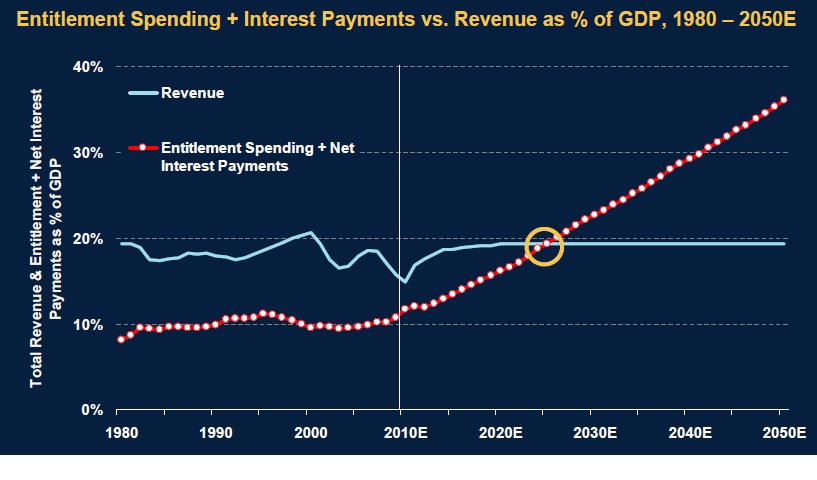
Source: MORGAN STANLEY
The blue line is Revenue as % of GDP;
The red line is Interest + Entitlements as % of GDP
A little-noticed report by the Congressional Budget Office (CBO) (“Long Term Budget Outlook, 6/10”) does the following: It projects revenue as a % of GDP (projected to be stable, at about 20%, mainly because of Republican pressure for tax cuts and no tax hikes), while two budget components only, interest payments and ‘entitlements’, will rise from about 10% of GDP today to 20% by 2020, owing to America’s aging and huge debt along with rising interest rates.
Note: the CBO is regarded as highly professional and credible.
A word of explanation: Entitlements include federal spending on Social Security, Medicare, Medicaid, based on current legislation.
What does this mean? It means that all tax revenue will be spent on interest payments and entitlements, leaving nothing for discretionary programs (such as defense, education, etc.).
At some point, between now and 2020, some American Administration will have to bite the bullet and slash entitlements, regarded politically as a “third rail” (especially Social Security). But who? Republicans show no inclination to this, nor does Obama. With Obama likely to be re-elected in 2012, and his 2nd term ending in 2016, he will have to deal with this issue during his second term.
But will he have the guts? And will the Republican opposition allow it?
The only solution is to raise taxes. Republicans are ferociously opposed. But the CBO study suggests there is no alternative.
Stay tuned. Without a major policy change, on spending entitlements and taxes, America is bankrupt by 2020.
Global Crisis/Innovation Blog
Reforming America’s Banks: Dodd-Frank Act Got It Wrong –Why are We Not Surprised?
By Shlomo Maital
Andrew Ross Sorkin’s regular Global NYT column (May 11/2011, p. 20) summarizes the Michael R. Milken Annual Conference held recently in Los Angeles, on financial reform and the Dodd-Frank Act. You will recall, this Act, signed into law by President Obama last July 21, regulates “sweeping” financial reform, to prevent another meltdown like that of 2007-9, and in particular, preventing banks “too big to fail” from failing and needing bailouts.
Sorkin says the video clip from the conference is “riveting”; find it at the Milken Foundation website.
Critics at the Milkin Conference were fierce. Thomas J. Wilson, chair of Allstate (a huge insurance company) and deputy chair of the Chicago Federal Reserve Bank, said the new law “creates more uncertainty than certainty”. But the most damning critic is Kenneth C. Griffin, founder of a $15 b. hedge fund Citadel, who says the new legislation “will deeply entrench crony capitalism into the very fabric of the capitalist system”. Readers will recall, it was crony capitalism that got us into this huge mess in the first place.
The problem, Griffin explains, is that when the government liquidates a bank (as it did with Lehman Bros.), it decides which creditors it will make “whole” (compensate) and which it will punish severely. Griffin says, this means “companies connected to Washington that curry political favor will be favored at the expense of companies that do not have their business model “revolve around appeasing politicians and making campaign contributions”. Recall that Obama will spend $2 b. on his 2012 campaign, and so will his Republican counterpart. One way or another, they have to raise that money – and much of it will come from the financial services industry.
Remember that $50 m. check we wrote for you? Bank X will say, gently, to the ruling politicians, when it lands in trouble.
Wilson adds a doom loop scenario, noting that as soon as you declare a major financial institution insolvent, people are going to run from it (withdraw their money), and this will “actually accelerate people’s demise rather than stop it.” Of course this happened with Lehman Brothers.
The fighting head of FDIC (Federal Deposit Insurance Corp.) Sheila Bair has announced she is leaving. With her departure, and with Dodd-Frank, don’t look for serious fixes in the flaws that led to the 2007-8 meltdown. And for bankers who gripe at government “over-regulation” – ask them if they would swallow an unregulated pill or fly in an unregulated airplane. Why is regulation great for everything except where it really matters – banks and money?
Global Crisis/Innovation Blog
Commodity Price Collapse: Why Commodity Prices Are Becoming the New Las Vegas
By Shlomo Maital

Silver: Definitely not a gold mine for investors
On Thursday May 5, a startling decline occurred in the prices of commodities, fulfilling a short-term prophecy made by Goldman Sachs last month. Goldman Sachs’ chief commodity trader closed out long positions in April, causing ridicule and laughter. Turns out he was right, showing the huge advantages of strong independent thinking.
The price of oil plunged, with Brent crude losing $12 yesterday, or 10 per cent, to trade at around $109 a barrel. Silver, just a few days ago trading at around $50, is now back down to $35, having suffered its steepest crash since the 1980s. (Since 29 April, silver has crashed 23.3 per cent). London Mercantile Exchange tin is down 9.8 per cent, palladium has lost 10.4 per cent, gold lost 4.5 per cent and brent crude 9.1 per cent. In the US last night, the price of a barrel of oil was back below $100.
What in the world is going on? The explanation seems fairly straightforward. US and global economies are slowing. And commodity prices, which are always a play on excess liquidity (money) and future inflation, have suddenly done a U-turn, when that inflation seems unlikely to occur. According to Pulitzer Prize winning columnist Dave Leonhardt (NYT):
For the second straight year, the recovery seems to be at risk of stalling. The economy grew at an annual rate of only 1.8 percent last quarter — eerily similar to the 1.7 percent growth last spring, just when job growth started slowing down. Fully 80 percent of people say the economy is in fairly bad or very bad shape, according to a New York Times/CBS Poll last month. More people say it’s getting worse than getting better, the opposite of a few months ago. …The typical financial crisis has caused unemployment to rise for almost five years, according to historical work by the economists Carmen Reinhart and Kenneth Rogoff. We are well ahead of that timetable, thanks to aggressive action by the Fed, the Obama administration and, in its final months, the Bush administration. But our working assumption should be that this recovery will remain at risk for a long time.
In the American and global economies, we are going to be riding a seesaw for years to come. News will alternate between optimism (inflation) and pessimism (deflation), and commodity prices will become highly variable. Ironically, this variability itself will attract new players, because potential profit (and loss) rises in direct proportion with variance. In the Black-Scholes option pricing equation, the higher the variance of the asset price, the higher the option price. Look for commodity prices to become the new Las Vegas.
Innovation Blog
Back to the Future II — Jason Pontin: Futuristic Renewable Energy is Here!
By Shlomo Maital

Jason Pontin is editor and publisher of MIT Technology Review, a magazine that tracks new technologies and has some 2.6 m. readers worldwide. Here is his take on near-future advances in renewable energy, as presented to the MIT Enterprise Forum of Israel annual event, May 5, Tel Aviv:
“Carbon is the current product of the energy industry. Heat and light are byproducts. This will stop. Each year, 1,366 watts of solar energy strike every squ. meter on the earth. Yet today solar energy supplies only 1 % of US energy needs. The largest solar project in the U.S. is Exelon Solar City in Chicago. (Sunny Chicago? Related to the fact it is President Obama’s city, and the project was funded by stimulus package money, or 80% of the total $60 m. cost). There are 32,292 solar panels, covering 41 acres, generating 10 megawatts, enough for 1,500 homes. It costs $6/kilowatt to build – far too high to be profitable. All such solar energy programs are heavily subsidized.
“We need breakthroughs! Here are five blue-sky energy technologies that could provide such breakthroughs. They focus on new ways to generate, transport and store solar or nuclear energy:
- Plasmonic Solar: These are thin-film solar panels, developed by Harry Atwater at Caltech (California Institute of Technology). [According to Wikipedia: Plasmonic solar cells (PSC) are a class of photovoltaic devices that convert light into electricity by using plasmons. PSCs are a type of thin-film SC which are typically 1-2μm thick. They can use substrates which are cheaper than silicon, such as glass, plastic or steel. The biggest problem for thin film solar cells is that they don’t absorb as much light as the current solar cells. ]
- Artificial photosynthesis [Dan Nocera, MIT]: Research is being done into finding catalysts that can convert water, carbon dioxide, and sunlight to carbohydrates. This is a way of storing energy, a crucial element of capturing solar power. Nature does this with ease – it is called photosynthesis. Inventors are trying to replicate it. The cobalt catalyst from MIT’s Dr. Dan Nocera of MIT is “providing strong results.”
- Software defined Thermal Solar. In this technology, towers collect energy from mirrors. The mirrors are costly. Bill Gross (inventor of the original Google ad interest-related model) is the pioneer of this method; “his eSolar’s proprietary sun-tracking software coordinates the movement of 24,000 1 meter-square mirrors per 1 tower using optical sensors to adjust and calibrate the mirrors in real time. This allows for a high density of reflective material which enables the development of modular concentrating solar thermal (CSP) power plants in 46 megawatt (MW) units on parcels of land, resulting in a land-to-power ratio of 4 acres (16,000 m2) per 1 megawatt”. [This implies that 62.5 sq. miles (or a desert area of 8 miles by 8 miles) of reflectors could supply all of Israel’s electricity needs. ]
- Liquid Batteries: [Don Sadoway, MIT]; One of the biggest challenges currently facing large-scale solar energy technology is finding an effective way to store the energy, which is essential for using the electricity at night or on cloudy days. The primitive storage method today is to pump water up a hill during the daylight hours. In 2009, Sadoway proposed a liquid metal battery that could be used in stationary energy storage systems. “No one had been able to get their arms around the problem of energy storage on a massive scale for the power grid,” says Sadoway. “We’re literally looking at a battery capable of storing the grid.”
- Superconducting DC transmission: [Phil Harris, Tres Amigas]. Thomas Edison once observed that electricity is a way of TRANSPORTING energy, not creating it. How can solar power be easily and quickly transported? Tres Amigas has the answer. “The Tres Amigas renewable energy market hub will be a multi-mile, triangular electricity pathway of Superconductor Electricity Pipelines capable of transferring and balancing many gigawatts of renewable power between the three Interconnections. Similar to highway rotaries used for traffic flow control, multiple power transmission lines from each of the Interconnections will feed power into and out of the Tres Amigas SuperStation through multiple AC/DC converters, each connected by DC superconductor cables. Tres Amigas, which will be a balancing authority, will help ensure the efficient and reliable flow of power from multiple renewable generation sources in all three power grids to customers across a wide area of the U.S., Canada and Mexico.”
- And: a sixth, still-distant but amazing dream: Nathan Myrhvold’s Travelling Wave Reactor: from wiki: “A traveling-wave reactor, or TWR, is a type of conceptual nuclear reactor that can convert fertile material into fissile fuel as it runs using the process of nuclear transmutation. Once started, TWR’s reach a state after which they can achieve very high fuel utilization while using no enriched uranium and no reprocessing, instead burning fuel made from depleted uranium, natural uranium, thorium, spent fuel removed from light water reactors, or some combination of these materials. TWRs could theoretically run, self-sustained, for decades without refueling or removing any used fuel from the reactor.” Former Microsoft guru Myrhvold is putting his own fortune into this, and plans to build a TWR in China.
Innovation Blog
Back to the Future: “Where we’re going, we don’t need roads”
By Shlomo Maital

Doc’s Back to the Future DELOREAN car
Marty McFly: Doc, we better back up. We don’t have enough road to get up to 88 (mph).
Dr. Emmett Brown: Roads? Where we’re going, we don’t need roads.
In the hit movie Back to the Future (1985), Marty McFly (Michael J. Fox) goes back to the future with Doc and sees flying taxis, 3D ads (a shark), and many other inventions. Some have come true. Some have not. President Ronald Reagan adopted Doc Brown’s statement about roads.
At the annual event of the MIT Enterprise Forum of Israel, titled Back to the Future 2015, held today, May 5, several farsighted experts gave their vision of the near-term future. Here are excerpts of what they said:
The first speaker was Zeev Efrat, CEO, Frost & Sullivan (Israel branch), a global business consulting firm. He identified four key megatrends that experts defined a decade ago, in 2000: Emerging China; the Internet explosion; Information Revolution; and Outsourcing. All powerfully affected the decade 2000-2009. The megatrends that will dominate the near-term future, according to Efrat, are:
* urbanization: A megacity is a city with over 10 m. people; a mega-region has over 15 m. people; By 2025, half of all megacities will be in developing countries. Life in cities will be dominated by an integration of smart+energy+plan. Smart: ICT will be everywhere in cities, making them ‘smart’ (traffic management, power management, etc.). Energy will be green. And planning will be highly sophisticated. Some 40 global mega-cities will be “smart”, in this sense, by 2020; over half of them will be in Europe and in North America.
* convergence: In the late 1970’s, MIT Professor Nicholas Negroponte identified three converging industries: entertainment, publishing, computers. Now Efrat identifies another three converging industries: Energy, IT and automation. This convergence will lead to a wave of mergers, as companies seek to build competencies in all three disparate technologies.
* social trends: Gen Y. There will be growing personalization of all goods and services. Generation Y, the dominant generation, will seek goods that cater to values, beliefs, interest and lifestyle. This generation, aged 15-34, will dominate – there will be 2.56 b. people in this age bracket, out of a total global population of 7.56 b. people by 2020, and 61 per cent, six of every 10, will be from Asia! The middle class will also dominate. By 2020 52 percent of the global 7.56 b. population will be defined as ‘middle class’.
Some other trends Efrat identified, in only 20 minutes!:
- Technology: some 900 satellites will be launched in 2011-20.
- World War III will be an information cyberwar; it has already begun.
- 2020 will be a virtual world, where reality and virtual unite; this will feature in shopping, surgery (practice), entertainment, business conferences, and others. The interface between real and virtual will be highly fluid.
- Innovation to zero: There will be zero waste, with 100% recycling, and no emissions, in cars, factories, homes.
- E-mobility: 40 m. electric vehicles will be sold worldwide in 2020 (in one year), 30 m. cars and 10 m. two-wheelers. The related industry will have new components: new OEM’s, along with utilities, integrators, charging stations, govt. and battery manufacturers. Commercial vehicles will also become E-mobile, with 300,000 such vehicles by 2020.
- From illness to wellness: Focus shifts from curing illness to preserving wellness. Without this trend, health costs will soar by 2050 to 20-30 per cent of GDP (13 per cent already in the U.S.). The theme becomes: Live well, stay health. From fat to fit.
Innovators, identify the megatrend that excites and energizes you. Then, identify a micro need (a well-defined group with an unmet need) within this megatrend. Finally, build your innovation around it.
In the next blog, I will report on another speaker, Jason Portin (editor and publisher of MIT Technology Review), who reviewed startling futuristic developments in the realm of renewable energy.
Innovation Blog
From “Made in China” to “Owned by China”: Or What Can You Buy with Two Trillion Dollars?
By Shlomo Maital
$1 b. in cash: now picture 2,000 piles
You have to hand it to the Chinese. They have a multi-stage long-run business strategy for China Inc. that is working to perfection. It is amazing that a group of former Communists have applied ‘modified free market’ strategy far better than the American blueblood capitalists, and have created an economy whose size will overtake America’s far sooner than we believed or expected.
Here is the simple version of the two-stage strategy ‘rocket’ China created.
Stage One. Attract huge resources from abroad, to create enormous state-of-the-art manufacturing capability, to generate a huge export surplus. Use the export surplus to accumulate enormous financial assets (mainly US Treasuries).
Stage Two. Use the pile of American dollars (growing daily, now equal to $2.5 trillion) to buy equity interests in companies and real productive assets around the world, to acquire control of resources, brands, and competitive advantage. Note: For only $1.5 b., Lenovo bought IBM’s Think Pad and leveraged it into near-market leadership in laptops. The transition from Think Pad to Lenovo branding was flawless and powerful.
Writing in the Global NYT, David Barboza says “flush with capital from its trade surpluses, China is spreading its newfound riches to every corner of the world..over the next decade, China could invest as much as $2 trillion to acquire overseas companies, plants or property”. The shift is amazing, Barboza says; a decade ago, China’s yearly equity investments abroad averaged only $2 b. a year, an inconsequential sum.
Just as we saw an almost panicky rush by global companies to shift production to China, we will now see a similar stampede by nations to vie for China’s money, by selling off national assets.
How much of that equity investment abroad will go to America? Very little, Barboza thinks. The study he cites suggests that because of political rivalry, America will benefit little from the Chinese direct investment. I hear a note of regret – alas, America will not ‘benefit’ from selling off its assets to China. For a nation that chants “USA USA, We’re Number One”, President Obama’s declared passion for welcoming Chinese equity investment, implicitly accepting “We’re #2—and we don’t even try harder” is impossible to understand.
As a business, China is exceptionally well run. Can’t say the same for America.
* David Barboza, “China’s cash goes global, but maybe not to US”, Global NYT May 4/011, p. 14.


