
You are currently browsing the category archive for the ‘Global Crisis Blog’ category.
Global Crisis Blog
If You Were America, When Would You Have Sounded the Alarm?
By Shlomo Maital
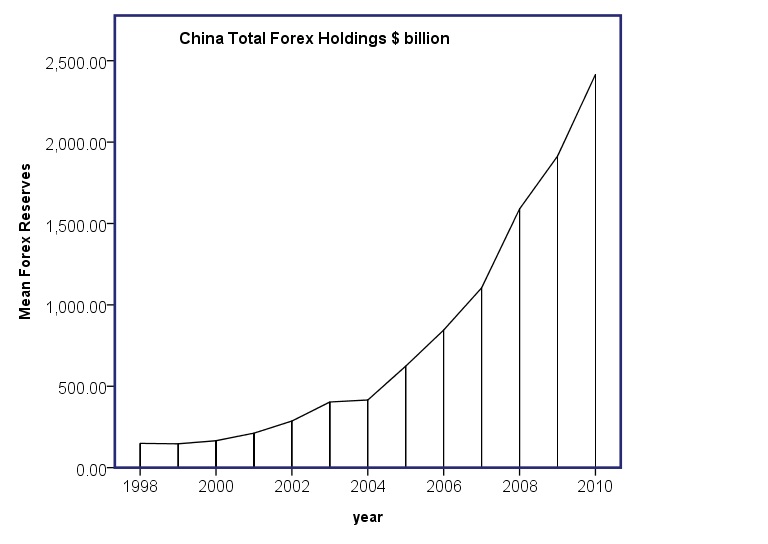
China: Total Forex Reserve $ Holdings
Suppose you, Joe Citizen, were in charge of America, USA Ltd. You are trading with a growing emerging nation, China. You become aware that the Chinese are manipulating their currency, by massive purchases of U.S. dollars, to keep their renminbi exchange rate undervalued, making their exports very cheap for Americans paying in dollars and your, America’s, exports, very expensive for them.
Now, the Chinese do this openly. You cannot buy huge amounts of U.S. Treasury bonds in secret. And unlike many other things, they openly disclose their holdings of U.S. dollar assets, every month. The above graph shows China’s U.S. dollar reserve holdings, dating back to 1994.
Now, here is the $64 trillion question. Viewing this graph, which you Joe Citizen religiously track, monthly, when would you become alarmed that China was screwing you, USA Ltd.? When would you sense that they are manipulating the exchange rate? In 2004? 2006? 2008, when reserves reached $1.5 trillion?
When did America itself raise the alarm? Indeed, have they? When would an ordinary person, seeing this graph, raise hell about currency manipulation? And why indeed is Clyde Prestowitz absolutely correct, when he titled his latest book The Betrayal of American Prosperity?
Global Crisis Blog
How China Taxes Its Workers Without Taxing Them: New Insight on the Downsized Yuan
By Shlomo Maital
..
Reuters global editor Christia Freeland has made a brilliant observation in her NYT column (Capitalism in China: Irony is gone), Friday April 29, p. 2. China’s policy of consistently undervaluing its currency, the yuan (renminbi, or in Mandarin, ‘money of the people’) is simply a subtle way to tax the workers. She bases her observation on a talk by George Soros, who said at a conference,
“the undervalued currency was a form of transferring purchasing power (wealth) from the citizens to the government without imposing taxation”.
How does this work?
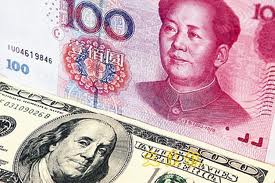
Today one yuan is worth about 15 U.S. cents, or 6.49 yuan per dollar. Its true, purchasing-power value, is about 30 cents, or 3.33 yuan per dollar. How do we know? If you bought items on a shopping list in Beijing, for 1,000 yuan, in America those same items would cost about $300. So China has a permanent half-price sale (if you pay in dollars). To maintain this exchange rate, the Chinese government has to buy billions in U.S. dollar assets, to support the dollar. It already has accumulated some $2.5 trillion!
But why? It is not solely to sustain China’s export-driven growth model. As Soros explains, when the yuan is undervalued, Chinese imports cost twice what they should, so ordinary people pay double for imported goods. Who gains? The government. Why? Because the government accumulates huge amounts of wealth, in buying up cheap dollars, and some of this wealth supports the top government officials. The undervalued yuan is a huge tax, hidden, on the workers of China, justified as a pro-export policy, but probably sustained by the fact that it further strengthens, enriches and entrenches the central government and its officials.
Chinese workers’ standard of living would rise dramatically if the yuan rose to 3.33 per dollar. But the governments’ wealth accumulation, and hidden tax, would disappear. So don’t hold your breath waiting for a rapid yuan appreciation. It won’t happen. As Adam Smith, noted, there are passions and there are interests. The interest of China’s officials and leaders is to sustain their hidden tax. Until that interest changes, China’s yuan will remain overvalued.
Renminbi “money of the people”, it turns out, is anything but. Like many things in China, the word renminbi is a bitter irony.
Innovation Blog
Starbucks’ Turnaround: Howard Schultz Reveals All, Reinvents the Business
By Shlomo Maital
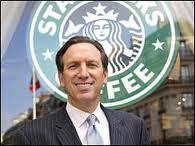 Howard Schultz returns!
Howard Schultz, who will turn 58 on July 19, is the legendary founder of Starbucks. After driving his startup to reinvent the concept of coffee (not just coffee, but ‘a third place’, outside home and work) and to achieve rapid growth, he turned over the reins of management to Jim Donald in 2005 – and had to return in 2008 when Starbucks stumbled. In 1987 Starbucks had 11 stores and 100 workers; at its peak it had 17,009 stores in 50 countries.
In a revealing interview in McKinsey Quarterly (2011, no. 2, p. 34), based in part on his new book Onward: How Starbucks Fought for Its Life without Losing Its Soul, Schultz tells all. Here are some excerpts about lessons learned:
1. Stop ‘comps’. Comps are comparisons of same-store sales, period-to-period, data demanded by Wall St. analysts, to reflect true growth of revenue without including the newly opened stores. Schultz found Starbucks store managers were driving up revenues any way they could, because they were measured and in some cases compensated, for their ‘comps’. Schultz halted use of ‘comps’ soon after returning in 2008. “We made decisions driving incremental revenue, not the brand equity”, he explains. Meaning: we sought money, not value and meaning. Lesson: Be careful what you measure! Is your ‘measure’ eliciting the desired behavior?
2. Build a new business design. Schultz is now trying to build a Starbucks brand sold in supermarkets and other retail outlets, while maintaining Starbucks’ own 17,000 stores. “Integrate ubiquitous channels of distribution with the retail footprint”. This is hard. Why should Wal-Mart sell Starbucks brands when Starbucks itself competes with it? This is based in part on the Starbucks card, which does 1 in all 5 Starbucks store transactions, and a reward system between the wholesale and retail channels.
3. Think Local, Act Local. China has 140 cities with over one million people! Starbucks is focusing on China. To do so, it will have to be very very local – black sesame muffins, rather than blueberry muffins, for instance. Far more new products will have to be invented locally, and not in Seattle headquarters. Starbucks has stumbled on its local message. Its 9 stores in Israel were closed in 2003, because local Israeli café chains were simply far superior. “We want to put our feet in the shoes of our customers,” Schultz says. Astonishing how great companies forget this simple lesson, again and again and again, and plunge into chaos.
4. Talent is the real constraint. What keeps Starbucks from growing? Not finance (it has $2 b. in cash) but management talent. And this shortage will worsen, as baby-boomer managers retire. Schultz wants to hire world-class people. He should also focus on how he will build such talent internally. Hired top talent tends to be mobile, leaping from firm to firm.
5. Discipline and creativity. Schultz seeks “real quantitative metrics to study the investments that we’re making across the board…– return on investment in stores, in advertising, new-product introductions, entry cost to new markets”. In other words: Make the lion of discipline lie down with the lamb of creativity. Schultz is keenly aware that such metrics – “comps” – ruined Starbucks’ value focus. The same issue of McKinsey Quarterly has a short piece about HR – how to use HR analytics as the basis of training programs. Measurement is not just technical, it is strategic – and often, badly managed.
Every global company grapples with this discipline/creativity paradox. Will Starbucks succeed? Stay tuned.
Global Crisis/Innovation Blog
Gene Sharp: Father of the Arab Revolutions? How Ideas Change the World
By Shlomo Maital
 Prof. (emer.) Gene Sharp
There are many examples of how obscure books change the world. Marx’s Capital is unreadable – and look what it did. F.A. Hayek’s slim The Road to Serfdom was read by two leaders called Ronald Reagan and Margaret Thatcher – and each dragged their countries toward free-market capitalism.
But few have heard of Gene Sharp, a retired American political scientist professor, Univ. of Mass., whose 93-page 1993 book on how to topple autocrats, From Dictatorship to Democracy, has become the Bible for revolutionaries from Bosnia to the Ukraine to Egypt’s Tahrir Square. Sharp offers 198 practical ways for ordinary citizens to use non-violence to bring down dictators. Available in 30 languages, Sharp’s slim book has a simple proposition.
“I have tried to think carefully about the most effective ways in which dictatorships could be successfully disintegrated with the least possible cost in suffering and lives. In this I have drawn on my studies over many years of dictatorships, resistance movements, revolutions, political thought, governmental systems, and especially realistic nonviolent struggle. “
According to Ruaridh Arrow, who has prepared a documentary film on Sharp soon to be released (speaking on the BBC): “Gene Sharp is the world’s foremost expert on non-violent revolution. His work has been translated into more than 30 languages, his books slipped across borders and hidden from secret policemen all over the world. As Slobodan Milosevic in Serbia and Viktor Yanukovych in Ukraine fell to the colour revolutions which swept across Eastern Europe, each of the democratic movements paid tribute to Sharp’s contribution, yet he remained largely unknown to the public. The Serbs who had used his books as a theoretical base for their activities founded their own organisation called the Centre for Applied Non Violence (CANVAS), and alongside their own materials have carried out workshops using Sharp’s work in dozens of other countries. When I met Srdja Popovic the director of CANVAS in Belgrade in November he confirmed that they had been working with Egyptians. ‘That’s the power of Sharp’s work and this non-violent struggle,” he says. “It doesn’t matter who you are – black, white, Muslim, Christian, gay, straight or oppressed minority – it’s useable. If they study it, anybody can do this’ .”
In Iran, the Ahmedinajad regime officially accused demonstrators of applying 100 of the 198 Sharp dictums.
Arab revolutionaries are of course reluctant to admit that an American professor has guided their revolutionary organizations. But his 198 step plan is remarkably practical, for a professorial scholar. Sharp’s passion, to remove autocrats without bloodshed, has changed the world. His 199th recommendation, however, is missing – how to deal with bloody tyrants like Syria’s myopic ophthalmologist Bashir Assad, who simply shoot demonstrators in cold blood, and then murder them again when they assemble to bury their dead.
It is worth reading his little book, available for download at: http://www.hermanos.org/nonviolence/dictodem.html
Global Crisis/Innovation Blog
Goldman Sachs Chopped Down the Cherry Tree – And Denies It!
By Shlomo Maital
 George / Goldman Sachs
There is a legend about George Washington, that he chopped down a cherry tree, and then, when his father queried him about it, admitted doing the deed, saying “I cannot tell a lie!”. Naturally historians have cast doubt on the story. They miss the point. The fact that the story resonated throughout American history, and was told and retold, becoming part of American culture, is far more important than whether it really happened.
After a lengthy investigation by the U.S. Senate Permanent Subcommittee on Investigation, led by Senator Carl Levin, it is clear that while Goldman Sachs sold mortgage-backed securities short, and profited enormously from the 2007-9 global crisis, they consistently denied doing so. “We didn’t have a massive short against the housing market”, Goldman Sachs CEO Lloyd Blankfein told Congress. Yes, Lloyd, you did. You chopped down the cherry tree, and then denied it. What is hard to understand is why Goldman Sachs continues to deny turning the cherry tree into wood shavings. Isn’t it preferable to be seen as super smart, ahead of the curve, able to anticipate trends others cannot? Why is Goldman Sachs playing dumb?
According to the Senate subcommittee, they found the phrase “net short” (meaning, a position in which Goldman Sachs has sold more of an asset than they actually own) some 3,400 times, according to Andrew Ross Sorkin, writing in the Global NY Times (Wed. April 20, p. 18). Goldman Sachs wrote to the Securities Exchange Committee, in a letter, that “during most of 2007 we maintained a net short subprime position and therefore stood to benefit from declining prices in the mortgage market”.
Thanks, Goldman Sachs. What the Senate report does not say, is that you not only shorted the subprime market, you kept this a closely guarded secret – because if the rest of us had found out, we might have done the same, and then the cat would have been out of the bag. Your profits would decline, and perhaps the eventual collapse might have been precipitated earlier, and hence been much less disastrous.
For Goldman Sachs, 2007 was a record year because of its mortgage department. This, while everyone else was losing their shirt.
Take a bow, Goldman Sachs! You put one over on us. And now, by denying you vaporized the housing cherry tree, you are doing it again.
Why will anything Goldman Sachs says never be credible again? George Washington knows.
Global Crisis/Innovation Blog
S&P: Substandard & Political — Why We Should Ignore Their “Alert”
By Shlomo Maital
David Beers, S&P sovereign debt rating head, announced on Monday that “there is a risk of one in three, that within two years the rating of U.S. Government bonds will be lowered to AA from AAA”. Within 30 minutes of this ‘alert’, the Dow Jones Stock Index dropped 200 points and stock prices fell all over the world. It was the first time S&P had issued such an alert – note, it’s an ‘alert’, not an actual downgrade – since the Japanese bombed Pearl Harbor in 1941.
S&P stands for Standard & Poor. It is one of three major bond-rating agencies, the others being Moody’s (which has Warren Buffett as an investor) and Fitch. Neither of these two will change their AAA rating or even issue an alert. Both experts and the general public have a very dim view of all three of these agencies. With the big banks as their main clients, they totally missed alerting us to the dangers of mortgage-backed bonds, backed by junk mortgages, until those bonds went into default in many cases. Now S&P seeks to regain some credibility by warning it might downgrade US Treasury Bonds. Its effort is Substandard and Political.
Many regard Beers’ “alert” as political, in support of the Republican effort to slash government spending. Republicans and Democrats remain divided on whether to cut the huge deficit by higher taxes or by lower spending.
Frankly, S&P’s alert is ridiculous. America will never default on its US Treasury Bonds, and the bond market still regards them as the gold standard; immediately after Beers’ announcement, US bond prices went up, not down. What is true is that America Inc. is a business, one that is very badly run. Among all the nations with debt crises, only the U.S. has no real emergency debt-reduction plan. (Japan too lacks one; but it is grappling with its disastrous earthquake). On May 16, the US Govt. will reach its debt ceiling of $14.294 trillion ! If Congress fails to approve raising the statutory debt ceiling, the government will not be able to pay its bills.
There are strong signs that worldwide, inflation is rising. China in particular is troubled by it, and is tightening bank credit as a result. A scenario far more plausible than S&P’s “one in three” probability of a Treasury bond downgrade is that America will passively let inflation degrade the real value of its debt. This is how nations typically evade debt. Meanwhile, the 2011 deficit of 1.6 trillion dollars is staggering, but will decline sharply in future years. Only 19 out of 127 sovereign nations whose bonds are rated by S&P get AAA; the U.S. is probably still the safest of the 19.
Roiling global markets, and making political statements, is not the mission of S&P. Let them stick to their knitting, providing us with transparent information so informed investors can make their own judgment. The enormous pressure on S&P to bestow AAA ratings (a precondition for many pension funds to buy them) will forever make us skeptical about anything S&P says or does. In the end, as with everything, it’s all about money.
Global Crisis/Innovation Blog
Dollarocracy: A p.s. from Donald Trump
By Shlomo Maital
No-one could have possibly dreamed this up. Yet it is true.
Donald Trump is a candidate for President of the United States, running for the Republican nomination. He has promised to put up $600 m. of his own funds. But this is far from enough, because he will need another $1.4 b. in order to match Obama’s war chest. So he is fund-raising (!), asking ordinary Americans to give up their lunch money, to ‘invest’ in him.
Invest? In Donald Trump? The person who brought you Trump Hair, The Apprentice, and celebrity divorce? Is Trump the person to lead America back from the brink of mediocracy? So far, Trump’s main to-do list focuses on challenging the legitimacy of Obama’s birth in Hawaii. Trump thinks Obama was born elsewhere and has paid investigators to check it out.
Don’t count Trump out. I think that with enough money, you could elect George Bush’s dog Barney (or his companion Miss Beazley) as President. Just run enough 30-second negative ads disparaging the opponent’s birthplace.
How many millions of Americans will vote for Don Trump, just because they hate politicians and think an outsider could do a better job? How long will it take for a truly capable candidate to step forward (say, Paul Otellini of Intel, or Jeffrey Immelt of GE)? And when will dollarocracy end, and true democracy begin, in America?
Global Crisis/Innovation Blog
Power to the People: Blessings We Take for Granted
By Shlomo Maital
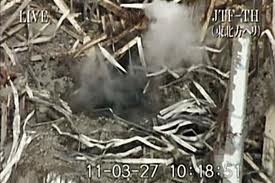
Fukushima Daiichi Power Plant
Easter and Passover religious holidays coincide, because the Jewish calendar is lunar, and Easter too is set according to the lunar calendar. Both holidays celebrate freedom and redemption and observe those values with time-worn rituals.
One of the elements of modern technology that has freed us from grinding labor is electricity – and it is something we all take for granted, an invisible blessing ignored and unappreciated, until there is a mishap and the lights go out.
Japan’s earthquake/tsunami took 25,000 lives and did massive damage. But according to David Pilling, writing in the Financial Times (April 14, p. 9), the loss of the Fukushima Daichi nuclear reactors will cause far more property and economic damage than the earthquake. TEPCO (Tokyo Electric Power Co.), which operates the reactors, supplies close to a third of Japan’s electricity, to 2 million businesses and 29 million households in Tokyo. Now, 13 of the company’s 17 nuclear reactors are out of action (not just those in Fukushima), and half of its 20 oil-fired thermal plants are out of action too, as well as the two coal-fired plants. The result is having a profound effect. This summer, there will be widespread blackouts in Japan, as Japanese try to air condition their homes and power use surges.
This in turn will damage huge swaths of industry – car parts, pulp and paper, steel, chemicals, breweries, computer chips, everything. All depend on a reliable plentiful supply of power.
“Modern Japan cannot function without TEPCO”, Pilling says. “Modern anywhere cannot function without electricity,” he might have added. TEPCo, he notes, is not a bad company. But it has been dogged by ‘moral hazard’ – by a long shoddy history of cover-ups and sloppy safety standards. And now the chickens have come home to roost. TEPCO has hugely mismanaged the Fukushima accident. And the Japanese government has bungled, in failing to nationalize the company and make the clean-up the responsibility of the government, which has far deeper pockets and resources.
An unceasing supply of electricity, because it is always just there, is ignored by nearly everyone. The people need power – and we need to bring power to the people, not just electric power, but power to regulate the electricity industry and make sure the electric companies (TEPCO is owned by shareholders) are run in a transparent, open and flawless manner. There is no room for error here. After BP’s disastrous oil spill, those who bought BP shares at the bottom made 70 per cent capital gains. This may happen with TEPCO as well. It is time to insist that basic necessities like water and power must be run on a pro-social, not pro-profit basis. Pilling asks, disturbingly, did TEPCO delay cooling the reactors with sea water, to avoid damaging equipment and suffering losses? Only managers who put shareholders’ interests first would even dream of such a calumny.
Global Crisis/Innovation Blog
Democracy? No – Dollarocracy: U.S. Elections Are About Money, Not Ideas
By Shlomo Maital
President Obama has announced the launch of his presidential candidacy for 2012. According to USAToday, the Democrat and Republican presidential candidates will each raise, and spend, $2 b. on the campaign! It’s a bright new era — the Age of Dollarocracy!
A stupid and disastrous Supreme Court decision has paved the way. In Citizens United vs. Federal Election Committee, the Court ruled in 2010 that independent groups not associated with political parties or campaigns can spend unlimited corporate and union cash on ads! The Republicans used this ruling effectively to outspend the Democrats in the mid-term 2010 elections and thoroughly drubbed the Dems. So the Dems are planning to try the same in 2012.
Election spending has been rising exponentially in the U.S. The elections have become a race to see who can raise more money for costly TV ads, not who can solve America’s myriad problems.
If you are really good at math, project these numbers into the future, and see where they lead. They definitely do not lead to an open democratic election where ideas compete, rather than corporate wallets:
(President, and his total campaign spending, by election): Clinton, 1992: $100.6 m. ; Clinton 1996, $108.5 m.; Bush, 2000, $172.1 m.; Bush, 2004, $356.4 m.; Obama, 2008, $745.7 m.; Obama, 2012, (est.), $2 b.
USAToday says Obama has asked 400 Democrat fundraisers to collect at least $350,000 each, by year’s end.
You may say that much of Obama’s money came from millions of small donations. Close inspection reveals, however, that it is the big corporate donations that drive fund-raising. And now, thanks to the Supreme Court, these are nearly unlimited.
Way to go, judges. You’ve helped ruin American democracy for many years to come, under the pretense that bankrolling candidates with unlimited millions is a constitutional right and part of freedom. Where is the freedom to elect the best candidate even if he or she takes positions that anger the big-money corporate interests?
Global Crisis/Innovation Blog
“Thunderous” New Nuclear Energy Technology
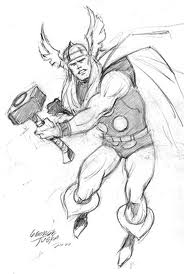
Thor God of Thunder
The current technology used to generate electric power from nuclear fission is a product of the Cold War. The nuclear reactors are derived directly from technology developed to power American nuclear submarines, by generating steam through nuclear fission, based on Uranium 235. This technology may be acceptable for nuclear subs, but after Japan’s disastrous mishap in Fukushima, it needs to be re-evaluated for civilian power stations.
There is an alternative. Kirk Sorensen, of Teledyne, and many top physicists, predominantly Nobel Laureate Carlo Rubbia (CERN), note that one ton of thorium can generate as much nuclear energy as 200 tons of uranium. But research on thorium reacts was halted in the 1950’s, when uranium reactors were built.
How would a thorium reactor work? Basically, if you use a small linear accelerator to bombard mined thorium (there is only one isotope, unlike uranium, which has several), with slow neutrons, Thorium 232 absorbs the neutrons and becomes Uranium 233. This fission reaction, which releases energy, creates heat that generates steam and turns turbines to make electric power. And the process can be designed so that the byproducts cannot be used to produce nuclear bombs. Moreover, the waste products deteriorate in a few hundred years, unlike thousands of years for plutonium waste. And the process can be halted instantly, in the event of trouble, unlike the uranium process, which requires cooling rods and cooling water (which tsunamis can disable). Just turn off the neutron-generating accelerator, and presto, the process halts. In the event of a disaster, the process stops itself in milli-seconds.
This is not theoretical. Pilot plants have been built in the U.S. and Russia, and China is currently engaged in large-scale research on thorium-based nuclear energy.
Thorium gets its name from the Greek God Thor, the god of thunder. A crash project to develop thorium nuclear technology could greatly help global warming, and alleviate the damage fossil fuels cause by generating carbon dioxide. It could be literally a thunderous development.


