
You are currently browsing the category archive for the ‘Global Crisis Blog’ category.
Global Crisis Blog: Dollar Weather Forecast: Calm Before the Storm — The Cassandra Syndrome
By Shlomo Maital
In Greek mythology, Cassandra, the daughter of King Priam was cursed — Cassandra was left with the knowledge of future events, but could neither alter these events nor convince others of the validity of her predictions.
I sympathize with Cassandra. While I believe a sharp deep fall in the value of the dollar is imminent and inevitable, the markets disagree. US Q4 GDP growth will soon be reported, and it will be very high. The Economist reports, in its latest issue:
America’s economy began growing in the middle of 2009 and seems to have accelerated sharply in the final months of the year. Initial GDP estimates for the fourth quarter are due on January 29th, and many analysts expect annualised GDP growth to have shot up to 5.5% or more.
You will not be surprised that Dr. Cassandra has an explanation. Much of this astonishing growth in GDP represents restoration of inventories, depleted during the previous two years. Actual final demand (GDP production that was purchased by someone) grew far more slowly. When inventories are replenished, GDP growth will adapt to final demand, and will fall sharply.
Why has the dollar not fallen, and instead risen? Writing in The New York Times (“Off the Charts”, IHT Jan. 24), Floyd Norris explains it clearly.
* China bought only $62 b. of US Treasury bonds in the first 11 months of 2009. Since some of China’s bonds matured during 2009, China’s total holdings actually fell, to $790 b.
* Since China’s Treasury bond purchases are its main avenue for supporting the dollar (vis a vis the renminbi), why did the renminbi not appreciate, instead staying constant at about 6.8 per dollar? Simple. China’s export surplus to the US declined sharply, leaving far fewer excess dollars splashing around in forex markets. And —
* America’s budget deficit soaring, owing to “stimulus” spending, and borrowing also soaring (in 2009 public holdings of US Treasury bonds rose by a staggering 23 per cent, or $1.4 trillion), to $7.8 trillion (!). But according to Norris, China bought just 4.6 per cent of the bonds the US Treasury sold in 2009, compared to nearly half of them in 2006. So who is funding America’s debt?
* The answer: Americans. With enormous amounts of money sloshing around in capital markets, and with investors traumatized by losses and risk, US Treasury bonds are newly popular. Moreover, large capital gains have accrued to savvy bond investors, as interest rates fell and bond prices rose. Norris reports that Americans bought 61 per cent of new Treasury bonds in 2009, while foreigners (China, Japan, Hong Kong, UK, etc.) bought only 39 per cent.
(Please see the graphs below).
======================================
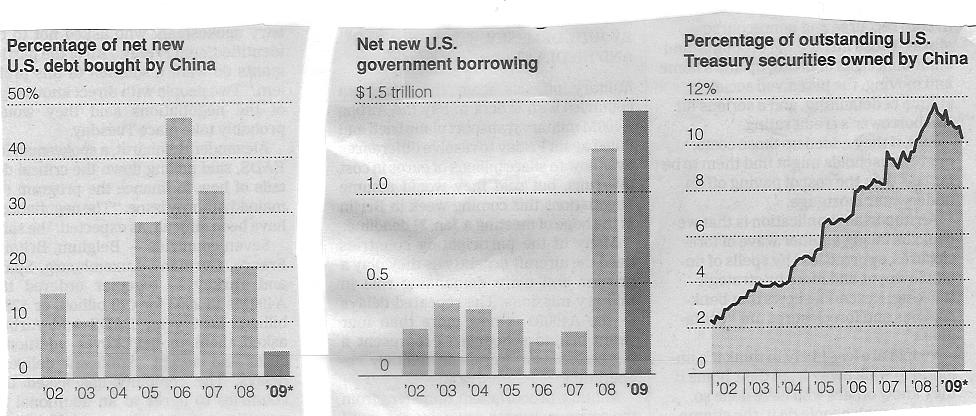
Caption: China bought far less US debt in 2009 (graph1) ; US govt. new borrowing soared (graph 2) in 2009, but more US investors bought Treasuries, hence China’s Treasury holdings as a percentage of total US Treasury Securities declined to about 10 per cent. Source: NYT
=========================
Conclusion: US institutional investors have temporarily ‘parked’ their money in low-yield safe Treasury Bonds. This took up the slack from China and kept the dollar strong.
What happens when these investors return to looking for more substantial rates of return, and dump Treasury bonds? Will Ben Bernanke raise interest rates to make Treasuries attractive? If so, bond prices will fall, causing capital losses. Moreover, higher interest rates may stifle the recovery.
America is still painted into its corner, and the dollar is still, in Cassandra’s opinion, very very shaky. Only a substantial increase in personal saving will generate stable demand for Treasury bonds. But if that happens, GDP growth will suffer. I don’t know what the solution is, nor does Fed Chair Ben Bernanke.
The strength in the dollar is the calm before the storm.
Innovation Blog
Intel Swims Upstream, Profits Downstream — “Moving Up” Strategy Pays Off
By Shlomo Maital
“if you see a successful organization, know that someone once made a courageous decision”. – Peter Drucker
Jane E. Shaw
In January 2009, at a time of general global panic over the 2007-9 crisis, Intel’s Board of Directors did what boards should do, but generally do not — it met in Santa Clara, CA., and chose to invest $7 b. in new chip plants in Oregon, Arizona and New Mexico, at a time when many other global companies were desperately slashing payrolls, investment and costs to survive. [1] It was a courageous move.
The Board’s decision was based on a strategy built by Mobility Group GM David (Dadi) Perlmutter, and MPG Mobile Platform Group Mgr Moolley Eden, who drove the design of a new chip, “Atom”. The Board itself, led by Chair Jane E. Shaw, (formally appointed as Chair only in May) took a triple gamble. It called for a large investment, when the future of demand for Intel microprocessors was in doubt. And it made those investments in the United States, where wages and production costs are high, rather than in Malaysia, Viet Nam, or China. Moreover, it invested in a low-price chip, Atom, used in netbooks, that threatened to ‘cannibalize’ Intel’s expensive four-core chips, much as Ford Motor Co.’s compact car Falcon, introduced in 1960, eroded demand for Ford’s higher-priced cars during the 1960’s.
Intel’s bold strategy was the quintessential embodiment of what management professors (including me) teach, but rarely see practiced: Move up in a downturn! Invest in a downturn, to capture market advantage during the upturn. Intel has done the same in past downturns. Intel has a huge pile of cash (driven by a zero-dividend policy, high margins and hence large retained earnings) and no leverage at all (Intel avoids bankers as if they had leprosy, because “they don’t understand high-tech”). It self-finances its investments. It never has to deleverage, like other firms. And Intel uses its cash aggressively, especially in downturns. It generated $11 b. in cash last year.
“They continued to innovate while many of their competitors were swimming in debt and reducing their head count,” said Bill Kreher, an analyst with Edward Jones. “The big and strong will emerge even stronger from the downturn, and Intel is no exception.”
Here are the results of Intel’s gamble, according to Ashlee Vance, writing in The New York Times:
On Thursday, Intel, the first major tech company to report earnings, said that revenue rose 28 percent to $10.6 billion in the fourth quarter, and the company earned the largest gross profit margin in its history. Net income was $2.3 billion, or 40 cents a share, up tenfold from the $234 million, or 4 cents a share, it earned in the last quarter of 2008. This week, Gartner, a technology research firm, reported that worldwide PC shipments rose 22 percent to 90 million units during the fourth quarter, which is a healthy recovery from the dismal fourth quarter of 2008. Because of its investment in the downturn, Intel, which makes the chips at the heart of most PCs, is poised to benefit from that surge more than most tech firms.
Why was the decision to go with the Atom so bold? Even Intel’s nimble competitor AMD is full of praise:
Intel executives had feared that the Atom and netbooks could undermine the company’s more profitable business with traditional laptops, but they pushed hard on the products anyway. The new plants produce the chip at a lower cost, and Intel is the leading player in the fast-growing netbook market. “I have to give them a pat on the back for having the guts to go with Atom despite the fact that it could have hurt their business,” said Fred Weber, a former executive with Intel’s rival, Advanced Micro Devices. “They built the right chip for the right time.”
Other global companies, too, have employed bold “Moving Up” strategies. Oracle, Cisco and HP all made strategic acquisitions during the past year. Oracle bought Sun Microsystems and thus added hardware to its software portfolio, Cisco spent $7 b. on a raft of acquisitions, and HP bought EDS’s services business.
The flip side of “Moving Up” is this — for smaller companies without cash reserves, your troubles are just beginning, not ending, as the recovery begins. Those huge formidable competitors you face? They’ve become much more formidable. They used the downturn to bulk up their muscles on steroids.
For the record, here are the members of Intel’s Board of Directors who made the courageous decision:
Jane E. Shaw Chairman of the Board, Paul S. Otellini President and Chief Executive Officer, Ambassador Charlene Barshefsky, Senior International Partner Wilmer Cutler Pickering Hale and Dorr LLP, Susan L. Decker, Entrepreneur-in-Residence Harvard Business School, John J. Donahoe, President and Chief Executive Officer eBay Inc., Reed E. Hundt Principal Charles Ross Partners, LLC, James D. Plummer Dean of the School of Engineering Stanford University, David S. Pottruck Chairman and Chief Executive Officer Red Eagle Ventures, Inc., John L. Thornton, Professor and Director of Global Leadership Tsinghua University, Beijing, Frank D. Yeary, Vice Chancellor University of California, Berkeley, David B. Yoffie, Max and Doris Starr Professor of International Business Administration, Harvard Business School.
[1] See Ashlee Vance, “Intel’s bet on innovation pays off in faster chips”, New York Times, Jan. 15, 2010.
Innovation Blog
Somali Piracy: Outsource the Problem to China?
By Shlomo Maital

US Missile Cruiser
 Somali pirate boat
A major part of world shipping goes through the Gulf of Aden, and the Bab-el-Mandeb strait, only 20 miles wide, between Yemen and Somalia, on its way to and from the Suez Canal. Somali pirates regularly attack ships, take them hostage and demand ransom. Some 21,000 ships cross the Gulf annually; pirate attacks are disruptive and damage world trade.
Using small motorboats, the pirates throw grappling irons onto ships, board them, and take them to the Somali coast, where they are held (sometimes for weeks or months) until ransom is paid by the shipowners.
Several countries have sent their navies to the region, including China and the United States. The US Navy should have solved the problem. America’s navy has battle tonnage equal to that of the 13 next-largest navies combined. It has missile cruisers that cost $1 billion each. Out of America’s annual defense spending of $533.8 b. (2010 budget), some $171 b. goes to the Navy (including Marines). The US Navy’s mission statement includes protecting “freedom of the seas”. Yet despite its presence in the Gulf of Aden, piracy continues and thrives.
Why?
Speaking on the BBC’s World Service, a Dutch ship captain who recently fended off a pirate attack analyzed the problem. He noted that China’s Navy is present in the area and is very effective. Chinese navy ships organize convoys through the Gulf of Eden that leave at precise regular announced times. Any ship that joins such a convoy is convoyed safely to its destination. But finding and joining such a convoy is fairly rare, because only the Chinese organize them.
Other navies, such as that of the US, do not announce such convoys, for fear that announcing the exact times and places will leave them vulnerable to attack by al-Quaeda suicide boats, like the kind that killed 17 US sailors in Aden, in the attack on the U.S.S. Cole.
If I were the U.S. Commander of Naval Operations, and if I allowed Somali pirates to continue to capture ships, I would offer my resignation at once, in humiliation. Why spend billions, if you cannot defeat a handful of Somalis with motorboats and AK-47s?
In a Letter to the Editor to the International Herald Tribune, commenting on another US failure (to forestall the nearly-successful attack on the Dec. 25 flight from Amsterdam to Detroit), Stein Bastiansen writes: “The U.S. is a country known for innovation, no-nonsense pragmatism and goal-oriented rationality but it also seems capable of building bureaucracies with choking limitations to creativity, independent problem-solving and critical thinking”.
Is there no-one in America’s Navy sufficiently embarrassed by the stinging defeat at the hands of illiterate Somalis to find a way to solve the problem? Of course, the root problem is the poverty-stricken failed state of Somalia. But sometimes illnesses are treated by attacking the symptoms. Surely 450,000 American sailors (regular and reserve), 284 ships and 3,700 aircraft can deal with the Somali pirates — or can they? If they can’t, American taxpayers have the right to demand their money back.
Innovation Blog
Global Water Shortage: A Simple Matter of Supply and Demand
By Shlomo Maital
Writing in the latest issue of McKinsey Quarterly, three authors show in stark terms the enormous global risk inherent in the current developing shortage of water, worldwide, and suggest why there are huge business opportunities in this risk. [1]
Using McKinsey analysis and data from the IFPRI International Food Policy Research Institute, the authors show the following:
1. Global annual demand for water, based on estimates from 154 water basins or regions, for the year 2005 is 4,208 billion cubic meters. Of that, 512 b. m3 is for home use, 693 b. m3 for industry, and by far the largest proportion, 3,003 b. m3 , is for agriculture. In other words, 71 per cent of water use goes for producing food.
2. Assuming 2 per cent compound annual growth (a conservative assumption), water demand will grow to 6,906 b. m3 by 2030 assuming no improvement in technology or water efficiency, or a rise of 65 per cent between 2005 and 2030. The fastest growth will be in water demand by industry, but agriculture (where demand will rise by 50 %, to support hungry growing populations) will still capture two-thirds of water demand.
3. Without a technological breakthrough, the world’s water supply will remain essentially constant in 2005-2030, at 4,222 b. m3 . This will be the world’s existing reliable water supply in 2030. The shortfall in the year 2030 will be huge: Almost 2,700 b. m3 .
4. If we project improvements in technology and infrastructure, up to 2030, world water supply will be 4,866 b. m3 . This still leaves an enormous shortfall, or excess demand, in the year 2030 of some 40 per cent of 2030 water supply, or 2,040 b. m3 .
5. Conclusion: Either the price of water will rise dramatically, all over the world, to ‘ration’ the short supply, or major technological advances arising out of massive R&D projects will reduce demand and increase supply. Of course, both will occur. Higher water prices will make large R&D investments in water technology profitable.
The world water shortage, like the world supply of oil and gas, will be inherently and massively unfair. Some countries like Canada will greatly benefit, if they have large supplies of fresh water relative to their population. Some countries which lack water (India) and where agriculture is important will greatly suffer.
Every country should calculate its own water balance in 2030 and build a strategic plan now. And innovators should begin to work on the key question: How can the world save water?
[1] Giulio Boccaletti, Merle Grobbel, and Martin R. Stuchtey. “The business opportunity in water conservation”. McKinsey Quarterly, 2010, no. 1.
Innovation Blog
The Most Effective Organization in America: You Won’t Believe Who It Is
By Shlomo Maital
 If you like lists of “greatest”, “most innovative”, “most creative“, try to guess who’s atop the list of “America’s most effective organizations”.
The expert selector? The late Peter Drucker.
His choice? The Salvation Army.
Said Drucker: “the Salvation Army is the most effective organization in America. No one even comes close to it in respect to © clarify of mission, © ability to innovate, © measurable results, © deducation and © putting money to maximum use.” [1]
Note those five criteria. How does your organization stack up on those five?
Salvation Army is highly visible at Christmas. Their bands and singers stand on street corners, ringing bells, singing and playing Christmas carols, and asking for donations. The organization was founded 145 years ago, in 1865, by William and Catherine Booth, who were appalled by conditions in the poor sections of mid-Victorian London and decided to change them. To accomplish their goal, they established an almost military-like organizational structure. Today, Salvation Army operates in some 120 countries, and has 2 million volunteers. They work with alcoholics, homeless, derelicts, and change their lives. Salvation Army’s mission? “…to preach the gospel of Jesus Christ and to meet human needs in His name without discrimination”. It has not changed a jot, in 145 years.
What is the key thing we can learn from organizations like Salvation Army. Notes Drucker: “Starting with the mission and its requirements may be the first lesson business can learn from successful nonprofits.”
If “getting the right people on the bus”, as Jim Collins writes, is vital for talent selection, then aligning the people chosen for jobs with the mission and vision is crucial. One of the for-profit organizations that does this best is outdoor apparel company Timberland, headed by Jeffrey Swartz. Swartz is an Orthodox Jew. He might be put off by this analogy, but I think Timberland is very similar to Salvation Army. Here is what Swartz told a group of Israeli start-up entrepreneurs that I led on a benchmarking visit to Timberland headquarters some years ago:
“At Timberland, we think ‘inside out’… from the factory, outward. In the Dominican Republic we have a plant that employs some 3,000 people. Most people there have worked in the factory for 12-15 years. We believe in social justice. We pay good wages there. This is the lowest-cost factory anywhere, and highest output. So social justice is also profitable.
“Community is more powerful than hierarchy. And in business strategy, moral authority trumps business authority. We build the joy of community.
“In the Godfather movie, the Godfather says (before ordering someone killed): ‘It’s not personal’. Of course it is personal. It is all personal. Showing respect to people, and answering their questions, is a major part of what I do.
Lately, Swartz told International Herald Tribune’s Adam Bryant: “..in hiring I’m desperately probing for the human inside the shell because the people who succeed at Timberland show a little leg, meaning they expose themselves. At Timberland I want to make it clear from the beginning it is personal… if you aren’t going to play at the level of personal, it’s probably not going to be nourishing for either of us.”
From Salvation Army’s deeply-committed Christians to Timberland’s Jeffrey Swartz, an Orthodox Jew, the message is the same:
A clear powerful mission, coupled with a careful selection process that recruits those who deeply and sincerely believe in it, create superior results.
[1] BBC’s Peter Day reported on the modern Salvation Army on Global Business, Dec. 24/09. Drucker’s article ” What Business Can Learn from Nonprofits” was published in HBR July-Aug. 1989.
Global Crisis Blog
The End of Chimerica — The End of the World?
By Shlomo Maital
Niall Ferguson is a respected historian and economist at Harvard. Together with Moritz Schularick, Free University (Berlin), he has made a compelling and deeply troubling argument. They show why the world economy is in deep trouble, what the solution is and — in my opinion — why the solution will not be adopted, until it is too late. [1]
Here is a brief summary (perhaps, I admit, made more extreme) of their case:
1. “For the better part of the past decade, the world economy has been dominated by a world economic order that combined Chinese export-led development with US over-consumption.” Under Presidents Reagan, Bush Sr., Clinton and Bush Jr., America lived beyond its means, buying cheap Chinese exports that stuffed the shelves of Wal-Mart, financed by borrowing from the Chinese (through Chinese purchase of US Treasury Bonds, over $2 trillion worth). America enjoyed living beyond its means for nearly three decades. China loved it too, because export-led growth created jobs for hundreds of millions of Chinese migrating from farms in the West to factories in the East. American capitalists made fortunes. American workers were totally screwed. America’s middle class lost its well-paying manufacturing jobs.
Here is evidence for the last underlined sentences: Fully HALF of the gain in family income, from 1993-2007, accrued to the top 1 % of income groups! [2]
% of total family income growth captured by top 1% of income groups:1993-2007 50 %
(Clinton: 1993-2000 45 %; Bush 2000-2007 65 % )
2. “In some ways China’s economic model in the decade 1998-2007 was similar to the one adopted by West Germany and Japan after World War II. Trade surpluses with the U.S. played a major role in propelling growth.”
Japan and Germany too used undervalued currencies to propel exports. But as they became wealthy, they realigned their currencies to realistic rates relative to the dollar. China refuses to do so.
3. “We conclude that Chimerica cannot persist for much longer in its present form. As in the 1970s, sizeable changes in exchange rates are needed to rebalance the world economy. A continuation of Chimerica at a time of dollar devaluation would give rise to new and dangerous distortions in the global economy.”
The global conspiracy between America and China (“Chimerica”), for America to overconsume and China to oversave has now led to global crisis. If China persists in keeping the yen-dollar rate frozen, and when (not if) the dollar drops, Chinese exports will become even more competitive relative to other currencies like the euro. This would be disastrous.
Conclusion: The world is in deep trouble. A major fall in the dollar relative to other currencies (except the yuan/renminbi) is inevitable. The question is only, when will it begin? And how massive will it be? America will welcome it, because it is the only way America can hope to repay the massive dollar debt it owes to other nations.
If China and America do not cooperate to manage the dollar collapse, the world economy will be in huge trouble.
China is led by shrewd leaders. They may perceive that a collapse in the dollar is in their interest, ending forever American hegemony. They may be willing to lose $600 b. (30 per cent of their $2 trillion dollar holdings) in return. China may be believe it no longer depends on the world economy, having built a strong Asian ecosystem and having shifted to rising internal demand to replace some export demand.
I urge all readers to think very carefully about a scenario, in which the value of the dollar relative to other currencies drops by 30 per cent, and in which China continues to try to buy massive amounts of dollars to keep the yuan-dollar exchange rate at 7 RMB per dollar — and ultimately, gives up, putting the dollar into free fall.
With Americans used to overspending, and China stubbornly clinging to its undervalued currency, there seems to be no other more hopeful scenario that is anchored in reality.
[1] “The End of Chimerica”. Niall Ferguson and Moritz Schularick. Harvard Business School Working Paper 10-037, Dec. 2009.
[2] “The Evolution of Top Incomes in the United States”, Emmanuel Saez, Univ. of California, August 5, 2009.
Global Crisis Blog
Deficit Panic: Let’s Hope History DOES Repeat Itself
By Shlomo Maital
Dec. 12/2009
A Nov. 30 headline in Britain’s Daily Telegraph reads:
Morgan Stanley fears UK sovereign debt crisis in 2010
“Britain risks becoming the first country in the G10 bloc of major economies to risk capital
flight and a full-blown debt crisis over coming months,” according to a client note by Morgan Stanley.
Capital flight from Britain? Want a real nightmare? How about capital flight from America? Britain’s debt-to-GDP ratio is growing the fastest, but America’s is much larger, soaring to over 100 per cent by 2013, a level that triggers IMF alarm bells for countries far less crucial that America.
There is good reason to panic about levels of government debt in America, UK, Japan and the EU.
But history also shows there is a solution.
Bill Clinton was elected President of the United States in Nov. 1992. He inherited enormous budget deficits from his predecessor, George Bush Sr. Together with his key economic advisor Larry Summers, Clinton fashioned a package of measures aimed at slashing the deficit, and getting government borrowing under control.
The Deficit Reduction Act: ¨ created 36 percent and 39.6 income tax rates for individuals. (28% was the maximum rate up to then). ¨ created a 35 percent income tax rate for corporations. ¨ the cap on Medicare taxes was repealed. ¨ transportation fuels taxes were raised by 4.3 cents per gallon. ¨ the taxable portion of Social Security benefits was raised. ¨ the phase-out of the personal exemption and limit on itemized deductions were permanently extended.
Many of these measures were tremendously unpopular politically, especially Medicare, Social Security and income tax.
The bill very nearly failed. It was a ‘squeaker’. According to Wikipedia:
“Ultimately every Republican in Congress voted against the bill, as did a number of Democrats.
¨ Vice President Al Gore broke a tie in the Senate on both the Senate bill and the conference report. The House bill passed 219-213.
¨ The House passed the conference report on Thursday, August 5, 1993, by a vote of 218 to 216 (217 Democrats and 1 independent (Sanders (VT-I)) voting in favor; 41 Democrats and 175 Republicans voting against), and
¨ the Senate passed the conference report on the last day before their month’s vacation, on Friday, August 6, 1993, by a vote of 51 to 50 (50 Democrats plus Vice President Gore voting in favor, 6 Democrats (Lautenberg (D-NJ), Bryan (D-NV), Nunn (D-GA), Johnston (D-LA), Boren (D-OK), and Shelby (D-AL) now (R-AL)) and 44 Republicans voting against).
President Clinton signed the bill on August 10, 1993.
Strong economic growth, which both helped (and was helped by) the deficit reduction act, led to booming tax revenues that eliminated America’s federal budget deficit within four years. From a deficit of $300 b. in 1993 (one fourth the size of today’s US budget deficit!), the deficit was zero by late 1997, and by the time Clinton left office (with George W. Bush narrowly defeating Al Gore, who had played a key role in getting the deficit reduction legislation through Congress), the deficit had become $300 b. — but a surplus!
(See Figure).
Under Bush, the deficit again soared (because of massive irresponsible tax cuts) to $500 b. within three years.
Can Obama follow Clinton’s lead? Can he slash the deficits, reduce America’s borrowing, and save the dollar form collapse, while sending more troops (and money!) to Afghanistan?
Remember — Obama’s chief economic advisor is the same Larry Summers that helped shape Clinton’s plan.
Let us hope history DOES repeat itself. If it does not, the world is in trouble.
Global Crisis Blog
“Wall Street Recruiters Trawl Online Poker Circles for Talent”
or
Why We Should Lose Sleep
By Shlomo Maital
Nov. 22/2009

Do you lose sleep, like me, because America will pay, in 2015, some $533 b. in interest on its public debt, debt equal to an entire year’s worth of GDP ($15,000 b.), where the interest alone will consume a third of all federal income taxes paid that year?
Do you lose sleep because, like me, you believe America is endangering the global economy because its currency, the dollar, has been dangerously overprinted and its impending collapse undermines global capital markets?
Do you lose sleep, like me, because while political leaders and central bankers declare the global recession over, global managers see no sign that ordinary people are spending more or that business are investing more, and a significant minority fear another recession soon?
If that is not enough, here is another reason to lose sleep. The title headline is genuine, though it appears to come from Comedy Central, or MAD magazine. It is from the International Herald Tribune, taken from Mason Levinson’s piece for Booomberg News.
Here is the gist of Levinson’s report: “an increasing number of hedge funds and brokerage firms are scrutinizing professional poker to find talent and analytical tools.” Levinson reports that a recruiter got a request from a hedge fund for online poker players with “no financial experience”, after the World Series of Poker in Las Vegas four months ago.
Let me get this straight. It is widely agreed that a core cause of the global crisis 2007-9 was the utter breakdown in risk management models of banks and investment funds. So, the solution is to recruit poker players? The people who bluff, conceal, and deceive, who bet the whole pot on a single card?
Global capital markets are apparently being rebuilt as enormous poker games with daily pots of $3.2 trillion (two-thirds of that derivatives). Some of the better players, like Goldman, Sachs are profiting enormously. In the past 90 days (the 3rd Quarter, July – Sept.), Goldman Sachs made $100 m. or more on each of 36 days from trading profits alone. Why would they not want to return to the Great Global Poker Game?
Let’s see if we can figure out an optimal way for the financial services industry to build back the public’s trust. How about, say, hiring a thousand star poker players? Yes — that will do it. That will certainly make ordinary people put their money back in banks and keep it there.
Global Crisis Blog
Tale of 20 Losers: A Massive Failure of Leadership
By Shlomo Maital
Nov. 16/2009
Fortune magazine publishes annually the Global 500, a listing of the world’s 500 largest companies. In 2008, 20 large companies (those with the dubious distinction of making the 20 Largest Losers list) lost a massive amount of money: $320 b. in total. (To reach that sum, Israel’s 7.2 million inhabitants would have to work for two entire years).
Fannie Mae $58.7, RBS $43.2, GM $30.9, Citigroup $27.7, UBS $19.3, Conoco $17 , Ford $14.7 , HBOS $13.8, Time Warner $13.4, Pemex $10, Delta $8.9, Hypo $8, Hitachi $7.8, Alcatel $7.6, Credit Suisse $7.6, Bayern $7.4, Lyondell $7.3, Flextronics $6.1, Mizuho $5.9, Deutsche Bank $5.9
Not all were banks or financial services companies. Some were manufacturing companies, media, telecom, airlines, even oil companies! All reflected a massive failure of CEO leadership.
What is the common thread uniting all of these losers — if there is one? I believe it is the utter failure of their Boards of Directors and CEO’s to think independently, and daily, to challenge what they were doing and how they were doing it. Some CEO’s, like Citigroup’s, seemed unaware of their organization’s huge exposure to risk.
There were those that did resist the ‘herd’. The CEO of Canadia’s Toronto Dominion Bank kept his bank out of the sub-prime mortgage market, while other huge banks like Citigroup were being swept to disaster.
Does your organization have leadership that thinks independently, evaluates evidence on its own, and constantly challenges the prevailing herd thinking? Does your Board of Directors contribute to this, and is it part of the problem (complacently rubber-stamping whatever the senior management says)?
If your answers are “NO”, and “YES” — prepare yourself to join Fortune Global 500’s list of losers in the future — perhaps, the near future.
———–
In the Tables below, I provide an analysis of the 20 Largest Global Losers in 2008:
Table 1. Industries Represented in the 20 Largest Losers
Banks & Financial Services (9 companies); Manufacturing (3); Automobiles (2); Oil Companies (2); Telecom Infrastructure (1); Media (1); Airlines (1); Real Estate Holding (1).
Table 2. Countries Represented in the 20 Largest Losers
U.S. (8 companies); Germany (3); Switzerland (2); UK (2); Japan (2); Mexico (1); Taiwan (1); France (1).
Table 3. Key Management Leadership Errors
(companies may appear more than once)
* Excess lending to poor risks, bad investments (9 companies)
* Overpriced, or badly-timed, acquisitions (5)
* poor products unsuited to market needs (5)
* exchange-rate-induced losses, poor hedging (3)
* operational inefficiency 1
Global Crisis Blog
Russia’s President Tells the Truth:
“Russia’s Economy is Archaic, Hollow”
By Shlomo Maital
Nov. 13/2009
Harvard Business School Professor Chris Argyris conveys a simple, powerful message to his students and clients: “Tell the truth!”. Organizations that cannot face the brutal facts by definition are incapable of dealing with them. “Tell the truth” is not a Sunday School moral lesson but a key principle of management.
Take Russia, for instance. It is widely assumed that former President Putin, who reinvented himself as Prime Minister, still pulls the strings. But new President Dimitri Medvedev (pronounced med-vye-dev, few TV and radio broadcasters — and even George W. Bush — take the trouble to learn to pronounce it properly) is asserting himself and becoming a strong leader. And he tells the truth.
In a recent speech, he said it bluntly: Russia’s economy is archaic and hollow. The money pouring in from oil is highly deceptive and dangerous. Russia can, and perhaps has, become like an oil-rich Mideast sheikhdom, drowning in paper but with no real economy apart from sticky black goo.
Here is an excerpt from an IMF report on Russia:
GDP went from less than $1 trillion (£600bn) in 1998 to $2.1tn (£1.26tn) in 2007 but has since dropped sharply (IMF). Exports as a portion of GDP soared from 20% in 1990 to more than 60% in 1992, but had fallen back to 33% by 2008 (World Bank). Mineral products accounted for 70% of exports in 2008, machinery – 5% (Russian government statistics).
Here is what Medvedev said, in his speech, according to the BBC:
Russian President Dmitry Medvedev has called for profound reform of the economy in his annual state of the nation address. The Soviet model no longer worked, he said, and Russia’s survival depended on rapid modernisation based on democratic institutions. An oil and gas-based economy had to be reworked with hi-tech investments. Inefficient state giants should be overhauled and issues of accountability and transparency addressed, he said. “Instead of a primitive economy based on raw materials, we shall create a smart economy, producing unique knowledge, new goods and technologies, goods and technologies useful for people,” Mr Medvedev said. “We can’t wait any longer,” Mr Medvedev said. “We need to launch modernization of the entire industrial base. Our nation’s survival in the modern world will depend on that.”
The BBC Moscow correspondent Richard Galpin, commented on the speech:
Mr Medvedev is certainly establishing more of a political identity by focusing on the modernisation theme. But there is still deep skepticism about his ability to deliver on any of the reforms he has called for because his power base is extremely limited and there will be many vested interests to overcome to bring about real change.
Russia is for many companies a potentially rich market, but fraught with huge difficulties — corruption, bureaucracy, chaos. We should watch Medvedev and Russia closely in the coming years. Former IMF Deputy Director Stanley Fisher once said that the world believed Russia, as a nuclear power, could not be allowed to collapse; yet in August 1998, it did and no-one came to the rescue. One can imagine a failed, hollow archaic Russian economy run by Mafia — and the immense mischief it could cause to the interests of freedom and stability in the world.


