
You are currently browsing the category archive for the ‘Global Crisis Blog’ category.
The Purpose of Life? Little Things Mean A Lot
By Shlomo Maital

In a recent blog, “Disney Theory of Life” (April 14), I referred to David Brooks’ New York Times column about the purpose of life. I offered my own theory, based on the Disney World mantra, “Make People Happy”.
In today’s New York Times, Brooks returns to this theme and quotes emails he received from readers. “I expected most contributors would follow the commencement-speech clichés of our high-achieving culture: dream big; set ambitious goals; try to change the world. In fact,” notes Brooks, “a surprising number of people found their purpose by going the other way, by pursuing the small, happy life.”
Examples? Kim (apparently a therapist): “Now my purpose is simply to be the person who can pick up the phone and give you 30 minutes in your time of crisis”. Terence: “big decisions have less impact on a life as a whole than the myriad of small seemingly insignificant ones.” Hans: “At age 85, …I am thankful to be alive. If there is one thing that keeps me focused, it’s the garden. Lots of plants died during the harsh winter, but, amazingly, the clematises and the roses are back, and lettuce, spinach and tomatoes are thriving in the new greenhouse.”
So, bottom line? Follow the wise advice of a woman I read about (probably in the excellent AARP retired persons’ magazine): “Ask yourself each morning, when you wake: what will I do for others today? And what will I do for myself?” And, as you fall asleep at night, ask yourself, “what did I do for others today? And what did I do for myself?”
A kind word? A helping hand? A smile? Little things, tiny things. They add up to something really big. They give real meaning to our lives, one day at a time.
Here are the words to the lovely song, Little Things Mean a Lot,
Blow me a kiss from across the room
Say I look nice when I’m not
Touch my hair as you pass my chair
Little things mean a lot
Give me your arm as we cross the street
Call me at six on the dot
A line a day when you’re far away
Little things mean a lot
Don’t have to buy me diamonds and pearls
Champagne, sables or such
I never cared much for diamonds and pearls
’cause honestly, honey, they just cost money
Give me your hand when I’ve lost the way
Give me a shoulder to cry on
Whether the day is bright or gray
Give me your heart to rely on
Send me the warmth of a secret smile
To show me you haven’t forgot
For always and ever, now and forever
Little things mean a lot
Give me your hand when I’ve lost the way
Give me your shoulder to cry on
Whether the day is bright or gray
Give my your heart to rely on
Send me the warmth of a secret smile
To show me you haven’t forgot
That always and ever, now and forever
Little things mean a lot
And, here is the link to Kitty Kallen’s lovely rendition of it. http://www.oldielyrics.com/lyrics/kitty_kallen/little_things_mean_a_lot.html
How Teachers Ruin Inquiring Minds – And Why They Must Stop
By Shlomo Maital

Illustration by Avi Katz
Thanks to my outstanding colleagues at Technion’s Center for Improvement of Teaching and Learning, our MOOC (massive open online course), Cracking the Creativity Code: Part One – Discovering Ideas, launched on the Coursera website on May 18, and has over 6,000 students enrolled, worldwide, from Qatar, India, China, Iran, Iraq and Saudi Arabia, among others. The course is based in part on the book by the same name by Ruttenberg & Maital.
Part of the course involves “chat” forums, organized as ‘forums’ on topics the students themselves initiate.
Lizzie writes: “My 7th grade teacher’s response to many a question was ‘don’t show your ignorance by asking that’. Which didn’t reduce my ignorance but did get me to stop asking questions and start hating school instead of loving it.” Malgorzata responds: “Oh yes. I have suffered high school phobia because of it. Constant bullying by teachers was unbearable.”
How many teachers encourage questions? How many shut them off, destroying the spirit of inquiry and love of learning? Are teacher training schools helping teachers encourage students’ questions, rather than shutting them off?
Javier writes about how his teacher, in Barcelona, requires the students to copy verbatim a short story. He tried an experiment – writing with his eyes closed, to see if he could write straight lines without looking. The teacher ridiculed him before the class. End of experiment. Could the teacher have responded: Class! Javier is trying to write with his eyes closed. Let’s all try it. Let’s see what happens. Javier, thank you for this interesting idea.!
There are millions of superb, dedicated teachers all over the world, educating the next generation, overworked, underpaid, underappreciated. But there are still too many to believe they should be teaching the laws of algebra, rather than (in addition) why mathematics is interesting and fun to explore.
The Nobel Laureate in Physics Isidore Rabi tells this story: When he came home from school, his mother never asked him, what did you learn today in school? Instead she asked, Isador, did you ask good questions in class today? He attributes his success as a scientist to his mother and to her question. How many Nobel Prizes are we destroying, by shutting off kids’ questions?
Pop a Pill? No! There’s a Better Way
By Shlomo Maital
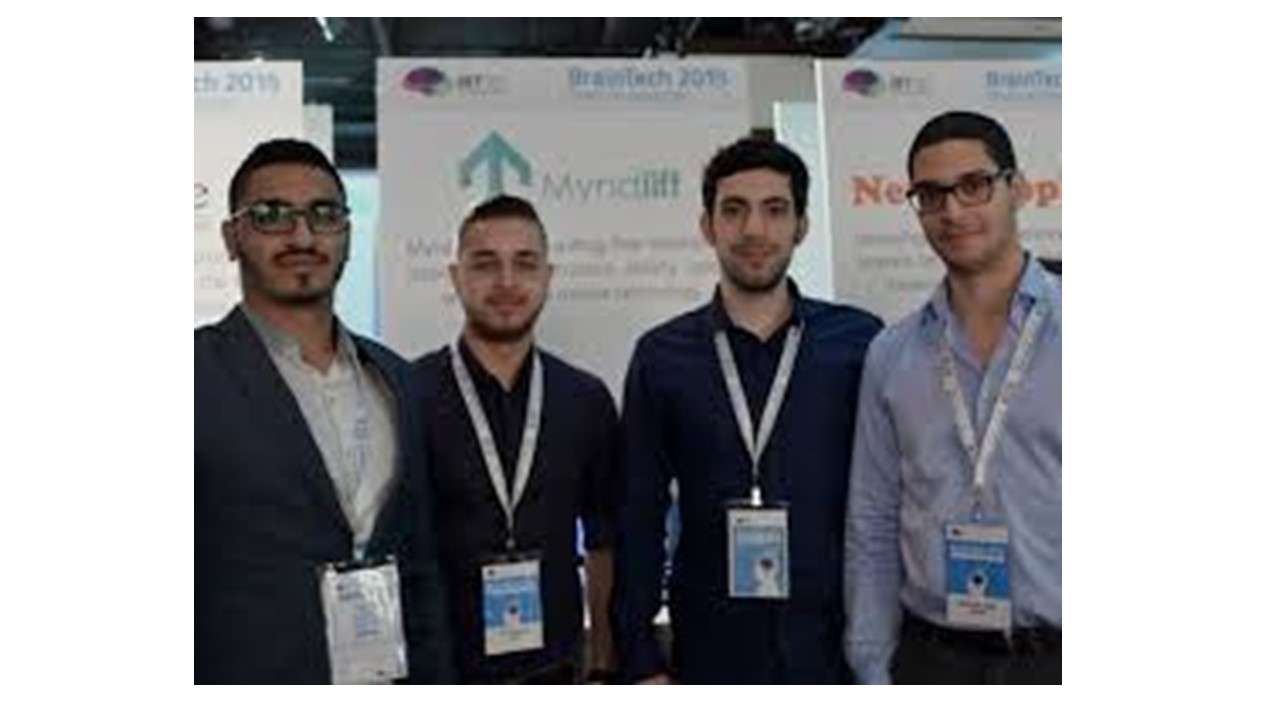
Aziz Kaddan, Amir Khalaily, Hilal Diab, Anas Abu-Mukh
Arab culture is highly entrepreneurial. Given the right opportunities, Arab entrepreneurs could transform the Arab world, shifting Western attention from ISIS and its vicious violence to IS (Innovation Startups). Here is an example (thanks to Sharona, my wife, who drew my attention to this story).
ADHD attention deficit hyperactivity disorder is widely treated with a drug, Ritalin. Novartis sells $350 m. worth of methylphenidate (Ritalin) each quarter. When kids have problems in school, it’s super easy for teachers to demand that they pop a pill – even if the problems could be addressed differently, with a little effort. In general, our pop-a-pill society plays into the hands of Big Pharma, and sometimes does immense harm to us all. Ritalin is now used widely as a recreational drug, too. For Big Pharma, it’s all just money.
NASA developed a computer-based technique to improve attention, focus and learning. Now, Aziz Kaddan, age 22, an Israeli Arab, and three friends have launched a startup, Myndlift, that uses biofeedback to deal with ADHD. It’s an app-based wearable solution, together with mobile games that work only through attention, and boost attention levels with only 10 minutes of play time a day. Kaddan is the son of a neurologist, and got a computer science degree at the age of 19.
Friends urged Kaddan to up the price of his app (it’s only $15 for the premium version), but he and the founders believe that to keep this solution accessible, it has to be quite cheap. (Big Pharma – don’t you just love it?).
Over the years, I’ve taught many students with ADHD. Most of them avoided Ritalin, and instead developed their own personal unique ways to focus and deal with their challenges. Sometimes, the ADHD was even a blessing, because it appears that those with ADHD happen to be very creative.
Next time you have a problem, and someone tells you to pop a pill, think about it for a while. Sometimes you really do need that pill. Sometimes, you can manage better without it.
Thanks to Aziz and his friends for showing us another way, other than pill popping. I hope their story will inspire other Israeli Arab entrepreneurs.
Why Boeing’s Dreamliner 787 Is a Nightmare
By Shlomo Maital

Yup, Boeing, one of America’s leading industrial exporters, is in trouble – again.
In 2011 it introduced the fuel-saving Dreamliner, a truly great and comfortable aircraft — but Boeing is still not making money on it. Normally, the learning curve lowers production costs dramatically, moving new planes into profitability. Why not the Dreamliner, which is a great airplane?
Reading between the lines in Christopher Drew’s New York Times article:
Boeing has not yet ramped up production to 12 a month. There are delays in supply of seats from a French supplier, Zodiac Aerospace.
But buried in the article is the real zinger: “Boeing has an aggressive stock repurchasing program; it spent $2.5 billion to buy back 17 million of its shares in the first quarter.”
Had Boeing used that cash to boost its production rate, and help Zodiac get those seats delivered, it could have moved down the learning curve faster. Instead it buckled to shareholder pressure and distributed the money instead of re-investing it.
I never give advice on the stock market. But here is one exception: Never invest in shares of a company that spends money to buy back its own shares. The reason: It proves the company knuckles under to shareholder pressure (bad sign), and proves the company has no other imagination or vision for using scarce resources.
And one more tip: Beware of the accounting numbers. Boeing apparently can book profits computed according to “average projected cost” (using the learning curve) rather than the actual cost of planes at the moment. This is highly dubious. And Boeing has used this method for ages. Where are the audit board and the auditors?
Financial Trading: They’re Still Ripping Us Off
By Shlomo Maital
 Sarao – The Guardian sketch
Navinder Singh Sarao
With the indictment in London’s Westminster Magistrate’s Court of Navinder Singh Sarao, we again become aware that financial traders and speculators are still ripping us off.
A criminal complaint filed against Sarao cites a practice known as “spoofing”, used to manipulate prices and make profits. Spoofing involves placing orders to move the price of a financial asset. When the price moves (up), the trader sells the asset, then cancels the original (fake) order. Apparently this practice is widely used by some high-frequency trading firms (i.e. firms that use super-computers to spot profit opportunities and buy and sell in a micro-second, faster than a human trader can spot them).
The spoofing method was apparently used in 2010, May 6, to move the Dow-Jones, which plunged some 1,000 points in moments and caused huge disarray in financial markets.
One of the markets in which spoofing occurs is the Chicago Mercantile Exchange, where traders can remain anonymous.
The information above is reported by Nathaniel Popper, in the New York Times.
Ordinary citizens are ripped off, because when asset prices are manipulated, the traders doing the manipulation take the profits at our expense, as we pay more for the assets we buy than we should.
There seems to be no end to the sleeze and crookedness in financial trading, and it is small comfort to hear they are ‘fringe crackpots’. The problem is, nobody knows how widespread these practices are, because there is almost no way to tell, especially with anonymous trading.
Why not end anonymous trading? It won’t end spoofing, but at least it will increase the risk the spoofers take. There is no crime in placing an order and then cancelling it. But when this is done systematically, it becomes suspicious. Proving criminal intent is super difficult. The only solution is, financial traders who don’t cheat. But, why not cheat, if enormous profits result from it?
Starbucks & Howard Schultz:
He’s For Real
By Shlomo Maital
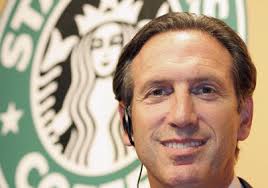
Is Howard Schultz for real? Are his pro-social activities and investments genuine? Or is it all an act, to promote Starbucks?
Writing in the New York Times, columnist Joe Nocera answers: He’s for real. Schultz grew up poor in Canarsie, Brooklyn, housing projects, bought a small coffee chain in Seattle and turned it into…Starbucks. He was CEO until 2000, turned over management to someone else, Starbucks quickly crashed, and Schultz returned to the CEO job in 2008. Starbucks’ market value rose from $5.3 billion at the time, to today’s $72 billion. Clearly, Schultz knows something about managing and growing businesses.
But what Nocera particularly stresses is Schultz’s social vision. Here are some of his projects:
- In 2011, he called for a boycott on political contributions, until the two parties Democrat and Republican began to work together
- He began a project to make loans to small businesses, partly with money from the Starbucks Foundation, when the economy was struggling.
- He co-authored a book about the plight of American military veterans, and donated $30 m. to this cause from his family’s foundation.
- He has launched a medica company, with Rajiv Chandrasekaran, that will use storytelling to tackle important social issues.
- He started, last month, Starbucks’ Race Together campaign… including 10 forums for Starbucks’ employees to discuss race issues.
- He has promised to hire 10,000 youths who are neither in school nor in the work force.
- He will open Starbucks stores in disadvantaged neighborhoods, including Ferguson, Mo. Personally, I think Starbucks coffee is ..well, yuck. It is Robusta, rather than Arabica, because Robusta is cheaper. But heck, let’s give Schultz credit. He knows how to manage, and he also has a highly pro-active conscience. We need more Howard Schultz’s.
- Schultz’s vision is to re-establish the American Dream, which he himself lived. As one scholar pointed out, it is not just the inequality in wealth and income that is disturbing, in America, but the lack of social mobility, the ability to move from lower deciles to upper ones, as Schultz did. The American Dream has become the American Myth. Schultz wants to rebuild it.
The Purpose of Life: Ask Walt Disney?
By Shlomo Maital
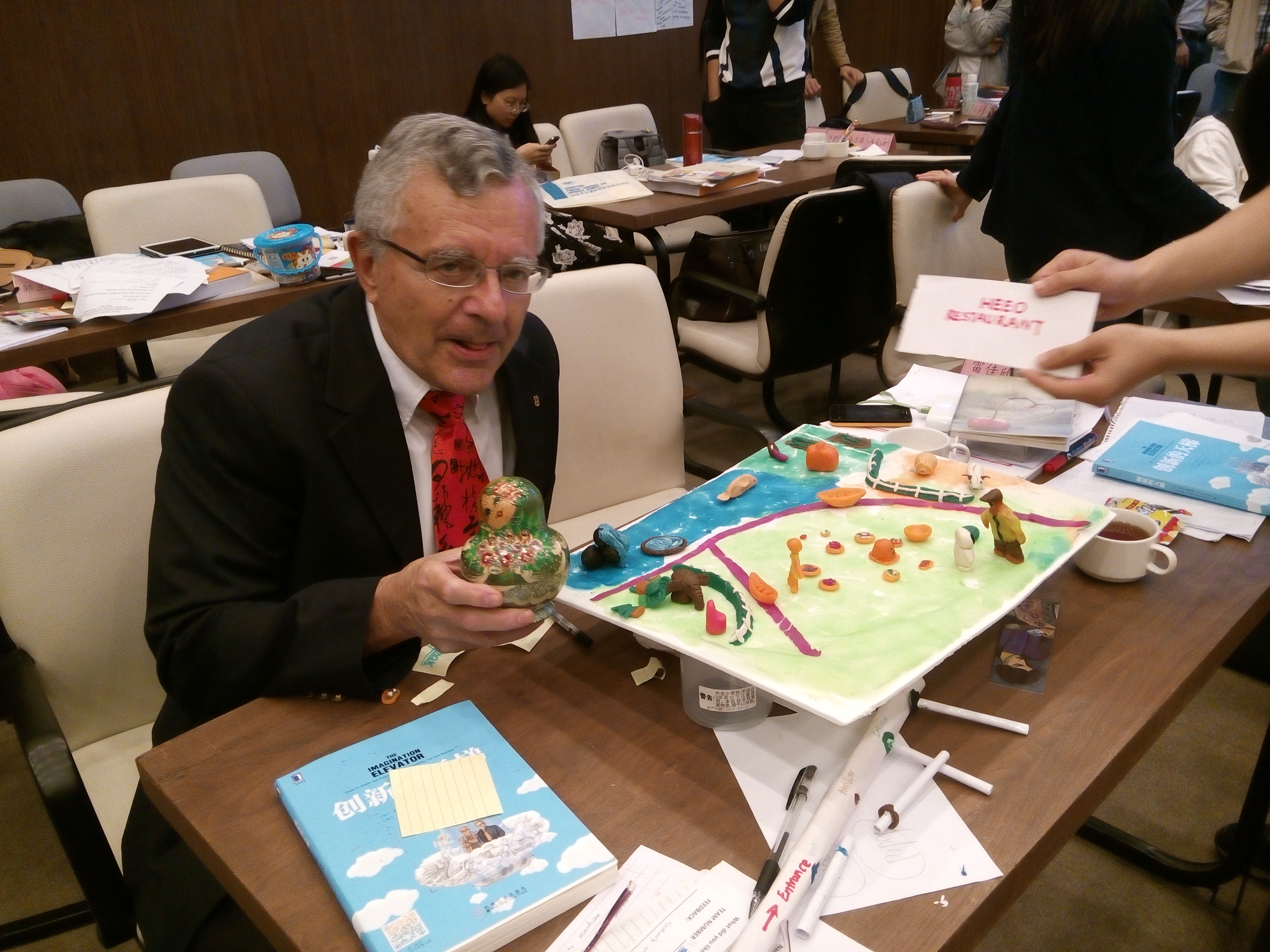
Last month, I taught a one-week course on entrepreneurship and creativity to 43 dynamic Chinese students, mainly undergraduates studying at Shantou University, Shantou (Guangdong). The course was in English; the students worked on business plans in teams, and made elevator-speech presentations (in English), prepared 2-minute videos, and wrote business plans (in English). (The photo shows a Play-Do, or plasticene, model of one of the team’s ideas, for a novel restaurant – they stayed up all night to create it!).
I just received an email from one of my students. I pasted it below, without correcting the syntax… (Shantou University has a phenomenal English Learning Center, that provides each student with a tailored personal program for learning to read write and speak English)….
I want to ask you a personal question, this question had confuse me for a very long time, the question is that “what do we live for?”, what’s the point of live? create value? make money? love? i not sure. now i just in my 20s age, i always feel there’s no a direction in my life, i’m not sure what is going on in my rest of life. but you have a lot of experience about life, you have make a lot of achievements in your life, so want to ask your answer about the question, i hope you can give me some suggestion.
Dear readers: How would YOU answer my wonderful student?
My own answer was rather woeful – but, here it is. Congratulations for just asking the question. Most of us ask it, at the end of our lives, when it is nearly too late to actually change anything. I think the purpose of life is best defined by Walt Disney. He set the mantra for Disneyland (later, Disney World): “Make people happy”. Create value. Use your brains, your courage, your intellect, and above all, your CREATIVITY – to create value, by widening people’s range of choices, and thus, making them happy, or at least happier. When you make other people happy (those around you, family, children, spouses, relatives, friends, total strangers), you will make yourself happy as well. If you only try to make yourself happy, in the end, you will be very alone.
Anthony Ray Hinton: 28 Years on Death Row:
What He Teaches Us All
By Shlomo Maital

The BBC World Service reports: “A man released from prison after nearly 30 years on death row in Alabama has blamed his conviction on being black and poor. Prosecutors dropped the case against Anthony Ray Hinton, 58, when new ballistics tests contradicted the only evidence that linked him to the murders of two restaurant managers in 1985.”
The man is Anthony Ray Hinton. And he has every reason to be bitter, angry and disconsolate. Society took away his life, unjustly.
So, how does he really feel? And how did he retain his sanity, while on Death Row for 28 years, beginning with when he was only 29 years old? (He is twice that age today). The BBC reports: “Asked if he felt angry about the people who imprisoned him he said: “I am a joyful person. I have a good sense of humor and that’s what kept me for the 30 years I was locked up. I couldn’t let them steal what I had left which was joy. They had robbed me of my 30s, my 40s and my 50s so if I get mad and hate them I’m letting them steal my joy.” He said he was taking life “one step at a time” and wanted to “just try to live within my own means, try to bring joy to someone else, live a fruitful life and just be happy”.
I believe that if Anthony Hinton can still seek to “bring joy to someone else”, after nearly 3 decades on Death Row, surely all of us can do the same!
And by the way – we learn one more thing from Hinton’s release, according to his lawyer: “Mr Hinton is the 152nd person to be exonerated after being sentenced to death. It’s a shocking rate of error. No system would tolerate that rate of error that cared about the people that were at risk but because most of the people on death row are poor or people of color we seem to not care as much that some of them are innocent.”
Methuselah Comes Back to Life!
By Shlomo Maital

In the Bible, Methuselah lived 969 years (Genesis 5:27), longer than anyone else recorded; his father was Enoch, who walked with G-d and went straight to heaven without dying.
The modern Methuselah is much older – a Judean date palm over 2,000 years old! And its products one day will be truly heavenly – dates that are identical to those enjoyed in Biblical times, in Judea and later exported to Rome, where the Romans loved them.
How did this happen? A decade ago, Sarah Sallon, an M.D., director of the Louis Borick Natural Medicine Research Center at Hadassah Medical Center, had a wild idea. Germination of Ancient Seed. The idea is to use seeds found in archaeological digs, use modern techniques to germinate them – and recreate ancient plants that have medicinal properties.
In the 1960’s the famous Israeli archaeologist Yigal Yadin excavated Massada, an outpost besieged by and conquered by the Romans, and discovered there date seeds. Sallon asked the late archaeologist Ehud Netzer for seeds from Yadin’s excavation. Netzer thought the idea of germinating them was insane – but agreed. Sallon brought the date seed to Dr. Elaine Solowey, a lecturer at the Arava Institute for Environmental Studies at Kibbutz Ketura in the Israeli Negev. “They gave it to me because I was the only one crazy enough to give it a try”, Solowey says. “I had to think very hard how I could sprout them, because you only get one chance. ..The date seeds were perfect, they had no wormholes.”
She called the seed Methuselah.
Now ten years later, it worked! Methuselah is a 10-year-old date palm. Turns out it is male. (Did you know date palms are male and female, separately – and the male ones fertilize the female ones with their pollen?). Methuselah’s pollen is potent! It can impregnate the right date palm female! Now all that is needed is a female date palm, 2,000 years old. Solowey will try to germinate a female date palm, 2,000 years old, and recreate the Judean date palm. Not many 2,000 year olds marry and have kids, but I sure hope Methuselah finds a great mate and manages to knock her up.
What I Learned from Lee Kwan Yew
By Shlomo Maital

Singapore’s legendary founding leader, Lee Kwan Yew, has passed away; he was 91.
I personally learned a great many things from this wise and courageous man, who led Singapore to independence in 1965 and like the founding leader of my country, David Ben Gurion, knew the odds were strongly against survival. He shaped a prosperous country with per capita GDP of over $60,000, double that of my country Israel.
I recall two things vividly. First, in the early days of Singapore, he appealed to the mothers of Singapore, to “urge your children to study math”. Why? So they could study engineering in college. Why? So Singapore could build its wealth on knowledge, having no resources or land. And it worked. They did, they did, and it did.
Second – he explained why America leads the world. China has 1.4 billion people. Among them are geniuses. America has only some 340 million. But America is a magnet. It attracts talent from the whole world – its talent pool is 7 billion, not 340 million. That is a huge advantage. My own parents migrated to Canada as immigrants from Bessarabia, now Moldova, worked hard, and passed their aspirations on to me. Canada, I think, benefited.
Recently, Harvard Professor Joseph Nye wrote a book, with the title asking a question, is the American excellence and domination over? His answer was, no. But I’m not sure. Because many Americans (especially the Republican party) are anti-immigrant, and I personally have waited hours and hours and hours to have my visa approved (in Toronto), just so I could go to Boston to teach a course FOR FREE. (Babson insisted I enter on a visa, rather than as a Canadian visitor). Amusingly, I had to show my Princeton diploma to the immigration official; it was in Latin! That took another few hours.
I know Singapore well, having taught there. I got to know a very senior civil servant, a man of enormous wisdom. I often wished my own country could have civil servants of such quality – and leadership like Lee Kwan Yew. Very few countries do. He will be missed.


