
You are currently browsing the category archive for the ‘Global Crisis Blog’ category.
Why Economies Don’t Grow
By Shlomo Maital

Michael Spence is a Nobel Laureate in Economics, pioneer in the economics of information, and has recently published an article explaining why Western economies simply don’t grow. He notes that there are five reasons. He also notes that growth forecasts have consistently been overoptimistic, ruining whatever little credibility remains for economists. I think his insights help us understand better our current state of stagnation in much of the Western world.
- Too little fiscal policy: Traditionally governments evaluate debt by looking at the debt/GDP ratio. They have slashed spending as a result. But they would do better, as economist Frank Newman argues in Freedom from National Debt, to look at the aggregate balance sheet, because “a productive public sector investment can more than pay for itself”. In other words: If governments spend wisely, the resulting assets more than pay off the resulting debt. Simple? Obvious? But…alas, overlooked.
- The impact of fiscal policy (“multipliers”) is much higher than previously thought, because there is so much excess capacity (i.e. idle labor and capital) lying around.
- Capital markets are disconnected from GDP. Because central banks have printed so much money, and because the money found its way into bond and stock markets, asset prices have risen a lot… but, not because the underlying economy is strong. This has simply created a lot of wealth for a few millionaires or billionaires, but hasn’t helped ordinary people, and hasn’t helped the economy.
- Governments have been badly led and run, and greatly favoured the wealthy, who buy influence with political contributions.
- Incomes in the bottom 75% of the distribution have stagnated, leading to a lack of aggregate demand. This drop has been “greater than expected”.
These five factors are chronic, and may last longer than we thought. Spence thinks we need to redistribute income and expand public services. We need to invest in key areas, like education, health care and infrastructure.
Under economic stagnation, isn’t this solution obvious? Apparently, not to many economists and political leaders. I wish more of them would read Spence’s short piece carefully.
Are Humans Smarter Than Microbes? It’s a Tie
By Shlomo Maital

At the moment, human beings, with their huge brains (average weight, 1.5 kgs., or 3.3 pounds, only 2 per cent of our body weight) seem to be losing the battle against microbes.
We use antibiotics to battle microbic infections. But the microbes have developed resistance, and many of them are resistant to common antibiotics. We continue to develop new antibiotics, but there are now microbes that cannot be killed by ANY antibiotics now known to man. This is a natural evolutionary process, and it is exacerbated by the widespread overuse of antibiotics, helped by doctors who overprescribe them and by patients who demand them (even for illnesses like flu that are not affected by antibiotics, because they do not kill viruses). Drug-resistance bacteria infect 2 million people yearly in America, and kill 23,000!
Writing in The New York Times, Denise Grady reports on a promising new breakthrough that may at least give us human beings a tie in the battle with microbes. A new method extracts antibiotics from bacteria that live in dirt. It was reported in the leading journal Nature last Wednesday. The new drug is called teixobactin. Tested on mice, it easily cured infections.
Best of all, it is very unlikely that bacteria will develop resistance to this new antibiotic. The discovery was reported by Kim Lewis, director of the Antimicrobial Discovery Center at Boston’s Northeastern University.
Basically, here is the new method: The earth teems with microbes, and they would dominate us were it not for antibiotics that microbes secrete to defeat rivals. Scientists “mine” soil samples for antibiotics. But they are limited. 90% of microbial species cannot be cultured in the laboratory. Kim Lewis and his team found a way. Basically, they put bacteria into a soil box, in a lab, with the same kind of soil from which the bacteria originated. As the bacteria multiply, they can be mined for their antibiotics. The bacteria are ‘tricked’ into thinking that they are on their home ground – not in the lab where scientists are seeking ways to conquer them. Because the ‘antibiotics’ secreted by bacteria have been around for so long, they seemed to have strong evolutionary survival power, because they enable the bacteria secreting them to survive against competitors.
There are some 25 new compounds that show promise as antibiotics, developed in this way.
Will this help us humans to at least win a tie with the microbes? Don’t underestimate Nature. The power of evolution, especially when it is rapid (because bacteria multiply quickly, live and die in short cycles) is immense.
Deflating Europe: The Simple Truth
By Shlomo Maital
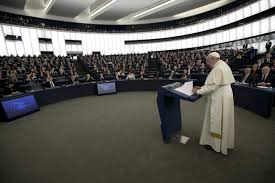
Pope Francis has quickly become one of my favorite role models, even though I am Jewish. He has taken on the moribund Vatican establishment and turned it upside down. His speeches are thoughtful and tackle the key issues of our day. And recently, last Nov. 25, he addressed the European Parliament – and told the Europeans some very very hard things they needed to hear, that their own leaders dare not say.
He told the Europeans bluntly: “Europe seems to give the impression of being somewhat elderly and haggard, feeling less and less a protagonist in a world which frequently regards it with aloofness, mistrust and even, at times, suspicion….. Men and women risk being reduced to mere cogs in a machine that treats them as items of consumption to be exploited, with the result that – as is so tragically apparent – whenever a human life no longer proves useful for that machine, it is discarded with few qualms, as in the case of the terminally ill, the elderly who are abandoned and uncared for, and children who are killed in the womb.”
Elderly and haggard. Right on.
Pope Francis has deflated Europe. And he does so, while Europe itself has sunk again into deflation, with prices now falling for the first time since 2008.
What’s wrong with falling prices? Put simply: there are two kinds of deflation (falling prices): a) the kind caused by higher productivity and lower costs, and b) the kind caused by falling demand. Europe suffers mainly from the latter. And it is an evil. Because it is accompanied by higher unemployment, stagnation and inequality.
And the problem is, Europe’s deflation is largely man-made, caused by the wrong-headed principle of austerity and budget cuts, partly imposed by Germany on Greece, Spain, Portugal and other “spendthrift” nations. And now Germany’s economy too is paying the price, because when Europe sinks, Germany does too.
Kudos to Pope Francis for deflating deflated Europe. Black marks to economists for selling Europe on the wrongheaded austerity policies. Why does it take a Pope to try to set Europe in the right direction?
Patents are Like Love: The More You Give, the More You Get
By Shlomo Maital
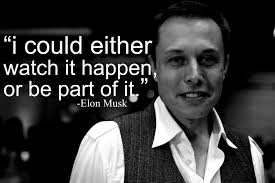
Elon Musk
Some innovations change the way people think about doing business. Elon Musk, a great innovator (co-founder of Paypal, founder of Tessla, Space-X….etc.) has just announced that he is “opening the books” for all the patents related to Tessla and his electric car technology. Meaning? Anyone who wishes can use the technology he and his company created, free of charge.
What in the world? What happened to the assumption that if you create IP, intellectual property, then you have the right, nay the duty, to make huge profits from it?
And is this philanthropy? Or shrewd business strategy?
It is the latter. Musk wants to build Tessla. To do so, he wants the established big car companies, the ones who proved unable to develop truly great electric cars, to adopt his technology.
If they do, then Tessla becomes the first, the authentic, the real thing. And the way to make that happen is to offer the technology free of charge, and – reap the benefits indirectly. And I am convinced, the indirect benefits to Musk and Tessla will be enormous, far bigger than any royalties.
We learn from Elon Musk that innovation is breaking the rules intelligently. Find a rule, e.g. patent everything that breathes, and see if you can break it, for your own advantage and the advantage of the world.
Are patents indeed like love – the more you give it away, the more you have?
Can You Store Wind Energy? Danielle Fong Finds a Way
By Shlomo Maital

One of the biggest as-yet unsolved problems in generating sustainable energy is that of storage – how do you store solar or wind power, for use when there is no sun (night time) or wind (calm periods)? This is vital, so wind turbines, for instance, can provide 100% all-the-time reliable power. A young creative Canadian entrepreneur named Danielle Fong may have cracked the problem. Her story is told in the excellent Atlantic Monthly department, “Eureka Moments”, by Stephanie Porter.
Danielle studied at Canadia’s Dalhousie University, in New Brunswick, graduating with honours in Physics and Computer Science at the age of 17, then beginning a doctoral program that year at Princeton University’s Plasma Physics lab. She left in 2007 to found LightSail in California in 2008, and was named Forbes Magazine’s Energy Standout (Under age 30) for her work.
LightSail’s technology achieves 90 per cent ‘round trip’ efficiency (storing and then providing the stored power), which is extremely high, almost unheard of. Her method uses compressed air, with a dense water spray used to capture the heat created when air is compressed, then store it for later use. Danielle’s father, Greg Fong, is direct of LightSail’s business development. He notes that the technology could offer remote communities and factories, far from the electricity grid, a way to generate stable electricity from stable sources. This could be of great importance for China, for instance.
Over 30 wind farms are already in use or in development in Nova Scotia. Billions are being invested too in tidal energy. But the way to store all this energy does not yet exists. Young Danielle may have the answer. Her idea is a huge “wow” and shows why great entrepreneurs with game-changing ideas always tackle the biggest problems around.
Big Disrupters of 2014
By Shlomo Maital

Disruptive technology is technology that completely changes the ‘game’ for established players in an industry – changes the nature of business, products, services, marketing or other key aspects of doing business and creating value. Harvard Business School Prof. Clayton Christensen drew our attention to disrupters many years ago. Established companies that ignore disrupters do so at their peril.
Here is part of the Financial Times list of the major disrupters of 2014. According to Financial Times reporters, “the range and number of individuals and companies that are upending business models around the world” is on the rise. … “the disrupters are everywhere”.
- Uber: Tim Bradshaw and Murad Ahmed has become “the poster child of Silicon Valley for disruption”; the 5-year-old company revolutionised the taxi business in 230 cities and 51 countries without owning a single car, through its smartphone app.
- Alibaba: This online retailer, with $300 b. worth of online sales has transformed retail in China. It is now “snapping up low hanging fruit in overly state regulated markets” for everything.
- Bob Diamond in Africa: He quit Barclays, and has now shown you can make money by inveting in sub-Saharan Africa. He raised $352 m. through an IPO in London in Dec. 2013, and has done deals in Botswana, Mozambique and Tanzania.
- Aldi and Lidl: They are disrupting the grocery market around the world, and Aldi is even exploring China. They have doubled their market share in the UK in the past four years. Aldi has opened 1,350 stores in the U.S. and aims at 2,000 by 2018. Lidl too will soon invade the U.S. market.
- Ford: Hard to think of Henry Ford’s moribund car company as a disrupter, but the new F-150 pickup truck, with an aluminium body, never used before on a high-volume vehicle, is indeed a disrupter. To do this Ford had to replace arc-welders with new machines to screw, rivet glue and laser panels together. I remember another disrupter – Subaru, which made aluminium engines in 1973; I bought one, it was great, but was warned it would fail. Soon everyone was using aluminium for engines.
- Tesla: last June founder Elon Munk offered to open up its patent book, which is very large, to rivals, “in the spirit of open source movement, for the advancement of electric vehicle technology”. This was a clever move, not just PR. Munk wants the big car makers to adopt Tesla technology and boost the market for electric cars. Imagine if other large companies (Intel, IBM, Hitachi, Samsung, Apple) opened THEIR patent books so that everyone could use them free of charge.
Messy Desk? Sign of Creativity
By Shlomo Maital

Say, is your desk messy? Are you troubled by it? Try to clean it up regularly, and fail? Get hassled by your neat obsessive significant other?
New evidence suggests – hug your messy room, don’t hassle it. It’s a sign you have a creative mind.
Writing in the online magazine NewsMic, (Nov. 10), Tom McKay reports that “There’s fairly robust psychological evidence that messiness isn’t just symptomatic of poor standards or effort, but might actually provoke creativity. He quotes psychologist Kathleen Vohs, who wrote in the New York Times, “being around messiness would lead people away from convention, in favor of new directions.”
Here is the experiment she ran. To test this hypothesis, Vohs invited 188 adults to rooms that were either tidy or “messy, with papers and books strewn around haphazardly.” Each adult was then presented with one of two menus from a deli that served fruit smoothies, with half of the subjects seeing a menu with one item billed as “classic” and another billed as “new.” The results (published in Psychological Science), Vohs reports, were enlightening. As predicted, when the subjects were in the tidy room they chose the health boost more often — almost twice as often — when it had the “classic” label: that is, when it was associated with convention. Also as predicted, when the subjects were in the messy room, they chose the health boost more often — more than twice as often — when it was said to be “new”: that is, when it was associated with novelty. Thus, people greatly preferred convention in the tidy room and novelty in the messy room. A second experiment with 48 adults found that subjects in a messy environment came up with ideas “28% more creative” while creating a list of unconventional uses for ping pong balls, even though the two groups came up with the same number of ideas. Vohs argues the results are clear: Messiness actually spurs creativity.”
The point here is obvious. Creativity itself is MESSY, in caps. Creativity people have messy minds, that collect random pieces of information and find new ways to link them. Creative ideas emerge from disorder and entropy, not order. The ultimate state of order is the universe as it will be in a few hundred billion years: All the energy will have been burnt up, and the universe will be perfectly orderly, at a temperature of absolute zero.
So — messy desk? Enjoy it. Cherish it. And, nonetheless — do clean it up once in a while, if only for your significant other.
Iceland Leads the Way
By Shlomo Maital

In the United States, despite the fact that the global financial and economic crisis began there, and was caused by irresponsible actions by senior executives in the financial services industry, not a single banker has been sent to jail on criminal charges. Banks have paid large fines for civil suits, but for the most part, those fines pale in comparison to recent profits. And to add to the insult – the Republicans have managed to modify the Dodd-Frank provision that keeps banks from investing in exotic derivatives (the kind that caused the problem in the first place).
But there is a country that has behaved differently. Iceland, with only 325,671 epople and 103,000 sq. km. in area. Iceland has been independent (from Denmark) only since 1944. Its banks were out of control in the first decade of the millennium and expanded irresponsibly. The collapse following 2008 was massive. Iceland had 20 percent inflation in 2008 and 8 per cent unemployment in 2010. Its debts were huge. But Iceland cleaned up the mess. Bankers were sent to jail. Iceland’s national debt was gradually reduced. Iceland managed to maintain its social welfare system despite the enormous financial crisis.
According to an Icelandic economist, “after the infamous crash of 2008, the Icelandic economy shrunk in 2009 and 2010. However, since 2011, the economy has been growing at a respectable rate, by 2.1% in 2011, 1.1% in 2012 and 3.5% in 2013. While purchasing power has yet to reach its pre-crash peak, and many families are still acutely aware of the crash when trying to make ends meet, the economy had safely exited recession.” Lately, the economy has slowed. And Iceland’s conservative government has practiced austerity, which in Europe has failed. Despite this, little Iceland has emerged from a deep crisis that was worse perhaps than in any other country. And without much help from anyone.
Myths about the Winter Solstice
By Shlomo Maital

Winter Solstice at Stonehenge, England
Today, Dec. 21, is the shortest day of the year in the Northern Hemisphere. It is known as the winter solstice. But – what is it exactly? Here is some help from the BBC. And a few myths are dispelled.
What is it exactly?
“This Sunday, 21 December, the northern hemisphere will experience the shortest day of its year, marked at 22:03 GMT by an astronomical phenomenon known as the winter solstice – the moment the North Pole is tilted furthest from the sun as the Earth continues on its orbit.”
In the Southern Hemisphere, it is the summer solstice – the moment the South Pole is tilted CLOSEST to the sun as the Earth continues on its orbit.
Doesn’t the winter solstice occur always on Dec. 21?
No. “The solstice doesn’t always occur on 21 December. Sometimes it nudges into the early hours of 22 December, which will happen again next year. The hour of day also varies. Last year’s arrived at 17:11. Next year’s will at 04:38.”
Doesn’t it get light earlier in the morning, from now on? And get darker later?
No. “It would seem logical that after the shortest day has elapsed the mornings would start getting lighter earlier, but this isn’t what happens – the mornings continue darkening until early in the new year and the sunset began later two weeks ago.”
Why??
The answer is a bit complicated, according to a British astronomer. “Because the solar day is not precisely 24 hours. It varies. …the Earth’s speed varies because it moves in an elliptical orbit around the sun, accelerating when it is closer to the star’s gravitational pull and decelerating when it is further away. The sun therefore in effect lags behind the clock for part of the year, then speeds ahead of it for another. As you can imagine, it would be complete chaos if our clocks and watches had to cope with days of different lengths, so we use 24 hours, the average over the whole year, for all timekeeping purposes. So, as the solar days in December are on average 24 hours and 30 seconds, while our clocks and watches are still assuming that each day is exactly 24 hours, this causes the day to shift about 30 seconds later each day. This cumulative shifting explains why the evenings draw in towards their earliest sunset a couple of weeks before the shortest day, and why the mornings continue to get darker until a couple of weeks after.”
What is the link between Stonehenge, England and the winter solstice?
The massive stones at Stonehenge are positioned precisely, so that the sunrise on the solstice peeks between the stones. A great many people rise early to watch this wonderful sight, which this year will occur on Dec. 22, as explained above.
Deadly Dominoes: Who Falls Next?
By Shlomo Maital

According to Reuters News Agency, “a prominent opponent has warned Vladimir Putin his days in power are numbered, as Russia awaits the president’s response to the dramatic decline of the rouble. Putin has been silent as the currency collapsed against the dollar.”
It’s that old déjà vu all over again. Remember August 1998? Russia defaulted on its foreign debt, after the price of oil collapsed. Oil prices, in turn, fell, because of Thailand’s crisis in July 1997 (which saw the baht devalued from 25 per dollar to over 50), leading to the so-called “Asian Contagion”, in which other Asian currencies fell and Asia went into recession. As Asian demand for oil fell, so did the price – toppling the Russian domino. Russian, in turn, would go on to topple Brazil, Argentina…and so on….
And it is more or less recurring. The cause of Russia’s crisis, this time, is not Asia, but rather Russia’s leader Vladimir Putin, whose adventure in Crimea and Ukraine has proved costly. The Russian people appear to believe that it is all a Western conspiracy to wound Russia. But in fact, it is in part a Saudian Arabian move, done not infrequently by that country, in order to bash oil prices down and hurt the Return on Investment for alternative energy forms that compete with its oil. By keeping oil prices unstable and variable, Saudi Arabia can mess up the boom in fracking, wind, solar and other energy forms. And at the same time, no one in Saudi weeps if Iran’s economy is badly hurt, along with that of Russia – and America’s enemies in general are also damaged. This episode has happened before – a sharp fall in the price of oil helped disassemble the USSR in 1989-91.
Meanwhile, the dominos continue to fall. Israel’s agricultural exports are badly hurt by the falling ruble. Turkey’s currency hits a record low against the dollar. Bonds of oil companies Petrobras, Pemex and Gazprom plummet and yields soar. Investors bail out of emerging markets, even those that are solid. This is a problem – emerging market companies sold $1.7 trillion in bonds since 2009. Petrobras’ debt is especially high.
Bottom line: No reason to rejoice over Russia’s woes, even if you dislike Putin. In the end it is always the people who suffer. Once again, we learn that adventurous leaders can ruin countries, even large nuclear ones. And it is the citizens who pay the price. Once again, we learn that we live in a global village, where dominos fall continuously and sometimes in ways we cannot predict or even imagine.


