
You are currently browsing the category archive for the ‘Global Crisis Blog’ category.
Whatever Happened to the U.S. Middle Class?
By Shlomo Maital

The middle class is the bulwark, the core, of every nations’ democracy and economy. It provides the labor, the capital and the stability that nations need. This is why we should worry, when the middle class is disappearing, as it is in the U.S. (Middle class is defined as a household with income from $35,000 to $100,000.)
A report in today’s Global New York Times by Dionne Searcey and Robert Gebeloff, based on their study, reveals these facts:
- 53 million middle class households, nearly half of all households, are aging; many are headed by those over 65. Why? Older Americans have the safety net of social security, which is politically safe and linked to the cost of living. While middle class income has declined (median household income fell 9 per cent since the year 2000), income of households headed by elderly adults has risen by 14 per cent. Problem is, that elderly safety net is going bankrupt.
- In the late 1960s, 60 per cent of middle class households were comprised of two married adults with children. Today? It is just 25 per cent.
- In the Great Recession, 2008 – ??, “we lost a lot of middle-income jobs and we gained a lot of low-paying jobs”, says an expert from the American Enterprise Institute. That is why the strong job figures lately are misleading. They are Wal-Mart and McDonalds jobs.
- The middle class deludes itself. A NYT survey shows 60 per cent of people who call themselves middle class think that if they work hard they will become rich. But this is an illusion. Social mobility in the U.S. has greatly declined. To get rich and richer, you need to be rich already.
I think the article fails to make a key and obvious point. America’s political leaders were accomplices in shifting America’s manufacturing to Asia. This destroyed millions of high-paying jobs (as in auto production). It was done both by Democratic and Republican Presidents. Nor is Congress even trying to get those jobs back. Apparently, you cannot have a strong stable middle class unless your country makes things other than hamburgers. Is that obvious? America is now paying the price for its leaders’ blindness.
Meanwhile, the U.S. middle class has not disappeared, it has simply migrated; middle class families in China and India are booming, thanks in part to well-paying jobs.
In his State of the Union address, President Obama called the middle class the “foundation of the American economy”. Really? Then, why have you, Obama, and other leaders allowed the middle class to decline so drastically? And what are you doing to reverse the trend?
Story-Driven Policy: Worth a Try!
By Shlomo Maital
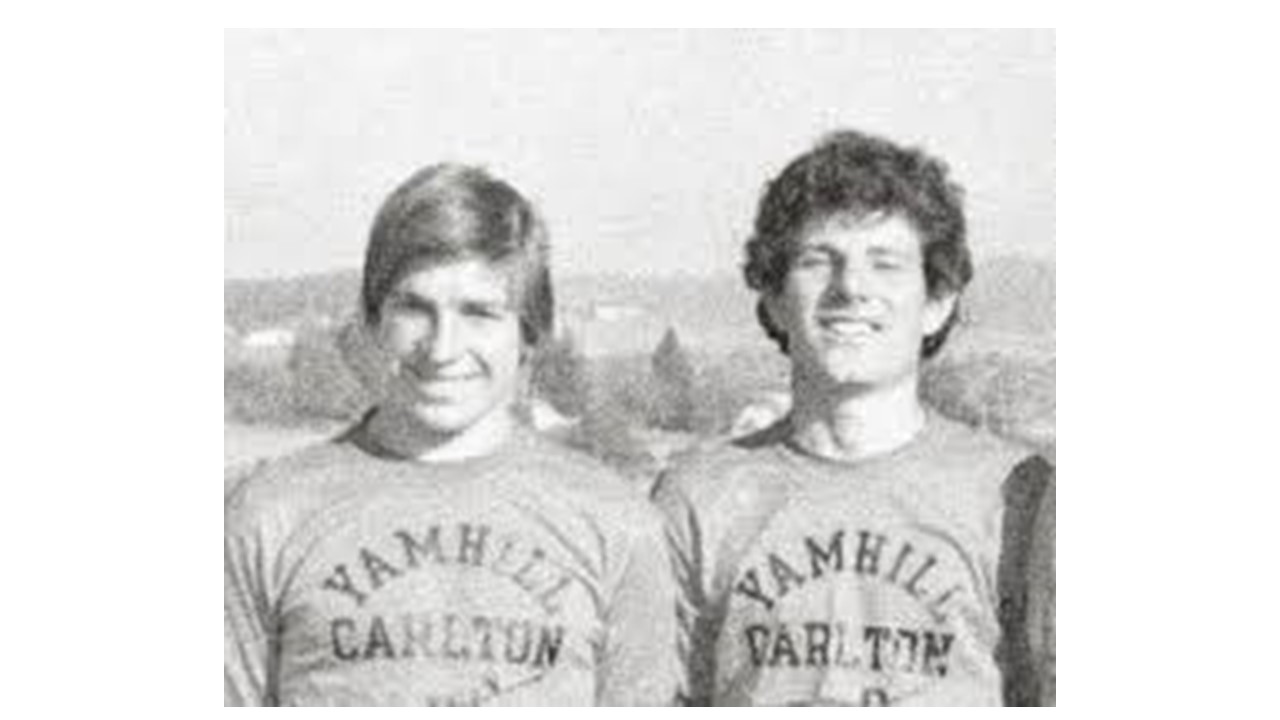
Nicholas Kristof and friend Kevin Green, Yamhill
The latest buzzword in professional and academic circles is “evidence-based”. As an adjective, it modifies ‘psychology’, ‘medical care’, ‘policy’… everything. Everything has to be evidence based. That usually implies a large data base mined for correlations. Problem with that is, G-d is in the details. Truth is in the details. By using data, especially Big Data, we miss the stories about the “little” people… forgotten people who struggle daily with illness, poverty, crime, drugs and other afflictions. The Talmud says, If you save a single soul, it is as if you saved the whole world. The point, of course, is to treat every single person with huge respect and massive importance.
Today’s New York Times has two seemingly-unrelated stories that make this point perfectly.
In his Op-Ed piece, Nicholas Kristof mourns the death of his school chum Kevin Green. They grew up together in Yamhill, Oregon, and ran cross-country together. Kevin lost a good job, went on welfare, got divorced, became obese, lived on food stamps, got diabetes, and died at age 54. Tea Party Republicans say he “had it easy because he got government benefits without doing anything”. Kristof notes that Kevin collected cans and bottles by the roadside, to make $20 a day for subsistence. Easy? Want to trade places? Did Republican wealth “trickle down” to Kevin and help him get a good job? Not a chance.
In Binyamin Applebaum’s piece on Washington, “Three stories illustrate Fed’s power and its limits”, he covers Janet Yellen (Fed Chair) and her first speech. Instead of an academic bore, quoting data, citing equations and analysis, Yellen, who is brilliant, told the stories of three Chicago residents struggling to recover from the recession. She used their stories to explain why she will be very very slow and cautious in ending the Fed’s low-interest policy, despite Republican pressure to do so. I wonder if she chose Chicago, because that is where President Obama lived and worked.
All three ‘heroes’ in Yellen’s speech are struggling, but gaining ground. Jermain Brownlee, 40, got a job building bus seats, though he makes less than he once did in construction. Dorine Poole lost her job, then got a new one as a full-time office manager. She makes $20,000 a year, far less than the $32,000 she once made before the recession, as a claims processor. Vicki Lara, 62, lost her job in the recession and a year later, is serving food samples in a supermarket two days a week, six hours a day. She wishes she could work more hours. She owed $1,200 when she lost her job, and that debt has now ballooned to $3,700, with interest. If she worked more, the companies to whom she owes money would simply garnish her wages. So she had to decline a full-time job. She told the NYT, “When I walk home to catch the bus, I see five homeless people freezing in this weather…I wish I made enough money to help them.”
Lots of people do make enough money to help them. But if you believe it’s their own fault, why bother? Surely, they LOVE being homeless, outside, in the freezing cold. Who wouldn’t?
I would like to see story-based policy. If you want to cut welfare as a policy, tell me a story about a real person and real events, to back up what you claim. When I was a professor, I wrote papers based on data. I always felt that the REAL story was in the story itself. But when I told stories, my papers were rejected, often with biting comments – because in Academe, “story” is a swear word. Single cases, it is claimed, prove nothing.
Wrong. They prove everything. They help us understand real people, real events, real problems. When the U.S. Congress is populated by elected representatives, half of whom are millionaires, how in the world can they understand people like kevin, Vicki, Jerome or Dorine? They can’t.
Shawn Leibowitz Retires Undefeated
By Shlomo Maital

Last Thursday 15-year-old Shawn Leibowitz completed a 2 km. race. He got a special medal, awarded in a podium ceremony. Big deal, you say? Marathons are 21 times longer. For Shawn it was a big deal. Shawn was abandoned as a baby, because he suffered from infantile paralysis. He trained for the race for months. His adopted parents live in a Moshav, Kochav Michael, in the South of Israel. His friends and coaches applauded him as he waved from the podium.
Yesterday Shawn passed away. His heart simply stopped. Was there a connection with the race? No one knows. Whatever the case, completing that race made Shawn immensely happy. It’s a cliché, but – he definitely died happy.
The race was held in memory of members of Kibbutz Yad Mordecai, on the Gaza border, who died in battle.
When I jog today I will think of Shawn. For many, running 2 km. is effortless. For a few it is an enormous challenge. Perhaps someday, Shawn will have a race named after him, with a special effort to enrol those who have a physical handicap.
:
Why ISIS has humiliated the West – and why it matters
By Shlomo Maital

ISIS (Islamic State, known as Da’esh in Arabic) is a radical Islamic organization whose goal is to establish a Caliphate in Syria, Iraq and the rest of the Mideast, based on Islamic law. ISIS seeks to do this through a tiny well-organized and well-funded military force that at its peak comprised some 25,000 fighters. After ISIS gained control of a huge swatch of land in Syria and Iraq, some 56,000 sq. kms. (about 16,000 sq. miles), three times the size of Israel (’67 borders), a coalition of some 60 (!) mainly Western nations organized to attack ISIS, mostly from the air.
Here are 21 countries of this 60-nation coalition, whose representatives met on Thursday Jan. 22 in London to take stock of the results of their joint action against ISIS:
Australia, Bahrain, Belgium, Canada, Denmark, Egypt, France, Germany, Iraq, Italy, Jordan, Kuwait, the Netherlands, Norway, Qatar, Saudi Arabia, Spain, Turkey and the United Arab Emirates. And of course, the United States, represented by Secretary of State John Kerry.
Here is the total result to date. The U.S. claims that 6,000 ISIS fighters were killed, a casualty rate of about 25 per cent. Mainly Iraqi Army forces have taken back one percent (that’s 1 %) of the land captured by ISIS.
And that’s it. That’s the whole result of the whole operation. President Obama, in his State of the Union address, said the 60-nation operation has “halted Islamic State’s advance”.
If I were a taxpayer in any of these 60 nations, I would demand my money back. If this is the best the West can do against a small murderous band of terrorists who claim to act in the name of their religion, who slaughter hostages and civilians brutally and challenge Western culture — to “halt the advance”, with aircraft carriers, F-16’s, drones, smart bombs, and all the rest of the West’s technology —
I’m reminded of the first Rocky film, starring and written by Sylvester Stallone. The main achievement of underdog Rocky was simply to last 12 rounds against the world champion Apollo Creed. Simply by staying in the fight, and holding the vast armoury of the West to a stalemate, ISIS will find an almost infinite number of recruits worldwide among impressionist young people, who see it as “Rocky”. By letting ISIS fight it to a stalemate, the West is handing victory to ISIS, and the price in future will be extremely heavy. Recruits worldwide will flock to ISIS to be part of the modern “Rocky” story, and already have.
It leads one to wonder whether the soft fat West is able to defend itself against the barbarians at its gates, or whether it will fall as Rome did in rather similar circumstances.
A report just issued report claims (unverified) that one of the two Japanese hostages held by ISIS has been executed.
The End of Moore’s Law? Why It Matters
By Shlomo Maital

In 1965 the (later) co-founder of Intel, Gordon Moore, published a scientific paper, in which he made the following claim: “Over the history of computing hardware, the number of transistors in a dense integrated circuit doubles approximately every two years.” This was quite amazing, because integrated circuits were very new and there was not much history of ‘computing hardware’. And how right he proved. (See the diagram). In 1971, around when Intel was born, there were 2,300 transistors on a single chip. Today? With 10-core microprocessors, there are some 2.6 billion! That is almost exactly 21 doublings, in the 43 years since 1971. How in the world did Gordon Moore know???
This powerful exponential curve, which presumes a 42 per cent annual compounded rate of growth (of the number of transistors on a chip), has completely changed our lives, placing a cell phone device in our hands that has the power of a major computer. It has placed chips into cars, refrigerators, and nearly everything. It has greatly reduced the price of electronic devices, because the same exponential curve that expands the number of transistors per microprocessor, also lowers exponentially (negative exponential) the cost, very rapidly.
In “Tapeout”, the magazine of the Israeli semiconductor industry, the latest issue asks whether Moore’s Law is about to “exit” (R.I.P., die, stop)? In a sense it already has. Intel’s 10 core microprocessor is impressive (basically 10 microprocessors in one) but the truth is, many of those ‘cores’ do not operate at any given moment. Intel simply shifted its marketing from “hey, count the megahertz” to “hey, count the number of cores”.
However, if microprocessor technology truly does ‘hit the wall’, like a marathon runner, and a limit to packing transistors onto a chip is reached, then an entire industry will be in crisis. It will have to find a new technology, to restore the exponential growth, on which profits and revenue are built. And shifting to an entirely new silicon technology – perhaps chips based on cell biology? — will be expensive, risky, difficult and will lead to a major shakeout in the industry, as small disruptive startups rise to the fore to replace big lumbering established firms.
In “Tape-out”, the experts are divided about the alleged end of Moore’s Law. After all, its ‘end’, demise, has been predicted now for decades. But as the technology approaches and passes 10 nanometers, it may be true that a physical limit is being reached.
Watch the semiconductor industry closely. Repeal of Moore’s Law will affect all of us, in so many ways.
“Moore’s law” is the observation that, over the. The observation is named after Gordon E. Moore, co-founder of the Intel Corporation, who described the trend in his 1965 paper. His prediction has proven to be accurate, in part because the law now is used in the semiconductor industry to guide long-term planning and to set targets for research and development.[4] The capabilities of many digital electronic devices are strongly linked to Moore’s law: quality-adjusted microprocessor prices,[5] memory capacity, sensors and even the number and size of pixels in digital cameras.[6] All of these are improving at roughly exponential rates as well
How the U.S. Govt. Helped Smash the Oil Cartel
By Shlomo Maital

With the price of oil below $50, and likely to remain low for quite some time, with $100 oil unlikely to return, it is interesting to discover why. The main reason? America is now the world’s biggest oil producer, topping Saudi Arabia, because of fracking and frantic drilling – and the Saudis choose not to fall on their swords and slash their production.
But WHY has America been able to produce so much oil? The answer is in Eduardo Porter’s piece in today’s Global New York Times (“Behind drop in oil prices, the hand of Washington”). It is: U.S. government policy and funding, dating back to Nixon, Reagan and the elder Bush. “Facing years of a broad energy shortage, in the shadow of an embargo by Arab oil producers [in 1973], Nixon..and Congress laid the foundation of an industrial policy that over …four decades developed the technologies needed to unleash American shale oil and natural gas onto world markets”. Porter cites a scholar who notes, “public investments in technology innovation [e.g. energy] can bring a huge benefit for both the economy and the environment”.
Congress approved the Prudhoe pipeline from Alaska just weeks after the Arab embargo. The 1974 Energy Act, creating the Dept. of Energy, kick-started a period of heavy government investment in R&D to recover gas from shale. This agency provided the funds to develop ‘horizontal drilling’ and polycrystalline diamond compact bits to cut through the shale, and performed the first big proof of concept hydraulic fracking, while Energy Dept. labs created a multi-well fracking site. The inventor of shale fracking, George Mitchell, got a lot of help from the government. And, the Reagan Administration, earlier, abolished price regulation, to remove a major barrier to unconventional development of gas deposits.
Of course, bold entrepreneurs who took risks and invested in fracking deserve credit. But as in many new technologies, the hand of government, in regulation and investment, was highly visible.
A key point is that even if rock-bottom oil prices drive oil shale producers out of business for now, the ability to quickly revive oil shale output will put a ceiling on oil prices that is far below the record $111 peak. Saudi Arabia can produce oil at a marginal cost of $5 to $8 a barrel, enabling it to smash prices lower. But America’s ability to produce virtually infinite amounts of fracked shale oil at a marginal cost of around $58 will help keep crude oil prices reasonable in the near future.
Let’s keep in mind, however, that persisting low oil prices will bankrupt countries like Russia, Iran, Venezuela, and others. This may not be good news. Russia is already looking for creative ways to make trouble for America, in Yemen and in Iran, out of spite for America’s lead in imposing sanctions on Russia. The world will remain unstable, despite low oil prices and in part because of them.
Health Insurers & Pharma Benefits: The New FDA
Will Kite Kill Cancer (Affordably)?
By Shlomo Maital
My university, Technion, is one of the few science universities with a President who is both a world-class scholar and successful entrepreneur. Prof. Peretz Lavie is a pioneer in sleep research, and his 10 patents have helped build two or three successful companies that treat sleep apnea, a common disorder that afflicts millions. In a guest talk to my Entrepreneurship class at Technion, Prof. Lavie explained that agreement by health insurance companies to pay for drugs or treatments is a more crucial obstacle for companies and inventors than perhaps even the FDA. Your drug may prove effective in Stage 3 clinical trials and pass the FDA, but – if it’s too expensive, insurers won’t pay for it and it is therefore doomed. As an entrepreneur, Lavie successfully dealt with this problem. By carefully collecting sleep apnea data, he was able to show the insurers why treatment was cost-effective.
Recently, we saw a great example of why insurers are the “new FDA”. Gilead Sciences developed Harvoni, a Hepatitis C drug that costs $94,500 a year. It competes with AbbVie’s $83,319 drug Viekira Pak. The FDA approved Harvoni. But America’s largest pharma benefits company (which provides drugs as part of health insurance) removed Harvoni from its approved list, saying it was more expensive than AbbVie’s drug Viekira Pak and not much more effective. Gilead’s stock plunged; it fought back and slashed its prices.
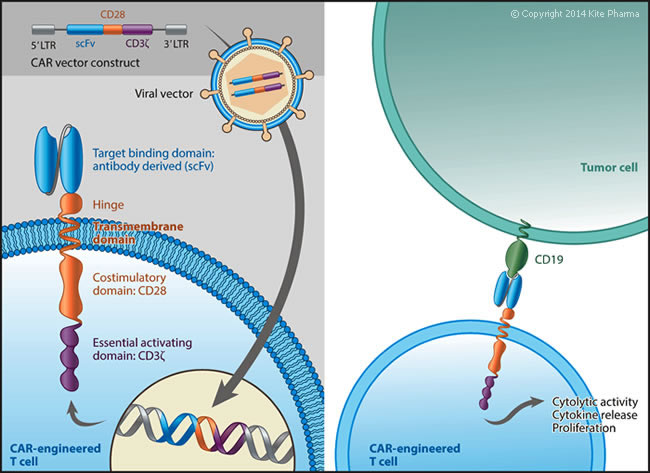
The key role of insurers came to the fore in recent days. Kite Pharma and its Israeli-born and educated CEO Dr. Arie Belldegrun has developed an experimental cancer treatment, a very expensive one, which costs hundreds of thousands of dollars. The complex diagram shows how it works. Briefly, here is how:
Cancer cells are removed from the patient’s body, treated – and then put back. The treated cells (unlike untreated cancer cells) trigger a powerful immune response.
To explain: Cancer cells cleverly shut down the body’s immunse system response; but Kite’s genetically engineered autologous T cell therapy fights back, tricks the cancer cells and restores the immune system’s ability to recognize and eradicate tumors. “In August 2014, Kite Pharma announced findings from its ongoing clinical trial: 12 of 13 evaluable patients with advanced B-cell malignancies had complete remissions (8 patients) or partial remissions (4 patients) resulting in a 92% objective response rate. The results support Kite Pharma’s plan to file an Investigational New Drug (IND) application in the fourth quarter of 2014 to initiate a clinical trial of Kite Pharma’s lead CAR-based product candidate, KTE-C19, in patients with DLBCL.”
Kite has a powerful strategic partner: Amgen, a huge biotech company. “In January 2015, Kite Pharma and Amgen entered into a strategic research collaboration and license agreement to develop and commercialize the next generation of novel Chimeric Antigen Receptor (CAR) T cell immunotherapies based on Kite’s engineered autologous cell therapy (eACT™) platform and Amgen’s extensive array of cancer targets.”
But the hitch is: will the health insurance companies and pharma benefits companies pay for this hugely expensive though lifesaving therapy? Kite is aware of the problem and is trying to deal with it.
Stay tuned.
Business Model Innovation: Reinventing the Supermarket
By Shlomo Maital

An Israeli entrepreneur named Iri Shahar has taught us a valuable lesson in creativity and innovation.
Formerly CEO of a chain of retail stores, known as Fishman Group, he has just opened a new supermarket chain called Ehad (One) with a simple basic premise: No-name (non-branded) products, and only one non-brand for each product. One type of Cola (not Coke). One type of cottage cheese (NIS 4.90, about 20 per cent less than branded cottage). Many products in the Ehad stores are 10 to 20 per cent cheaper than competing stores. At a time when Israelis are struggling with the high cost of living (higher in Israel by some 15 per cent than in the OECD average, according to the OECD), Ehad serves an important social purpose. I am certain this is Shahar’s goal – to make the cost of living lower for Israelis, while at the same implementing a new sustainable business model that generates enough profit to keep the business going and thriving.
Competitor Rami Levy, who some years ago opened a low-cost supermarket chain, pooh-poohs Ehad, saying that Israeli mothers will not give up their children’s favourite brand name products. It will be interesting to see if he is right. I don’t think so. I am frequently annoyed, doing the weekly family grocery shop, by the blizzard of types of cereal, shelves and shelves of it, most of it the same (Cheerios are Cheerios, after all), at a variety of prices, some of them atrocious, confusing the buyer.
What do we learn from Shahar?
* First, the most powerful innovation is not just in tweaking products or services, but in altering a business model or business design – how the product is sold, when, why, and to whom. Shahar’s stores have only 1,000 products, compared with 15,000 for the average supermarket.
* Second, Simplify! Subtraction is a more powerful innovation tool than addition.
* Third, it is a legitimate innovation to take an idea that succeeded elsewhere (Germany has Aldi and Lidi chains, that have spread worldwide) and apply it in your country. Indeed, this is great innovation, because a business concept proven elsewhere will likely succeed at home.
And by the way – Shahar pays good wages. He pays cashiers 25 per cent more than minimum wage and stockers, 40 per cent over minimum wage. “We want them to stay with us for a long time,” he notes.
Switzerland: Why It Is Scaring Us
By Shlomo Maital

Last Thursday Switzerland did two scary things. Scary for me – many (except for forex traders, who got creamed) did not take much notice.
First, they cut the interest rate paid on bank reserves to MINUS 0.75 percent. Minus??? That means, deposit 1 million Swiss francs, at the end of the year you get back 992,500. Why? To discourage money from flowing in.
Second, most important, the Swiss Central Bank announced it would no longer maintain the exchange rate vis a vis the euro at no more than 1.2 Swiss francs per euro, a policy announced in 2011. It pegged its exchange rate, to keep the Swiss franc from getting too strong, because the euro was undergoing a series of crisis and losing value. And each time the Swiss franc goes up relative to the euro, it makes Swiss exports more and more expensive. In a surprise move, the Swiss now say they can no longer maintain this peg and the Swiss franc will be allowed to rise and strengthen, relative to the euro and of course relative to the dollar.
Switzerland is one of the world’s most solid stable countries with by far the world’s strongest currency. It is a safe haven – when things go wrong in the world, and they do all the time, money flees to Switzerland, buys Swiss francs and sits mostly unnoticed in vaults and bank deposits.
Why is a strong Swiss franc a problem? Because Switzerland’s main trading partners are in Europe. When its currency strengthens, its goods become expensive. Amazingly, despite the enormously high wages and costs in Switzerland, the Swiss run an export surplus, exporting $308 b. yearly (over 70 per cent of their GDP) and importing only 288 b. How do they do this? By making and selling branded goods, high quality, precision machinery, and by selling value rather than cost. But there is a limit.
What do we learn from Switzerland’s actions?
First, no country is an island. Europe is suffering from deflation, caused by absolutely stupid austerity policy. EU policies, by bringing Greece to its knees, brought the euro to its knees as well; because again Greece threatens to leave the euro, and once one country does it, many others may consider it. Switzerland is paying the price not for its own mistakes but for those of Europe.
Second, deflation. Economist Abba Lerner once said deflation (falling prices) is 100 times worse than inflation (rising prices). He may have underestimated deflation. The only way to dig yourself out of deflation is to stimulate demand. But Europe is doing the opposite. So Europe is now exporting its deflation to Switzerland. The rising franc will make imports cheaper, and lower prices in Switzerland. This will boost imports and hurt the economy, thus importing Europe’s folly to Switzerland against its will.
Why are the Swiss no longer pegging the franc at 1.2 euros? Because they no longer can. To do this the Bank of Switzerland has to buy very large amounts of euros, and sell francs, thus expanding the money supply. The Bank feels it can no longer continue to do this nad maintain Switzerland’s vaunted stability. Switzerland has an absolutely balanced federal budget, and always does, because the Central Bank has the final say on the budget, and sends it back to the legislature if it is too loose.
Columnist Paul Krugman thinks a “fresh wave of safe-haven money was making the effort to keep the franc down too expensive.” Imagine – you can ruin your country by causing money to flow out, but apparently, also, by causing too much money to flow in (like Switzerland). So far the Swiss have brilliantly reaped the benefits of trading with the EU without actually adopting the shaky, fragile, illogical currency called the euro. But there is no way that the European sickness cannot spread to Switzerland too. We learned that last Thursday.
This whole episode is scary, because it shows clearly that no matter how well run an economy is, and its money, it cannot avoid the collapse, deflation and folly going on around it. Sorry Switzerland. You live in a bad neighborhood. And you can’t really move those beautiful Alps to, say, the Caribbean.
KidZania: Where Kids Find Reality, Not Fantasy
By Shlomo Maital

“We make people happy.” This is Disney’s famous mantra, implemented to perfection at Disney theme parks in California, Florida, Hong Kong, suburban Paris and elsewhere.
“We make kids grown-ups”. This could be the mantra of KidZania, a worldwide chain of theme parks where kids aged four to 14 get the chance to enact the roles of grownups in lavish, scaled-down worlds. The story of KidZania is told in Rebecca Mead’s article in the latest New York issue (“When I Grow Up”, Jan. 19 2015).
In KidZania, Mead explains, children “can work on a car assembly line, or move furniture, or put out fake fire with real water. KidZania has its own currency, kidzos, which can be used in branches around the world, or deposited and accessed with a realistic looking debit card.” Children get a check for 50 kidzos on arrival and can add to it with a ‘salary’ they earn for working. The most popular jobs (e.g. training to be a pilot on a flight simulator) pay less than the less popular ones, like being a dentist. (Kids look into a dummy’s mouth – wonder how many kids pick THAT one!). Kids can rent a car (small electric go-karts) and buy stuff at the mini city’s department store.
KidZania has its own language. “Kai!” means hi, along with placing two fingers over the heart. “Zanks” means thanks. Bye is “Z-U”, from Santiago to Seoul. Adult staff are Zupervisors. Staff ends conversations with kids by saying “have a productive day”.
The founder is an entrepreneur, aged 50, named Xavier Lopez Ancona. His headquarters are near the KidZania in Centro Santa Fe mall, Mexico, one of Latin America’s biggest shopping malls. KidZania now exists in over a dozen countries, including Japan, Malaysia, and Turkey. Lopez went to bizschool at Northwestern U. and ran GE’s private equity business in Mexico. A friend in the toy importing business came to him with an idea for a role-playing park for kids. Lopez joined the venture. The Santa Fe park opened in Sept. 1999. In the first year, 800,000 people came to it, double what the founders expected.
Lopez is careful to vary the KidZania parks according to the venue. In Mexico kids spend their kidzos as soon as they get them. In Japan it is hard to persuade kids to part with their kidzos for any reason. In Lisbon kids come with their parents. In the Gulf states kids come with nannies or are dropped off by their drivers. In KidZania in Jeddah, Saudi Arabia, girls will be allowed to drive cars – a privilege their moms don’t have and definitely, in my opinion, subversive.
Mead quotes one child in Kuwait: “In Kuwait parents and adults have responsibility for everything you do. In KidZania it is different – it’s like kids rule the world. That’s fun, but you can also learn how hard and complicated it is and how adults feel when they work. I have learned that being an adult is actually hard.”


