
You are currently browsing the category archive for the ‘Innovation Blog’ category.
Global Crisis/Innovation Management
What in the World Is Going On?
By Shlomo Maital
 THE WORLD IS IN A BLOODY MESS….
Are you as baffled as I am by the unfolding chain of events in the world, each one improbable and trouble?
What in the world is going on?
Here is my take, based in part on the keen-eyed observations of a friend, a senior Asian diplomat.
- The Arab Spring. Whoever called it “spring”? It feels more like fall, or a fall. It is not, as the media romantically portray it, a democratic uprising, but rather, soft coups, take-overs by the armed forces, especially in Egypt. The only forces organized enough in Egypt to gain control are the Army and the Muslim Brotherhood and in the end they will share power. For this crucial nation, the future is not bright, nor is it bright for their neighbors. Chaos never helps anyone.
- American debt ceiling: The damage has already been done, whatever the intransigent Republicans and the indecisive Democrats do. America should be stood in the corner, like a naughty child. Here is the simple reason why. America built the current global system, built around the US dollar as the key global currency, and in doing so, back in 1944 (at Bretton Woods), promised to run its money responsibly, with the interests of the world in mind. But, as former Texas Governor John Connolly once said, “it’s our money and your (the world’s) problem”. So America has flooded the world with cheap bucks, and the result is to endanger world stability. The U.S. debt ceiling crisis has been managed, as if America alone existed. And the ‘collateral damage’ Obama referred to is not the American people, but innocent bystanders, 7 billion of them, around the world. This is immoral and irresponsible behavior, unforgiveably bad behavior by America, and the damage is permanent. America will not regain the trust and credibility it once had, in the eyes of the world.
- Europe: No, it’s not about Greece. It’s about wealthy northern economies doing well, and poor southern Europe economies doing badly, and the rich in the North doing nothing to help them, except hassle them to pay their bills. Europe is now a mixture of competitive economies doing well and uncompetitive economies doing badly. For the latter to do well, they will have to undertake painful structural changes, which none of them are equipped to do. The only result can be a split, because the current situation is unstable and will bounce from crisis to crisis. No-one is addressing the question: How will the southern economies build a winning global competitive strategy? How will they rebuild some sort of strategic competitive advantage? No it is not about debt – it is about how people will make a living.
Mideast, America, Europe. About half the world’s economy is in deep trouble, and the source is all the same – political mis-governance, and in some cases, too much democracy rather than too little. (If the system is democratic, what group of people will ever vote to impose serious pain on themselves, in the short run, even if long run gain is assured?).
This may all seem very pessimistic, but it is not. There are huge opportunities in this mess for creative clever people who want to do good, who know how to run organizations and build ideas, and act to create value and meet needs. Don’t wait for the politicians. It’s up to you and to me.
Innovation Blog
Norway’s Tragedy: A Sense of Proportion
By Shlomo Maital
The enormous tragedy caused by Norway’s lone deranged extremist terrorist is difficult for anyone to fathom, especially the serene Norwegians.
I have tried to put the loss of life in proportion. My arithmetic may seem insensitive to some, but perhaps of some value to others.
America’s population is 311.8 million. Norway’s population is 4.923 m. So America’s population is 63 times that of Norway.
In 9/11, America lost 2,752 lives. In the recent attack, Norway lost 93 lives. Loss of life in 9/11 was 30 times that of Norway’s incident.
In other words, Norway’s tragedy, relative to its small population, was twice as massive as 9/11. Take into account as well that many of those murdered in Norway were youths.
Israel has grappled with Islamic terrorism for decades. It has to this day forced Israel to place armed guards with magnetometers at the entrance to every shopping center, supermarket and coffee shop. While we take this for granted, it is a heavy burden. Norway is now realizing that the serenity, naivety and openness of its society may have been lost forever – the fact that it took police well over an hour to get to the scene of the crime on Utoya Island must never ever recur, even taking into account the fact the Norwegian police were preoccupied with the earlier bomb blast in central Oslo. Norway, a key player in the effort to attain Mideast peace in the Oslo Agreements, is ironically now learning how a handful of deranged murderous idiots can forever alter society – as Israel learned long ago.
Innovation Blog
Top Social Entrepreneurs Change the World
By Shlomo Maital
 Jeff Sheinbein and Kevin McCracken
Bloomberg Businessweek ran a contest in which several thousand readers voted for which social entrepreneurship idea they most liked. Here are a few of the top ones chosen, including Social Imprint, #1, which got some 15 per cent of all the votes:
● Social Imprints, a print shop, garnered 15.7 percent of the nearly 3,000 votes readers cast since we published profiles of 25 finalists in June. Co-founded by Jeff Sheinbein and Kevin McCracken, who overcame heroin and alcohol addiction himself, the 3-year-old company employs seven people and had $2 million in revenue last year.
● Dalberg, a New York-based consultant focused on international social and environmental problems, came in second with 15.4 percent of readers’ votes. Founded by veterans of McKinsey in 2001, Dalberg has sales above $15 million and 120 employees in 10 global offices.
● Close behind was Intuary, the maker of an iPad app that helps people who can’t speak communicate, with 15.3 percent of readers’ votes. The 5-employee startup is launched the app, called Verbally, in March and is projecting sales of $200,000 this year.
● Nest Collective, which sells healthy children’s food under the Plum Organics baby food brand and Revolution Foods lunchbox snacks, got 8.5 percent of readers’ votes. The 26-employee company, founded in 2007, had $15 million in revenue last year.
● StayClassy, an online fundraising platform for small nonprofits, received 6.2 percent of readers’ votes. The 6-year-old company had $250,000 in revenue last year and has helped 2,000 nonprofits raise more than $5 million.
Social entrepreneurship is booming, as innovators act to fill the gap created by growing social distress, on the one hand, and shrinking government resources and energy, on the other.
What is YOUR idea for a change-the-world business – note that both the noun and the adjective are crucial.
Global Crisis/Innovation Blog
Brazil Helps the Poor – And Helps Itself
By Shlomo Maital
Check out Brazil! While eyes are focused on nations drowning in debt (US, Europe), according to the World Bank:
Brazil weathered the global financial downturn with relatively minor impacts. The country was one of the last to fall into recession in 2008 and among the first to resume growth in 2009. Brazil’s GDP grew 7.5 percent in 2010 and is expected to grow approximately 4 percent in 2011. Brazilians are benefiting from stable economic growth, low inflation rates and improvements in social well-being.
Credit former President Lula da Silva with policies that maintained stable economic growth in a stable political climate, while making sure to spread the benefits to the underclass, the uneducated, the unskilled.
● Poverty ( US$2 per day) has fallen markedly, from 20 percent of the population in 2004 to 7 percent in 2009.
● Extreme poverty ( US$1.25 per day) also dropped dramatically, from 10 percent in 2004 to 4 percent in 2009.
● Between 2001 and 2009, the income growth rate of the poorest ten percent of the population was 7 percent per year, while that of the richest ten percent was 1.7 percent. This helped decrease income inequality (measured by the Gini index) from 0.596 to 0.54 in the period.
● Key drivers of this have been low inflation, consistent economic growth, well-focused social programs, and a policy of real increases for the minimum wage.
Brazil’s new President, Dilma Rousseff, promises to continue Lula’s policies.
Perhaps, in addition to studying how Brazil makes ethanol out of sugar cane, the world needs to benchmark how it advances the working classes.
It is of course true that Brazil still has one of the world’s most unequal distributions of income and wealth. But at least, it is working to mitigate it.
Many countries simply accept growing inequality as a fact of life. It isn’t. Brazil is proof.
Innovation Blog
Entrepreneurship the Hard Way: In the Eye of the Storm
By Shlomo Maital

Dov Frohman had an illustrious career with Intel U.S., then decided he wanted to return to his homeland, Israel. Intel agreed to have him set up a development team in Haifa in the early 1970s; one of the early products, developed by perhaps two engineers, was a math co-processor. Later the team pioneered the Pentium, and then, the Centrino chipset. Dov built the innovative culture of Intel’s R&D group in Haifa.
In his book Leadership the Hard Way, Frohman makes a key point, which he stressed in a recent interview:
“I think any genuine leader today has to learn leadership the hard way—by doing it. That means embracing turbulence and crisis, not avoiding it. It means “flying through the thunderstorm.” That’s not to say that there are no basic principles to orient you to the challenge. Indeed, I describe some in the book. But there are no simple recipes. Until you have lived it, you don’t really know how to do it. That’s what I mean by “leadership the hard way.”
I believe the same principle applies to entrepreneurship and innovation. Until you launch a business, and fly directly into the eye of the storm, and then emerge on the other side, you will never really learn this skill. The longer you delay flying into the storm, the less likely it is you will ever do it.
Frohman relates how the idea for the book came to him:
I’m an active pilot, and one time I actually found myself caught in a thunderstorm. It was too late to turn back; I just had to fly through it. What was so interesting to me, afterwards, was that despite all my years of training and flying, none of it really prepared me for the experience of being in the middle of the storm. All the things that I had ever learned about flying were far from my mind. There were too many things going on at once, too many contingencies that I couldn’t predict or anticipate. Instead, I was consumed by the crisis, operating on instinct, reacting rapidly to the developments of the moment. I think leadership is like that: it can’t be done by the book. Rather, it means having the capacity to respond appropriately in an instant.
Substitute “entrepreneurship” for “leadership” in the next-to-last line, and the passage works just as well.
I teach entrepreneurship and try to provide useful tools for my students. But I agree with Dov Frohman – Just do it. That’s always my final message to my students.
Innovation Blog
Lucien Freud Dies at Age 88: What He Taught Us
By Shlomo Maital
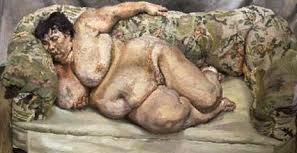
“Benefits Supervisor Sleeping”
Sigmund Freud’s grandson, Lucien Freud, a portrait artist, has died at age 88. I think innovators can learn a lot from his life and work.
“Don’t try to surprise! Don’t try to shock!” he once said. “That only works once.” Today a great deal of art, and for that matter, innovation, seeks desperately to surprise and to shock. For example, Robert Rauschenberg, an artist once painted a canvas pure white. He was lauded. The painting sold for $2.8 million. (A deranged woman even defaced it once!). But, what next? How many all-white canvases can you do? Freud worked patiently at his portrait skills, gradually evolving a style that was realistic, but also had elements of surrealism and expressionism. He found his own style, rather than copy that of others.
Lucien Freud listened to his own inner voice. In an age when nearly all painters paint in abstract style, he was figurative. He painted real people, recognizably. But unlike many classic portrait painters, he never glorified his subjects or air-brushed away the pimples and warts. The opposite – he revealed the person, as he or she truly was. He once said, “I want the paint to work as flesh. The paint IS the person!”
In 2008, his nude portrait of a heavy-set civil servant reclining on a sofa, “Benefits Supervisor Sleeping,” sold for $33.6 million at a Christie’s auction, a record figure at the time.
Born in Berlin in 1922, Freud was one of three sons of Austrian architect Ernst Freud and his German wife, Lucie. The family fled Nazi Germany in 1933 and eventually settled in London. During World War II, the budding artist served with the British merchant navy.
Look closely at his portrait of the “Benefits Supervisor Sleeping”. What do you see? What do you feel? Do you find innovation in it? Do you hate it? Love it? Or both?
Innovation Blog
Greeks and Arabs are Greeks and Arabs Only in America:
The REAL Greek Debt and Arab Spring Crisis
By Shlomo Maital

Here is an ongoing mystery:
● In the United States, there are 1.5 million persons of Greek descent (Wikipedia). There are also 1 m. Greeks in Britain. They are known for their entrepreneurial energy, especially in the food business but extending far beyond.
● In America, there are 4 million persons of Arab descent. According to a study by Samia el Khoudry, “Arab-Americans are younger, more educated, more affluent and more likely to own a business [than native-born Americans]. In general, Arab-Americans are better educated than the average American. More of them attend college, and they earn masters or higher degrees at twice the average rate. Median household income is strikingly higher for Arab-Americans in the Pacific, Northeast, New England, and South Atlantic regions, exceeding $50,000 annually. Arab-Americans are significantly more likely to become entrepreneurs than native Americans.”
The mystery is, why are Greek Americans, and Arab Americans, more dynamic, entrepreneurial and business-oriented in America, than are Greeks and Arabs in their own countries?
It’s no mystery. The simple answer: Because they can. Because the social and economic context of America permits their native culture to flourish, while the social and economic context in their native countries stifles entrepreneurship. Greek bureaucracy is horrendous, starting a business there is a nightmare. In many Arab countries, like Syria, the regime doles out business fiefdoms like pieces of candy to its supporters; small entrepreneurs don’t have a chance.
Writing in his NYT column, Tom Friedman quotes an Athens Univ. business professor Dimitris Bourantas, who says that “Greeks, when they move to the US, unleash their skills and entrepreneurship in ways that enable them to thrive in commerce. But here in Greece, the system encourages just the opposite. Greece is the only country in the world where Greeks don’t behave like Greeks.”
The short-run solution to the Greek debt crisis, and to the Arab Spring’s economic crisis, is to provide funds. The long-run solution? Help Greeks and Arabs be Greeks and Arabs in their own countries, to unleash the nuclear energy of enterprise. It works – America is proof.
“Become who you are,” Nietzsche once said. Let’s hope Greece and Arab Spring nations will help their citizens to become who they truly are. That is the true, and simple, solution to their economic woes.
Innovation Blog
Why Scientists Compete – When They Should Collaborate: “Market Failure” in Knowledge Production
By Shlomo Maital
A short article in Elsevier’s on-line publication Academic Executive Brief, which covers academic research, * reveals the following:
From 2000 to 2008, success rates dropped for the National Institutes of Health R01eqivalent grants, from over 30 per cent of all applicants to under 20 per cent, while at the same time the average age of awardees increased. This trend exacerbates pressure on researchers who, particularly in the early stages of their careers, are driven by the need to further themselves. Survey results show that 74% of scientists, on average, believe that access to other researchers’ data benefits — or would benefit — their own research; however, only 54% are willing to allow other researchers access to their raw research data. And the gap is increasing over time. Academics may also be disinclined to share and collaborate because of the nature of the reward structure in science, which esteems first discoverers.
This is a massive “market failure” in the production of knowledge. Essentially it replicates the situation of ‘monopoly’ in business. By building an incentive system that rewards egoistic selfish behavior, universities have done serious damage to the way research is done. Just as free competition benefits business, and anti-trust bans monopolies and cartels, so should collaboration on data sources benefit science. Why should cartels be banned in business and allowed and even encouraged in scientific research?
There is a simple solution. Make it a condition of scientific research grants, that all data must be openly shared. After all, the money for these grants is taxpayer-funded. It is incumbent on universities, therefore, to optimize its use. By fostering little research-lab monopolies, the money is wasted. Require researchers to upload their data onto the Web – and watch science take off. I believe that in the end, this will benefit all researchers. Knowledge is like love – the more you give it away, the more you get in return.
The problem is definitely one of “Prisoner’s Dilemma” – it doesn’t pay for any one researcher to collaborate and give away data, but if everyone did it, all would benefit. So, on a count of three – one, two three – everybody, say, here’s my data!
- Andrew Plume, “Why Scientists Don’t Share – And Why They Should”.
Innovation Blog
will.i.am (Black Eyed Peas): Intel’s new creative asset
By Shlomo Maital
 will.i.am, Black Eyed Peas
It has taken me six months to learn about it, but, better late than never – a report in Computer World last January notes that Intel has made a creative appointment to enhance its creativity:
William James Adams Jr, better known as Will.i.am of the popular music group Black Eyed Peas, was named Intel’s new director of creative innovation, the chip maker said Tuesday. Adams, a Grammy winner with multiple platinum albums, will work with Intel on developing new technologies, music and in technology advocacy, Intel said in a statement. It is “a multi-year, hands-on creative and technology collaboration with Intel,” the chip giant said.
Will.i.am kicked off his own music apps company this week, Will.i.apps, with an app called BEP360 on iTunes, featuring a 360 degree video of the song “The Time (Dirty Bit).” Users can move their iPad, iPhone or iPod Touch around for a 360-degree view of the music video on their screen, similar to the way Google Sky works. Will.i.apps aims to develop applications that more creatively use advanced digital technologies in music and videos.
“That’s the kind of digital media that we want to tap into, that kind of brain,” said David Dickstein, an Intel spokesman. He said Will.i.am already has an Intel employee badge and may soon have a workspace at the company.
Intel is making desperate efforts to read the future in order to position its new products to capitalize on it. Intel now believes that multimedia will be a huge new market for its microprocessors. At the same time Intel appointed will.i.am, it also announced that Erik Huggers, director of the BBC’s Future Media & Technology division, will join Intel as corporate vice president and general manager of its Digital Home Group.
Computer World reports that HP too has joined the parade. Hewlett-Packard, for example, is using sound technology developed in tandem with rapper Dr. Dre in multimedia laptops, called Beats Audio. The goal, according to HP, is “to provide the optimal sound experience — the way the artist intended it — when playing music or audio through headphones or external speakers.”
The Intel and HP appointments indicate a growing trend in innovation – Make the consumer, or in this case, the actual producer (of media), a key partner in the process. Democratized innovation, the title of Eric von Hippel’s book, has truly arrived.
Global Crisis/Innovation Blog
How to Play the China Card
By Shlomo Maital
China’s economy grew by 9.5% in the year to the second quarter, cooling slightly. As America struggles with 9.2 per cent unemployment, and Europe seems impotent to resolve the euro crisis now spreading to Italy, China’s market seems one of the few places where new and old businesses can find growth.
But where? And how?
A new McKinsey report provides suggestions, from their office in Shanghai. Here are some of their recommendations, based on five key sectors:
- New strategic industries are singled out for global leadership.
- Domestic-consumption engines drive consumer growth in the homeland.
- Restructurers are under government mandate to change.
- Reinventors are mature industries that must innovate and reinvest to close the gap with global leaders.
- Social utilities are large state-owned enterprises managing significant components of the national infrastructure.
Here’s what they mean. China wants to dominate biotech and cleantech. This area will get high priority and ample funding. If this is your line, China is your (gold)mine. Airlines, food, pharma, shipping, tourism – these are domestic consumption engines, which will boom as the Chinese middle class expands and spends. To win here, you have to offer products precisely tailored to the Chinese middle class and its rapidly changing tastes. They seek global brands, prestige, quality and fair prices. Real estate and banking are both shaky. China’s government wants to restructure them, reinvent risk management models, and stress affordable housing. If you have expertise in these areas, you can do well in China. China has a lot of mature manufacturers who need to upgrade. If you have productivity tools to help them, you can prosper in China. China’s infrastructure – power, railroads, roads, communications – are state-run, often poorly. China’s government knows this and seeks ways to upgrade the management of its infrastructure, as it spends billions on the physical infrastructure itself.
China’s 12th Five-Year-Plan is worth reading carefully. It offers massive business opportunities for those who know how to imagine, move..and scale. And China has scale in spades.
Guangyu Li and Jonathan Woetzel , “What China’s five-year plan means for business”, McKinsey Quarterly, July 2011.


