
You are currently browsing the category archive for the ‘Innovation Blog’ category.
Innovation Blog
Stop the Waste! Fight Famine! Eat the Soy, Don’t Feed it to Cows!
By Shlomo Maital

Soy veggie burger
The world faces an urgent crisis. It hasn’t yet reached the media and headlines, because nobody is dying, starving, killing or being killed. But it may happen, unless we act. Here is why.
Worldwide climate change and economic growth have created a large excess demand for wheat. The world will produce 674 million tons of wheat this year, down 100 million tons from last year owing to drought and climatic change. China’s production will drop precipitously, and China will now enter world markets to buy grain rather than export it. We are already seeing significant food inflation worldwide. It will hurt the poor, who already live on the edge. Part of the cause of the Egyptian riots was a precipitous rise in the price of bread.
There is a solution. It is called soy. Soy is a wonderful nutritious food, with high vegetable protein content. You can make veggie burgers out of it, and other foods, that are very tasty. An Israeli firm Tivall has done this for many years and has marketed it successfully to Israeli mothers, who want to feed their children healthy nutritious meals.
Did you know that 98 per cent of the soybeans grown in the world are fed to animals? Eating meat is incredibly inefficient. It takes seven vegetable calories fed to cows to generate one meat calorie. What a waste. And the world is eating more and more meat, as the meat-eating middle class grows in Asia. Moreover, food experts tell us that one calorie of protein (soy) is more satisfying to the body than one calorie of carbohydrate (grain or rice) because it takes longer to digest.
Let us see a concerted combined effort by innovators and marketers, to create soy-based protein foods, that are delicious, and to market them to people who traditionally are highly conservative and loathe to change in their eating habits. Let us see McDonald’s create a soy-based veggie burger and market it! Let us tackle the worldwide food shortage before people begin to starve and die.
Innovation Blog
“T’mura” – An Innovation in the Way Innovators Share, or,
Find the Next Bill Gates and Place Your Bet
By Shlomo Maital
“T’mura” (Hebrew for ‘reward’ or ‘compensation’) supports worthy Israeli charities in an innovative way. Founded in 2002 by Yadin Kaufman and Baruch Lipner, Tmura solicits grants of stock options from start-ups, and uses the proceeds to fund worthy organizations, when a few of the start-ups achieve profitable ‘exits’ (acquisition by larger, usually foreign, firms).
So far, Tmura has collected in this fashion over $3 m. for 30 NGO’s (nonprofit organizations) in Israel, including those that deliver educational programming for social justice in high schools, that provide computer centers in periphery towns, Big Brothers/Big Sisters of Israel, and others. Temura also raised $3.5 m. through grant-matching programs, in which entrepreneurs who sold their companies give part of their newfound wealth to T’mura, which matches the donation.
“What the country [Israel] needs now is for the leaders of the start-up nation to move into social entrepreneurship,” said John Medved, founder of Vringo, a start-up. “We’ve got the tech and business entrepreneurship down. But we need to unleash the same energies and same kind of creativity and passion that we displayed for start-up businesses for start-up social ventures”.
T’mura is based on a similar American idea called Entrepreneurs Foundation.
Entrepreneurs Foundation (EF) was founded in 1998 to make it easy for U.S. companies to meaningfully engage in their communities through strategic corporate citizenship and corporate social responsibility programs. Through Entrepreneurs Foundation, over 880+ companies in the United States and Israel have created corporate foundations and community benefit programs. In partnership with Entrepreneurs Foundation, companies leverage their corporate assets to create customized philanthropy and community programs that meet corporate objectives and serve social needs. Entrepreneurs Foundation provides expertise, resources, best practices and a network to companies so that maximum corporate and community benefit is achieved. Entrepreneurs Foundation provides a unique model for pre-public companies to invest in their communities by seed funding corporate foundations with pre-IPO stock. See http://www.efbayarea.org/
Does your country have its own version of T’mura? Why not start one? Identify promising start-ups, find those with social consciences, and ask the founders to provide a contingent give-back-to-society—contingent, of course, on ultimate success. You only need one start-up to succeed, to generate substantial funding. Find the next Bill Gates – and place your bets.
Innovation Blog
Hal, the 2001 Computer, as “Watson”: Sane, Smart – and Creative?
By Shlomo Maital
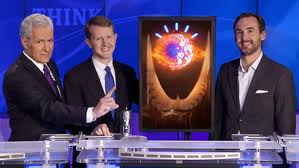
Jennings, “Watson” and Rutter,
playing Jeopardy
Remember Hal, the psychotic computer in the movie “2001”, inspired by sci-fi writer Arthur Clarke and directed by Stanley Kubrick, in 1968? Well, Hal’s back, 43 years later. He has a new name: “Watson”. And he’s not only sane, he’s very very smart, very fast… but, not yet, creative. *
In “2001”, Hal the computer, on a space ship, has a nervous breakdown. Early drafts of the script show it occurred because Hal was order to withhold information from the astronauts about the true purpose of their mission. Apparently, it’s tough for computers to lie.
“Watson” is an IBM computer named after IBM founder Thomas Watson and designed to play the TV game “Jeopardy”. In Jeopardy, three contestants are given ‘answers’ (“This 50th American state is the birthplace of the current President”), and asked to give the appropriate ‘questions’ (“Who is Barack Obama?”). First to press a buzzer gets to answer; if the answer is right, the contestant wins money. The one who wins the most total money, wins the game and returns the next time. The star of Jeopardy is named Ken Jennings, whom won 74 games in a row, and Brad Rutter, another act. At the IBM T.J. Watson Research Center in Yorktown Heights, the computer “Watson” went head-to-head with Jennings and Rutter. “Watson” won hands down. Watson beat its opponents to the buzzer, in the second round, 24 times out of 30, and got most of the answers right.
This is not a frivolous exercise. It cost IBM a lot of money. IBM will use the publicity to leverage new products, including a Watson-like physician’s assistant, where doctors would query it just like with Jeopardy. This, in turn, will change the nature of medical education. “The power of Watson-like tools will cause us to reconsider what it is we want students to do,” said Dr. H. Chase, a clinical medicine professor. No longer will memory skills be paramount.
The one thing neither Hal nor Watson (nor IBM’s Big Blue chess-playing computer that defeated world champion Gary Kasparov) could do, is to be innovative and creative, coming up with novel ideas that link seemingly unrelated things. In Jeopardy, wherever there was ambiguity in the question, Watson stumbled. Only the human brain has this capability called ‘imagination’, the ability to see not what is, but what could be. Indeed, as computers take over more and more memory and cognition functions, the one thing computers cannot do will become immensely valuable to those possessing it – the capability to dream.
* see: John Markoff, “Artificial intelligence gets lift on TV quiz”, IHT, Feb 18, 2011, p. 21.
Innovation Blog
Jellyfish, Curiosity, Collaboration: Why the 2008 Nobel Prize for Chemistry is a Great Parable for World-Changing Innovation
By Shlomo Maital

Jellyfish: Green Edges when Upset!
The Nobel Prize in Chemistry was awarded to three scientists: one Japanese, one Chinese, one American. The story of how their research helped unlock the innermost secrets of life is a parable about the three drivers of world-changing innovation: curiosity, collaboration, and “X + Y” (connecting things others would not think of joining).
First, the story. The Nobel Prize in Chemistry 2008 was won by Osama Shimomura, Martin Chalfie, and Roger Tsien. My source is: http://www.moleclues.org
1. “The jellyfish glows green around the outer edge when it becomes agitated. What makes it glow??? Who cares? Only those who have the freedom to follow their interest, and who have curiosity about everything strange, on this earth. In 1961 Osamu Shimomura set out with other scientists to find out the answer. They managed to isolate two proteins which were responsible for making the jellyfish glow. They named them aequorin and green fluorescent protein (GFP). Little did they know that many years later the green fluorescent protein would change the world of science.
Normally proteins are not visible in a microscope, but green fluorescent protein (GPF) absorbs Ultraviolet light or blue light and then glows green. Wouldn’t it be great if you could link GFP to another protein that you are interested in studying, so that you could see your protein glow? Perhaps even in other organisms?”
2. “The second Nobel Prize winner, Martin Chalfie, showed that this was indeed possible! Each protein in our cells is produced by turning on a specific sequence in our DNA, a “gene”. Chalfie inserted the gene that codes for GFP next to the gene that expresses another protein. When the protein is made, it is automatically attached to GFP: a glowing protein is produced! Now scientists can see exactly where in the cell the protein is and follow its movements using a microscope.”
3. “ Roger Tsien, the 3rd Nobel winner, looked at the molecular details of GFP and was able to change the protein very slightly to produce new types that emit light in DIFFERENT COLORS! Now researchers could see proteins interact with each other in the cell by labeling each one with different colors… multicolored glowing proteins revealing the secrets of life inside the cell! Tsien thus built on the findings of his colleagues. “
“ Nowadays GFP and similar proteins are a very important tool in science to light up and see molecules at work using a microscope. Some really spectacular applications include mice that fluoresce under ultraviolet light (used in medical research)… And Glofish…fish that glow thanks to a linked fluorescent gene.”
Innovation Blog
The Entrepreneur Who Could Not Spell His Own Name:
How Jeff Pearce Overcame Dyslexia
By Shlomo Maital

Young Jeff (James) Pearce
Over my 43 years as an educator, I have taught many students who had dyslexia, a learning disability that makes it hard to read and write, afflicting from 5 – 10 percent of the population. For a few, it was severe. They used many self-invented tricks to overcome it and many went on to achieve great success—the discipline and persistence required to overcome dyslexia served them well later, as start-up innovators.
Here, from the BBC World Service’s Outlook program (recounted by journalist Jo Fidgen), is the story of James (Jeff) Pearce, in his own words. Jeff is literally someone who could not spell his own name for 54 years, nor read or write – yet he was voted Retailer of the Year in the U.K. and twice built business empires. If Pearce could succeed, despite the odds, surely any of us can.
“Three letter words, cat, dog. I’d spell them backward. Teachers thought I was disruptive, kids laughed at me, teachers put me in the corner with a dunce cap, made me face the wall, they did not know what dyslexia was then, and the punishment made me worse, I lived with shame. In promotion from junior to senior high, the day before I went in, my mum knew I would get laughed at, because I could not write my own name, James, I couldn’t spell it, mum sat me down and said from now on, you are JEFF “J” “E” “F”, then add another ’f’ on , I could just about handle that. I lived with that all my life. I became Jeff Pearce.”
“My mom brought us up on the ‘markets’, she had to find money to feed five children, dad drank every penny he earned; in the morning, she told me, on you go on, go earn some money. I was 14. I went to the ‘markets’, asked the business people there if I could do errands, deliver messages? I became an entrepreneur…that put me in good stead for when I went into the world. I set up own business at 17. I’ve always worked for myself, for the simple reason I was unemployable, who would employ someone who couldn’t write their own name?”
“How did I manage? I lived two lives. As entrepreneur/businessman, I employed over 40 staff. They didn’t know I lived another life of torture, as a man that couldn’t write his own name. I hid things. Gina, my wife – she came with me to the bank, gave me a form to fill out, she’d say, I’ll do that so you can keep talking. I couldn’t fill it out. She’d say, Jeff, just sign there. And it got worse. We lived a millionaire life style. We mixed with doctors, accountants, lawyers, we’d go for dinner. I couldn’t read the menu. Gina would say, Jeff, the steak, you like that, “Yes, I’ll have that”, I’d say, pretending I read the menu. Wine list? Gina: Jeff’s bad at wine, let me pick. Gina and I have been together, for 35 years…she’s with me here today, she goes with me everywhere.”
“I hid my dyslexia from our daughters for many years. “I was living millionaire life style, house, car, horses, you name it, big cars… I’d come home, our daughters Katie, 7, Fay, 5, would say, daddy read us a story. They passed me a book. I went to pieces. I started to make a story up with the pictures. ”Daddy you’re being silly, you can’t read”. I can! I can! I said. Lights out! I cried my eyes out. Please don’t let that happen again, I told Gina, I can’t handle that. I would have given all my wealth up just to be able to read my girls a story. I felt I was living a live of a con man, trickster, once in school the teacher said to me, no good will come of you, you were a waste of time… those words were in my mind, but I always felt, nobody who can’t spell their name should be an entrepreneur nor live this life style. “
“When I lost my business, in 1992, when the recession came, bank called me in, called the loan, I lost everything, I sat there, close to suicide…at that time, I thought, that was my punishment for being a fraud. I should not have succeeded in the first place. I lost my family home. My daughters were privileged, all of a sudden I took it away from them. But I started again, on the markets, 10 hard years later, I built up another empire, my own dept. store in Liverpool, I felt then I wasn’t a fraudster I was named most outstanding retailer of the year…in the taxi on the way back to the hotel that night, with 2 awards, I felt as equal as the person next to me..I told my daughters, I can’t read and write! It was very emotional. It was a relief to tell them, best moment in my life, a beautiful feeling, 54 years of hell, it all came out. After retirement, I learned to read and write. Why not before? The shame and embarrassment was with me all my life. I want to go to schools now and tell those who have dyslexia, do not hide it, I did it for 54 years!”
Global Crisis/Innovation Blog
Capitalism for the Long Term: The View from McKinsey
By Shlomo Maital

Dominic Barton, McKinsey
Writing in the March issue of Harvard Business Review, McKinsey global managing director Dominic Barton addresses “Capitalism for the Long Term”. Few people are better equipped to write about how capitalism should be reformed than the peripatetic consultants of McKinsey. Barton’s main point: Business leaders — rewire the way you govern, manage, and lead corporations to restore the public’s trust in a capitalist system jeopardized by the financial crisis and ongoing social anxiety. If you don’t, the political system will reinvent capitalism, and you will not like the result at all.
Barton says the business leaders of capitalism must implement three major reforms in the way they think and act.
First, “business must jettison its short-term orientation in favor of a longer-term focus.” The short-term focus that led to financial collapse did major harm to almost everyone, including those who committed the ‘crimes’. “
Second, “executives must also infuse organizations with the perspective that serving all major stakeholders is not at odds with maximizing corporate value.“ In an earlier blog, published on Aug. 6, 2010 (timnovate.wordpress.com), I noted the credo of Scott Paper magnate Tom McCabe, who insisted his managers seek the wellbeing of customers, workers, the community, thee nation, and finally, the shareholders – an old-fashioned credo that seems to be making a comeback.
Finally, companies must bolster the power of boards to cure the ills stemming from dispersed and disengaged ownership. The purpose of the Board of Directors is to give the CEO and top management a hard time, track everything they do and say, and challenge their decisions, making them provide hard data and clear rationales. Failure of many boards to do this led to the fatal crashes of Fannie Mae, Lehman Bros., Citigroup, GM, and many other companies.
Investor – check your portfolio of stocks. Do the companies whose shares you hold understand these three ‘new capitalist’ principles? If not, perhaps it is well to find companies who do.
http://e.mckinseyquarterly.com/10742fd80layfousubktwfcyaaaaaa2bdqgjshi2w4ayaaaaa
Innovation Blog
Innovations That Don’t Create Jobs: A Global Social Dilemma
By Shlomo Maital
Tyler Cowen: The Great Stagnation
Innovations have been declining!
Here is the list of the world’s top 20 innovating organizations, from the magazine Fast Company, for the year 2010. (See below).
Company Rank* Revenue Profit ($ billion) *rank in Global Fortune 1000, 2010
1. Facebook –
2. Amazon #340 $24.5 $0.901
3. Apple #197 $36.5 $5.7
4. Google #355 $23.7 $ 6.5
5. Huawei #397 $21.8 $2.7
6. First Solar –
7. PG&E –
8. Novartis #160 $45.1 $8.4
9. Walmart #1 $408 $14.3
10. HP #26 $115 $ 7.7
11. Hulu –
12. Netflix –
13. Nike #453 $19.2 $ 1.5
14. Intel #209 $35 $ 4.4
15. Spotify –
16. BYD –
17. Cisco #200 $36.1 $ 6.1
18. IBM #48 $96 $13.4
19. GE #13 $157 $11.0
20. Disney #199 $36.1 $ 3.3
Several interesting conclusions emerge.
* First, very few of the great innovators are big, in global size (ranked by revenues, from the Global Fortune 1000, 2010). Walmart is an exception (#1). So is GE (#13) and HP (#26).
* Second, the hottest of the new innovators are pure Internet companies (Facebook, Hulu, Netflix, Spotify) that create massive amounts of wealth but very few jobs, because when your product is bits and bytes, you do not need assembly-line workers.
* Third, the list of Top 20 innovators from 2005 (Bloomberg/Business Week) is very different. A great many innovators have fallen off the list,
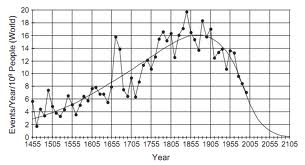
In his best-selling new eBook, The Great Stagnation, Tyler Cowen notes that the automobile industry generated millions of good-paying jobs, but Facebook employs 2,000, Twitter 300 and eBay about 17,000. Only 14,000 people make and sell iPods, but iPods eliminate other jobs (CD manufacturing, etc.) and anyway most of those iPod-based jobs are outside the U.S. Cowen notes that this current era’s technological breakthroughs generate great gains for society but very little added economic activity.
Can we imagine a futuristic economy, in which a majority of the population does not work at all, and in which the privilege of working goes to only an elite handful with high-level skills? A society in which innovation benefits humanity, takes brains, but requires no hands to generate those benefits?
Recall that Henry Ford complained he got an (un-needed) brain every time he hired a pair of hands. Perhaps in future, his innovative industrial descendants will complain that they get (un-needed) hands along with the brain. Perhaps that future is already here.
Global Crisis/Innovation Blog
Wake Up, America! To Innovate, You Have to Make What You Invent!
By Shlomo Maital
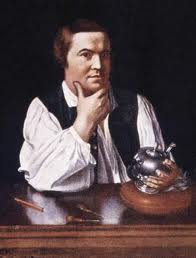
Paul Revere: when America still made stuff!
Veteran New York Times reporter Louis Uchitelle is helping to wake up America. * His point: When you no longer manufacture, dumping everything off to China, you also cease innovating.
To make this point, he studies the flatware industry. Since America’s colonial times and Paul Revere (silversmith), America has made knives, forks and spoons. The last such plant closed recently, in Sherrill, NY. Some 80 workers lost their jobs. Nobody seems to notice.
But, Uchitelle notes, the local value-added component of the remaining manufacturing plants is also declining, as more and more components are imported, mainly from China.
“The imported portion has risen to more than 25 percent from 17 percent in 1997, according to Susan Houseman, a senior economist at the W.E. Upjohn Institute in Kalamazoo, Mich. The Boeing Company, to consider one striking example, once bought all of its components from American suppliers, or made them in its factories here. Now the wings of several of its airliners are manufactured by Japanese subcontractors and shipped across the Pacific in giant cargo planes.”
Economist Houseman says an accurate measure of America’s manufacturing would give it no more than 10.5 per cent of GDP, down from over 30 per cent in the 1950’s.
“How did the nation get into this situation?” Uchitelle asks. “America gambled, in effect, that by importing more from foreign suppliers and from American companies that had set up shop abroad, consumer prices for manufactured products would fall, without any sacrifice in product quality. Low-wage workers abroad would make that happen. American manufacturers, on the other hand, would be the world’s best innovators, developing sophisticated new products here at home and producing them, at least initially, in their domestic factories. The first part of the arrangement worked very well. Consumer prices did fall as imports flooded in. The second part of the arrangement, however, has been more problematic. As it turns out, the United States is not the only path-breaker. The Toyota Prius, the first hybrid, shines as an example of Japanese ingenuity, and more than a decade after that car was developed it is still being exported from Japanese factories, marrying innovation to production and jobs”.
“The big debate today is whether we can continue to be competitive in R&D when we are not making the stuff that we innovate,” Houseman says. “I think not; the two can’t be separated.”
The point is simple. You have to make the stuff you innovate. If you don’t, you lose the value added from innovation, and you lose the vital information that production brings.
Wake up, America! Get your manufacturing back. If you don’t, you will lose your innovation as well.
* Louis Uchitelle, “When Factories Vanish, So Can Innovators”, Global NYT February 12, 2011
Innovation Blog
The REAL IQ: How Creativity and Intelligence Combine
By Shlomo Maital
“Teach boys and girls nothing but facts! Facts alone are what is wanted in life.”
– Thomas Gradgrind & Mr. McChoakumchild, “Hard Times”, Charles Dickens
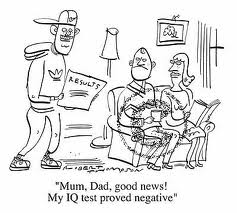
Mom, Dad, great news, my IQ test came back negative!
Psychologist Robert Sternberg, a pioneer in cognitive psychology and now an educational innovator, has used his remarkable life story to blaze new trails in the concept of IQ. After he suffered from text anxiety and failed an intelligence test. Sternberg realized that this score did not predict his intelligence. Just one year later, in the seventh grade, Sternberg developed his first intelligence test: the Sternberg Test of Mental Ability, or STOMA. Because he was a perpetual ‘outsider’, Sternberg never feared challenging the prevailing paradigms in psychology, such as conventional IQ.
Writing in School Psychology International,* Sternberg outlines his own concept of intelligence, called WICS, an acronym for “Wisdom”, “Intelligence”, “Creativity” and “Synthesis”. “The basic idea is that citizens of the world need creativity to form a vision of where they want to go and cope with changes in the environment, analytical intelligence to ascertain whether their creative ideas are good ones, practical intelligence to implement their ideas and to persuade others, and wisdom to ensure the ideas will help achieve ethically-based common good. Then, ‘synthesis’ is needed to combine the W, I and C.
The WICS theory is remarkably similar to what innovators need, in my view, to achieve marketplace success: Creativity, for vision, Intelligence for analysis and implementation, Wisdom, to create value for everyone not just the inventor, and then Synthesis, to combine the three seamlessly. I would prefer to call the ‘innovation’ version of the model, CIWS.
Sternberg has created a Rainbow Project to measure WICS and complement the standard terrifying SAT tests for college entrance. At Tufts U., where he served as Arts & Sciences Dean, he developed Kaleidoscope, which asked applicants to write stories on such creative topics as “The End of MTV”. Kaleidoscope scores did not correlate at all with SAT’s.
Sternberg’s WICS teaching method encourages students to: a) create, b) invent, c) discover, d) imagine if… e) suppose that, and f) predict. Teaching for creativity is very hard for teachers used to teaching ‘facts’.
These six stages match closely stages the inventors follow, in particular, d) e) and f), imagine, suppose, predict. They also match what parents and teachers often call ‘dreaming’, for children and students whose vision wanders far away from blackboard ‘facts’.
* R.J. Sternberg. “WICS: A new model for school psychology”. School Psych. International, Dec. 2010.
Innovation Blog
Where Does Innovation Come From? R&D? Or “Dark Matter”?
By Shlomo Maital
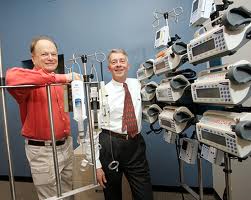
Eric von Hippel and user-created innovations
Innovation, much of it, comes not from institutionalized R&D funded by companies, but rather from tinkerers and users, who have a real need and solve it inventively with their own two hands.
Eric von Hippel is an MIT scholar who pioneered research showing ‘lead users’ can be enormously valuable to companies, who want to improve their products. Now, with a British study funded by the British government, he conducted the first large-scale survey of consumer innovation ever done. *
The astonishing result: The amount of money individual consumers spent in making and improving products was more than twice the amount spent on product research and development by all British companies combined, over a three-year period. It makes sense – there are probably 20 million British consumers, and perhaps 1/100 that number of R&D engineers. Von Hippel will replicate his study in Finland and in Portugal.
Harvard Business School professor Carliss Baldwin says, “we’ve had on a set of mental blinders”, because we have missed, or underplayed, this key source of inventive progress.
“We’ve been missing the dark matter of innovation,” von Hippel said, meaning, just as dark (i.e. not visible or detectable) matter exists, because otherwise the universe would not be expanding, even though we can’t really see it, so does consumer –driven innovation exist, though we don’t really see it (until now). Von Hippel says 77 per cent of scientific instrument innovation come from users in the field. One of the implications? Change patent law, to enable people to build on others’ ideas without fear of law suits.
Does von Hippel practice what he preaches? He does indeed. His book Democratizing Innovation is available for free, by download from his personal website, even though the standard print version is published by MIT Press. I wonder how he managed to persuade MIT Press that free downloads actually boost print book sales.
I am certain that this type of small-scale one-off innovation is crucial. Think of all the times you have taken a product, and in small ways changed it to improve it. Now, imagine if you had shared these ideas with the world, using Internet, the way Daniel Reetz did.
Reetz built a commercial book scanner, that normally costs $10,000, out of two old Canon A590 Powershot cameras, using parts rescued from junkpiles. Total cost: $300. He can scan a 400-page book with it in 20 minutes! Reetz uploaded his do-it-yourself product to DIYbookscanner.org, 1,000 people joined his forum on that site, and 50 people actually built the scanner.
Do you have an innovation, small or big? Tell the world about it. Share it. If enough of us do this, a wave of innovation will wash over the globe, enriching all our lives.
* Patricia Cohen, “Turning innovation on its head”, Global New York Times, Feb. 11, 2011, p. 18


