
You are currently browsing the category archive for the ‘Innovation Blog’ category.
Innovation Blog
(Lack of) Innovation in B-Schools: Help!!!
By Shlomo Maital

Alan Brandt GMAC
Bloomberg Business Week reports on a contest for ideas to innovate business school programs. There were some 650 entries. Winner Alice Stewart conceived this idea: She envisioned professors from different disciplines creating micro-curriculums, where they’d weave content together from business education, engineering, and the sciences. Students who completed the classes, which she dubbed “stackable knowledge units,” would get a certificate. Eventually, they could combine these certificates to earn a business degree, she wrote in her proposal, thereby allowing students to customize their education track.
According to Alan Brandt, who heads the GMAC-funded contest, “This is essentially building your own degree based on creating stackable units. It is something that is different enough and could help you, as an individual student, in approaching a program in the way you want to do it without a wholesale change to the existing way a school is working.”
As always, I am distressed by the lack of innovation in business schools that teach innovation (all do), because I live and work in a biz-school environment. My former student B. Joseph Pine, co-founder of Strategic Horizons, an innovative consulting firm, published Mass Customization 12 years ago. In it, he noted the strong trend of ‘markets of one’ – creating customized products for customers. Many consumer products have done this for year, for instance Dell Computer Co.’s customized design-it-yourself computers. Yet MBA programs continue to offer a curriculum of standard functional stovepipe core courses and a few “electives” – mainly, one size fits all. There is little integration, little cross-disciplinary teaching, little team-teaching (too expensive), little customization.
When will we see Alice Stewart’s idea truly implemented? At the current snails pace of innovation in B-schools – I may not see true mass customization in MBA programs in my lifetime.
Innovation Blog
How to Milk Goats for their Spider Webs – Say That Again??!!
By Shlomo Maital

Spider silk surpasses steel
In this blog, I often write about how Nature, with its ultimate patience that uses millions of years of evolution to create winning innovations, surpasses by far human ingenuity. Here is a story about how human innovation partners successfully, and highly creatively, with Nature’s innovation. You can learn more by watching the wonderful four-part Public Broadcasting System Nova series on “Making Stuff”.
Spider silk is amazing. It has higher tensile strength than steel. Nature has patiently, through evolution, enabled spiders to spin tough silk. Nothing humans make rivals it.
. A thread of silk can resist more pull before breaking than a thread of most kinds of steel. It is also quite stretchy. In the spotlight recently has been the newly discovered Darwin’s bark spider of Madagascar, which builds one of the largest webs known. The silk of this spider is twice as strong as other spider silks, ranking it among biological materials with the highest tensile strength and toughness known.
[At the American Museum of Natural History, you can see a large orange blanket, woven from spider silk. It took four years to painstakingly collect enough thread, by ‘milking’ spiders into an alcohol bath, then retrieving the threads that coalesce in it.]
Univ. of Wyoming molecular biologist Randy Lewis asked himself, how can we create spider silk commercially (since humans cannot synthesize it)? Here is what he does.
First, he extracts one of the two key genes spiders have, that enable them to produce their silky threads. Next, he inserts it into goats, creating baby goats that have the spider-silk DNA.
Next, he milks the goats, and extracts the spider silk compound from their milk. The level of spider silk in their milk is about 1 per cent (like low fat milk). A quart of goats’ milk generates a tiny thimble of spider silk material, that can be used to produce ultra-strong threads.
Here is how Lewis describes his thinking: “We needed a way to produce large quantities of the spider silk proteins,” Prof Lewis said. “Spiders can’t be farmed, so that route is out and since they make six different silks, even that would not work if you could.” Spiders also have a tendancy to eat each other, so milking one thread from six out of a solo spider was clearly never going to service the entire human race. Prof Lewis and his team singled out the “dragline” – the outer strand of the web – as the strongest of the six types of silk. They spliced the DNA that creates the silk into a female goat’s DNA, then waited for it to give birth and start lactating.”
Lewis says he is thinking of inserting the gene into alfalfa, rather than goats.
It is therefore time to begin thinking about uses. What uses can you, reader, think of, for ultra-light [a strand of spider silk that circles the world, 25,000 miles, weighs only one pound!] and ultra-strong, stronger-than-steel, thread? Fishing line? Bullet-proof vests (we use Kevlar today)?
Innovation Blog
Art as Common Stock: Will It Fly?
By Shlomo Maital

Vezzoli, Premiere of a play that will never run
The French company A&F Markets has come up with a venture called Art Exchange that will treat artworks as investment vehicles, opening them up to partial purchase by shareholders. The first two works to be offered by Art Exchange are both owned by Paris’s Yvon Lambert Gallery. Pierre Naquin, the founder and president of the investment venture, related that the initiative has just launched with an offer of shares in two pieces, one by Sol LeWitt and the other by Francesco Vezzoli. Now 11,000 shares of LeWitt’s “Irregular Form” are available at €10 ($13) per share, for a total value of €110,000 ($142,000) and 13,500 shares of Vezzoli’s “The Premiere of a Play That Will Never Run” are also offered at the same rate, giving it a total price of €135,000 ($174,000).
What is the basic idea of this innovation? Suppose you are an investor, and believe that art is a good investment, as part of a diversified portfolio. You can invest in it by buying a painting or a sculpture. But the price is high, and you may lack expertise. So why not offer ‘shares’ in a painting, so that when the value of the painting rises, you profit (and take the profit when the painting is sold).
Apparently this art stock market is not the first. China’s Shenzhen Artvip Cultural Corporation started selling shares last year on the Shenzhen Cultural Assets and Equity Exchange. Instead of selling slices of an individual work, Artvip sold 1,000 shares in a collection of pieces by artist Yang Peijiang, which sold out immediately.
Is this idea good for art? I heard an expert criticize the idea. But surely, by making art ‘liquid’, you attract resources to art and thus help both galleries and artists.
This art stock market is not for collectors. They are well-heeled, and want to own paintings, so they can enjoy them while perhaps making capital gains. This market is for ordinary people who feel that perhaps, the market for art is bullish and worthy of, say, a 10 per cent tranche of their total investments.
There are some open questions. How is the decision made to sell a painting, and when? By a ‘shareholders’ meeting’? Majority of shares decides? How are shareholders consulted?
Like all innovations, the market will determine this one’s success. I think it might just work. Stay tuned.
Innovation Blog
“I Have a Dream!” – Merging Spontaneity and Discipline in Innovation
By Shlomo Maital

Today America celebrates Martin Luther King Day. We recall the remarkable “I Have a Dream” speech given on Aug. 28, 1963, for only 17 minutes, from the steps of the Lincoln Memorial – a speech that influenced millions and probably changed history. But how did those memorable words at the very end of his talk happen? Where did they come from?
The particularly moving and dramatic segment, with the refrain “I Have a Dream”, almost didn’t happen. King came to the end of his prepared speech. And then, gospel singer Mahalia Jackson, on the stage with him, had an insight. As a performer she realized that King had failed to energize and impassion his audience – which is what gospel singers do, and do it wonderfully. And she also knew how King could do it. She had appeared with him at various rallies, and recalled one particularly powerful speech King gave earlier that year in Detroit, when he marched at a demonstration with legendary labor leader Walter Reuther.
“Tell them about the dream, Martin!” Mahalia Jackson said. You can clearly hear her speaking these words on most of the YouTube versions of the speech. “Tell them about the dream!”.
M.L. King listened. He got it. He understood. He seized the moment. He was able to improvise, turning an ordinary speech into one of the most extraordinary orations in history. He did this with a combination of spontaneity – he probably made the decision to add the “I have a dream” segment in a split second – and discipline, because he had given the “dream” segment before, prepared it, thought about it, and it was like a perfectly designed suit of clothes ready to be taken out of its wrapping and worn immediately.
Spontaneity, and discipline – the oil-and-water combination that when combined, create history-making innovation. This for me is one of the messages of M.L. King’s wonderful speech.
Innovation Blog
No-Huddle Offense in Oregon: ‘Subtraction’ Wins Again
By Shlomo Maital

Chip Kelly, Oregon Ducks Coach
For years, in college football, University of Oregon was a laughingstock, playing in the tough Pac-10 conference against superior teams with winning records and even national championships. Even its name arouses laughter: The Ducks. Ducks??? The fighting (quacking) ducks? Pit a ‘duck’ mascot against, say, an Indian warrior mounted on a Palomino pony, or a bulldog?
What do you do to create a winning team? Well – innovate. But how? Football is a century-old game with a lot of proven rules. Why not try breaking a rule? Perhaps a key one? Let’s say – the rule that the quarterback calls the offensive plays in a ‘huddle’.
One of the proven principles of innovation is ‘subtraction’ – take the key ingredients of a product or service, then remove one of them, and see what happens. OK – let’s take away the huddle and see what happens, said innovative Oregon Coach Chip Kelly. Take away the huddle??? How then can the quarterback call plays? Perhaps – just audibly, right at the line of scrimmage.
Kelly’s innovative, spread-option, no-huddle offense thrives on speed. Run a play. Race to the ball. Run another play. And so forth. No huddle. You only wait for the referee to ‘spot’ the ball…and off we go. Give the opposition no time to gather their thoughts and organize defense. Start the offensive play quickly, before the defenders can even figure out what play you’re likely to run.
At times Oregon takes only nine seconds from the end of the previous play to the snap of the new one. National Football League teams have used no-huddle offense, mainly toward the end of the game, when they lack time-outs and have to race against the clock to score. But Oregon, under coach Chip Kelly, uses it all the time, every time, every offensive play. It has even led opponents to feign injuries, just to stop the clock and slow down the superfast Oregon juggernaut.
According to USAToday: “They are so good at it, and so fast at it, that a typical game sees them run about 80 plays and score about 50 points, which is the biggest reason the Ducks are playing for a national championship.”
And play they did. Improbably, Oregon played in the Bowl Championship Game against Auburn, for the title of National US #1 College Team.
They lost. But so what? They made it to the championship for the first time, they played well in a hard-fought close game. And they proved that creativity and innovation, through ‘subtraction’, can offset other disadvantages and create competitive advantages that can take you (almost) to the top.
Look for Chip Kelly to make it to the NFL as head coach. And look for other teams to emulate Oregon’s amazing innovation.
Innovation Blog
Wikipedia – 10 Years Old! When Vision Defeats Greed
By Shlomo Maital
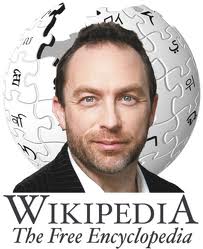
Jimmy Wales
On Jan. 15, Wikipedia, the on-line encyclopedia whose entries are written by the users and readers themselves, celebrates its 10th anniversary. What can we learn from Wikipedia’s decade of innovation?
An entire new discipline known as wikinomics has sprung up, based on the notion of products and services created and developed by the users themselves. Many companies, notably Procter & Gamble and Lego, have enlisted users successfully as an integral part of their product development, and MIT Professor Eric von Hippel has written a book about democratizing innovation (to be consistent, he offers free downloads). Lately, IBM and other global firms have implemented versions of this idea.
Founder (co-founder?) Jimmy Wales could have made a huge fortune from Wikipedia, because it is one of the websites that attracts the most eyeballs, and that could easily be transformed into advertising revenues. But he refuses. His vision is to retain the popular open flavor of Wikipedia and stay away from revenue, bottom-line and money-making and wealth creation. I salute him. There aren’t many entrepreneurs who willingly turn down a check for $1 billion.
Wikipedia has many many flaws. Some of its material has clear biases, written by those pushing a special interest. Some of its material is inaccurate. Political wars are fought in Wikipedia. Yet for sheer ease in getting basic facts about almost anything, Wikipedia is unrivalled. It has changed the way I work and write, and I am sure has changed the world for millions of others.
Wikipedia has some 3.5 million articles in English alone. According to one of its principals, Susan Gardner, Wikipedia’s vision is “to offer “the sum total of all human knowledge” in the native language of all of Wikipedia’s users. This vision reminds me of Google. Google’s founders, Larry Page and Sergei Brin, sought to bring all the information in any language to any person, at any time. But Google took a commercial route, with advertising revenue and an IPO. It reportedly has over $30 b. in cash stashed away, waiting for its next strategic play.
In contrast, Wikipedia relies on contributions, struggles to raise money, depends on hard-working volunteers, and steadfastly refuses to play the capitalist game. Instead it wants to implement its vision, bringing all the knowledge to everyone, anywhere, in any language.
The big question is, can Wikipedia triumph and implement its vision without resources, without a true business model? Would it serve its users better with an advertising business model? Jimmy Wales is steadfast. Let’s wish him well, and follow this wonderful experiment with interest and affection.
Innovation Blog
Oh, Say, Can YOU See? Innovating the EyeGym
By Shlomo Maital
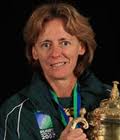
Sherylle Calder
A former South African women’s hockey team member, Sherylle Calder, has made a breakthrough innovation in performance enhancement in sport. She did it by introspection – by understanding her own special gift, then developing methods to help others acquire it. And she has proven results: She helped coach two World Cup rugby champions, South Africa and England to world titles.
The basic idea is simple. Athletes need superb eye-hand coordination, and eye-feet coordination. Training methods focus on the hands, the feet, the body – strengthening muscles, and making them quicker and more resilient and durable. But what about the ‘eye’, a heretofore neglected aspect of physical ability? Is vision simply a ‘given’, determined by DNA? Nothing, in fact, is wholly determined by DNA – everything can be improved, by hard work.
Calder developed a series of pathbreaking eye exercises, in what she calls the EyeGym, to improve what players see on the field. I imagine she works on peripheral vision, and on quickening reaction time to what the eye sees, and in particular, to anticipating where the play will move to, on the field. “You have eyes in the back of your head”, she was told, when she played field hockey. And that is literally true. The brain can cooperate with the eyes, to translate what the eyes see into a near-term scenario, what will happen a second from now, or a split-second.
Introspection and empathy are powerful tools for innovators. First introspection. What do you do well, or what do you know, or what skill do you have, that are distinct and special? What is special about them? Second, empathy. How can you apply those skills, to help those who may not have them? Can you teach them? Can they be developed? How did YOU acquire them? Can others follow suit? And can you apply Malcolm Gladwell’s approach – 10,000 hours – can you invest 10,000 hours to sharpen a skill, insight or competency, and transform it from something unusual to truly extraordinary? And, can you make a living doing it?
- Developing a better eye for the game, by Emma Stoney. Global New York Times, Tuesday Jan. 11, 2011.
Innovation Blog
The Moomins: Can YOU Invent a Whole New World?
By Shlomo Maital
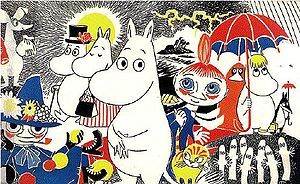
A wonderful new translation (into Hebrew) of Tove Jansson’s book The Moomins: The Story of the Magic Hat, brought back wonderful memories of reading The Moomins to our children and watching the superb animated TV series with them. To this day, one of our four children identifies himself with Snufkin, a sometime-Moomin family character. There are 9 Moomin books in all, along with a Moomin theme park in Western Finland and a Moomin Museum in Tampere, Finland, which my wife visited and loved.
The Moomins are trolls, with rounded snouts, and they live in Moominvalley, somewhere in Finland. (Tove Jansson, their creator, was ethnic Swedish but lived in Finland, where there is a substantial Swedish-speaking group). There is a father, mother, children, and sometimes, an unwanted visitor or an unexpected event.
Jansson invents a magical world for the Moomins, and sets them off on wonderful adventures. By creating non-human creatures, she is able to describe human characteristics and family interactions incisively, perhaps more sharply than she could if her heroes were truly human. By creating a whole new world, Jansson makes us accept her premise, that we must set aside all our assumptions and preconceptions, and frolic with her, leaping and diving into the world she has created.
Here is a small test to see how innovative you truly are, reader.
Create a new world. Start with “zoom out” – the physical place. Describe it. Draw a map, showing where your main characters live. Then “zoom in”. Create your characters. Notice how hard this is – we tend to ‘invent’ things that are familiar. Jansson’s Moomins are just human enough to be likeable, but non-human enough to be very interesting and draw our curiosity.
Now, after zoom in and zoom out, lights! Action! Set your characters in motion. What sort of adventures will they have? What kinds of conflict will they encounter? Will they have their own internal conflicts? External ones? How fanciful will your world be? Will it have gravity, night, day, time? Will you manage to persuade your readers to engage in what a famous writer called “the willing suspension of disbelief” – not an easy task, especially in the age of video.
There are numerous brain exercises that have proven helpful with creativity. I think that ‘invent a world’ is one of them.
Try it. See if you can draw your characters and their surroundings. Don’t assume you cannot draw, like me and many others. Just do it. Find your own style, perhaps simple or stylized. You will be surprised.
Innovation Blog
Goldman Sachs: Again, an End Run Around the Rules
Are the Regulators Impotent?
By Shlomo Maital
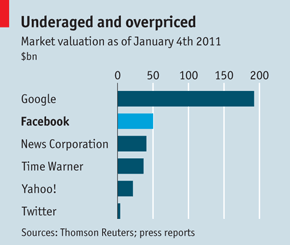
A report in The Economist, Jan. 6 issue, describes the following: Facebook is not a publicly-listed company, all its shares are privately held, by (allegedly) fewer than 500 investors, so it is not required to disclose any financial information. No-one knows for sure what its revenues or profits are. There are great competitive advantages Facebook enjoys, behind this veil of secrecy. But there is enormous interest in Facebook shares; Growing numbers of investors want to buy them. But Facebook CEO and founder Mark Zuckerberg do not want to do an initial public offering (IPO) of shares yet. They want to wait until Facebook’s soaring valuation peaks, perhaps at over $100 b. Yet Zuckerberg needs money, to expand his operations. How can you square the circle, sell shares without actually selling them?
Goldman Sachs to the rescue! This investment bank has valued Facebook at $50 b., and has set up an investment fund, investing $500 m. in Facebook and creating a fund that may invest another $1.5 b. Its partner in this venture is the Russian company DST. According to The Economist, “Clients considering signing up to its proposed Facebook fund are reportedly being asked to commit at least $2m each to it and to hold on to any shares they receive until at least 2013.”
This action clearly circumvents the intention of the regulators, that once there is wider public ownership of shares in a company, even if the shares are not publicly listed the company must begin to disclose financial information.
Is Facebook worth $50 b.? No-one knows. Certainly there is great value to having over 500 m. subscribers. But what is Facebook’s revenue model? Can it support as high a valuation as $50 b.? And what are Goldman Sachs’ motives? Are they, perhaps, interested, in setting up an inside track for underwriting Facebook’s IPO, a deal that could bring them many billions of dollars in fees?
And again, where are the regulators? Is Goldman Sachs and its Russian partner, along with Facebook itself, making a terrific speedy end run around the regulations, within the law but with dubious ethics? And have we seen this movie before, in 2005-9?
The Economist concludes: “ Regulators have a duty to protect investors and weigh the concerns of companies that wish to remain private. It is a delicate balancing act. But anyone who invests in a market this frothy must surely realize it is also risky. Meanwhile, Goldman and the other banks which hope to turn these vehicles into a big business should consider friending some good lawyers.”
**** postscript: Facebook, under pressure, has announced it will disclose financial results by April 2012 (probably a runup to an IPO), and the U.S. Securities and Exchange Commission has announced it will investigate Goldman Sachs’ “end run”.
Innovation Blog
Nature as the Great(est) Innovator
By Shlomo Maital

HORNET and its “photovoltaic” cell
The stories I recount below confirm, I believe, that the greatest innovator remains…Nature. Nature, and the enormous power of natural selection, have the patience to try experiments and select only those that work. And some of the results are quite incredible. The free-market paradigm of economics is only a weak imitation of Nature’s innate innovation process.
* Gulf oil spill: Enormous quantities of methane spilled into the Gulf of Mexico, after the BP Deepwater oil spill, because methane is a major component of natural gas. Now, scientists find, most of it has disappeared. Where did it go?
Apparently, there are microbes that feast on methane. They are mainly dormant in the oceans, because they have no food supply. But suddenly, when the Good Fairy arrives with millions of tons of methane, they feast, reproduce, feast…and so on. A Christian Science Monitor report reveals that “bacteria took fewer than four months to finish off the methane, and it appears that at no time did oxygen levels in the area the team studied fall to levels dangerous to marine organisms there.” Hey – chalk one up for Nature.
* Carmel Forest fire: A disastrous fire destroyed many acres of lovely forest in Israel’s Carmel Forest. A walk through the area reveals that after winter rains, green shoots are everywhere, as the forest struggles to renew itself. It will take years – but it will happen. A type of orange mold has been discovered, which feasts on charcoal, created by the forest fire. Another one for Nature.
* A team of Texas A&M scientists has studied leaf-eating farmer ants, which chew up leaves, make a paste, use it to grow fungus, then eat the fungus. They found that when the ants whose job it is to cut leaves find their mandibles have grown dull, too dull to effectively cut leaves, they simply switch jobs, and become carrier ants – ants whose job it is to transport the leaves cut by younger ‘sharper’ ants. Remember how Prussian diplomat Bismarck, who invented the Old Age pension system, picked the age of retirement as 65? It was an age so old, then, he felt very few would live to collect their pensions. Today, nearly everyone does. So in many nations pension funds are actuarially bankrupt. Solution? Follow the ant, as the Bible says. Abolish retirement. Simply reorganize to shift careers – as the ants do. Ever heard of an ant on pension? Yet another for Nature.
* Hornet’s nest: A study described in ScienceDaily, done by a team of Tel Aviv U. interdisciplinary researchers, has discovered that the hornet’s striped body captures and transforms solar energy, much as plants do in photosynthesis. In the course of their research, the Tel Aviv University team also found that the yellow and brown stripes on the hornet abdomen enable a photo-voltaic effect: the brown and yellow stripes on the hornet abdomen can absorb solar radiation, and the yellow pigment transforms that into electric power. “The team determined that the brown shell of the hornet was made from grooves that split light into diverging beams. The yellow stripe on the abdomen is made from pinhole depressions, and contains a pigment called xanthopterin. Together, the light diverging grooves, pinhole depressions and xanthopterin change light into electrical energy. The shell traps the light and the pigment does the conversion. The researchers also found a number of energy processes unique to the insect. Like air conditioners and refrigerators, the hornet has a well-developed heat pump system in its body which keeps it cooler than the outside temperature while it forages in the sun.” The team is now trying to mimic the hornet’s energy innovation with ‘bio-engineering’.

 TIMnovate