
You are currently browsing the category archive for the ‘Innovation Blog’ category.
Innovation Management
Outsourcing Innovation: Worst Idea of 2010
By Shlomo Maital
(400th blog since April 27 2008)
Large organizations invariably struggle with innovation, precisely because of their size. The anonymity and bureaucracy of ‘scale’ are enemies of creativity. It is hard to find big companies, indeed, that are dynamically creative. Apple may be an exception. But after achieving market capitalization of almost $300 b., some analysts wonder whether Apple is truly big enough (about 37,000 employees) to generate sustained growth and profitability.
One solution companies are adopting is outsourcing. Find consultants who will come up with the ideas, just as you find Chinese factories who will do your manufacturing. Such organizations are JUMP, IDEO, or Kotter International, do such consulting. * For example, Procter & Gamble, known as an organization that puts huge stress in its strategic planning on innovation, employs JUMP, to help study the “future of water and its water-dependent products, like detergent”. MARS asked JUMP to help study the current meaning of “indulgence”. GE retained JUMP for 10 different projects.
There is an alternative to outsourcing innovation. It is this: Take ownership of the innovation process, at the CEO level. Put together a task force. Use consultants only when the project, issues, and success criteria, are clearly defined.
The objective: Build a personalized creativity/innovation machine, suited to your organization’s culture, history, personality, competencies and goals.
Like a fingerprint, this creativity machine will be, MUST be, unique. And only you, the organization, can build it. Others may help – but the organization’s leaders must take ownership of the innovation process, building and operating it.
For this reason, I like the approach of Prof. Vijay Govindarajan, an innovation expert who will not even call himself a consultant. He is author of The Other Side of Innovation. “Consultants solve problems,” he says. “What I want is for companies to self-diagnose their problems and self-discover their own solutions through my thought leadership”.
I have helped companies work on constructing their innovation processes, and often, find there is an Act Two problem –an initial world-changing innovation, followed by immense difficulty in repeating it, precisely because no well-defined innovation process, aligned with the company’s goals and culture, has been put in place, even while every other imagineable process has been organized and defined in an operations manual.
Companies – Build your own personal Creativity Process. If you succeed, it will create a torrent of powerful innovations. If you fail, or do not even bother, other organizations who do will eat your lunch.
* based on: David Segal, “Paying others to assume burden of thought”, IHT Dec. 18-19, 2010, p. 11
Innovation Blog
Throwing Money at Innovation: Bill Gates Learns a Lesson *
by Shlomo Maital

Bill Gates
Five years ago, Bill Gates made an extraordinary announcement. He invited the world’s top scientists to define the world’s biggest health problems, and then to tackle them, and provided nearly half a billion dollars in five-year grants for 43 proposals (out of a total of 1,500), through the Bill and Melinda Gates Foundation.
Now, five years later, Gates has brought the grant-receiving scientists together in Seattle to evaluate the results. Frankly, they are not good. For instance, the pursuit of vaccines that do not need refrigeration (scarce in poor countries) has failed.
Says Gates: “On drawing attention to ways that lives might be saved through scientific advances, I’d give us an ‘A’!” But, he continues, “I thought some [breakthroughs] would be saving lives by now, and it’ll be more like in 10 years from now.” If then.
In some ways, Gates’ medical philanthropy mimics Microsoft’s innovation philosophy. Microsoft never misses an opportunity to miss an opportunity. It missed the iPad revolution, and now announces it is coming out with its own version of iPad, using its massive cash reserves to fund expensive “catch-up innovation”. But throwing money at innovation, large amounts of money, can be self-defeating, because the very existence of money precludes some of the wonderful creativity driven by the very lack of money. The core paradox here is this: How do you fund worthy innovation projects, without ruining them with that very funding? How do you apply former Curitiba Mayor Jaime Lerner’s dictum, which he applied religiously, that if you want innovation, slash two zero’s off the budget?
Gates is now shifting his strategy. Like Microsoft, Gates makes mistakes but usually learns from them. His plan now is to make hundreds of smaller, $100,000 grants. Mimicking Nature, Gates hopes that a thousand experiments will eventually turn up one or two breakthroughs.
Of course, we all wish him well and admire his philanthropy. I wonder if Gates and his foundation might have made better progress and saved hundreds of millions of dollars, had he thought more carefully about the nature of creativity and innovation, and its ambiguous connection with money.
* based on: Donald McNeil Jr., “Taking stock of a health quest”, IHT Dec. 21/2010, p.1.
Innovation Blog
“Retrovation” – Innovation By Looking Back: “Kangaroo” Care for Preemies
“By Shlomo Maital

“Kangaroo” care of preemie, with Daddy
Two key innovation principles joined together, to save the lives of prematurely-born babies in developing countries. One is the desperation of having no money – leading to superheated inventiveness and creativity. The second is the wisdom of looking back to old ideas, rather than constantly seeking technology-intensive expensive new ones, which I call “retrovation”.
Here is the story. Dr. Edgar Rey, chief of pediatrics at Mother & Child Institute, Bogota, Colombia, was desperate. Toward the end of the 1970s, Dr. Rey had a desperate shortage of incubators for premature babies. At times, three babies were crowded into one incubator, spreading infection. Even when alone, “preemies” tend to do poorly in incubators. One reason, Dr. Rey felt, was that preemies were separated from their mothers when in incubators.
Let’s be creative, he reasoned. Incubators keep babies warm, oxygenated and nourished. Just like the womb. What else can do this job, without costly equipment? How about – mothers? Dr. Rey invented “kangaroo care” – here is how it works.
A mother of a preemie puts the baby on her exposed chest, dressed only in a diaper and a cap, upright or semi-upright, strapped in by a scarf or other cloth sling supporting its bottom, all but its head covered by mom’s shirt. The mother keeps the baby like that, skin-to-skin, even when sleeping in a reclining chair. Fathers can wear the baby too, to give Mom a break. The babies stay warm, their own temperature regulated by the sympathetic biological responses that occur when mother and infant are in close contact. The mother’s breasts heat up or cool down, depending on what the baby needs. Feeling the mother’s breathing and heartbeat helps babies stabilize their own heart and respiratory rates. They sleep more. They can breastfeed at will. Preemies simply do better with “kangaroo”, according to randomized clinical research.[1]
“Kangaroo” is basically how mothers care for babies in “poor” countries that cannot afford technology, and how mothers cared for babies through history. By looking “backward”, both in terms of history and in terms of technological sophistication, a major breakthrough was achieved.
One of the careful clinical trials of “kangaroo” was conducted here in Israel, at Nahariya Hospital.
[1] Tina Rosenberg, “The human incubator”, Global New York Times, Friday Dec. 17, 2010, p. 6.
Global Crisis/Innovation Blog
QE2 Has Failed – Here’s the Evidence
By Shlomo Maital
My friend David Frank, a rising blogger who has significant experience in US bond markets, provides evidence that Fed Chair Bernanke’s QE2 (quantitative easing, version 2) has failed.
In his forthcoming blog, he notes:
- Since the program began in November, 5-year-yields (the yield on five-year US treasury bonds) have risen by a very large 0.9 percentage points (90 basis points). This means that the Fed has taken a $3 b. capital loss on the $116 b. worth of bonds it bought, because their prices have fallen, making their current value only $113 b. This is not the key point – the point is, QE2 was aimed at LOWERING long-term interest rates, and apparently it has done the opposite.
What went wrong?
Frank attributes the core problem to lack of coordination between the White House and the Fed — not the first time. The White House, by embracing the Republicans ‘ beloved extension of the ‘tax cuts for the rich’ program, has created even more red ink and postponed even further dealing with America’s near-11 per cent of GDP deficit. This means the Federal government will need to sell even MORE bonds in future to pay for its deficits – and by the laws of supply and demand, higher supply means lower prices (and higher bond yields).
It is not at all surprising, given the actors in place now in the Obama Administration, that the Treasury is acting at odds with the Fed. But it is distressing – because the Fed is the World’s Central Bank, not just America, and at the moment, it is bring mismanaged, as is the US Treasury, to the detriment not only of the rest of us outside the US but to the detriment of ordinary Americans as well.
Global Crisis/Innovation Blog
Secret Bankers’ Meeting: Is This Restraint of Trade or What?
By Shlomo Maital
Take senior business leaders from nine top companies in a vital industry.
Arrange for them to meet on the third Wednesday of every month in New York.
Purpose of the meeting: Protect their monopoly on an enormously profitable product.
Secrecy: “the details of the meeting and identities of the participants have been strictly confidential”.
Question: Does this qualify for breaking the law, under America’s anti-trust legislation, or what?
In her front-page exposé in the Global New York Times “Secret group keeps grip on trading derivatives” [Monday Dec. 13 2010], Louise Story reveals how top global banks “fought to block other banks from entering the market [for derivatives], and are also trying to thwart efforts to make full information on prices and fees freely available.
Let me get this straight. The huge, unregulated global derivatives market, including CDS’s (credit default swaps, that destroyed AIG), created by the huge banks, almost destroyed the global economy during 2007-9. The same people who brought you the Global Crisis Act One are now conspiring in secret to recreate it and keep it alive – the very assets that caused ordinary working people all over the world enormous grief and job loss.
Why are they doing this? Apparently, according to Story, because the derivatives market is hugely profitable, precisely because it is secret, unregulated, and no-one knows for sure how much the banks are charging legitimate companies for the vital hedging activities that derivatives permit.
How do we know it is enormously profitable? Checked the banks’ P&L statements lately? Wondered where all that profit is coming from, in a weak economy, with limited bank lending and borrowing? Two sources: Derivatives, and speculative trading.
The global banks failed to truly destroy global capital markets in their first try.
Perhaps this time, unless they are brought under control, they will succeed.
For the record, the bankers who meet secretly are: Thomas J. Benison, JP Morgan Chase; James Hill, Morgan Stanley; Sthanassios Diplas, Deutsche Bank; Paul Hamill, UBS; Paul Mitrokostas, Barclays; Andy Hubbard, Credit Suisse; Oliver Frankel, Goldman Sachs; Ali Balali, Bank of America; Biswarup Chatterjee, Citigroup. Note that it was JP Morgan who invented credit default swaps in the first place.
Ostensibly they meet to manage a “clearing house” for derivatives. In practice, they are effective in keeping out newcomers, including respected banks including Bank of New York-Mellon Clearing.
“Fundamentally the banks are not good at self-regulation”, said a former Federal Reserve regulator Theo Lubke who oversaw derivatives review until last autumn.
Here, we have the hands-down winner for Understatement of the Year!
Innovation Blog
Make a “Not-Do” List – And Make Time for Creativity
By Shlomo Maital
In their latest Bloomberg Business Week “Innovation Engine” column,* Michael Maddock and Raphael Louis Vitón quote Warren Buffet:
“…the difference between successful people and very successful people is that very successful people say “no” to almost everything!”
As people “hunker down” worldwide to begin preparing their “to do” list for 2011, the authors recommend that we try a “not-do” list. Make a “stop-doing” list. What will you stop doing in 2011, to boost your happiness and your impact on the world?
I did this myself a decade ago, after a serious illness. After taking early retirement, I pursued a policy of only doing things that either I really loved, or had the potential to make a difference to someone, or both. I gave up using a cell phone. Since creating a “stop doing” list (stop going to boring pointless lectures and conferences, stop writing pointless academic papers that no-one ever reads, stop teaching students who do not want to learn, stop wasting [negative] energy in battling bureaucrats or venting anger….), I have managed to product a book a year, write a regular column in a magazine, and launch a number of successful projects. Note that a stop-doing list is not an act of selfishness. Maybe of the things on my to-do list are aimed at helping other people and changing their lives. Stop-doing is actually altruistic – it says, our time on earth is limited, if we waste it we will be far less able to change the world.
“Stop-doing” is not just personal, it is managerial. Innovation really ought to begin, as Peter Drucker pointed out 50 years ago, not with innovation, but with abandonment. What should we STOP doing, so that we have energy and resources for new things? Stop-doing is just another word for laser-sharp focus.
The authors conclude:
“The best leaders have come to understand that the likelihood of market success is closely tied to how well they focus their teams’ attentions. You don’t want your big brains jumping from little challenge to little challenge. You want them laser-focused on the biggest challenges, the biggest opportunities, the most important company issues. When you can make this happen, you fulfill the promise of good leadership to your team. You also reward them with the efficiency and profits that make the business engine hum. You’ll find innovation will come easier. We promise.”
* The Innovation Engine December 7, 2010
Innovation Blog
Learning is Child’s Play: How a Principal Revived A Moribund School
By Shlomo Maital

Ein HaYam, Haifa ISRAEL
This is the story of how Baruch Yaakobi, principal of a moribund elementary school in a working class neighborhood of Haifa, used innovation to make his school an “observation center”, where principals from all over Israel come to learn best-practice.
Yaakobi’s school is in Ein Hayam, overlooking the Mediterranean on the lower slopes of Mt. Carmel. The neighborhood is aging and enrollment has dwindled, as young people leave for better-off neighborhoods with better schools. Yaakobi used innovation to save his school. According to Esti Ahronovitz, writing in the weekly magazine of Haaretz, at Ein HaYam, children learn by – playing games. They “play” literature, “play” Bible, “play” reading and arithmetic, “play” geography and history. Each day, Ahronovitz reports, children leave classrooms and enter “game playing arenas”, both inside and outside the school building. There are nearly no frontal lessons. The children play in order to learn, develop, enjoy themselves and become better people. In doing so, they implement Plato’s dictum that children learn not by coercion but by play – a principle development psychologists have proven beyond a shadow of a doubt.
For example:
- In a small grove at the entrance to the school, Grade One students learn addition and subtraction by collecting pine cones and stones and solving problems in notes attached to trees.
- Another group plays a memory game, using cards with arithmetic exercises whose solutions are found on a game board painted on the playground.
- 2nd graders do a treasure hunt, with arithmetic exercises that send kids scurrying from one place to another.
- 3rd graders are at the beach, researching the sand.
- 4th graders are in the gym, playing games with boxes. Nearby a teacher holds up signs with multiplication problems. Kids who give the right answer get to shoot baskets.
- 5th graders are in the bomb shelter, converted into a game-production lab (know many countries where children learn in bomb shelters?). One group prepares a trivia game with questions about Israeli towns and cities, after downloading information from the Internet. Another group prepares a history game, “feast of the gods”, where pupils dress in white sheets and wear floral wreaths. And so on….
Yaakobi says, I did not invent the notion of learning through play. “A child needs a large variety of play activity in order to develop emotionally, socially and cognitively. Play creates opportunities in which children can solve problems and develop emotional tools to cope with conflicts. Nowadays, children no longer play at school. A child who does not play will not develop properly.”
I believe Yaakobi’s concept is applicable to adults as well. I recall bringing each of four children to kindergarten, and looking at the warm inviting ambience, with Play-Do, plasteline, crayons, finger paints and other toys, I secretly wished I could stay – for the whole day. Later, I thought about creating Kindergartens for Elders – where high-pressure managers could go to unwind and return to childhood.
Ein HaYam and Baruch Yaakobi suggest it just might work.
Global Crisis/Innovation Blog
Now is The Time to Rethink Manufacturing in China: Bring Those Plants Home!
By Shlomo Maital
This is a perfect time to rethink the losing strategy (losing, at least, for middle class factory workers in America and Europe) of producing everything in China. According to Joe Manget and Pierre Mercier, writing in Bloomberg Business Week, “The rising cost of manufacturing in China gives multinationals a rare chance to rethink global production plans”.
The authors note that rising wages are eroding China’s massive competitive edge. They point to Foxconn (huge Taiwan-owned contract manufacturer in China) and its doubling of wages, following strikes, suicides and worker unrest.
“Much has been written about the more than doubling of wages at the Shenzhen factory of Foxconn, the world’s largest electronics contract manufacturer, which produces Apple (AAPL) iPhones and iPads and employs 920,000 people in China alone. ‘One can talk about a world pre- and post-Foxconn,’ says Victor Fung, chairman of Li & Fung, the world’s biggest sourcing company and a supplier of Wal-Mart (WMT). ‘Foxconn is as important as that.’ ”
Wage inflation in China, coupled with soaring minimum wages (20 – 30 per cent increases in most regions) and stagnant productivity, suggest this is a great time to rethink the Made in China strategy. If wages continue to rise 20 per cent a year, note the authors, added wage costs will total $623 / month in five years. (They cite a BCG Boston Consulting Group study). Why not anticipate this trend, and bail out now, rather than wait for foreign multinationals’ Chinese plans to become uncompetitive?
I fear that again, CEOs of multinationals will again take the easy path and instead of working hard to build competitive plants in America and Europe, they will look for another source of cheap labor. It’s easy to find – Vietnam. According to Manget and Mercier,
“Take one factory in Vietnam, where wages of 80¢ per hour are 31 percent lower than in China. On the face of it, this looks like a good deal—but factor in the differing productivity rates, and the Vietnamese factory’s cost edge drops to 14 percent. Furthermore, it won’t take long for young Vietnamese to demand the same treatment as their Chinese counterparts.”
It is time for the U.S. to wake up and abolish all the major tax incentives granted under George Bush for companies that produce abroad, and transform those tax incentives by 180 degrees – give them to companies producing in America, rather than companies producing in Asia. No country can ever maintain a strong prosperous middle class, healthy employment, modern production technology, and rising productivity, when it produces services almost exclusively. It is obvious. Why, then, is it not obvious to political leaders in the West?
A golden opportunity presents itself to tackle the pernicious job crisis, with policies that are neither fiscal nor monetary. Will our leaders again not miss an opportunity, to miss an opportunity?
Global Crisis/Innovation Blog
QE2 Fails – So Let’s Go for QE3 !
By Shlomo Maital
Ben Bernanke’s bond-buying rampage, known as QE2, or Quantitative Easing #2 (after the smash hit of QE1), has brought a deluge of criticism, global instability, and renewed fears of inflation, with no discernible impact on the US economy.
Writing in Bloomberg Business Week, Prof. Scott Shane [Case Western Reserve Univ.] shows that small business – the same small businesses who created nearly all the new jobs in America in the past decade, while big businesses were firing and laying off workers – will not benefit, while big business (yes, the ones firing and laying off) will. Even if QE2 does lower interest rates, it will not help small businesses, who have trouble getting loans at any rate, and who, moreover, refrain from borrowing because of weak demand for their products.
Prof. Shane notes what is completely obvious to everyone: The banks will continue to use the liquidity created by QE2 to shore up ravaged balance sheets (which continue to record losses, as banks ‘mark to market’ and write down their assets) by keeping every dollar the Fed pumps in, rather than lend it.
“QE2 is unlikely to get banks to lend. Banks have weakened balance sheets as a result of the financial crisis and are more likely to use the money created by the Fed’s asset purchases to shore up their reserves than to lend more.”
Faced with overwhelming evidence against QE2, and widespread protest from business economists (those who really know what is going on), Bernanke has thought carefully and deeply, and apparently – decided to try a third round of quantitative easing, QE3. And, doubtless, a fourth and a fifth, until the dollar collapses and inflation recurs.
The Obama Administration is clearly desperate. It cannot use fiscal policy, because capital markets now seem to demand a cut in budget deficits rather than an increase. So its message to the Fed is, don’t just stand there, do something! With monetary policy also having shot its wad, the right message to the Fed should be: Don’t just do something, anything, stand there! Hasty ill-advised policy will prolong Americans’ travails, rather than cure them. And that is precisely what is happening.
Innovation Blog
Maldives Islands Underwater? Does Anyone Care?
By Shlomo Maital
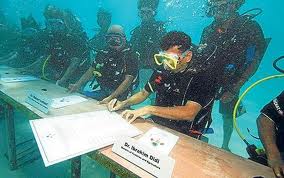
Underwater cabinet meeting
The President of the Maldives Islands, a small island nation in the Indian Ocean, is Mohamed Nasheed, a former political prisoner turned leader. His tiny island is basically at sea level, and global warming and rising sea levels threatens to put his whole country under water by the end of this century. He is desperate to get the world’s attention to his small country’s plight. But how?
Try this for innovation:
Mohamed Nasheed has organised an underwater cabinet meeting and told all his ministers to get in training for the sub-aqua session. Six metres beneath the surface, the ministers will ratify a treaty calling on other countries to cut greenhouse emissions. Ahead of the meeting, scheduled for 17 October, cabinet members have been squeezing into wet-suits and practising their underwater skills. The President was not present at the first session, held over the weekend, because he is already a qualified diver.
Maldives is comprised of some 1,200 coral atolls. It has only some 300,000 people, and its highest point is the lowest of any country in the world – 2.3 meters (about 7 feet).
Did President Nasheed’s underwater cabinet meeting attract huge attention? I’m afraid not. When it comes to concerted consensus action on global warming, the entire world is under water. I’m waiting for his next innovation to attract attention. Mohamed, keep trying. Don’t give up! Here are a few suggestions –
Do a ‘sand box’ simulated model of land masses in North America Europe and Asia. Show the impact of global warming on sea levels, by 2150 and 2200, including Rotterdam, New York, Boston, and other port cities under water. Sell “Maldive snorkels” to green activists around the world, to fund your public relations activities. Create fake gills to place next to people’s ears – showing how we will have to breath in future, like fish, if action is not taken. Stage a trial – put the leaders of the US and China, huge foot-draggers, on trial for putting the world under water. Recreate Atlantis, the under-water world, as a tourist attraction.
Just trying to help, Mohamed. Why not mount a web-based contest, worldwide, for possible solutions to your little country’s problem? My suggestion: Tow your 1,200 atolls across the Pacific and park them in San Francisco Bay. Declare war on America, lose it, and then accept massive munificent American foreign aid, which America always bestows on those it defeats.


