
You are currently browsing the category archive for the ‘Innovation Blog’ category.
Innovation Blog
Poetry & Innovation: Mommy, Daddy, Tell Me a Story!
By Shlomo Maital
Nov. 4/2009
Do you want to build a powerful business innovation? I ask my students.
If you do — tell me a story. Build a powerful narrative that has real people in it, a plot, conflict, a story line, and above all, a happy end. These are all elements of every great children’s book, stories we all grew up on, Good Night, Moon, Where the Wild Things Are, and so on. Children make meaning out of the world through stories. So do we adults, it seems. War and Peace, Anna Karenina — great novels are all great stories.
So — I ask my students to write a great narrative, rather than a dull-as-dust business plan with a huge spreadsheet. Tell me a story. Tell me how you will build a prototype, sell to one customer, scale up — and change the world. And make sure there is a vivid photographic happy end.
Who is the main client for such a story? Investors? VC’s? No. The main is client is YOU yourself! Does your story excite you, does it reflect your deepest passions? If so, you have a business idea with potential to succeed. If not — you’re wasting your time. If you cannot energize yourself, you will not energize others that you will need on your team, in order to succeed.
Great stories create meaning. They are memorable. They inspire. No-one ever joined a business venture because of an inspiring spreadsheet. They do join because of a powerful change-the-world visionary narrative.
To tell the absolute truth — many of my students do not ‘get it’. They have been polluted by follow-the-rules here-is-how-to-do-it MBA course formulas for writing conventional business plans. Do it this way, students learn in their MBA studies. Is it not ironic that we teach entrepreneurship and innovation, by instructing our students to avoid innovation (in business plans) like the plague?
I find badly-needed moral support in last week’s New York Times column by Thomas Friedman, titled “More Poetry Please”. Here is what Friedman says:
“President Obama has not tied all his programs into a single narrative that shows the links [among all his ideas and initiatives]. …such a narrative would…evoke the kind of popular excitement that got him elected. Without it, the President’s eloquence is lost in a thicket of technocratic details. OBAMA NEEDS TO ENERGIZE THE PROSE of his Presidency by recapturing the poetry of his campaign!”
[Yesterday’s (Tuesday) elections in the US prove the point. The Democrats lost two key races for Governor (New Jersey and Virginia), despite Obama’s intervention there.]
Precisely! Every innovator, including Mr. “Yes, we can”, must energize the prose of his or her idea (the feet-on-the-ground business details) with head-in-the-clouds narrative poetry, to excite himself or herself and to energize the team, the investors, and even the clients.
But innovators, beware! Building such a narrative is extraordinarily difficult. Entrepreneurs are not supposed to be poets! Many innovators are engineers; engineers are trained to understand the Second Law of Thermodynamics, not the First Law of Rhetoric and Narrative.
Here is a suggestion. Do you have a business idea? Tell it to a six-year-old. Make it into a story. If you can hold their interest, and elicit questions, maybe you have a good business idea. If you cannot, if you cannot respond to “Mommy, Daddy, tell me a story”, with a good one — go back to the drawing board.
Innovation Blog
How to Say “I Love You” Without Saying “I Love You”!
By Shlomo Maital
Nov. 4/2009
A BBC World Service program on the songs of Irving Berlin and George and Ira Gershwin, American Jewish songwriters and musicians who lived in the 1930’s, reveals a key innovation principle:
Often, thinking IN the box [i.e. within difficult binding constraints or limitations] spurs enormous creativity.
In the 1930’s composer George Gershwin (Rhapsody in Blue, An American in Paris] and his brother Ira, who wrote the words (lyrics), wrote wonderful love songs. They did so, however, without using the words “I love you”, because those words were overused and tired.
How do you say I love You without saying I Love You? Wow, here are two great examples: Gershwin’s Let’s Call the Whole Thing Off, and Irving Berlin’s How Deep is the Ocean?
Let’s Call the Whole Thing Off
This song was written for the 1937 movie musical Shall We Dance? By Ira and George Gershwin. It was sung by Fred Astaire and Ginger Rogers, who did an innovative dance while singing it, on …. roller skates! It is pure magic! Compare these lyrics with today’s rap!
Things have come to a pretty pass
Our romance is growing flat,
For you like this and the other
While I go for this and that,
Goodness knows what the end will be
Oh I don’t know where I’m at
It looks as if we two will never be one
Something must be done:
You say either and I say either,
You say neither and I say neither
Either, either
Neither, neither
Let’s call the whole thing off.
You like potato and I like potahto
You like tomato and I like tomahto
Potato, potahto,
Tomato, tomahto.
Let’s call the whole thing of
But oh, if we call the whole thing off
Then we must part
and oh, if we ever part, then that might break my heart
So if you like pyjamas
and I like pyjahmas,
I’ll wear pyjamas
and give up pyjahmas
for we know we need each other so
we better call the whole thing off
let’s call the whole thing off.
You say laughter and I say larfter
You say after and I say arfter
Laughter, larfter
after arfter
Let’s call the whole thing off,
You like vanilla and I say vanella
you saspiralla, and I saspirella
vanilla vanella
chocolate strawberry
let’s call the whole thing of
but oh if we call the whole thing off
then we must part
and oh, if we ever part,
then that might break my heart
So if you go for oysters
and I go for ersters
I’ll order oysters
and cancel the ersters
for we know we need each other
we better call the calling off off,
let’s call the whole thing off.
I say father, and you say pater,
I saw mother and you say mater
Pater, mater
Uncle, auntie
let’s call the whole thing off.
I like bananas and you like banahnahs
I say Havana and I get Havahnah
Bananas, banahnahs
Havana, Havahnah
Go your way, I’ll go mine
So if I go for scallops
and you go for lobsters,
So all right no contest
we’ll order lobseter
For we know we need each other
we better call the calling off off,
let’s call the whole thing off.
How Deep is the Ocean?
Irving Berlin’s 1936 song, to which he wrote both words and music, conveys the deepest feelings of love , using I love you only twice, but as a question….
How can I tell you what is in my heart?
How can I measure each and every part?
How can I tell you how much I love you?
How can I measure just how much I do?
How much do I love you?
I’ll tell you no lie
How deep is the ocean?
How high is the sky?
How many times a day do I think of you?
How many roses are sprinkled with dew?
How far would I travel
To be where you are?
How far is the journey
From here to a star?
And if I ever lost you
How much would I cry?
How deep is the ocean?
How high is the sky?
Innovation Blog
WHAT WOMEN WANT
Shifting Consumer Mindset:
Are You Tracking It? Part II
Oct. 31/2009
Boston Consulting Group expert Michael Silverstein and colleague, who head BCG’s global consumer practice, recently ran a web-based survey of some 25,000 women worldwide. They published their results in a recent book What Women Want. The results are important and revealing. They show a rapidly developing and changing market, based on women who are increasingly stressed and pressed for time, and whose needs are not being fully met. There is much room here for innovation. If innovation is largely managed, led and conducted by men, perhaps it is time to enlist women — unless men can suddenly become massively empathetic to the needs of half the world that has XX chromosomes. The female economy, we learn, is a quiet economic and social revolution.
Here is a brief summary, taken from Singapore’s Business Times, Oct. 29, written by BCG principals in Southeast Asia:
We are on the brink of a major business revolution. Over the next five years, women will have US$5 trillion in incremental earnings to spend and we see this as a commercial opportunity bigger than the rise of the consumer economies of China and India combined, and an economic stimulus far larger than any government bailout package. Women control US$12 trillion of the overall US$18.4 trillion in global discretionary consumer spending, and they will have an even bigger share in the coming years. These women increasingly earn a substantial portion of the household income and control up to 65 per cent of household spending. Taken from What Women Want – a Boston Consulting Group (BCG) global consumerism survey of more than 12,000 women in 22 countries around the world – these figures and survey analysis highlight their focus — the [need to] understand and serve this female economy.
Much of the research from the survey findings shows that women are dissatisfied with the products and services available to them. Companies fail to answer women’s needs and misunderstand the overwhelming demands placed on their time and the challenges they face when dealing with the myriad roles they typically play – as wives, mothers, sisters, daughters, partners, professionals, friends and colleagues. These dissatisfactions need to be addressed by businesses in many industries before they can truly win the trust and consistent purchasing power of women.
Specifically, companies fail to:
¨ address women’s need for time-saving solutions;
¨ design and customise products specifically for women;
¨avoid condescending and clumsy sales and marketing efforts;
¨align with women’s values or develop community; and,
¨increase their social initiatives and give back to society in more meaningful ways.
The women surveyed in Women Want More indicated they are most dissatisfied with financial services (73 per cent), health care (71 per cent) and consumer durables (up to 47 per cent).
Of the three, financial services is the industry that frustrates women most. In general, women indicated they don’t have a desire to accumulate money for its own sake or experiment with complicated financial instruments. A majority of the women value money as a means for caring for their families and themselves, improving their lives and assuring long-term security. Many indicated they want advisers and services that recognise their need for short-term simplicity and long-term stability.
For the most part, women aren’t getting the financial management solutions they want. Instead, many experience a lack of respect, poor advice, contradictory policies and an obstacle course of red tape and paperwork. Of the companies studied, very few understand the significance of the female economy to their business. If they respond to this economy at all, they do so by making small adjustments to their product line or to their organisations.
To better understand the female audience, companies must reconsider how they do research, how they develop products, how they sell and merchandise and how they add services to their value proposition. Companies must rethink how they segment the female audience and how these segments react to changes in consumer bahaviour. To facilitate broader analysis of what women want, we created six key female consumer segments –
¨ fast-tracker, ¨ pressure cooker, ¨ relationship-focused, ¨ managing on her own, ¨ fulfilled empty nester and¨ making ends meet.
Each archetype is defined by income, age and stage of life. Such segmentation proved useful for our research and is now successfully informing the development and marketing of offerings to women.
Understanding what women want can be done through a four-R approach –
¨ recognise, ¨ research, ¨ respond and ¨refine.
¨ Recognise the opportunity;
¨ research how a product or service is being consumed; and respond with new disruptive innovations that create new categories, new segments, or entirely new sources of products and services; and,
¨refine ideas in a way that creates lasting relationships with female consumers, builds connections and continually improves the offering to strengthen those relationships.
Balancing ‘work at work’ and ‘work at home’ : Women earn a substantial portion of the household income and yet they still do the bulk of the housework and home management. As a result, it is not surprising that women in every corner of the world are starved for time and many are stretched.
BCG’s research has shown that women are struggling to balance the ‘work at work’ with the ‘work at home’. At the same time, they have high standards and even higher expectations of themselves.
These expectations – combined with the responsibilities women shoulder for caring about good nutrition, education, health care and making money for the family – create tremendous stress.
Women hold approximately 50 per cent of university places throughout the world. Apart from the number of graduates entering the workforce, there is a global increase in the number of women going to work in full-time and part-time positions.
The facts cannot be ignored, and increase in significance as companies recognise the importance of the female economy. By systematically targeting this market and understanding women’s dissatisfactions, companies can holistically, rather than incrementally, participate in and profit from one of the most important commercial opportunities of the century. Women will benefit from and appreciate the outcomes too.
Source: Copyright © 2007 Singapore Press Holdings Ltd. All rights reserved.
Innovation Blog
The ABCDE’s of Innovation:
Remembering Albert Ellis
By Shlomo Maital
Oct. 21/2009
Psychologist Albert Ellis died on July 24, 2007, age 93. He singlehandedly led a revolution in psychotherapy toward cognitive therapy, as opposed to Freudian approaches. He was active and vigorous to the end of his life, and will be remembered in particular for his lively exchanges with friend and sometimes opponent Aaron Beck at APA (American Psychological Association) meetings.
Ellis pioneered focused results-oriented RETP Rational Emotive Behavioral Therapy. He opposed Freudian psychotherapy that could drag on for years, without measurable results. Ellis’ key precept: We ourselves are responsible for how we interpret events — we can either turn them into emotional disasters or into uplifting constructive actions.
Here is an example of Ellis’ A B C D E approach (from personal-development.com):
My son returns from work or school and goes to his room without saying anything.
This is ‘A,’ the ACTIVATING event. Listed below are five thoughts I may have, depending on my BELIEFS. Next to the thoughts are emotions that are linked to them.
1. “After all I’ve done for him, he doesn’t have the common courtesy to say hello.” Feeling angry.
2. “Something must have upset him.” Feeling concerned about his welfare.
3. “He must be angry with me.” Feeling worried.
4. “He must be upset because this morning I told him he was late for work again.” Feeling hurt.
5. “He must be lost in thought.” Feeling compassionate and understanding — no loss of happiness.
In thought #1, I believe my son is rude and I feel angry, the CONSEQUENCE of which may be an argument with him. But what if he was innocent? The happiness of two people are jeopardized by my irrational thought (distorted thinking). On the other hand, what if I DISPUTED the thought before flying off the handle? As soon as I felt the anger, I could have paused and asked myself some questions such as, “Am I jumping to conclusions? Can there be an alternative explanation for his silence? Am I unfairly judging him? Since I am his father and not a child, why don’t I take the initiative by greeting him and starting a conversation to learn why he was so quiet?”
Can you see the powerful EFFECT of changing my thought? Doesn’t it also change my behavior and its CONSEQUENCE? The point to remember is that it is not the ACTIVATING EVENT that determines our actions or behavior, but our interpretation of that event. You can practice the ABCDE steps with the other four example thoughts. Once you’re comfortable doing so, practice with your own thoughts and watch you change your life!
Can we develop a Rational Emotive A B C D E approach to innovation? Consider the following:
Activating Event: An observation of something unusual, out of the ordinary, that catches your attention. This requires empathy; seeing things others may not observe.
Belief: The thoughts and emotions that A creates. Empathy: I detect that someone is unhappy, has a need or want that is unsatisfied.
Consequences: What you do with those thoughts and emotions. How can I satisfy that need?
Dispute: Challenge the conventional way of thinking about C; see it differently, turn it upside down, reverse it, use “what if?” Add on more features to an existing product? Or — remove some features. Create a completely new product.
Effect: Use A B C D to create a powerful innovative business idea, one that others locked into conventional ABCD paths cannot and will not see.
Ellis sought to help people with deep emotional problems and distress. And he did. Moreover he trained several generations of psychologists in his methods, and they in turn helped countless people. With his innovation, he changed the world. Indeed, a survey ranked Ellis as the second-most influential psychologist in history. First was Carl Rogers; third was… Sigmund Freud.
I regret I will not have the chance to ask Ellis if he thought Rational Emotive therapy could also become a technique for innovation.
Innovation Blog
Innovative Ideas Start with a Mantra
By Shlomo Maital
Oct. 17/2009
In Indian religions, a mantra is a sound, syllable, word, or group of words that are considered capable of “creating transformation”.
According to Wikipedia:
The Sanskrit word mantra- (m. मन्त्रः, also n. मन्त्रं) consists of the root man- “to think” (also in manas “mind”) and the suffix -tra meaning, tool, hence a literal translation would be “instrument of thought”.
Generally, innovators create new products and services, then at a much later stage, hire creative people to market them. Creative departments in advertising agencies seek powerful mantras that change, or even transform, people’s perceptions of the product. Great businesses can emerge from powerful mantras. Mantras can help communicate a powerful vision not only to clients, but also to managers and workers; they can align behavior with strategy.
· “Just do it!”. Not only has Nike built its business around this mantra, many people claim it has changed their lives by self-empowerment. I am one of them.
· I © NY. This mantra, marketing New York City, appears everywhere. It is a powerful example of how a complex message can be compressed into almost zero space, with instant comprehension.
· Think Different. Differentiation is a key element of successful innovation. Apple’s products are different. Their mantra communicates this powerfully, and everyone in the Apple organization seeks to apply it, including industrial designers (Apple products look different – they have to, if they looked the same, this would be inconsistent with the mantra).
“Everything we do and the way we do it, everything we say and the way we say it, sends a message”, says Nicolas Hayek, founding CEO of Swatch.
Sends WHAT message? The mantra message.
Start with an idea. Build a mantra. Then move forward. The mantra, if it is powerful, will transform your clients and your workers. The mantra will ensure that everyone, everywhere, ‘gets’ your product’s message. It will ensure you you yourself understand the message your idea conveys, the perception you wish to create and the need or want you seek to satisfy.
Mantras are indeed an ‘instrument of thought’. They will help everyone in your organization think in a clear and focused manner on the product, what it does, how it looks, who uses it — and how it will transform the world.
Do you have a great mantra? Can you create one?
Innovation Blog
“It’s the Avon Lady!”
By Shlomo Maital
Oct. 16/2009
There are two management functions that are consistently undervalued, even in organizations of excellence.
One is HR – human resources. HR managers are often first to be fired, first to have training and development budgets slashed, and often do not have a seat at the table where company strategy is made. When HR executives have training exclusively in organizational development, they are often not sufficiently intimate with company products, strategy and operations, to merit membership in the strategy brain trust. This is regrettable, because few strategies can be successfully implemented without well-aligned human capital elements.
A second is sales. Most companies have Marketing VP’s, but many lack Sales VP’s, or combine Marketing and Sales (a mistake: they are often oil and water), or put the head of Sales under the Marketing VP. Sales personnel have a wealth of information about clients and markets. But because they are in the field, rather than at headquarters, they are often not sufficiently consulted. I have given workshops to large numbers of senior managers, and, in a group of, say, 150, find there are no sales managers present at all or perhaps one or two.
How the sales force is organized and managed can be a powerful source of innovation and competitive advantage. Avon, one of the three largest global cosmetics firms, is a good example. Avon has 5.8 million direct-sale “Avon ladies”. Avon (will not sell its products in stores, in order not to compete with them. In the global downturn, Avon’s dynamic CEO Andrea Jung has recruited 200,000 more Avon ladies in the U.S. alone; when jobs are scarce, selling Avon products door-to-door becomes attractive.
According to CEO Jung, one of the world’s highest-paid female executives ($19 m. last year):[1]
” We’ve been successful at gaining representatives and consumers during these tough economic times. This confirms our belief in the inherent advantage of our direct-selling business model. As women around the globe are seeking income and smart value products, Avon is there to meet their needs. We’re offering women an opportunity when times are tough and unemployment is high. Women are turning to us for additional income for their families. In the emerging world, women are coming into a socio-economic status where they’re wanting to earn. We’re one of the largest micro-lenders in the world, because every time a representative joins us, we give her a small loan by supplying her with her initial products up front. With credit drying up in the world, we have more money lent to women than any other business. This year, Avon responded to the recession by launching the biggest recruitment drive in its history to hire new door-to-door agents in 44 markets. It increased its agent headcount by 200,000 in the US alone in the first quarter of 2009 and lots more are signing up in the UK too.
“What keeps [my job] meaningful and purposeful is that it’s about doing good, not just doing well: making some kind of difference. On a bad day I go out and meet our Avon representatives and they really do inspire me because they’ll tell you stories about how from nothing this company has given them an opportunity to change their lives. I meet people from villages all over the world who say they have been able to send their son or daughter to the UK or US for education. No matter what kind of day I’m having, that’s a hugely satisfying and gratifying thing.”
Jung understands the opportunities inherent in the downturn. She says:
“My philosophy was ‘let’s go on the offence, not the defence’. It’s easy in these kinds of times to hunker down, cut everything and wait for sunnier days. But if you study businesses in the worst economic periods, that’s when heroes can be made. More market share can be lost or gained in tough economic times than in other periods. Our bold strategies to counter the recession are working.”
Imagine having 5.8 million energized sales personnel in the field, in 44 countries, reporting back on market reactions and suggesting new product ideas, at a time when the success of those ideas directly imply higher sales and incomes for each of them, and at a time when the global downturn is causing rapid change in customer preferences. This innovation function of a sales force is, I believe, often underutilized and neglected.
[1] “Avon boss on the offensive”, London Sunday Telegraph 10 Oct 2009, p. 10
“Cognitive dissonance” is a concept built by social psychologist Leon Festinger, defined as the discomfort we feel when we entertain two conflicting ideas or notions. For example, in Aesop’s Fables, the tale of the fox and the grapes, the fox fails to reach the grapes, and then concludes, “they were probably sour anyway”. (a) “I want the grapes” (b) I cannot have them (dissonance) —à resolution – I don’t want them, because they are sour. (This tale is the origin of the expression: “sour grapes”.). or: “I am a good person”, and “I just did a bad thing”, resolution: rationalization, I had to do it because….
Festinger studied a UFO (unidentified flying object) cult, and wrote a book on it, When Prophecy Fails. The cult predicted the end of the world. When it did not happen, rather than dissolve, the cult grew stronger, as members recruited other members; they resolved the dissonance between “the world will end” and “the world did not end” by concluding: “the world did not end because our cult saved it”.
Cognitive dissonance causes discomfort. The human mind, apparently, does not like ideas that clash with one another and works very hard and very rapidly to eliminate the clash.
Creative people, however, are known to be very good at holding dissonant ideas in their minds for long periods of time, using the clash of ideas to create totally new concepts or inventions. For instance, Einstein thought that time was not constant but in fact variable; yet he looked at his pocket watch 10 times a day and saw that it was perfectly regular and constant. He held this dissonance, until he developed the special and general theories of relativity.
I believe that part of what we mean by “moving out of our comfort zone” is precisely this — creating dissonances that are uncomfortable, and holding on to them rather than artificially and superficially resolving them. Practice holding two clashing ideas in your mind, without seeking compromise or resolution.
* I am a good person; I am a bad person.
* Simple designs are beautiful; complex designs are beautiful.
* creativity is thinking out of the box; creativity is thinking within the bounds of realistic constraints.
…. Be careful not to “turn gray”. In other words, holding “black” and “white” in your mind simultaneously does not mean to turn them into one color, gray. This is the opposite of creativity. It means seeing black, seeing white, feeling strongly the clash — and not seeking to resolve or eliminate it, but rather holding it, holding the tension, exploring the tension and letting it guide you toward new ideas. To do this, you need to welcome the discomfort (often extreme) that cognitive dissonance generates.
“EVERY MAN is in certain respects;
a. like all other men,
b. like some other men,
c. like no other man.
“He is like all other men because some of the determinants of his personality are universal to the species. That is to say, there are common features in the biological endowments of all men, in the physical environment they inhabit, and in the societies and cultures in which they develop.
In certain features of personality, most men are “like some other men.” The similarity may be to other members of the same socio-cultural unit. The statistical prediction can safely be made that a hundred Americans, for example, will display certain defined characteristics more frequently than will a hundred Englishmen comparably distributed as to age, sex, social class, and vocation.
Finally, there is the inescapable fact that a man is in many respects like no other man. Each individual’s modes of perceiving, feeling, needing, and behaving have characteristic patterns which are not precisely duplicated by those of any other individual. This is traceable, in part, to the unique combination of biological materials which the person has received from his parents. More exactly, the ultimate uniqueness of each personality is the product of countless and successive interactions between the maturing constitution and different environing situations from birth onward.”
-Henry A. Murray and Clyde Kluckhohn, from Personality in Nature, Society, and Culture (1953).
In reading through the 100 “humble masterpieces” (paper clip, disposable lighter, eraser, etc.), several conclusions emerge. A key one is that many great innovations emerge because the inventor needed something, built a prototype — and discovered that other people too wanted it and would buy it.
Much of applied innovation stems from amateur cultural anthropology. The anthropologist Clyde Kluckhohn once stated, in only 18 words, what I believe is the key principle of empathic innovation.
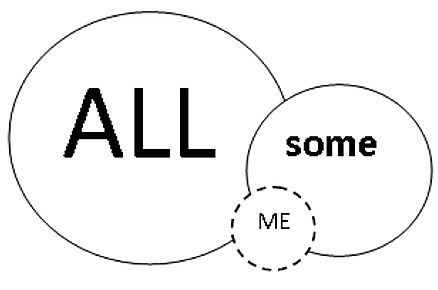
All of us are like everyone else. We share common needs, wants, values, desires, goals. All of us are like some other people — we all belong to groups, tribes, families, organizations, with shared values and personalities. And every one of us is like no one else — every one of us is unique. The circle diagram shows this — part of each of one of us is unique, part is like some other people, part is like all other people.
Innovation begins with identifying an unsatisfied need. But how can such needs be found? Often, the best way is to search within ourselves and discover our own unsatisfied needs. The best place to search is in the “ALL” circle. The next best place is in the “SOME” circle. Increasingly this approach is proving fruitful.
A previous blog cited the book Microtrends. A powerful successful business can be built on identifying an unmet need for only 1 percent of the population — “Some”.
No business can be built on just “Me” – an unmet need that is unique to me and to me alone.
Innovators should focus, I believe, on the “Some” circle, and the small area where “Some” intersects with “Me”, because this is where their chances of success are highest. In their business ideas, they should try to quantify, with circles, how wide this unmet really is, and how many people are characterized by it.
To help with this task, ask:
* In what ways am I like ‘some other people’? Who are they? What are their goals, desires, wants, needs, personalities, values?
* For this group, are there unmet needs? What are they? What are the key ones? How do I know? What is the evidence?
* How can I use enabling technology, where necessary, to meet this unmet need, to satisfy it, using a powerful creative business model?
By beginning the invention and innovation process in this way, we ensure that we do not ‘push’ imaginative innovative products into a market where there is no real need, and instead, begin with a true need and pull technology in order to meet it.
And a good place to begin is to read Kluckhohn, who was passionate about the Navajo, a native American tribe, and other anthropologists, whose skill it is to ‘read’ other cultures. No skill can better serve an innovator seeking to empathize with all others, some others, and himself or herself.
A special issue of National Geographic: 2010 State of the Earth contains some staggering (to me) facts about America’s gluttony. Here are a few of the facts, and issues they raise for innovators:
• America has only 5 per cent of the world’s population, yet uses a quarter of the world’s energy.
* Innovators: How can you get Americans to consume less energy? Gasoline in Europe is about $8 a gallon; in America it currently averages $3.45, or less than half. Why?
• 27 per cent of food available for consumption in America is discarded. This is enough to feed 80 million people: almost enough to feed, for instance, four times the population of Australia, or everyone in Germany. Or, at 1,500 calories a day, almost all the hungry people in India.
* Innovators: How can you get Americans to throw away less food? How can this wasted food be used for the poor and hungry?
• Only one-third of agricultural consumption in America is used directly for food. The rest is for animal feed. It takes 7 calories of animal feed to make one edible calorie of meat. If Americans ate their agricultural crops rather than fed them to animals, they could feed much of the rest of the world. Also: some 18% of all human-related greenhouse gases come from animals!
* Innovators: How can you get Americans to use more of their agricultural production for food and less for wasteful animal feed? How can you get Americans to eat less meat?
• In 1970 Americans consumed 2,234 calories daily on average. In 2003, it was 2,757 calories, or 23 per cent more.
* Innovators: How can you get Americans to consume the amount of calories they consumed in 1970, thus saving resources and reducing enormous human and social costs of rampant obesity?
As leaders of the world meet in Bangkok, and later this year in Copenhagen, to discuss global warming, each leader will dump the blame and the pain on other countries. Can President Obama, surprise winner of the Nobel Peace Prize, stun everyone and make the following statement:
Gluttonous America is primarily responsible for global warming. We accept responsibility. We accept the onus for taking painful measures to reduce our gluttony. We will do this before demanding the same from other countries. We will slash our appetite for energy and for calories and for meat. We will become vegetarians. We will ride bicycles. We will build and drive small electric cars. Only then will we demand that other countries do the same.
Some say the Nobel Peace Prize is awarded (as Obama himself claimed) to put ‘wind in the sails’ of good causes, rather than reward actual results.
Will Obama use this ‘wind’? Or will he simply generate more and more hot air?
This is the second in a series of blogs about “Humble Masterpieces”*.
Ever wonder how M&M’s were invented?
Like many wonderful innovations, M&M’s were not invented, but rather — discovered, observed and perfected.
An American named Forrest Mars (the M&M company is still named Mars, and is the largest confectionary company in the world; the other “M” is his partner, Bruce Murrie) visited Spain during the Spanish Civil War (1936-9). He noticed that Spanish soldiers were eating chocolate covered with a hard sugary coating. The coating kept the chocolate from melting.
When he came home to America, Mars developed a recipe for M&M’s. When WWII broke out, he made and sold M&M’s to the US Army and soldiers fighting in Europe consumed large amounts of them. After the war, Mars began to market M&M’s to the public, in cardboard tubes. Later, he shifted to the plastic packets we know today.
M&M’s has stuck fast to its original look and product over the decades. It added chocolate-coated peanuts in 1954. Since then, Mars has added incremental innovations, such as new colors — pink, and blue.
A great many of the ‘humble masterpieces’ were built on sharp-eyed observations by innovators, rather than do-it-from-scratch inventions.
Innovators: Is your vision 20/20? Do you watch constantly for ways people use conventional products differently, to overcome constraints, to make their lives easier? Do you observe closely how people use your own products or services, in unusual ways? When the founders of Quicken (book-keeping software) saw that people were buying Quicken not to manage their checkbooks (its original intention) but actually to run their small businesses, they quickly moved to exploit this huge unexpected market.
This is why time to market is so crucial for innovations. Get it out there fast! Then observe and learn. Often this is the only way you will discover what the true market is for your product, and what its true Unique Value Proposition is, and for whom!
*Paola Antonelli, Humble Masterpieces: Everyday Marvels of Design. Harper Collins: 2005.

 TIMnovate