
You are currently browsing the category archive for the ‘Innovation Blog’ category.
Kids Sue Elders: Is This What We’ve Come To??
By Shlomo Maital

I recently wrote a column in the fortnightly magazine Jerusalem Report, titled “Waging War on our Children”. The title was a direct quote from Professor Larry Kotlikoff, Boston University. Kotlikoff pioneered economic studies of “intergenerational equity” – how one generation passes on a better (or a worse) economy and society to the younger generation.
Today, Kotlikoff’s meticulous studies show, it is …worse! Much much worse. Because, when you take the present value of US spending obligations (education, health, pensions), and the present value of US tax revenues, there is an enormous fiscal gap of $200 trillion, or 10 times US GDP. This is the debt burden the US is dumping on its young people. And this is true of other countries too, including my own, Israel. (see Kotlikoff.net)
In the latest issue of NATURE magazine (Nov. 8), I spotted this amazing short article. American ‘kids’ (young people) are suing the government (older generation), for ruining the climate and leaving them with a bloody mess.
This is a serious suit. Of course the Trump administration seeks to have it dismissed. But the Supreme Court will debate it seriously.
Is this where we’re at? Is this how low we’ve sunk? Our kids have to sue us, to get us to do something about the god-awful mess we’ve left them?
Hey kids. It’s not just the climate. It’s the toxic volatile divisive angry political situation, the hollowed-out economy (industry sent abroad), the spend-and-borrow society, the crummy schools, and much more. Broaden your suit. Sue us for the mess in general, not just climate change. Maybe that will wake us up?!
Peak America? The Numbers Say, Yes!
By Shlomo Maital
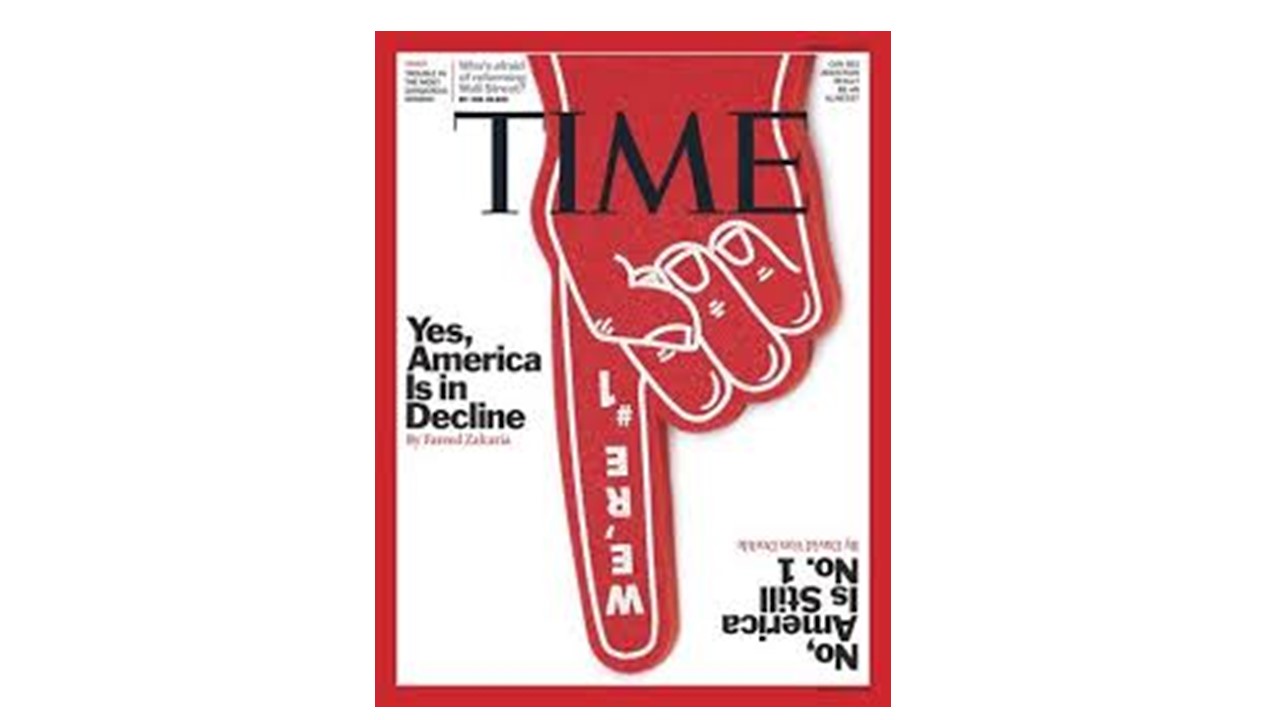
Writing in the Washington Post, (and on his GPS program on CNN), Fareed Zakharia cites Morgan Stanley expert Ruchir Sharma, who argues that America may at this moment be at its peak of economic and financial power – and heading downward.
“As Morgan Stanley’s Ruchir Sharma has pointed out, the global economy looks as if it’s at “peak America.” U.S. stocks have outperformed the rest of the world this decade, and that sort of trend rarely lasts. The current recovery is now the second-longest in history, and it is due for a downturn. Interest rates are rising, corporate profit growth is slowing, and budget deficits are surging. Even President Trump seems aware of the likelihood of a dip, which is why he has been preparing the ground for it, blaming the Federal Reserve for raising interest rates.”
Sharma notes this striking fact: US stock markets have tripled in value since 2010, while all other stock markets in the world have risen by only an average of 50%.
The last time such an imbalance happened? 1999 (just before the dot.com bubble burst). And before that? 1929.
Zakharia notes: “Anywhere one goes in the world these days, leaders talk about the United States’ retreat from the world stage. They note that it began before Trump. Most date it to the aftermath of the Iraq War, spanning the administrations of George W. Bush, Barack Obama and now Trump. And while the Trump administration is bellicose in its policies, especially on trade, they are all in service of a Fortress America mentality that seeks less engagement with the world, politically and economically.”
And he continues: “Foreign leaders also note that the United States is likely to be increasingly constrained by its mounting budget woes. The Financial Times’s Gillian Tett points out that the U.S. government now spends $1.4 billion a day on its debt, 10 times more than the next major industrialized country does. As interest rates rise and more Americans reach the age of collecting Social Security and Medicare, the federal government will be unable to fund much else. Ezra Klein has quipped that the American government is “an insurance conglomerate protected by a large, standing army,” and that is becoming truer every day.”
Many in the US and abroad loathe President Trump. They should not, however, gloat when he makes America decline (again) (MAD). A world with a declining America will be chaotic, violent and troubled.
Zakharia: “American retreat will not produce a better world. It will be messier and uglier. To get a glimpse of it, look at the Middle East today. As the United States has withdrawn from its traditional role as the region’s power-broker — maintaining relations with all sides and striving to achieve some degree of stability — Iran, Turkey and Saudi Arabia are all jockeying for influence. The United States has simply subcontracted its policy to Riyadh, encouraging the Saudis’ reckless behavior and resulting in the world’s gravest humanitarian crisis, the war in Yemen, where 12 million people are on the verge of famine.”
State & City Budgets:
Dangerous Hot Potato
By Shlomo Maital

US State and Local Budget Deficit/Surplus, 1960-2016
Amazon has just announced it will split its new headquarters buildings between Long Island City, Queen’s, and Northern Virginia, and a smaller center in Nashville. According to CNBC: “The company said it will receive up to $2.2 billion in performance-based incentives from the three areas: $1.5 billion associated with its investment in Long Island City, $573 million in Arlington and up to $102 million in Nashville. The incentives take the form of cash grants and tax credits, and some take effect over time.”
The announcement highlights an interesting fact. As MIT Dean Lester Thurow noted once, companies once paid taxes to cities, and now cities pay taxes to companies (like the huge grants Amazon received). True, Amazon will invest substantially – but giving over $2 billion to a company whose stock is worth $800 billion? That made $3 billion in profit in 2017? From city budgets that are already strapped? Amazon’s Jeff Bezos, of course, cleverly strategized by creating a competition among cities over who would give him the best deal.
And there is a much deeper problem, too.
The U.S. federal government recorded a $100.5 billion budget deficit in October, an increase of about 60 percent from a year earlier. That is the gap between what the federal government spent and what it earned in taxes, in just one month!. On a yearly basis, the federal deficit is headed for a record 1 trillion dollars, or over 5 % of US GDP. The cause? Mainly, the massive Trump tax cut passed in 2017. Most of it went to businesses, and they in turn spent it on buying back their shares and on dividends. Very little went to capital investment.
How will this deficit affect ordinary Americans? The press focuses on the massive $20 trillion US public debt that future generations will have to pay, as the federal government borrows tons of money to pay its bills. But there are deeper reasons for concern.
Many experts predict an imminent slowdown in the US economy – perhaps, a recession. What happened in the last recession that followed the 2008 financial crash?
According to Tracy Gordon, Brookings Institute, Washington, “More than in past economic downturns, state and local governments were a prominent casualty of the recent recession. States in particular saw their revenues plunge. Although state taxes have been rebounding, local property taxes have dipped, consistent with a two- to three-year lag between home prices and property tax rolls. These reductions coincide with state cutbacks in local aid, further squeezing local budgets.
[See Figure: State & Local Government Deficit/Surplus 1960-2016]
Why is this a potential serious problem? Gordon continues,
“These are critical issues because states and localities perform most of the activities we commonly associate with government. They undertake most direct spending on public goods and services (including their expenditures from federal funds), and they bear primary responsibility for investments in education, social services, and infrastructure that directly affect our national economy and quality of life. States and localities are also key economic players, comprising 12 percent of Gross Domestic Product (GDP) and employing 1 out of 7 workers – more than any other industry, including health care, retail sales, and manufacturing.”
In other words, state, local and city governments supply the things that underpin quality of life – health care, education, transportation, infrastructure. They generate one dollar in every 8 dollars of GDP and employ one worker out of every seven.
So, here is a scenario that is a cause for worry. The US economy goes into recession in late 2019. The trillion dollar federal budget deficit swells dangerously. The federal government slashes spending where it can – cutting financial aid to state governments. State governments (many are constrained by law to balanced budgets) in turn slash their grants to municipal, local and city governments.
And these, in turn, slash spending on the things that make life pleasant, or bearable, for most Americans. Potholes? Traffic jams? Dangerous roads? No money available to fix them.
This is a dangerous game of ‘hot potato’. And it’s not a pipe dream. It happened in 2010. Deficit hot potato passes from the federal government to the state government, which in turn tosses it on to local and city government. The buck stops there, and that hot potato burns our fingers. It happened before – it will happen again.
On a recent trip to the US, my wife and I made frequent use of WAZE. WAZE kindly told us about every pothole. And there were a whole lot of them. I don’t recall that feature in other countries.
Even in good times, city budgets are strained. Seeking re-election, mayors spend their money on the short-term, while costly long-term capital spending is neglected. (Why spend money to help some future mayor, maybe a rival, get elected?).
There is a solution. Let state legislatures require cities to build five-year capital expenditure budgets, to accompany the one-year operating budgets. Let the federal government help the states and cities pay for interest costs on debt that finances capital spending. Protect those five-year budgets zealously from ‘theft’ (shifting spending from long-term to short-term).
Conservatives will scream, socialism! Five-year plans are used, for instance, in China. OK – ever looked at China’s infrastructure? Fast trains, brand new airports?
Hot potato crises for city budgets make no sense. It’s time for a change.
Half the world’s population now lives in cities. By 2050 that will rise to 75%. How cities spend their money and raise their revenues will have a huge impact on the wellbeing of the people who live in them. And there is a ‘hot potato’ problem. It’s time to fix it.
Global Economy: Clouds Gather
By Shlomo Maital
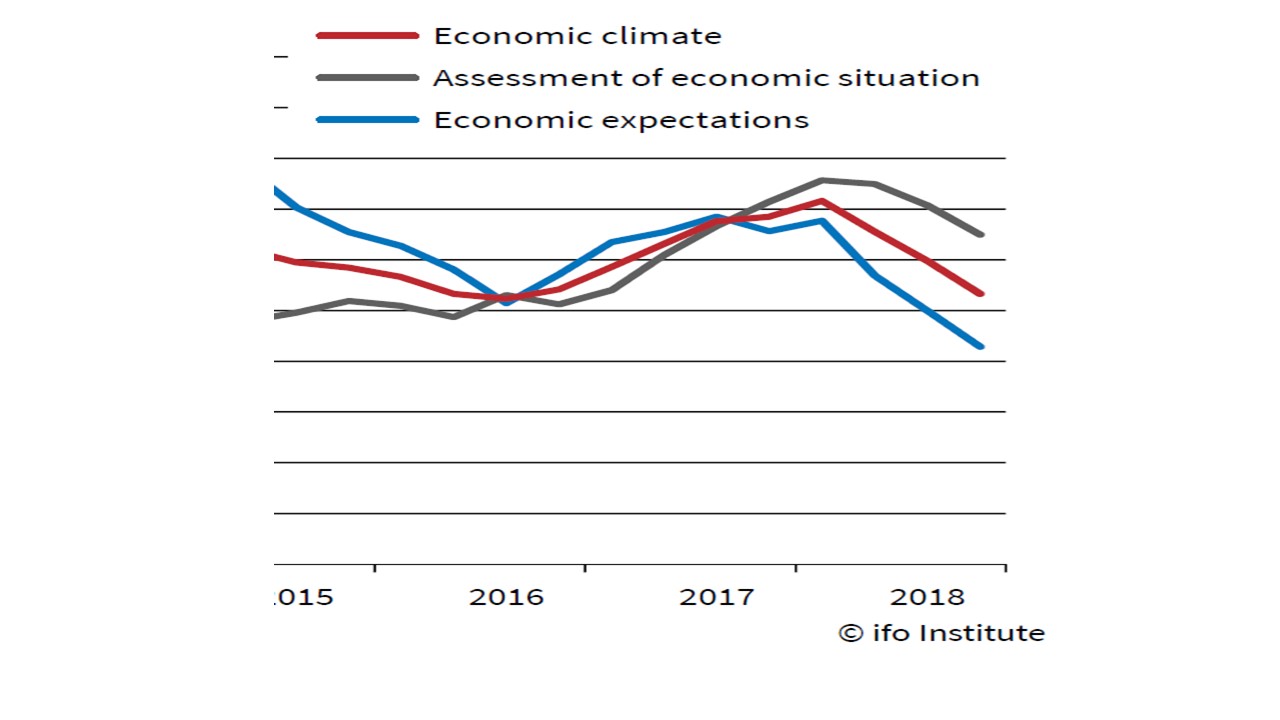
Caption: In the EU, the current state of the economy, and expectations for the near-term future, have both turned down sharply since the beginning of 2018.
I regularly respond to a questionnaire from Ifo – Institute for Economic Research, based in Munich. Ifo regularly surveys economists and business leaders around the world, to put a hand on the pulse of the global economy.
Ifo’s latest report is worrisome. Here are some excerpts from their latest report:
“Sentiment in the euro area continued to weaken this quarter. The ifo Economic Climate for the euro area fell significantly from 19.6 points to 6.6 points, plunging to its lowest level since mid-2016. Experts downwardly revised their assessments of both the current economic situation and their expectations significantly. The euro area’s economy is moving into rough waters.”
There are major problems in Italy and Spain. Italy’s new right-wing government is quarreling with the European Commission. Spain is showing signs of instability. In Germany, Chancellor Angela Merkel announced she will not run again for the leadership of her party, and may possibly resign as Chancellor by year’s end. Hungary is muzzling the press and its judiciary.
The Ifo report continues: “Experts scaled back their export expectations for the euro area, reflecting beliefs that barriers to trade have grown higher. At the same time, a larger number of experts now believe that short and long-term interest rates will rise over the next six months; and that the US dollar will continue to strengthen.”
China’s economic growth is slowing, and the renminbi (yuan) is touching 7 to the dollar. In tomorrow’s election, the US may find itself with a split Congress – Democratic House, Republican Senate. The US stock markets had their worst month in years.
The world is now paying for neglecting countries, and wage-earners, who were left out of global growth and wealth creation. Migration has destabilized Europe, the Mideast and to some extent, the US. If wealth does not come to a country, and if it is not distributed well, many people in that country will flee toward the wealth. And when they do, the resulting instability will put a deep dent in wealthy economies.
Are You Trapped in the Tunnel of Scarcity?
By Shlomo Maital

Are you trapped in the tunnel of scarcity? If you are, you may not be aware of it.
In his wonderful National Public Radio podcast “Hidden Brain”, Shankar Vedantam discusses the “tunnel of scarcity” – a situation in which we invest so much mental energy in one thing, there is too little left for other essential things (family, rest, relaxation).
Princeton University Professor Eldar Shafir and colleagues showed in 2013 and 2014 (in Science journal) how being poor affects negatively our cognitive functioning. [1] If you are poor, you focus on your immediate needs, with little thought or energy left to plan for the long run. Ability to defer gratification, to acquire human and financial capital, is thus impaired. They find:
A person’s cognitive function is diminished by the constant and all-consuming effort of coping with the immediate effects of having little money, such as scrounging to pay bills and cut costs. Thusly, a person is left with fewer “mental resources” to focus on complicated, indirectly related matters such as education, job training and even managing their time.
Vedantam expands on this phenomenon, and describes the “tunnel of scarcity”. If there is something that you feel you need very badly, your brain focuses on it exclusively, and crowds out other things that may be important. He interviews a former medical resident, who focused obsessively on excelling in her residency, and burned out.
I co-host a course on Entrepreneurship at my university. I invited a former very senior Intel executive to share his life lessons, in a life filled with innovation. He began his “10 Lessons” with Lesson #1 – Family, and described the heavy toll that high-tech can take. He cautioned students to be aware of it, lest it consume their family life.
In evolution, 25,000 years ago, humans who entered the tunnel of scarcity and focused single-mindedly on immediate needs – food, water, shelter – tended to survive, and reproduce, more than those lacking it. So evolution has equipped our brains with “tunnel of scarcity” capability.
But in modern life, unless we are keenly aware and mindful of it, and if our friends and family fail to alert us to it, we can all of us fall victim to entering a tunnel of obsessive focus – and destroy without intention things of value. And when we awake to the situation, it may be too late. A brain trapped inside the tunnel may struggle to escape.
Are you in such a tunnel? Is there sufficient light at the end of it, to guide you out of it?
. . . .
p.s. In 1972/3, 45 years ago, my wife Sharone, a psychologist, and I submitted an article to the American Economic Review. In it we argued that because the poor are not proficient at deferring gratification, to build future income, poverty tends to be transmitted from generation to generation. The editor of the journal rejected our submission out of hand, quipping glibly that “in fact the poor are expert at deferred gratification – they do it every day”. Eventually we did publish the article. But it has taken decades for psychology to invade, and perhaps even capture, mainstream economics.
Sharone Maital and Shlomo Maital, “Time preference, delay of gratification and the intergenerational transmission of economic inequality”. In Orley Ashenfelter and Wallace Oates, editors, Essays in Labor Market Analysis, (Halsted Press/John Wiley & Sons, New York: 1978, 179-199).
[1] “Poverty Impedes Cognitive Function” Anandi Mani, Sendhil Mullainathan, Eldar Shafir, Jiaying Zhao. 30 Science AUGUST 2013.
Why Do Writers Write? Where Do Their Ideas Come From?
By Shlomo Maital
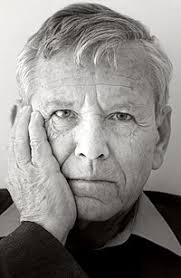
Amos Oz
What’s in an Apple? Six Conversations about Writing and about Love, about Guilt and Other Pleasures. Amos Oz with Shira Hadad (Keter – Hebrew, May 2018).
I write and teach about creativity. The key question, where do ideas come from?, has always fascinated me. This book (so far, only in Hebrew), answers that question for one especially talented writer, Israel’s greatest novelist Amos Oz. His editor Shira Hadad, who knows his books better than Amos himself, asked him hard questions and recorded the answers.
Amos Oz is 79. His work has been published in 45 languages in 47 countries. He was short listed for the Mann Booker Prize and is purported to be a candidate for a Nobel Prize. His latest work is Judas (2014). His book A Tale of Love and Darkness was made into a movie.
Here are a few quotes, that I have translated…:
Oz recounts that he was an only child, and his parents would bring him to a Jerusalem coffee shop, swearing him to silence, promising him that if he did not bother their conversation with friends, he would get a rare treat, ice cream. So Oz recounts, he became a ‘spy’, listening to conversations, and weaving stories based on them. “My first motivation was to think, what would I feel, if I were they, If I were he, If I were she… I was an only child, did not have friends…I simply began to ‘spy’ on the people sitting at nearby tables….”
“[famous Israeli author A.B. Yehoshua] – I have an issue with him. He places the moral question, crime and punishment, at the center of his works. I think about the moral issue in a different way — I put myself in others’ shoes, for a few hours, or inside their skin… I believe that a curious person is even a better [marriage] partner than a non-curious one…and even a better driver! (you are always thinking what the other guy will do!). ..There is also ‘dark curiosity’. About those who injure others, to see them suffer….”
“Usually I write out of anger. I get angry about something. And curiosity is not only a necessary condition for intellectual endeavors, it also has moral virtue.”
Oz recounts that he rises at 4 a.m., and even before coffee, goes out into the dark streets of Jerusalem for a walk. He returns at 4:45, has coffee, and then begins to write, for 3-4 hours. Every single day. Not a miss.. Sometimes he sees lights on in windows, and wonders about those inside… He writes endless drafts, sometimes 10 or even 15 of them, by hand …discards the bad ones, picks the best…and tears the rest into tiny pieces and flushes them down the toilet, lest someone discover them. (Kafka, he observes, ordered his executor and friend Max Brod to burn ALL his manuscripts. Brod, luckily, refused. Oz says, if you want to destroy your work, do it yourself. If you ask someone else to do it, they won’t…).
Oz says that he writes about the past.. this is the natural time to write about, not the present, or the future. “Story” he says, is part of the word “history”. He does not like to read his own books.. because he always knows he could have done better.
One of his earliest books was My Michael (1968). So Oz has been writing productively for over 50 years, and is still writing, at age 79.
How does he know if his work of fiction is ready to publish? If, he says, his characters argue with him, dispute him, take on their own lives. If I tell them what to do too easily, he says, it doesn’t work. I refuse to write a certain scene. My character says, write it! I say, No! My character says, don’t tell me what to do! This is when I know the work is going well, he recounts.
Oz is politically left. So are David Grossman, A.B. Yehoshua and David Grossman, the other great Israeli writers.
Why, I wonder, are great authors almost always liberal and left politically? I guess the answer is simple. Great writers have incredibly sensitive empathy for other people and for their suffering. So they feel the suffering of their ‘foes’ and want to reduce or eliminate it.
Those on the right seem rather inured to this suffering. Too bad.
Who Are You?
By Shlomo Maital

William Revelle, Northwestern University
For years, psychologist William Revelle battled the idea that you can pigeon-hole people into “personality types” or traits. With colleagues, he did a very large study, believing he would find evidence contradicting the five-personality-trait idea. To his surprise, he found the opposite.
Martin Gerlach, Beatrice Farb, William Revelle & Luís A. Nunes Amaral “A robust data-driven approach identifies four personality types across four large data sets”. Nature – Human Behaviour (2018)
Here is a part of the abstract of this article, published in the leading scientific journal Nature:
Here we develop an alternative approach to the identification of personality types, which we apply to four large data sets comprising more than 1.5 million participants. We find robust evidence for at least four distinct personality types, extending and refining previously suggested typologies. We show that these types appear as a small subset of a much more numerous set of spurious solutions in typical clustering approaches, highlighting principal limitations in the blind application of unsupervised machine learning methods to the analysis of big data.
And – here are the four types.
Average
Average people are high in neuroticism and extraversion, while low in openness. This is the most common personality type.
Reserved
The Reserved type is emotionally stable but not open or neurotic. They are not particularly extraverted but are somewhat agreeable and conscientious.
Role models
Role models score low in neuroticism and high in all the other traits. They are good leaders, dependable and open to new ideas.
Self-centered
Self-Centered people score very high in extraversion and below average in openness, agreeableness, and conscientiousness.
Hand on your heart – which are you? Or do you think this is just spurious research?
Walter Mischel: Marshmallow Man
By Shlomo Maital
 Walter Mischel…
 ..and the marshmallow
On Sept. 12, psychologist Walter Mischel passed away, in New York City. He was 88.
Mischel became famous for what was known as the Stanford Marshmallow Experiment. He designed a series of studies, on “ability (or willingness) to defer gratification”. In them, a child was offered a choice between one small reward provided immediately (a marshmallow) or two small rewards (two marshmallows) if they waited for a short period, approximately 15 minutes, during which the tester left the room and then returned.
Mischel and colleagues, in follow-up studies, found that children who were able to wait longer for the delayed rewards tended to have better life outcomes – better SAT scores, educational attainment, body mass index (BMI) and other life measures. The logic here is simple. Achieving good results later in life demands investing effort, sacrifice and pleasure now, today. Those good at this will excel. It is a skill imparted, in part, by parents, and improves with practice.
Mischel fled with his family from Austria, with the rise of the Nazis, at age 6. He taught at Stanford for years, and later at Columbia. He joined the legions of scholars who came to America as immigrants and made huge contributions to America’s scientific research and academic excellence.
Mischel’s research is hugely relevant for today’s society. Western nations have as a whole become unable and unwilling to defer gratification. Gas lines explode in Massachusetts; bridges collapse in Genoa, Italy. Western countries seem unable to save and invest in the future, preferring present gratification. A majority of Americans could not scrape together $400 in cash, in an emergency. The Great Divide between have-nots and millionaire/billionaires is spurring a rise of anti-democratic extreme right-wing political parties and leaders. It is ironic that the forces that led Mischel to America, have in part followed him there.
Hidden Racism: Causes and Cures
By Shlomo Maital

How do you measure racist attitudes? Certainly, not by asking people if they dislike blacks, Jews, Arabs, Muslims or gays. People mostly know there is social disapproval for such attitudes and answer according to the norm, rather than their own intrinsic belief.
One approach is known as the IAT – implicit association test. How does it work? On an open website, people are asked to sort faces (black and white) according to descriptions pertaining to “good” and “bad”. The decision is taken quickly, without conscious thinking. It was developed by a social psychologist named Anthony Greenwald about 20 years ago.
The implicit-association test (IAT) is a measure within social psychology designed to detect the strength of a person’s automatic association between mental representations of objects (concepts) in memory. …. the Race IAT shows that more than 70% of individuals have an implicit preference for Whites over Blacks. On the other hand, only half of Black individuals prefer Blacks over Whites. Similarly, the Age IAT generally shows that most individuals have an implicit preference for young over old, regardless of the age of the person taking the IAT.
The IAT is part of Harvard University Project Implicit, which investigates thoughts and feelings that are largely outside of active awareness or control. The key point here is powerful: Racism and other forms of hatred and discrimination are based primarily not on conscious thought, as per white supremacists, but unconscious attitudes driven by the social milieu and context. Perhaps this is why racism remains endemic in most societies, long after laws have become more equal for all.
If this is so – can such racism be overcome? Can an individual overcome it, if it is in the air we breathe? The answer is, yes, given time. Decisions taken rapidly, are driven by the limbic brain. Decisions taken thoughtfully are driven by a cognitive conscious process. Research shows, if police (as in Dever, Colorado) can take even a few seconds to think, consider, and judge, actions driven by subconscious racism can be corrected and made more equal.
I myself am an example. I consider myself liberal, and try hard every day to respect every single person I encounter, whatever their race, religion, creed or age. Yet, recently, in a workshop I led for high school teachers, I had a participant who wore a hijab, a Muslim head covering worn by women. “Salima” (pseudonym), I assumed instantly, would not contribute much to the Workshop. This was my subconscious speaking. That wrong racist first impression was corrected rapidly. It emerged that Salima was a Technion graduate in chemical engineering, and was the most brilliant of my Workshop participants. She contributed immensely.
Most enlightened people strongly deny they have racist beliefs. Yet, we live in society, and society has racist beliefs. So it is hard for individuals to escape them, especially when they are ‘underground’, subterranean. The IAT tells us to be aware of the underground forces and to use our cognition to control and alter them.
Why a Bloody Pogrom in 1903
Gave Me Life in 1942
By Shlomo Maital

The word “pogrom” is a Russian word, usually applied to anti-Jewish violence in the Russian Empire in the late 19th and early 20th centuries.
Today’s New York Times has a review of a new book by Stanford University historian Steven J. Zipperstein, Pogrom: Kishinev and the Tilt of History. The review reminded me that the reason I am alive, on this earth, is because of this horrendous pogrom.
On Easter in 1903, mobs of anti-Semites tore through the Jewish section of Kishinev, a provincial town on the western edge of the Russian empire. In just 1 1/2 days, in a cluster of streets and alleyways, they murdered 49 Jews, raped scores of women and girls, ransacked stores and homes, and shredded the sacred Torah. Many children were killed. That event came to define “pogrom” — a word derived from the Russian for thunderstorm — and to represent the worst horrors perpetrated against Jews in Europe before the Holocaust. Its reverberations would reshape the image of czarist Russia, alter U.S. immigration policy, bring Jews into the Russian revolutionary movement and even help launch the NAACP. “It was a moment,” Stanford historian Steven J. Zipperstein writes, “that cast a shadow so deep, wide and variegated as to leave its imprint on Jews, on Jew-haters, and on wounds licked ever since.”
My late mother was born in 1909, six years after the pogrom, in a small rural Jewish village, Dombroven, in Bessarabia, 300 kms. (180 miles) from Kishinev. (Bessarabia is now called Moldova, and It is the poorest nation in Europe). My father was also born in Dombroven, in 1904, just after the pogrom.
The pogrom made it clear to the Jews of Dombroven that they had no future there. This, even though Dombroven had a small Jewish militia that circled the village at night and guarded it from the marauding Cossacks. My grandfather Israel, my father’s father, left for America. His mission: Raise money to bring the family over. (The Kishinev pogrom, as Zipperstein notes, did help open the immigration doors of both Canada and the US). He worked very hard, even though he was a Talmud scholar by nature, and made enough money to pay for the family’s passage. He missed his family terribly. He sent the money by mail – and it was lost in transit when World War I broke out, in 1914. My grandfather died in Pittsburgh in 1918, during the global influenza epidemic. I believe he simply died of a broken heart. I once searched for and found his grave, up on the old Jewish cemetary on Mt. Liberty. I am named (Yisrael Shlomo) for him.
So, with my grandmother Rivka a widow, it was up to my father, the oldest, to make the journey to Canada. He left in 1920; he was only 16. Grandmother Rivka insisted that he take his sister, Dora, age 12 with him. The two young people were stranded for an entire winter in Antwerp, because Canadian immigration claimed my father had an eye disease (he didn’t). In the Spring, the Jewish community in Antwerp helped, arranged a visa, and the pair left for Canada by ship, landing in Montreal, and travelling by train to Regina, Saskatchewan, where relatives had settled earlier. My mother had emigrated earlier to Canada, with her mother and father, in 1910, when she was only a year old.
Many Jewish people did not emigrate. They were wiped out by the Nazis during World War II. So, my mother and father, grandmother Rivka, grandfather David, and grandmother Sassi Feige, and aunts and uncles, were saved because the pogrom made them desperate to migrate, and because Canada and the US welcomed them, partly as a result of the widely publicized bloody pogrom.
How terrible was the 1903 Kishinev pogram? Israel’s national poet Haim Nachman Bialik, who at the time lived nearby, in Odessa, (now Ukraine), wrote a poem, The Slaughter, about the pogrom, including these striking last lines: “A curse on any who says, Avenge this! For revenge for the blood of a child, Satan himself has not yet invented”.
I was born in Regina, Sask., in 1942. Had my father not made the perilous journey to Canada, with his little sister, and had he not survived that awful cold winter in Antwerp, I would not be here.
Every time I read about migrants drowning in the Mediterranean, or children torn from their migrant mothers and fathers in Texas, or Syrians bombed and gassed, or Israel trying to expel Eritreans and Sudanese against their will, I feel deep physical pain. I can only believe that there is a punishment for those who mistreat hapless homeless migrants, and that one day, somehow, it will be meted out with justice.

 TIMnovate