
You are currently browsing the category archive for the ‘Innovation Blog’ category.
Health Insurers & Pharma Benefits: The New FDA
Will Kite Kill Cancer (Affordably)?
By Shlomo Maital
My university, Technion, is one of the few science universities with a President who is both a world-class scholar and successful entrepreneur. Prof. Peretz Lavie is a pioneer in sleep research, and his 10 patents have helped build two or three successful companies that treat sleep apnea, a common disorder that afflicts millions. In a guest talk to my Entrepreneurship class at Technion, Prof. Lavie explained that agreement by health insurance companies to pay for drugs or treatments is a more crucial obstacle for companies and inventors than perhaps even the FDA. Your drug may prove effective in Stage 3 clinical trials and pass the FDA, but – if it’s too expensive, insurers won’t pay for it and it is therefore doomed. As an entrepreneur, Lavie successfully dealt with this problem. By carefully collecting sleep apnea data, he was able to show the insurers why treatment was cost-effective.
Recently, we saw a great example of why insurers are the “new FDA”. Gilead Sciences developed Harvoni, a Hepatitis C drug that costs $94,500 a year. It competes with AbbVie’s $83,319 drug Viekira Pak. The FDA approved Harvoni. But America’s largest pharma benefits company (which provides drugs as part of health insurance) removed Harvoni from its approved list, saying it was more expensive than AbbVie’s drug Viekira Pak and not much more effective. Gilead’s stock plunged; it fought back and slashed its prices.
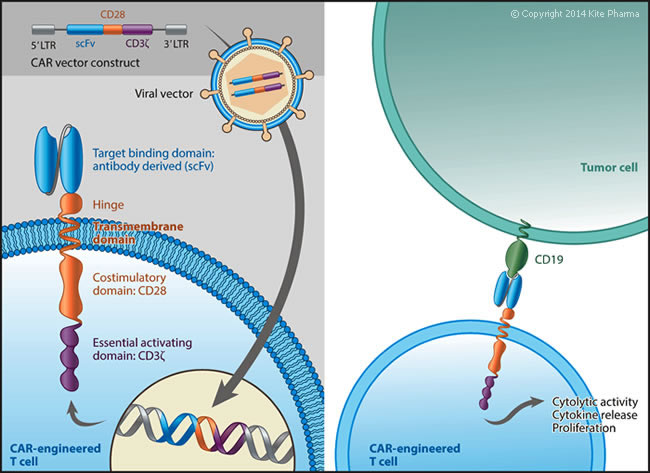
The key role of insurers came to the fore in recent days. Kite Pharma and its Israeli-born and educated CEO Dr. Arie Belldegrun has developed an experimental cancer treatment, a very expensive one, which costs hundreds of thousands of dollars. The complex diagram shows how it works. Briefly, here is how:
Cancer cells are removed from the patient’s body, treated – and then put back. The treated cells (unlike untreated cancer cells) trigger a powerful immune response.
To explain: Cancer cells cleverly shut down the body’s immunse system response; but Kite’s genetically engineered autologous T cell therapy fights back, tricks the cancer cells and restores the immune system’s ability to recognize and eradicate tumors. “In August 2014, Kite Pharma announced findings from its ongoing clinical trial: 12 of 13 evaluable patients with advanced B-cell malignancies had complete remissions (8 patients) or partial remissions (4 patients) resulting in a 92% objective response rate. The results support Kite Pharma’s plan to file an Investigational New Drug (IND) application in the fourth quarter of 2014 to initiate a clinical trial of Kite Pharma’s lead CAR-based product candidate, KTE-C19, in patients with DLBCL.”
Kite has a powerful strategic partner: Amgen, a huge biotech company. “In January 2015, Kite Pharma and Amgen entered into a strategic research collaboration and license agreement to develop and commercialize the next generation of novel Chimeric Antigen Receptor (CAR) T cell immunotherapies based on Kite’s engineered autologous cell therapy (eACT™) platform and Amgen’s extensive array of cancer targets.”
But the hitch is: will the health insurance companies and pharma benefits companies pay for this hugely expensive though lifesaving therapy? Kite is aware of the problem and is trying to deal with it.
Stay tuned.
Business Model Innovation: Reinventing the Supermarket
By Shlomo Maital

An Israeli entrepreneur named Iri Shahar has taught us a valuable lesson in creativity and innovation.
Formerly CEO of a chain of retail stores, known as Fishman Group, he has just opened a new supermarket chain called Ehad (One) with a simple basic premise: No-name (non-branded) products, and only one non-brand for each product. One type of Cola (not Coke). One type of cottage cheese (NIS 4.90, about 20 per cent less than branded cottage). Many products in the Ehad stores are 10 to 20 per cent cheaper than competing stores. At a time when Israelis are struggling with the high cost of living (higher in Israel by some 15 per cent than in the OECD average, according to the OECD), Ehad serves an important social purpose. I am certain this is Shahar’s goal – to make the cost of living lower for Israelis, while at the same implementing a new sustainable business model that generates enough profit to keep the business going and thriving.
Competitor Rami Levy, who some years ago opened a low-cost supermarket chain, pooh-poohs Ehad, saying that Israeli mothers will not give up their children’s favourite brand name products. It will be interesting to see if he is right. I don’t think so. I am frequently annoyed, doing the weekly family grocery shop, by the blizzard of types of cereal, shelves and shelves of it, most of it the same (Cheerios are Cheerios, after all), at a variety of prices, some of them atrocious, confusing the buyer.
What do we learn from Shahar?
* First, the most powerful innovation is not just in tweaking products or services, but in altering a business model or business design – how the product is sold, when, why, and to whom. Shahar’s stores have only 1,000 products, compared with 15,000 for the average supermarket.
* Second, Simplify! Subtraction is a more powerful innovation tool than addition.
* Third, it is a legitimate innovation to take an idea that succeeded elsewhere (Germany has Aldi and Lidi chains, that have spread worldwide) and apply it in your country. Indeed, this is great innovation, because a business concept proven elsewhere will likely succeed at home.
And by the way – Shahar pays good wages. He pays cashiers 25 per cent more than minimum wage and stockers, 40 per cent over minimum wage. “We want them to stay with us for a long time,” he notes.
Switzerland: Why It Is Scaring Us
By Shlomo Maital

Last Thursday Switzerland did two scary things. Scary for me – many (except for forex traders, who got creamed) did not take much notice.
First, they cut the interest rate paid on bank reserves to MINUS 0.75 percent. Minus??? That means, deposit 1 million Swiss francs, at the end of the year you get back 992,500. Why? To discourage money from flowing in.
Second, most important, the Swiss Central Bank announced it would no longer maintain the exchange rate vis a vis the euro at no more than 1.2 Swiss francs per euro, a policy announced in 2011. It pegged its exchange rate, to keep the Swiss franc from getting too strong, because the euro was undergoing a series of crisis and losing value. And each time the Swiss franc goes up relative to the euro, it makes Swiss exports more and more expensive. In a surprise move, the Swiss now say they can no longer maintain this peg and the Swiss franc will be allowed to rise and strengthen, relative to the euro and of course relative to the dollar.
Switzerland is one of the world’s most solid stable countries with by far the world’s strongest currency. It is a safe haven – when things go wrong in the world, and they do all the time, money flees to Switzerland, buys Swiss francs and sits mostly unnoticed in vaults and bank deposits.
Why is a strong Swiss franc a problem? Because Switzerland’s main trading partners are in Europe. When its currency strengthens, its goods become expensive. Amazingly, despite the enormously high wages and costs in Switzerland, the Swiss run an export surplus, exporting $308 b. yearly (over 70 per cent of their GDP) and importing only 288 b. How do they do this? By making and selling branded goods, high quality, precision machinery, and by selling value rather than cost. But there is a limit.
What do we learn from Switzerland’s actions?
First, no country is an island. Europe is suffering from deflation, caused by absolutely stupid austerity policy. EU policies, by bringing Greece to its knees, brought the euro to its knees as well; because again Greece threatens to leave the euro, and once one country does it, many others may consider it. Switzerland is paying the price not for its own mistakes but for those of Europe.
Second, deflation. Economist Abba Lerner once said deflation (falling prices) is 100 times worse than inflation (rising prices). He may have underestimated deflation. The only way to dig yourself out of deflation is to stimulate demand. But Europe is doing the opposite. So Europe is now exporting its deflation to Switzerland. The rising franc will make imports cheaper, and lower prices in Switzerland. This will boost imports and hurt the economy, thus importing Europe’s folly to Switzerland against its will.
Why are the Swiss no longer pegging the franc at 1.2 euros? Because they no longer can. To do this the Bank of Switzerland has to buy very large amounts of euros, and sell francs, thus expanding the money supply. The Bank feels it can no longer continue to do this nad maintain Switzerland’s vaunted stability. Switzerland has an absolutely balanced federal budget, and always does, because the Central Bank has the final say on the budget, and sends it back to the legislature if it is too loose.
Columnist Paul Krugman thinks a “fresh wave of safe-haven money was making the effort to keep the franc down too expensive.” Imagine – you can ruin your country by causing money to flow out, but apparently, also, by causing too much money to flow in (like Switzerland). So far the Swiss have brilliantly reaped the benefits of trading with the EU without actually adopting the shaky, fragile, illogical currency called the euro. But there is no way that the European sickness cannot spread to Switzerland too. We learned that last Thursday.
This whole episode is scary, because it shows clearly that no matter how well run an economy is, and its money, it cannot avoid the collapse, deflation and folly going on around it. Sorry Switzerland. You live in a bad neighborhood. And you can’t really move those beautiful Alps to, say, the Caribbean.
KidZania: Where Kids Find Reality, Not Fantasy
By Shlomo Maital

“We make people happy.” This is Disney’s famous mantra, implemented to perfection at Disney theme parks in California, Florida, Hong Kong, suburban Paris and elsewhere.
“We make kids grown-ups”. This could be the mantra of KidZania, a worldwide chain of theme parks where kids aged four to 14 get the chance to enact the roles of grownups in lavish, scaled-down worlds. The story of KidZania is told in Rebecca Mead’s article in the latest New York issue (“When I Grow Up”, Jan. 19 2015).
In KidZania, Mead explains, children “can work on a car assembly line, or move furniture, or put out fake fire with real water. KidZania has its own currency, kidzos, which can be used in branches around the world, or deposited and accessed with a realistic looking debit card.” Children get a check for 50 kidzos on arrival and can add to it with a ‘salary’ they earn for working. The most popular jobs (e.g. training to be a pilot on a flight simulator) pay less than the less popular ones, like being a dentist. (Kids look into a dummy’s mouth – wonder how many kids pick THAT one!). Kids can rent a car (small electric go-karts) and buy stuff at the mini city’s department store.
KidZania has its own language. “Kai!” means hi, along with placing two fingers over the heart. “Zanks” means thanks. Bye is “Z-U”, from Santiago to Seoul. Adult staff are Zupervisors. Staff ends conversations with kids by saying “have a productive day”.
The founder is an entrepreneur, aged 50, named Xavier Lopez Ancona. His headquarters are near the KidZania in Centro Santa Fe mall, Mexico, one of Latin America’s biggest shopping malls. KidZania now exists in over a dozen countries, including Japan, Malaysia, and Turkey. Lopez went to bizschool at Northwestern U. and ran GE’s private equity business in Mexico. A friend in the toy importing business came to him with an idea for a role-playing park for kids. Lopez joined the venture. The Santa Fe park opened in Sept. 1999. In the first year, 800,000 people came to it, double what the founders expected.
Lopez is careful to vary the KidZania parks according to the venue. In Mexico kids spend their kidzos as soon as they get them. In Japan it is hard to persuade kids to part with their kidzos for any reason. In Lisbon kids come with their parents. In the Gulf states kids come with nannies or are dropped off by their drivers. In KidZania in Jeddah, Saudi Arabia, girls will be allowed to drive cars – a privilege their moms don’t have and definitely, in my opinion, subversive.
Mead quotes one child in Kuwait: “In Kuwait parents and adults have responsibility for everything you do. In KidZania it is different – it’s like kids rule the world. That’s fun, but you can also learn how hard and complicated it is and how adults feel when they work. I have learned that being an adult is actually hard.”
Why Economies Don’t Grow
By Shlomo Maital

Michael Spence is a Nobel Laureate in Economics, pioneer in the economics of information, and has recently published an article explaining why Western economies simply don’t grow. He notes that there are five reasons. He also notes that growth forecasts have consistently been overoptimistic, ruining whatever little credibility remains for economists. I think his insights help us understand better our current state of stagnation in much of the Western world.
- Too little fiscal policy: Traditionally governments evaluate debt by looking at the debt/GDP ratio. They have slashed spending as a result. But they would do better, as economist Frank Newman argues in Freedom from National Debt, to look at the aggregate balance sheet, because “a productive public sector investment can more than pay for itself”. In other words: If governments spend wisely, the resulting assets more than pay off the resulting debt. Simple? Obvious? But…alas, overlooked.
- The impact of fiscal policy (“multipliers”) is much higher than previously thought, because there is so much excess capacity (i.e. idle labor and capital) lying around.
- Capital markets are disconnected from GDP. Because central banks have printed so much money, and because the money found its way into bond and stock markets, asset prices have risen a lot… but, not because the underlying economy is strong. This has simply created a lot of wealth for a few millionaires or billionaires, but hasn’t helped ordinary people, and hasn’t helped the economy.
- Governments have been badly led and run, and greatly favoured the wealthy, who buy influence with political contributions.
- Incomes in the bottom 75% of the distribution have stagnated, leading to a lack of aggregate demand. This drop has been “greater than expected”.
These five factors are chronic, and may last longer than we thought. Spence thinks we need to redistribute income and expand public services. We need to invest in key areas, like education, health care and infrastructure.
Under economic stagnation, isn’t this solution obvious? Apparently, not to many economists and political leaders. I wish more of them would read Spence’s short piece carefully.
Are Humans Smarter Than Microbes? It’s a Tie
By Shlomo Maital

At the moment, human beings, with their huge brains (average weight, 1.5 kgs., or 3.3 pounds, only 2 per cent of our body weight) seem to be losing the battle against microbes.
We use antibiotics to battle microbic infections. But the microbes have developed resistance, and many of them are resistant to common antibiotics. We continue to develop new antibiotics, but there are now microbes that cannot be killed by ANY antibiotics now known to man. This is a natural evolutionary process, and it is exacerbated by the widespread overuse of antibiotics, helped by doctors who overprescribe them and by patients who demand them (even for illnesses like flu that are not affected by antibiotics, because they do not kill viruses). Drug-resistance bacteria infect 2 million people yearly in America, and kill 23,000!
Writing in The New York Times, Denise Grady reports on a promising new breakthrough that may at least give us human beings a tie in the battle with microbes. A new method extracts antibiotics from bacteria that live in dirt. It was reported in the leading journal Nature last Wednesday. The new drug is called teixobactin. Tested on mice, it easily cured infections.
Best of all, it is very unlikely that bacteria will develop resistance to this new antibiotic. The discovery was reported by Kim Lewis, director of the Antimicrobial Discovery Center at Boston’s Northeastern University.
Basically, here is the new method: The earth teems with microbes, and they would dominate us were it not for antibiotics that microbes secrete to defeat rivals. Scientists “mine” soil samples for antibiotics. But they are limited. 90% of microbial species cannot be cultured in the laboratory. Kim Lewis and his team found a way. Basically, they put bacteria into a soil box, in a lab, with the same kind of soil from which the bacteria originated. As the bacteria multiply, they can be mined for their antibiotics. The bacteria are ‘tricked’ into thinking that they are on their home ground – not in the lab where scientists are seeking ways to conquer them. Because the ‘antibiotics’ secreted by bacteria have been around for so long, they seemed to have strong evolutionary survival power, because they enable the bacteria secreting them to survive against competitors.
There are some 25 new compounds that show promise as antibiotics, developed in this way.
Will this help us humans to at least win a tie with the microbes? Don’t underestimate Nature. The power of evolution, especially when it is rapid (because bacteria multiply quickly, live and die in short cycles) is immense.
Patents are Like Love: The More You Give, the More You Get
By Shlomo Maital
Elon Musk
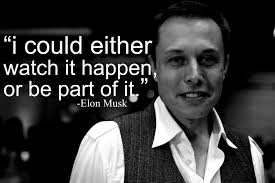
Some innovations change the way people think about doing business. Elon Musk, a great innovator (co-founder of Paypal, founder of Tessla, Space-X….etc.) has just announced that he is “opening the books” for all the patents related to Tessla and his electric car technology. Meaning? Anyone who wishes can use the technology he and his company created, free of charge.
What in the world? What happened to the assumption that if you create IP, intellectual property, then you have the right, nay the duty, to make huge profits from it?
And is this philanthropy? Or shrewd business strategy?
It is the latter. Musk wants to build Tessla. To do so, he wants the established big car companies, the ones who proved unable to develop truly great electric cars, to adopt his technology.
If they do, then Tessla becomes the first, the authentic, the real thing. And the way to make that happen is to offer the technology free of charge, and – reap the benefits indirectly. And I am convinced, the indirect benefits to Musk and Tessla will be enormous, far bigger than any royalties.
We learn from Elon Musk that innovation is breaking the rules intelligently. Find a rule, e.g. patent everything that breathes, and see if you can break it, for your own advantage and the advantage of the world.
Are patents indeed like love – the more you give it away, the more you have?
Can You Store Wind Energy? Danielle Fong Finds a Way
By Shlomo Maital

One of the biggest as-yet unsolved problems in generating sustainable energy is that of storage – how do you store solar or wind power, for use when there is no sun (night time) or wind (calm periods)? This is vital, so wind turbines, for instance, can provide 100% all-the-time reliable power. A young creative Canadian entrepreneur named Danielle Fong may have cracked the problem. Her story is told in the excellent Atlantic Monthly department, “Eureka Moments”, by Stephanie Porter.
Danielle studied at Canadia’s Dalhousie University, in New Brunswick, graduating with honours in Physics and Computer Science at the age of 17, then beginning a doctoral program that year at Princeton University’s Plasma Physics lab. She left in 2007 to found LightSail in California in 2008, and was named Forbes Magazine’s Energy Standout (Under age 30) for her work.
LightSail’s technology achieves 90 per cent ‘round trip’ efficiency (storing and then providing the stored power), which is extremely high, almost unheard of. Her method uses compressed air, with a dense water spray used to capture the heat created when air is compressed, then store it for later use. Danielle’s father, Greg Fong, is direct of LightSail’s business development. He notes that the technology could offer remote communities and factories, far from the electricity grid, a way to generate stable electricity from stable sources. This could be of great importance for China, for instance.
Over 30 wind farms are already in use or in development in Nova Scotia. Billions are being invested too in tidal energy. But the way to store all this energy does not yet exists. Young Danielle may have the answer. Her idea is a huge “wow” and shows why great entrepreneurs with game-changing ideas always tackle the biggest problems around.
Big Disrupters of 2014
By Shlomo Maital

Disruptive technology is technology that completely changes the ‘game’ for established players in an industry – changes the nature of business, products, services, marketing or other key aspects of doing business and creating value. Harvard Business School Prof. Clayton Christensen drew our attention to disrupters many years ago. Established companies that ignore disrupters do so at their peril.
Here is part of the Financial Times list of the major disrupters of 2014. According to Financial Times reporters, “the range and number of individuals and companies that are upending business models around the world” is on the rise. … “the disrupters are everywhere”.
- Uber: Tim Bradshaw and Murad Ahmed has become “the poster child of Silicon Valley for disruption”; the 5-year-old company revolutionised the taxi business in 230 cities and 51 countries without owning a single car, through its smartphone app.
- Alibaba: This online retailer, with $300 b. worth of online sales has transformed retail in China. It is now “snapping up low hanging fruit in overly state regulated markets” for everything.
- Bob Diamond in Africa: He quit Barclays, and has now shown you can make money by inveting in sub-Saharan Africa. He raised $352 m. through an IPO in London in Dec. 2013, and has done deals in Botswana, Mozambique and Tanzania.
- Aldi and Lidl: They are disrupting the grocery market around the world, and Aldi is even exploring China. They have doubled their market share in the UK in the past four years. Aldi has opened 1,350 stores in the U.S. and aims at 2,000 by 2018. Lidl too will soon invade the U.S. market.
- Ford: Hard to think of Henry Ford’s moribund car company as a disrupter, but the new F-150 pickup truck, with an aluminium body, never used before on a high-volume vehicle, is indeed a disrupter. To do this Ford had to replace arc-welders with new machines to screw, rivet glue and laser panels together. I remember another disrupter – Subaru, which made aluminium engines in 1973; I bought one, it was great, but was warned it would fail. Soon everyone was using aluminium for engines.
- Tesla: last June founder Elon Munk offered to open up its patent book, which is very large, to rivals, “in the spirit of open source movement, for the advancement of electric vehicle technology”. This was a clever move, not just PR. Munk wants the big car makers to adopt Tesla technology and boost the market for electric cars. Imagine if other large companies (Intel, IBM, Hitachi, Samsung, Apple) opened THEIR patent books so that everyone could use them free of charge.
Messy Desk? Sign of Creativity
By Shlomo Maital

Say, is your desk messy? Are you troubled by it? Try to clean it up regularly, and fail? Get hassled by your neat obsessive significant other?
New evidence suggests – hug your messy room, don’t hassle it. It’s a sign you have a creative mind.
Writing in the online magazine NewsMic, (Nov. 10), Tom McKay reports that “There’s fairly robust psychological evidence that messiness isn’t just symptomatic of poor standards or effort, but might actually provoke creativity. He quotes psychologist Kathleen Vohs, who wrote in the New York Times, “being around messiness would lead people away from convention, in favor of new directions.”
Here is the experiment she ran. To test this hypothesis, Vohs invited 188 adults to rooms that were either tidy or “messy, with papers and books strewn around haphazardly.” Each adult was then presented with one of two menus from a deli that served fruit smoothies, with half of the subjects seeing a menu with one item billed as “classic” and another billed as “new.” The results (published in Psychological Science), Vohs reports, were enlightening. As predicted, when the subjects were in the tidy room they chose the health boost more often — almost twice as often — when it had the “classic” label: that is, when it was associated with convention. Also as predicted, when the subjects were in the messy room, they chose the health boost more often — more than twice as often — when it was said to be “new”: that is, when it was associated with novelty. Thus, people greatly preferred convention in the tidy room and novelty in the messy room. A second experiment with 48 adults found that subjects in a messy environment came up with ideas “28% more creative” while creating a list of unconventional uses for ping pong balls, even though the two groups came up with the same number of ideas. Vohs argues the results are clear: Messiness actually spurs creativity.”
The point here is obvious. Creativity itself is MESSY, in caps. Creativity people have messy minds, that collect random pieces of information and find new ways to link them. Creative ideas emerge from disorder and entropy, not order. The ultimate state of order is the universe as it will be in a few hundred billion years: All the energy will have been burnt up, and the universe will be perfectly orderly, at a temperature of absolute zero.
So — messy desk? Enjoy it. Cherish it. And, nonetheless — do clean it up once in a while, if only for your significant other.


