
You are currently browsing the category archive for the ‘Innovation Blog’ category.
It’s a Snap: Webcams for People, Not Just Eaglets
By Shlomo Maital

Snap the Eaglet
A new series in the New York Times Opinion section, called “Menagerie”, launches today (June 21) with a fine story by Jon Mooallem about Snap, Crackle and Pop: Three bald eagle eaglets, shown on a webcam installed in a nest somewhere in Minnesota. The webcam is called the Decorah Eagle cam. It was put in place by the state’s Department of Natural Resources, and is aimed at increasing empathy and consideration for wildlife.
Great idea! Except – inadvertently, Snap’s mom or dad stepped on her and broke her wing. So many people watched daily on their screens as little Snap suffered. The wildlife experts on principle will generally not intervene, because that interferes with Nature. That’s reasonable. Except viewer outrage was so enormous, the Department finally had to use a lift to extract little Snap and euthanize her (she wasn’t strong enough to be saved).
It’s quite amazing how much empathy, sympathy, love and concern can be aroused for animals (dogs, cats, dolphins, whales), especially if they are cute and furry. When our little mixed-breed Yorkshire, Pixie, went missing for a few anxious moments recently, the sense of panic we felt was indescribable. A webcam on a bald eagle’s nest can arouse immense public feeling, among millions.
So, I have a modest suggestion.
Can we perhaps install a webcam in the hut of a Darfur or South Sudan family, struggling to find water and raise babies?
Can we install a webcam in the shack of a Syrian refugee family, in the Jordanian refugee camp that houses untold thousands of them?
Can we put a webcam in the home of an illegal immigrant family in Italy, or America, or Israel, where authorities threaten deportation daily?
We do need to treat animals humanely; it’s part of treating ALL living things humanely. But we especially need to treat suffering HUMANS humanely, especially children.
Sorry, Snap. We do feel for you. But I wish the same passion and empathy could be aroused for human babies and children, even though they don’t have fur or feathers.
Innovation: WHEN, not just What? Daybreaker Parties
By Shlomo Maital

Einstein taught us that the key to true creativity is how you frame questions, not how you come up with answers. The question we usually assume that launches innovation is: What? But rarely do we ask When??? In Israel, years ago, afternoon newspapers innovated simply by printing their newspapers and delivering them at 6 a.m. British Airways once tried serving meals on the ground, before the long flight, so people could simply go to sleep on the plane.
If you find a way to deliver a known liked product at a different and unusual time – this can be a powerful innovation.
Here is an example. Two young entrepreneurs, Matthew Brimer, 27 and Radha Agrahal, 30, are ‘edu-preneurs’. They are engaged in educational technology. Their company General Assembly offers on-line classes, workshops, programs and education ‘in the most relevant skills of the 21st C.’. They had the idea of creating ‘morning raves’ – get-togethers held at 7 a.m., for two hours, before heading to work. Daybreaker parties have no drugs, liquor or other substances. What do you do? Mingle, chat, and dance. Why no alcohol? “The idea is not to flood the senses with external influences but to stimulate them through natural means. Through the music and body movement. All the senses are engaged.” In other words – you don’t need junk or booze to get high.
The parties are held monthly, midweek (usually Wednesday), each time at different locations, to those who signed up earlier by email. The idea is spreading from Silicon Alley (most of the participants are in high-tech, are young and without kids, so no need to make kids’ sandwiches and get them on the school bus), and it started in New York City and is spreading to London, San Francisco and Tel Aviv (it debuts in Tel Aviv this summer).
Parties have existed for thousands of years. Change the time from midnight, to 7 a.m. – and you have an innovation.
What else can you innovate, by taking something loved, with a set time, and shift the time completely?
The Key to Innovation in Big Companies: Work Together
By Shlomo Maital
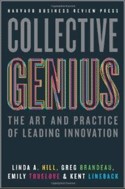
Generally I write blogs about books or articles that I’ve read. This time, I want to write about a book I intend to read soon, based on excerpts and interviews from Harvard Business School’s Working Knowledge magazine. The book is:
Collective Genius: The Art and Practice of Leading Innovation, (Harvard Business School Press) was written by Prof. Linda Hill, the Wallace Brett Donham Professor of Business Administration, with Greg Brandeau, former CTO of The Walt Disney Studios and current COO/president of Media Maker; Emily Truelove, a PhD candidate at MIT’s Sloan School of Management; and Kent Lineback, Hill’s cowriter on her earlier book Being the Boss: The 3 Imperatives for Becoming a Good Leader.
Here is the main point: “….. innovation is a “team sport,” not the act of a sole inventor. “Truly innovative groups are consistently able to elicit and then combine members’ separate slices of genius into a single work of collective genius,” the authors write. Or, as Hill puts it, “Conventional leadership won’t get you to innovation.” The authors identified organizations with reputations for being highly innovative, then found 16 leaders within those organizations and studied how they worked. …. the authors include narratives of executives within India-based IT company HCL Technologies, the German division of online auctioneer eBay, and the marketing division of automaker Volkswagen in Europe.”
Here is the ‘boldest’ example of innovative leadership and teamwork, according to Hill. It comes from India.
“Of the 16 leaders studied, Hill says Delhi-based HCL, under former CEO Vineer Nayar, might be the boldest. Nayar, who pulled the company out of a five-year slump, challenged the common belief that Indian companies provide low-cost products and services but don’t innovate. “That (assumption) made him crazy,” Hill says. “He said ‘We can and will compete that way.’ ” Nayar focused on changing the organization from within, starting by empowering employees. In 2005, he told a team of 30-something young employees called the “Young Sparks” to develop the brand and a plan to change how employees experienced HCL. The group started with an icon, Thambi, which means “brother” in Tamil, symbolizing “the importance of the individual and the value of the collective” at HCL. Nayar recast his role as leader. He pushed for more transparency, adding 360-degree reviews for all employees and 360-degree feedback of his own work—he promised to resign if his own review dropped to a certain level. He set up a portal that asked employees to solve “my problems” and reported getting incredible answers from workers. From 2005 to 2013, when Nayar led HCL as president and then CEO, the company’s sales, market cap, and profits increased six fold, according to the book. Fortune magazine wrote that the HCL had “the world’s most modern management” and the company was named one of Businessweek’s most influential companies. Nayar tells people, “I don’t know the answers,” which goes against the common belief in Indian business that the CEO should be a visionary. For Hill, Nayar shows the possibilities of what can be accomplished by an innovative leader who embraces a new style of leadership.”
Big organizations ALL have trouble innovating. Perhaps Linda Hill’s new book will help them figure out why and find a workable solution.
2013: Tough Year for Workers, Great Year for HNWI’s
By Shlomo Maital

Illustration by Avi Katz
For most of us, 2013 was yet another hard year. The U.S. and EU economies were either in recession or barely growing. Unemployment remains high; the job market, weak. China faces slowing export growth and a housing bubble.
But it was a super-great year for HNWI’s, the Wall St. euphemism for the rich and super rich (High Net Worth Individuals), who are the focus of a huge and profitable industry known as ‘wealth management’. And wow, is there ever a lot of wealth to manage.
According to the Boston Consulting Group’s Global Wealth 2014 report, global private financial wealth grew by nearly 15 per cent last year and now totals $152 trillion, more than double world Gross Domestic Product. Wealth multiplies with ease, even when the rich do not actively work at it. Microsoft founder Bill Gates, 58, is the world’s wealthiest person, with net worth of $78 b., even though he has spent most of the past few years giving his money away. His Microsoft shares continue to generate more and more billions in wealth for him, even though he resigned as Microsoft Board Chair in February.
Capital has boomed because of urbanization and rising real estate prices, rising share prices, vast amounts of new money printed by central banks everywhere and loaned at low interest, and new capital markets in emerging nations, creating assets where none existed before. Global private wealth boomed last year because investors put money into the stock market and stock markets rose sharply. Wall Street broke all records and closed the year 23.8 per cent higher.
The wealthy have capital and so quickly accumulate more of it; the poor do not. The capital of the rich grows exponentially. The income of the poor stagnates. This is inherently unfair.
But can’t the poor rise to wealth, by hard work and saving?
The American “Horatio Alger” rags-to-riches myth is just that, according to the Equality of Opportunity Project, led by Harvard and Berkeley economists. This study found that an American child born in 1971 to parents in the poorest fifth of the income distribution had an 8.4% chance of making it to the top quintile. For a child born in 1986 the odds were 9%, basically the same. In other words, in the U.S. you have less than a one in 10 chance of rising from poverty to wealth, and it’s been that way for nearly two generations. You need to be fairly rich to go to good schools and to be accepted to good universities. In contrast, in Denmark, the probability of climbing from the bottom quintile to the top one is double that of America. If you want rags to riches, you’d better be born in Scandinavia.
If the democratic system cannot repair itself, because the super-rich control the system through high-paid lobbyists and donations to politicians — what other solution is there? The French Revolution, 1788-1804, used the guillotine; that did not work out too well for anyone and ultimately brought a dictator-emperor named Napoleon, who destroyed Europe.
The rich are different. They have money, and when they invest it, it multiplies rapidly. At 8 per cent compound interest, wealth doubles every nine years. There is nothing wrong with being rich. But when extreme wealth perpetuates itself in the manner now occurring worldwide, poverty perpetuates itself too. Trickle down? It’s a myth, too.
The rich use their wealth to make a whole lot more of it, with ease. That process does not seem to help working people much.
Unless people of good will everywhere, rich, middle-class and poor, get together to resolve this dilemma, society is simply going to fracture, perhaps violently. And that won’t be good for anyone, rich or poor.
Piketty: The #1 Amazon Bestseller Nobody Really Reads
By Shlomo Maital
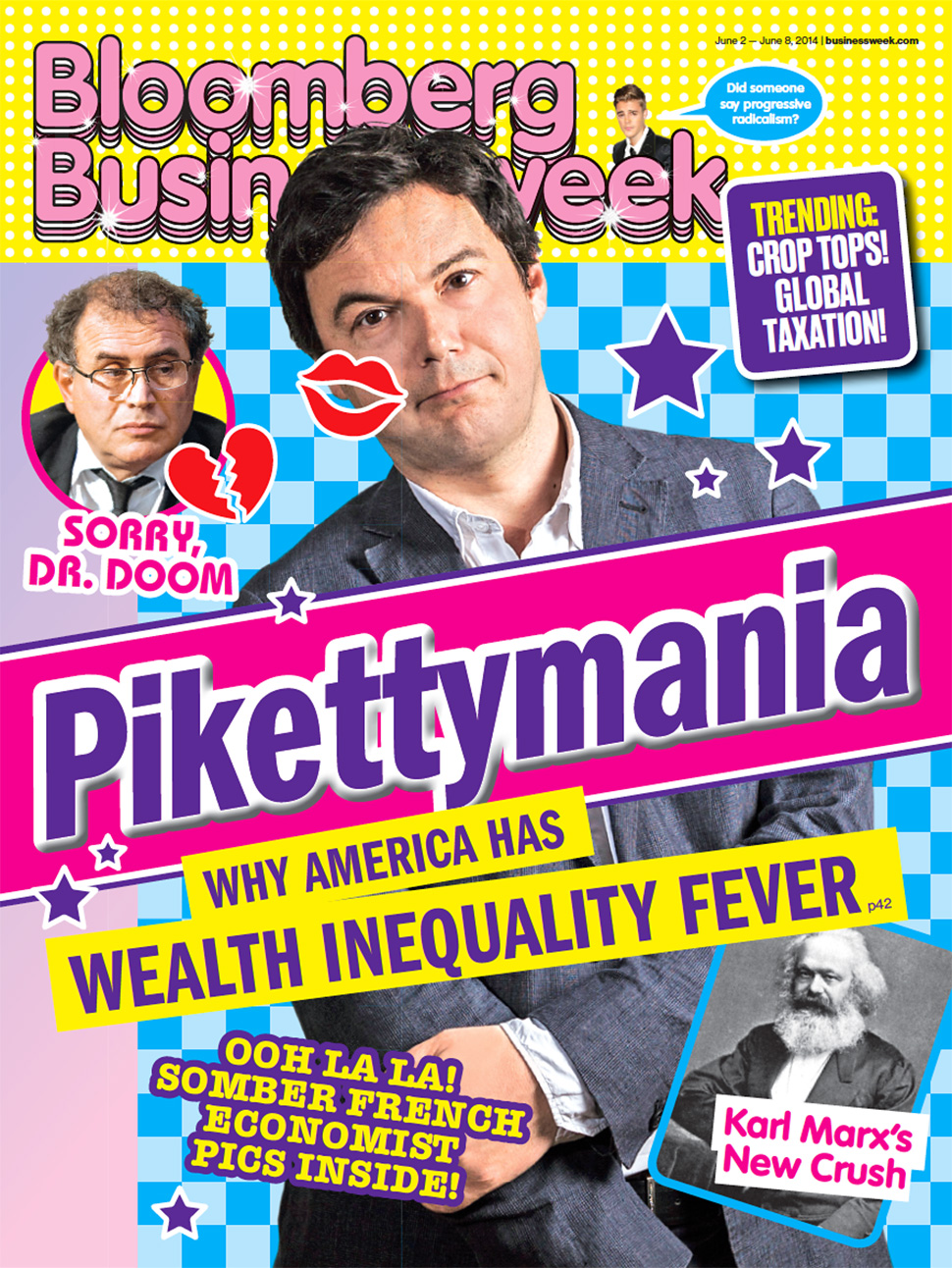
Can you believe a 696-page boring economics book, Capital in the 21st C., is the #1 Amazon best-seller, and one of Harvard University Press’s (Belknap) all-time best-sellers? And can you also believe very few people have actually ploughed through this tome? And that people constantly mispronounce the author’s name: He is French, and his name is toh-MA pi-ke-TTY, rhymes with bring me TEA!
Bloomberg Business Week has devoted an entire issue to Piketty, his arguments and his criticics, including Chris Giles (Financial Times) and two respected macro-economists, Per Krusell and Tony Smith. (See: http://www.businessweek.com/articles/2014-05-29/pikettys-capital-economists-inequality-ideas-are-all-the-rage ).
As a service to my readers, and to prevent a widespread narcolepsy epidemic (the malady that causes people to fall asleep in daytime), here is a very short summary of the ongoing debate.
What does Piketty claim? Simply – that “Beta” (the ratio of capital to income, for nations) initially fell, but in recent decades has risen. This is because the fraction of income saved (which is what leads to capital accumulation) exceeds the rate of growth of income or GDP.
So what? People who own capital can earn high return on their wealth, averaging 8 %; this doubles their wealth every 9 years. People who spend their income (most of us working people) fall into debt and fail to accumulate wealth.
So what? People with great wealth gain control of the democratic system, to perpetuate their wealth through tax breaks.
The growing concentration of wealth in fewer and fewer hands cannot be corrected by the democratic system (the vast majority, who have no wealth), because the super-rich use their wealth to manipulate the democratic system.
That last paragaph is NOT in Piketty. It comes from an article by John Cassidy, “Is America an Oligarchy?”, The New Yorker, April 18. He quotes two political scientists, Gilens and Page, who claim that: “Our analyses suggest that majorities of the American public actually have little influence over the policies our government adopts”:
Americans do enjoy many features central to democratic governance, such as regular elections, freedom of speech and association, and a widespread (if still contested) franchise. But …in the United States, our findings indicate, the majority does not rule—at least not in the causal sense of actually determining policy outcomes. When a majority of citizens disagrees with economic elites and/or with organized interests, they generally lose. Moreover … even when fairly large majorities of Americans favor policy change, they generally do not get it.
On many issues, say the authors, the rich exercise an effective veto. If they are against something, it is unlikely to happen.
So here is where things stand. Wealth grows faster than income. Wealth concentrates in fewer and fewer hands. Wealth corrupts democracy.
Marx predicted that the concentration of wealth would grow so intolerable, that the proletariat would revolt.
If the democratic system cannot repair itself – what other solution is there?
The World Can Live WITHOUT Perpetual Growth—and It Must
By Shlomo Maital
Today’s Global New York Times (June 5/2014) has a fine column by Eduardo Porter. He refers to Prof. Tim Jackson’s 2009 book, Prosperity Without Growth, and Jackson’s back of the envelope calculation. It shows a bitter truth: The macroeconomic assumption, that continual perpetual growth in GDP per capita is both good and feasible, cannot be sustained. We have to have policies that seek a stable level of per capita GDP, while redistributing wealth and income from rich countries to poor — a very tall order.
Here is the simple arithmetic. Assume that developing nations citizens are entitled to roughly the same level of per capita income as Europe, by 2050 (that’s 36 years away, about a generation and a half!). By then there will be 9 billion people in the world.
- If European incomes grow by 2 per cent annually through 2050, and
- If we want to keep the Earth’s temperature from rising more than 2 degrees C. (3.6 degrees F.) above what it was before the industrial era [in order to prevent violent, unpredictable environmental upheavals], then: the world can emit at most 6 grams of carbon dioxide for each dollar of GDP it produces.
Hmmm… Advanced nations emit 60 times that much, at present! Developing nations emit 90 times that much!
If we want to eradicate poverty (we do) and save our planet (we do), we are going to have to reduce carbon emissions by an order of magnitude. A very tall order, one that will take massive investment of resources, huge creativity, a pro-environment mindset, global cooperation, and a wide variety of new technologies.
President Obama’s new proposal, for limiting carbon emissions, falls far short of what is needed, and even THAT could be sabotaged by Congress (though Obama claims he will implement it as an executive order).
Is no-growth economics possible for rich countries? It is. Look at Japan. Despite Japan’s huge efforts, its per capita GDP has grown very little for two decades. Yet Japan remains a prosperous country, with a high living standard. Is Japan a natural experiment, showing that zero growth is not only possible, but desirable – provided we change our mindset?
I’m afraid that my generation is delivering a ruined planet to the younger generation. They have the right to put us all in jail for this.
Panera – Innovation for People Who Have No Money
By Shlomo Maital

Writing in the Boston Globe, Alyssa Edes tells us about Panera, a French bakery/café that has a new business innovation – give your stuff away, for free, or nearly free.
For example, “when Jonathan Diotalevi walked in to “Panera Cares”, a new Panera branch near Boston’s Government Center, “a smiling employee greeted Diotalevi at the door; he waited in line, ordered a tomato- mozzarella panini, and then asked the clerk, “So, can I, like, just give you two bucks?” Yes, he could. And he did, dropping the money into a nearby donation bin.”
What? No prices? No 30 per cent profit margin? How in the world can you run a business like this? Fox Network will scream that this is a Commie plot to undermine capitalism.
Here is how this branch works. “The restaurant at 3 Center Plaza may have been as busy at lunch time as any of the chains’s other cafes nationwide — more than 1,600 of them — but there’s a reason cochief executive Ron Shaich calls this one “a test of human nature.” The nonprofit outpost of Panera Bread Co. doesn’t have any cash registers, or set prices. Instead, it depends on donations from customers who pay whatever they can afford. The Government Center shop is the fifth of its kind for the St. Louis-based company — the first in this region.”
Note: Some people pay more than the regular price. “I think it’s awesome because it’s obviously beneficial for people who are a little less fortunate,” said customer Yanick Belzile of Lowell. “We can afford to, so we put in a little bit extra. If we can help someone else who can’t pay for a meal, why not?”
“Wayne Gilchrist, who said he lives under a bridge in Cambridge, said he made a modest donation for a coffee and French bread with butter. “I’m homeless,” Gilchrist said. “I got nothing and still gave because I want others to have.” “
About one out of every six Americans, or about 50 million, are “food insecure” or have trouble coming up with enough money to buy food, according to the US Department of Agriculture. “Many of those people work — some of them work two jobs,” said Kate Antonacci, Boston Panera Cares project manager. “Hunger affects people of all types, so it’s not only the destitute we serve. “
When I’m next in America, I plan to eat at Panera. Let’s support capitalists who get it, and who build businesses on the idea that people are basically trustworthy.
This idea could spread. What if businesses charged according to “pay what you can” and “pay what you think is fair”, rather than “pay as much as we can gouge from you, to keep our rich shareholders happy”? Wall St. might never be the same.
$1.3 b. to develop a new drug? It’s a myth!
By Shlomo Maital
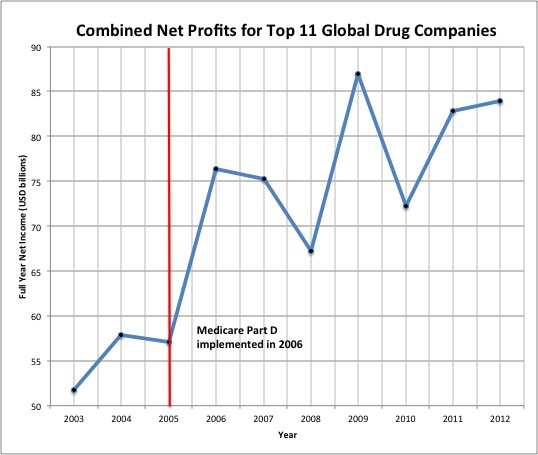
Some numbers, with no basis in fact, become truth simply through repetition. Take, for instance, this one: It costs $1.3 b. to develop a new drug. We all know that, right? That’s why medicine is so expensive.
Wrong. Here is how two eminent doctors (1) debunk that number. And at the same time, prove that “pharmaceutical companies are price-gouging”, with the biggest 11 pharma firms piling up ever-rising net income – nearly $85 b. in 2012.
* Half the $1.3 b. is the opportunity cost of capital invested in developing drugs. An inflated unrealistically high rate of return is used. Right now, the risk-free rate of return on bonds is about 1 per cent. So – knock off fully half of that $1.3 b. We’re at $650 m.
* Taxpayers finance pharma’s research costs, through tax credits and deductions. This brings the $650 m. cost down to $325 m.
* That $1.3 b. is based on the most costly one-fifth of new drugs, NOT the average of all drugs. Correcting this brings the cost down to $230 m.
* A few expensive drugs inflate the average. So it’s best to use the median, not the average. The median: the point at which half of the research projects cost more, and half less. This brings company research costs down to $170 m.
* Pharma inflates the cost of basic research underlying the new drugs. The net median corporate research cost comes down to just $125 m., when the figure is adjusted for more realistic basic research costs. Pharma invests only 1.3 per cent of revenues in basic research; the rest goes to developing new drugs with very little advantage over existing ones, just to inflate profits.
For cancer drugs, most of the cost of clinical trials are paid for by the U.S. National Cancer Institute.
What is worse – big pharma raises the prices on some of their older drugs by 20-25 per cent a year, and in the past decade, they have almost doubled their prices for cancer drugs. This is a ‘market spiral pricing strategy’, at a time when most other new products, like iPhones, fall rapidly in price.
Someone has to blow the whistle on Big Pharma. They are ripping us off, and people are dying because they cannot afford costly medicine. This is inexcusable.
(1) Cancer Rx: The $100,000 Myth. By Donald Light and Hagop Kantarfian. AARP Bulletin: May 2014, p. 22.
The Three Intersecting Circles of Innovation
By Shlomo Maital
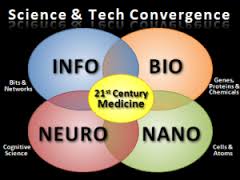
My attention was recently drawn to a three-year-old report, done by MIT scholars, for the health science research community. The report is The Thid Revolution: The Convergence of the Life Sciences, Physical Sciences and Engineering. The authors, which include stellar figures like Profs. Phillip Sharp and Robert Langer, argue that “convergence will be the emerging paradigm for how medical research will be conducted in the future.”
In order for this convergence to happen, they say, we will not “not simply collaboration between disciplines but true disciplinary integration.”
Today, the structure of nearly all the universities in the world is obsolete, ancient, creaky and counterproductive. It is based on faculties, which are silos that work in direct opposition to convergence. The exceptions are research institutes that are cross-disciplinary, specifically nanotechnology. My university has a Nanotechnology Center that draws scholars from many disciplines, and the resulting integration has been tremendously productive. A small example: Prof. Hossam Haick, whose discipline is chemical engineering, but who has harnessed nanotechnology, electronics, chemistry, physics and engineering to produce an ‘electronic nose’, which can sniff cancer molecules, for instance. He recently delivered the first course in Arabic, on Coursera, on nanotechnology.
Structure is not strategy, it is sometimes said. But, sometimes it is. Let’s change the structure of universities. Let’s find a way to restructure them, so that each faculty member has a very clear area of expertise, a clearly-defined discipline, but also has broad knowledge of other fields and above all, works as part of a convergence interdisciplinary team. And for this to work, their offices have to be adjacent…. Despite IT and networking, nothing beats face-to-face conversations over coffee.
Convergence poses a big challenge to those who would innovate. You need to achieve two conflicting goals, both of which are highly challenging.
First, as Nobel Laureate Dan Shechtman repeatedly urges, you must become expert, truly expert, at SOMEthing…. his expertise was in electron microscopy, and it enabled him to overcome fierce opposition to his discoveries, and ultimately win the big prize. You need deep knowledge in at least one field or sub-field.
Second, you need to become curious and learn a great many things about a great many fields, not in depth but sufficient to understand them. You need wide knowledge, surface knowledge, in just about everything. Even if you have team members who have deep knowledge, it still helps a lot to innovate if you have basic understanding of other, distant disciplines.
In future, all the major breakthroughs will occur at the point of convergence among several disciplines. In order for you, innovator, to be there, you need to acquire depth, and breadth.
Good luck!
Ibaka: Mental Toughness Trumps Genius
By Shlomo Maital
 Ibaka Blocks Another Shot
Serge Ibaka is a star player for the Oklahoma Thunder, now battling San Antonio Spurs for the Western Conference championship and the right to play Miami (probably) in the NBA finals. Ibaka is from the Republic of Congo, and a citizen of Congo and Spain.
Ibaka is injured. He could barely walk. His team was down 2-0 to San Antonio and on the verge of being eliminated. So Sunday, he decided to play. Oklahoma won 105-92, with Ibaka, a stellar defender who leads the league in blocks, playing a key role. (He is 6’ 10”, 245 lbs., won silver with Spain in Olympic basketball 2012, and gold in the European Championship in 2011.) Oklahoma is a different team when he plays. Kevin Durant and Russell Westbrook score scads of points, but Ibaka is vital for keeping the opponent from scoring.
Why did he play? Ibaka grew up very poor. His family suffered during the Second Congo War; his father was imprisoned. He played basketball on concrete, with worn out shoes or no shoes. He moved to France, then to Spain, playing with second division clubs and working his way up. He was one of 18 or 20 children. His mother died when he was 8. Then civil war broke out in Congo.
Here is what he said, when asked why he played injured. “The military, when they go out there to fight, when they sign up, they sign for evrything. No matter what happened last night, I signed up for this. That’s what I get paid for. When we sign here in the NBA, we sign on everything, man.”
Ibaka was in superb physical condition when he was injured. This is in part why he could come back so quickly. He is known as a rim protector, and is given nicknames like air Congo, Serge Protector and iblocka by his teammates.
Ibaka teaches us that mental toughness, commitment, loyalty, persistence, resilience, and in general character trump genius and innate skills. He has a $12 m. contract with Oklahoma. It hasn’t spoiled him. Because for him, it’s not about the money.
Ibaka reminds me of Fred Smith, founder of Fedex. Smith invested $48 million to launch Fedex. When asked whether he was not fearful of losing the money, he explained that he had served in Vietnam as a Marine, was in life-threatening situations, and “when you can lose your life, losing money has no fear.” Ibaka knew real hardship. Playing hurt, playing through pain, was not even close.


