You are currently browsing the category archive for the ‘Innovation Blog’ category.
Bolsa Familia: Welfare Payments That Work
By Shlomo Maital

As the super-rich and powerful of the world gather at Davos, Switzerland, the amount of hypocrisy spoken there about battling poverty could sink a mid-sized country. The super-rich wring their hands…and the next moment, use both of them to grasp more and more assets.
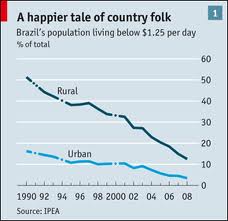
Right under our noses is one possible solution. Theory doesn’t help. We need to see what works. Check out Brazil. “Bolsa Família (formerly Bolsa Escola) started in the 1990s and expanded rapidly in 2001 and 2002. It provides monthly cash payments to poor households if their school-aged children (between the ages of 6 and 15) are enrolled in school, and if their younger children (under age 6) have received vaccinations.” In other words – attach the welfare conditionally to actions that will help get the NEXT generation out of poverty, through good health and good education and schooling.
The result? Look at the graph above. Since Bolsa Famliar was introduced rural poverty declined steeply, and urban poverty declined impressively, where poverty is measured as living on under $1.25 daily. There is still severe poverty in Brazil – but Bolsa Familiar is helping to battle it.
The basic idea is so simple. To survive, poor families have to send kids out to work sometime. Offer them help – but condition it on sending the kids to school. Now, if the super-rich at Davos could take a moment from the ski slopes and fancy restaurants, perhaps they might consider investing some of the trillions they have in a large-scale pilot project, for very poor countries, along the lines of Bolsa Familia. That might diminish slightly the cynical hypocritical atmosphere that is so evident.
Root for the Jamaican Bobsled Team at Sochi
(Remember ‘Cool Running’?)
By Shlomo Maital

Remember the legendary Jamaican Olympic bobsled team, in the 1993 movie Cool Running? Well, they’re back, big time!
Thanks to an outpouring of support for its online crowdfunding campaign, the Jamaican bobsled team is heading to Sochi with over $120,000 — and a dream 12 years in the making. On Monday, the members of the underdog team from the island nation learned they had qualified for the two-man bobsled competition for their first appearance in the Winter Olympics since 2002. That elation has been followed by overwhelming gratitude from the team toward its fans, after a crowdfunding campaign exceeded their target goal of $100,000 in a matter of days.
Team member Winston Watts said, “the team has stopped accepting funds as of Tuesday after hitting its financial target.” A campaign on the crowd-funding site Crowdtilt.com, combined with another campaign involving the virtual currency Dogecoin, has raised more than $125,000. Another campaign on the site Indiegogo has raised more than $43,000.
This is Watts’ fourth Olympics! He competed in 1994, 1998 and 2002. He and his team are an inspiration for Israel’s ice hockey team.
Today, thanks to crowdfunding, if you have an inspiring idea and can communicate it well, you can fund projects that otherwise would die. Zach Braff directed the hit cult movie “Garden State” a decade ago. He managed to crowdfund his new movie “Wish I Was Here” on Kickstarter last April, raising $2 million in 48 hours and $3 m. overall, from over 40,000 people! It made it possible for him to make his new movie without the dictates of investors.
Jamaica’s bobsled team may finish last. But Watts and the team embody the Olympic spirit, which is that competing is the goal, not just winning gold. Go Jamaica! Run cool.
Is Dissent A Necessary Condition for Innovation?
The Case of China
By Shlomo Maital

In this blog, I prefer to raise a question, rather than provide an opinionated answer
The question is: Can China become an innovation leader, without permitting open dissent and democratic debate?
In today’s New York Times, Stephen Sass, a Cornell materials scientist, argues, the answer is no. “I don’t believe China will lead in innovation anytime soon – or at least not until it moves its institutional culture away from suppression of dissent and toward freedom of expression and encouragement of critical thought.” He notes that almost all the paradigm-shifting innovations in the past few hundred years emerged “in countries with relatively high levels of political and intellectual liberty.” The reason? Free countries encourage people to be skeptical and curious. National innovation is the result of creative individuals who have the freedom to broach new ideas. And finally, free societies attract creative talent, oppressed societies push them out.
Here is a series of ‘yes’ arguments. China will innovate, by innovating its own approach to innovation. For instance, China excels at “design for value”, innovations in product design that create excellence in ‘manufacturability’. Chinese innovation will be far more team-based, rather than garage-based American Wild West individualism. China’s culture fosters discipline, and focused discipline is a key aspect of innovation. China’s huge growing internal market will make entrepreneurship much easier, as startups can sell at home rather than sell abroad, as in Israel. China has massive savings, which make availability of capital for startups much easier than in the West. China’s educational system generates enormous numbers of engineers; even if only 1 per cent of them are creative, that is sufficient to fuel a wave of innovation.
Can China become truly innovative? Don’t hold your breath for China to become democratic and tolerate widespread dissonance. The Chinese leadership believes this would blow the lid of China’s economy. Given the ‘in the box’ thinking of innovation without dissent — China will struggle to find its way. Time will tell if they succeed.
Why Money Should Be Like Manure – But It Isn’t!
By Shlomo Maital

Money, it is said, is like manure. To do any good, it has to be spread around widely.
But in today’s screwed-up post-global-crisis world, it isn’t. Money is increasingly concentrated in a very few hands. And as a result it just sits there. This is the nub of the problem.
Consider these two pieces of data.
* A new study by Oxfam, the British philanthropic NGO, claims that 85 super-super-rich individuals in the world hold wealth worth $1.65 trillion! This amount of wealth, held by fewer than 100 individuals, is equal to the value of all the wealth held by the poorest half of the whole world – 3.5 billion people. The average wealth of the super-super-rich 85 is $19 b. per person.
Try this imaginary exercise. Suppose, tomorrow, these 85 super-super-rich followed Warren Buffett and Bill Gates and gave away their wealth (gradually selling assets, in order not to depress the prices of stocks, bonds and real estate) and handed the proceeds to the world’s 3.5 billion poor people. Each poor person would get $471. This is a paltry sum. But it would change the lives of the poor. They could start businesses, buy small pieces of land, buy a home. And this spending would generate income for other poor people, who in turn would spend it…and end the global economic stagnation.
Imagine, as John Lennon says.. Imagine. But it’s just a pipe-dream. The wealth of the super-super-rich is the opposite of manure. It sits in their safes and living rooms, instead of spreading around the world.
* According to the Financial Times, Jan. 22, “the pile of unspent corporate cash that has built up since the start of the financial crisis is being held by an increasingly concentrated pool of companies that will be crucial to hopes of a pick-up in business investment to stimulate the world economy.” A study by the consulting firm Deloitte shows that globally, “about a third of the world’s biggest non-financial companies are sitting on most of a $2.8tn gross cash pile of unspent corporate cash (retained earnings) ! And of that sum, fully 5 per cent is accounted for by Apple alone, with $150 b. in unspent cash! ” “Looking ahead, the wave of cash [spending] that many are expecting will depend on the decisions of a few, rather than the many,” a Deloitte expert said.
Why aren’t corporations spreading around their cash, like manure? In a risk-averse world, with sluggish economies, there is no need to invest in more productive capacity. Better to hold on to the money and play with it than invest it in real industry, in real job-creation, in real innovation. This is what the handful of rich corporations believes.
Why not impose a tax on unspent retained earnings, to create an incentive to invest it? Why reward Apple for holding its cash abroad, instead of investing it in America?
So there you have it. Billionaires and rich corporations. Both sit on huge piles of money. And the money just sits there. Until it starts to move, we won’t see true global economic recovery or more new jobs for those who really need them.
What We Learn from Claudio Abbado
By Shlomo Maital

Claudio Abbado
The great Italian conductor Claudio Abbado died on Monday, age 80. He passed away at his home in Bologna, Italy. He had been ill for years.
We can learn a great deal from this fine man. Star orchestra conductors often have egos the size of Texas and personalities that combine General Patton and Genghis Khan. Not Abbado.
Abbado used to say, “Many bad things in the world could be avoided if only people would listen to each other.” He told this to his musicians: Listen to each other. Play as you like, he told them, clashing violently with the Herbert von Karajan ‘my-way-or-highway’ approach; don’t just wait for me.
This combination of respect, empowerment, respect for his musicians, and teaching them respect for one another, led to crisp, brilliant, lyrical performances. He broke the rule that great orchestras, like the Berlin Philharmonic, are utterly disciplined, like elite army units. He got the best out of his orchestras, like La Scala, by getting his musicians to like and respect him, and motivating them to work hard to make extraordinarily beautiful music. This is true leadership.
Abbado was an innovator. He encouraged avant garde music. He performed Manzoni’s “Atomtod”, at the Salzburg Festival – entirely in the dark!
He once explained his awkwardness in taking curtain calls, citing a conductor, Knappertsbusch, who refused curtain calls entirely. Abbado said, “it still embarrasses me to take bows. I’m not a showman.” In an age when famed conductors are primarily showmen, Abbado was rare. He broke the rules. We can learn much from his leadership style.
Singapore Redefines Literacy
By Shlomo Maital

“Kids who read – succeed!” Of course. But somehow, technology keeps raising the bar. It used to be that literacy meant the ability to read and write. A sad proportion of the world’s kids still can’t read or write. Today, literacy means, or should mean, computer literacy. And as usual, Singapore leads the way.
Singapore has announced plans to start software-programming classes in public schools, so that more students will learn how to write computer programs, according to the website Tech in Asia.
Singapore’s Infocomm Development Authority (how many nations even HAVE an infocomm Development Authority???) will introduce computer-coding classes in the schools in the next few months. The courses could be part of the curriculum, or perhaps an extra-curricular activity.
Singapore sees developing programming literacy as a “strategic catalyst for Singapore’s competitive advantage”.
My guess is, programming will become part of the official curriculum. It should be – and it should in other nations as well. Literacy is no longer the ability to write words. It is the ability to write computer code. Let’s imitate Singapore, which as usual has blazed the educational trail for the rest of us.
If You Thought Washington Is Dysfunctional – Wait ‘til You Read Gates!
By Shlomo Maital

I prefer to write blogs about books I’ve read. And it’s super-easy today to acquire any book – it takes 30 seconds to download an Amazon e-book. But today I want to write about a book I haven’t yet read, but will soon – based on a review. Because the content is so terribly disturbing. America is still the leader of the Free World – and it is rudderless, incompetent, cynical, according to the consummate insider Robert Gates, former Defense Secretary.
Gates’ book is called Duty: Memoirs of a Secretary at War. Gates served for many years in the CIA, headed the CIA for two years, then was Defense Secretary under both Bush and Obama (December 18, 2006 – July 1, 2011). In reviewing his book, national security expert Thomas E. Ricks calls it “probably one of the best Washington memoirs ever.” Ricks doubts Gates can ever again hold a Federal govt. job, or even want to.
Here are a few juicy tidbits: “VP Joe Biden is a ‘comical motormouth’…who “has been wrong on nearly every major foreign policy and national security issue over the past four decades”. Former White House chief of staff Rahm Emanuel: “hell on wheels…a whirling dervish with attention-deficit disorder”. Tom Donilon (Obama’s 2nd national security advisor): “suspicious and distrustful of the uniformed military leadership”; Congress: “truly ugly”…parochial, self-interested, rude and bullying. Harry Reid, Senate Majority Leader: “small-time hack who phones Gates to lobby for Defense Dept. funding for research on irritable bowel syndrome”. (didn’t know whether to laugh or cry, Gates says). Senator Nancy Pelosi, “said she wasn’t interested” when Gates tried to state the facts on the ground in Iraq. Senator Patty Murray, Washington, “read from prepared notes…no one had bothered to remove the Boeing letterhead from her talking points”. On Afghanistan and Obama: “the president doesn’t trust his commander, can’t stand (Afghan Pres.) Karzai, doesn’t believe in his own strategy and doesn’t consider the war to be his.” The Obama White House: “still stuck in campaign mode a year into the presidency”.
And this is just a start.
I guess most of us knew or suspected all this. But it is still disturbing to read it. No wonder “cold-blooded killers” (Gates’ description) like Russia’s Putin and Syria’s Assad are eating Obama for lunch daily.
Will Your Well-Paying Job (And Your Kids’) Soon Be Obsolete?
By Shlomo Maital

Slide Rule: Will Your Skill Soon Be As Obsolete?
One test of a futuristic prediction is to spot in several independent sources. After my previous blog on how we’re failing to teach our kids the right 10 skills – The Economist has a lead editorial on how technology will affect our future jobs. (See the Jan. 18 edition).
According to the Economist: “ Innovation, the elixir of progress, has always cost people their jobs. In the Industrial Revolution artisan weavers were swept aside by the mechanical loom. Over the past 30 years the digital revolution has displaced many of the mid-skill jobs that underpinned 20th-century middle-class life. Typists, ticket agents, bank tellers and many production-line jobs have been dispensed with, just as the weavers were.”
“Why be worried? It is partly just a matter of history repeating itself. In the early part of the Industrial Revolution the rewards of increasing productivity went disproportionately to capital; later on, labour reaped most of the benefits. The pattern today is similar. The prosperity unleashed by the digital revolution has gone overwhelmingly to the owners of capital and the highest-skilled workers. Over the past three decades, labour’s share of output has shrunk globally from 64% to 59%. Meanwhile, the share of income going to the top 1% in America has risen from around 9% in the 1970s to 22% today. Unemployment is at alarming levels in much of the rich world, and not just for cyclical reasons. In 2000, 65% of working-age Americans were in work; since then the proportion has fallen, during good years as well as bad, to the current level of 59%.”
What should be done? What can be done? “Innovation has brought great benefits to humanity. Nobody in their right mind would want to return to the world of handloom weavers. But the benefits of technological progress are unevenly distributed, especially in the early stages of each new wave, and it is up to governments to spread them. In the 19th century it took the threat of revolution to bring about progressive reforms. Today’s governments would do well to start making the changes needed before their people get angry.”
It will take a long time for people to get angry…and by the time that happens, society will be in deep trouble.
But individuals can act. Ask yourself, what is your main skill? Could it be made obsolete (like the skill of middle level managers who once processed data, now available on the screen of senior managers instantly) by technology? If so, how? When? Can you develop a new skill? Should you start now?
And get your kids to ask the same questions. That nice fat paycheck of today could be a green slip tomorrow. Prepare yourself and your loved ones. Remember the slide rule.
Can China Conquer Its Mountain of Money?
By Shlomo Maital

During the global financial crisis, China’s economy should have been hard hit. As Western economies’ demand for exports collapsed, China should have imploded. But it didn’t. After a short pause in its growth, the near-double-digit growth resumed.
One reason? China’s Central Bank rapidly and massively expanded the money supply, making credit exceptionally cheap and easy to get. China’s money supply (M2) grew by 30 per cent at the end of 2009. Credit growth has slowed but is still very rapid. M2 grew by 13.6 percent last year, about the same as in 2012 (13.8 per cent).
Overall, the amount of money in China has tripled since the end of 2006. One result has been to create a huge housing bubble and asset inflation. Hence, buying a very modest apartment in Wuhan, reports Keith Bradsher, in the Global New York Times, now costs about $100,000, or 14 years of pay at $575 / m. for an average industrial worker. Unaffordable.
In the U.S. and U.K., central banks created easy money (quantitative easing) by buying bonds, thus injecting reserves into the system. It was only partly effective, because banks chose to hold on to the cash rather than lend it, to shore up their ravaged balance sheets.
In China, monetary policy works differently. China buys huge amounts of U.S. dollars and Treasury Bonds and Bills, in return for renminbi, to keep the renminbi from growing stronger, and to maintain its undervalued exchange rate at about 6 RMB per buck (it probably be around 3.5, based on purchasing power). This keeps China’s exports cheap. Currency manipulation is illegal, but – not much can be done. If the U.S. screams too loudly, its multinationals will use their valuable cheap production sites in China and Apple, for instance, could cease to exist.
The problem China now faces? How to rein in that mountain of money, and keep it from generating inflation, or keep the housing bubble from bursting when the mountain starts to shrink (or grow more slowly)? America has failed at a much smaller task – ending Wall St.’s addiction to quantitative easing and free money. Will China do better? We should all watch China closely, and hope that wily Zhou Xiaochuan, longtime People’s Bank of China governor, will succeed. If he fails, we will all feel the pinch.
Are Parents & Schools Failing Our Children?
Future Work Skills for 2020
By Shlomo Maital


TEN KEY FUTURE SKILLS
I have a strong feeling that both we parents and the schools are letting kids down, by not preparing them properly for the future – for acquiring the key skills they will need to change the world. A study by the Institute for the Future (Univ. of Phoenix, 2011) uses a ‘signals’ methodology (a new product, practice, market, policy or technology, in one locale, that has bigger implications globally) to identify the ten key skills for the future workforce. Here is the list, and the definition of each. Check whether your kids’ schools are helping develop these skills, and whether you, as parents, are too. If you get less than 6 out of 10 …you (and the schools) flunk. Note how many of these skills involve creative problem-solving.
1. Sense-making (ability to determine the deeper meaning or significance of what is being expressed). 1
2. Social intelligence (ability to connect to others in a deep and direct way) 1
3. Novel and adaptive thinking (proficiency at thinking and coming up with solutions nad responses beyond what is rule-based or rote-based)
4. Cross-cultural competency (ability to operate in different cultural settings) 1
5. Computational thinking (ability to translate vast amounts of data into abstract concepts1
6. New-media literacy (ability to critically assess and develop content that uses new media forms, and leverage them 1
7. Transdisciplinarity (literacy in and ability to understand concepts across multiple disciplines) 1
8. Design mindset (ability to represent and develop tasks and work processes for desired outcomes) 1
9. Cognitive load management (ability to discriminate and filter information for importance, maximize cognitive functioning) 1
10. Virtual collaboration (ability to work productively, drive engagement, and demonstrate presence as a member of a virtual team). 1