You are currently browsing the category archive for the ‘Innovation Blog’ category.
America’s DEEP Poverty: The REAL Scandal!
By Shlomo Maital

Deep Poverty
All eyes, all attention, all media are focused on America’s government shutdown and debt ceiling crisis, now coming to a head. This is indeed a scandal – no way to run a country, as the Economist cover claims.
But as usual, the real scandal is elsewhere, and is largely ignored by all, including the squabbling Washington politicians.
According to the Wall Street Journal Europe (Friday Oct. 11-13, p. 7), “Extremely Poor Fall Further Behind”, despite the so-called economic recovery, 44 per cent of Americans who live below the poverty line are in “deep poverty” (i.e. they have income that is half or less that of the official ‘poverty line’, which itself is exceptionally low. Some 20.4 million Americans live at this level of income! One American in every 16 lives in deep poverty. This is up from one American in about 30, in 1975.
Some 45 m. Americans live in poverty, defined as an income of $23,492 for a family of four. So deep poverty is an annual income of $11,750, or about $240 a week. Some of the biggest increases in deep poverty occurred in the Deep South – Mississippi, Indiana, Georgia, Alabama.
Many of the ‘deep poor’ have part-time jobs in retailing, and struggle to get enough hours to get by, because their jobs are for 20 hours a week or fewer.
I wonder how many of us could survive in the U.S. on $240 a week, to pay for food, shelter, clothing, education, and of course paying for health insurance at that income level is out of the question.
So while partisan Washington squabble over politics, the deep poor sink deeper and deeper into despair. What really could help the deep poor? Sustained economic growth. Only that can create the jobs they need, and convert part-time jobs into full-time ones. But we won’t get sustained economic growth, while U.S. government spending is being slashed, because right now the government is the main, even only, source of growth in demand. And of course the deep poor have no voice – they are silent, unorganized, with no-one to stand up and speak for them.
Those of us who are comfortable should try to speak up for those who have so little. But I just don’t know how to do this effectively. Do you?
http://online.wsj.com/article/SB10001424052702304520704579127683358228854.html
Memo to Every Country: Keep Your Bright People!
By Shlomo Maital
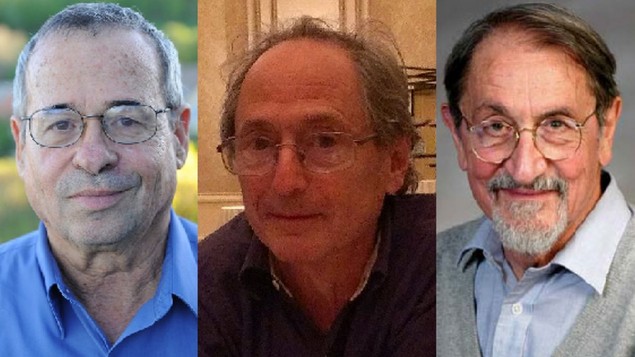
Nobel Winners Warshel, Levitt and Karplus
This year’s Nobel Prize for Chemistry was won by three scholars, two of whom were Michael Levitt, Stanford Univ., and Ariel Warshel, U. of Southern California. The latter two are Israelis; Levitt studied and did research at Israel’s Weizmann Institute, and Warshel studied at Technion-Israel Institute of Technology. Both did their Nobel research abroad. Levitt told the press that he would have preferred to remain at Weizmann, but it was “not his decision”. The three winners did research that used software algorithms to simulate and predict chemical reactions, now widely used in drug development. Like many Nobel breakthroughs, their work combined fields not often combined: in this case, classical physics and quantum physics. One of the winners was French: Martin Karplus, of Univ. of Strasbourg.
Both Levitt and Warshel studied in Israel; Ariel studied at my university and won awards. Both say they would have preferred to make their careers in their home countries, but could not get academic positions.
I believe that one of the key ways we should judge our political leaders, is whether they do everything possible to keep our bright young people at home, and to attract those who have left to come home. This is our future; to do less is to damage our future. I don’t see how Israel’s government is doing anything serious to stem the massive brain drain, or attract home those who left in earlier years. It is very small comfort to see an expat Israeli win a Nobel Prize, for Stanford or Southern Cal. We see an exodus of brainpower from Greece, and from Spain, and other nations in fiscal trouble. The cost of this is simply immense.
Source:
http://online.wsj.com/article/SB10001424052702304520704579127683358228854.html
Pittsburgh: Last Great Undiscovered American City
By Shlomo Maital

On Wednesday I was in Pittsburgh, Pa., and gave a talk at Carnegie-Mellon Univ. Pittsburgh is perhaps the last great undiscovered American city. Once a grimy steel town, with steel mills spewing pollution on the three rivers that merge in downtown Pittsburgh (Allegheny, Monongahela, Susquehana), Pittsburgh once saw the mighty United States Steel building tower over its skyline. (Its NFL football team, Pittsburgh Steelers, gets its name from that era). In the 1950’s, I visited the steel mills that employed thousands of Pittsburgh workers.
No longer. The steel mills are long gone. Grimy Pittsburgh is now squeaky clean. And the steel jobs have been replaced by health care jobs. In place of the US Steel sign, UPCM (University of Pittsburgh Medical Center) towers over the skyline. Pittsburgh has become a health care center, with two great universities at its core, University of Pittsburgh (Pitt) and Carnegie Mellon. Pitt is unusual; it is one of the only universities in the world whose core building is a skyscraper, the 40 story Cathedral of Learning.
Nearby cities, like Detroit, and Cleveland, are in desperate trouble. Detroit has declared bankruptcy. Detroit lost its auto jobs, Cleveland lost its heavy industry. Somehow, Pittsburgh fought back and found something to replace the steel jobs. What we learn from this is simple: Every individual, organization, city and country needs to ask, what is it that I can do, to create value for others, that is done better, faster, cheaper, than others? What is my ‘differentiator’? Every company, every city, every country needs one. Some cities never bother asking that question, and they sink. Of course, you need to do more than ask the question – you need to answer it wisely and then implement the answer. Pittsburgh has done that. It is a thriving vibrant city, with a vigorous cultural life, many young people who flock to the high-quality universities and stay after they graduate, and strong political leadership.
Võ Nguyên Giáp: 1911-2013
By Shlomo Maital

Gen. Giap with former Brazilian President Lula
Vietnamese General Võ Nguyên Giáp died on Oct. 4. He was 102.
Gen. Giap was a leading commander in two wars: against the French, and against the United States. He commanded Vietnamese forces at the key battle of Dien Bien Phu, against the French, which ended French colonial rule of Vietnam. Giap surprised the French, by hauling howitzers up steep mountainsides, pulled by troops. While primitive, the howitzers were a surprise to the French and proved decisive in the battle – the French had not expected the Vietnamese to have artillery. Giap had his 24 105-mm howitzers dug into the hillside on its forward slope (normally artillery is placed behind the crest of the hill, to hide it), to demoralize the French troops and ensure that they see them. Giap had a series of trenches dug, which encircled the French and gradually enveloped them.
This was not the first time Giap was underestimated. In the battle against the U.S., Giap created the Ho Chi Minh trail, which kept supplies flowing to the Viet Cong in the South, despite American efforts to bomb the trail with B-52’s and interrupt the crucial logistical supplies.
We in the West consistently underestimate the resilience, inventiveness and dogged determination of Asians. The Vietnamese people are physically relatively small; this too is a factor in how Westerners regard them. But I have acquired immense respect for them. Here is a small story that explains why.
At MIT, I had a young Vietnamese student in my summer course, which required a great deal of reading. His English was very poor and he got 50% on a mid-term exam. I tried to console him. But he shook his head and told me, “I know half material, I get 50%; end of course I know all material, I get 100%”. And he did. He simply went without sleep, and got the job done.
What are the odds that a fighting general could engage two great powers in brutal wars, triumph, and die in his bed at the ripe age of 102? Let us have new respect for Asia and its people. They are not to be underestimated, in peace as in war.
Horn of Africa Migrants: Does Anyone Care?
By Shlomo Maital
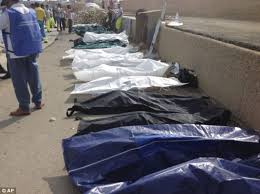
Again – a line of body bags. No, not from Syrian Army poison gas attacks. This time, an estimated 300 or more migrants from Africa’s Horn, who perished on a leaky ship bound for Lampedusa, an Italian island, from Libya. According to the BBC the ship’s engine failed. Someone on board lit a fire to attract help. The fire then raged out of control. People on the ship fled the fire, too many moved to one side of the ship, and it tipped over. Many drowned. All this took place just one kilometer, or 0.6 miles, from shore! Italy’s conscience was aroused – the Italian Prime Minister declared a day of mourning.
The migrants were mainly from Somalia and Eritrea. Somalia is a failed state, has been for years, suffering from drought and famine, and is often in the news. Eritrea, on the other hand, is nearly invisible, run by a brutal dictator who does not allow journalists into his country. The result: Eritrea is rarely in the news, despite the brutal violence imposed against its citizens. Until Israel built a high fence along its long border with the Egypt’s Sinai Peninsula, many Eritreans fled to Ethiopia, north to Sudan, thence to Egypt, from there to Bedouin smugglers across Sinai, to Israel. They suffered enormous hardship, extortion, blackmail and much worse.
Total annual world military expenditure amounts to $1.75 trillion. Suppose just five per cent of that amount, $87.5 b., were allocated to programs that helped Horn of Africa migrants study and resettle in Western countries. Ultimately, Somalis could return to rebuild their country. Eventually, when the murderous dictator is removed, Eritreans could, too. These migrants are full of energy, hard work and the desire to contribute. All they seek is a chance. We have more than 50,000 of them in Israel, mostly in South Tel Aviv. Why do 300 of them have to die, in order to arouse the world’s conscience, for an Andy Warhol 15 minutes – only to be forgotten again in no time?
Tom Clancy: April 12, 1947 – October 1, 2013
By Shlomo Maital

Tom Clancy died on Oct. 1, age 66. His first published novel was The Hunt for Red October, published in 1984, about a Russian submarine. More than 100 million copies of his novels are in print, and 17 became NYT best-sellers.
We can learn much from Clancy’s life. He was an insurance salesman in Baltimore, but had a lifetime fascination for the Navy and for military technology, from an early age. He read books about ships and the Navy when he has a child. In his spare time he wrote “Hunt for Red October”. It had a great many details about Soviet submarines, weaponry, satellites and fighter planes; Navy Secretary Lehman asked Clancy, in 1986, “who the hell cleared it?” The answer: Nobody. All the data came from technical manuals, interviews and published books. A lot of great intelligence simply comes from gathering openly published material.
Clancy sent his manuscript to the Naval Institute Press in Annapolis, MD. An editor, Deborah Grosvenor, was mesmerized by it, but had trouble persuading her boss to publish it. She finally got Clancy to cut 100 pages and remove some technical descriptions. The Press paid $5,000 for the book. It became a smash best seller when President Ronald Reagan said it was “my kind of yarn” and mentioned that he couldn’t put it down.
We can learn an important lesson from Clancy and his life. He was 36 when his first book was published. That means he spent long years selling insurance, while pursuing his true passion in evenings and on weekends. Clancy died relatively young – but he had 30 good years doing what he loved and doing it well. We should all pursue our true passions, after finding out what it is, and at least try to make our living from it, even while earning a living from something else. Rest in peace, Tom. Thanks for all those great books – and the movies based on them.
Meet Your Neighborhood Bee – Up Close!
By Shlomo Maital

Ever wondered what a bee looks like, up close – really close? New photos of insects using new technology, published in Bloomberg Businessdaily, are highly revealing. The photographs are by by Sam Droege/USGS Bee Inventory and Monitoring Lab. The US government monitors bees because mysterious diseases have been depleting bee colonies in the US and abroad.
Bees are miraculous creatures (See Harun Yahya, The Miracle of the Honeybee, available online at http://fs.fmanager.net/files/flashpages/index.php?bookid=4193
Here are a few amazing facts about bees:
* A beehive contains thousands of larvae, at many different stages. The worker bees will visit each larva 10,000 times! In its first 6 days of live, each larva increases its weight by 1,500 times, feeding on royal jelly for the first three days. Royal jelly is an exceptional compound, comprised of 67% water, 12.5% crude protein, including small amounts of many different amino acids, and 11% simple sugars (monosaccharides), also including a relatively high amount (5%) of fatty acids. It also contains many trace minerals, some enzymes, antibacterial and antibiotic components, pantothenic acid (vitamin B5), vitamin B6 (pyridoxine) and trace amounts of vitamin C.
* Worker bees produce “propolis”, an anti-bacterial substance they produce by combining their saliva with sticky resin collected from trees, in the pods they use to gather pollen. When there is ‘junk’ in the hive that is too heavy to be carried away, the workers cover it with propolis and seal it. They basically mummify it. E.g., invading wasps. Somehow the worker bees know that dead bodies in the hive will decay and cause disease, and through evolution have developed an effective method for preventing this. Imagine if we humans were able to produce our own antibiotics – inside our own bodies.
* Guard bees release a strong odor, known as pheromones, when they sting an intruder. This acts as an alarm or siren for the entire hive to mobilize and defend itself.
* Bees protect their hives with their lives. Their sting sacs are amazing weapons. The stinger detaches itself, with its poison, from the body of the guard bee, which quickly dies. But the stinger continues to inject the poison into the intruder, even though detached from the bee’s body. If you’ve ever been stung by a bee, you may have seen this in action.
* When a hornet invades a Japanese bee hive, it is too large to be killed. So the bees envelop it in a ball of 500 bees, and with their wings rotating rapidly, generate immense heat – high enough to kill the hornet.
Bees have very very tiny brains. How then do they do all these miraculous things, that seem to require very high intelligence? Evolution. The power of evolution through accidental mutations generated bees adapted to survive.
Some believe teaching evolution is anti-religion. But the result of evolution, those amazing honeybees, are simply Divine in nature. We humans have much to learn from them.
Destroying Our Most Precious Resource – (It’s Not Air or Water)
By Shlomo Maital

98% geniuses, age 5; 2% geniuses as adults
In an interview with the AARP (retired persons) magazine, Warren Buffett warns against investing in gold, and in doing so, informs us how much gold there is in the world: 170,000 tons, which if melted together would form a cube 68 feet on each side, worth $9.6 trillion (at $1,750 per ounce). Wow…that’s a lot of cash, more than half America’s annual GDP.
Now – imagine reverse alchemy: Irradiating that cube until it becomes…lead. $10 trillion in value disappears instantly. Gone forever.
Insanity? We are doing the equivalent every day to our children.
Studies show that nearly all (98%) 3-to-5 year-olds score as creative geniuses, when measured by their divergent thinking skills (ability to envision multiple solutions to a problem – matching the definition of creativity as ‘widening the range of choices’). [The test is used by NASA to measure creativity among its employees]. By age 10, only 32% scored at genius level. By age 15, 10%. And by adulthood: 2% ! *** [See Figure above].
We can only blame the way kids learn in schools for this. Rigid, regimented, this-is-the-right-way convergent thinking, my way or highway.
What is the value of this destroyed creativity? Far far more than that cube of gold. Imagine all the wonderful ideas we will never have, to enrich our lives and change the world, because our young geniuses have their creative sparks extinguished. And we can never get it back.
If only there were awareness of the problem. If only we could stop destroying creativity in our children, by a few simple ways to foster divergent thinking.
Is anyone listening?
*** Education researcher Y. Zhao notes, in a 2009 book: “In their 1992 book Breakpoint and Beyond: Mastering the Future—Today, Land and Jarman (1992) describe a longitudinal study on creativity beginning in the 1960s. Land administered eight tests of divergent thinking, which measure an individual’s ability to envision multiple solutions to a problem. NASA uses these tests to measure the potential for creative work by its employees. When the tests were first given to 1,600 three- to five- year-olds, Land found 98% of them to score at a level called creative genius. But five years later when the same group of children took the tests, only 32% scored at this level and after another five years, the percentage of geniuses declined to 10%. Figure 0.1 illustrates the sharp decline in one measure of creativity as children get older. By 1992, more than 200,000 adults had taken the same tests and only 2% scored at the genius level.”
AK 47’s biggest fans? Syrians? Congolese? No! Americans!
By Shlomo Maital

A boring short news item datelined Moscow: “Russian maker of AK-47s sells stake to investors”. The Russian government is raising money by selling 49% of the company that makes AK-47 Kalashnikov assault rifles to private investors. The weapon is named after its inventor, General Mikhail T. Kalashnikov.
So?
Read on:
“Izhevsk Machine Works…returned to profitability in recent years in large part because of robust sales to U.S. civilians. …The U.S. is the world’s largest importer of small arms, bringing in about $1.2 b. worth of guns in 2011. …Because of so many ‘bootlegs’ (copies), producing the gun of choice for a broad spectrum of people who carry firearms, from child soldiers in Africa to terrorists to rappers, was never good business for the factory known as Izhmash, until sales to relatively wealthy U.S. buyers picked up….40 per cent of the factory’s output went to gun buyers there – about the same number as bought by the Russian military.”
Why do ordinary Americans need AK 47’s, or their civilian version? It’s obvious. To protect themselves from the bad guys – who also have AK-47’s.
The crazed shooter at the Washington Navy Yard who mowed down many innocent people used a civilian version of the M-16, a lethal semi-automatic weapon that fires bursts of three bullets – burp burp burp. That way, even if you have poor aim, you still kill your target. And the shooter did use it as a semi-automatic.
Despite this, effective gun control legislation in the U.S. remains a fantasy, as the powerful NRA National Rifle Association dominates politics. The U.S. cannot even ban purchase of semi-automatic weapons, even though such guns have no conceivable use in hunting or self-defense. This is simply insanity.
There is of course an upside to this story. With its fiscal deficits, the U.S. can solve them all forever by zero-ing the defense budget ($729 b. in 2012) and firing every single U.S. soldier. Just put ordinary American citizens into the field, who own an AK-47, and they will easily match Russia’s AK-47 wielding army. And what’s more – the Americans who own AK-47’s are mostly nutty and extreme. So the Russians won’t have a chance.
An Increasingly Messy World: What We Each Must Do About It
By Shlomo Maital

My friend Bilahari Kausikan, a veteran Singapore diplomat and now Ambassador at Large, has written an excellent study titled “East Asia, US-China Relations and A New Global Architecture”. Some of the points he makes have major implications for each and every person. Here are a few excerpts:
1. We need a new ‘global architecture’: “… once an American President has acknowledged the need for a new global architecture, it is a view that must be taken seriously. Only the US can lead and manage the transition from one system to another. To reach a new global architecture, three sets of more or less tandem and inter-related adjustments will be necessary: a) global, b) regional, particularly in East Asia, and c) domestic in key countries, especially in the US and China. All are complicated and the interregnum between one type of international system and whatever may come after will be prolonged, measured in decades. Along the way there will be stresses to be managed and recurring political, financial and economic crises to be navigated. It will be a more than usually messy and unpredictable environment for East Asia and for the world for a quite long time to come.
2. “… while US leadership is still irreplaceable, the imperative of US leadership is no longer self-evident, both to other major countries and to many Americans who now question the burdens and sacrifices of global leadership. America will in all probability look increasingly inwards for some time. This is what it has been historically been prone to do after major wars, and the wars in Iraq and Afghanistan were the longest in American history. It would thus be prudent to anticipate a global leadership deficit of some degree.”
3. “The US and China will eventually grope and stumble their way towards a new modus vivendi. The questions that cannot now be answered are what the contours of the future US-China relationship will look like; what trade-offs they will make between themselves; how long it will take to reach a new equilibrium; and what excitements the region will have to endure along the way?”
4. “In the 21st century, ‘normal’ politics is all too often dysfunctional. This is a global phenomenon manifest in all polities legitimated by some variant of the notion of the sovereignty of the people. The experience of countries around the world has shown that the validation of politics by this 18th century political philosophy sooner or later sets up a dynamic that makes governance more difficult.”
So what does all this mean for ordinary people and for companies?
As Bilahari notes, the world is going to remain highly unstable, for years to come. It is not a multipolar world, but a NONpolar world. America still has the clout to impose order, but it lacks the will do to so, after futile wars in Iraq and Afghanistan. Moreover, normal 18th. C.-style democracy has become dysfunctional, in a fragmented era of social-network protest.
For companies, strategy will need to be flexible, agile, rapid, alacritous. Survivors will be those best able to react quickly and correctly to unanticipated changes.
For individuals, the precise opposite. We cannot forecast labor markets, we do not know which skills, products, industries or even geographies will prevail. So, best to look inward, identify our passions, and work to fulfill them, irregardless of the typhoons raging around us. This was always the best path. It it even more so in the turbulent world that Bilahari Kausikan decribes.
One more thing. A USAToday Poll finds that young Americans have a strong impulse to contribute to their society – but not through politics. Only 17% of Caucasians, and just 8% of all blacks, say they seriously considered running for elective office (at any level); only 22% of college grads, and only 25% of those who earn $100k or more; only 22% of men, and just 8% of women! America’s dysfunctional politics, about to push the Obama administration off the fiscal cliff, will be dominated by second-rate scoundrels, precisely at a time when strong leadership is needed.
How in the world do we get young Americans to clean up America’s political mess, which is polluting not just America but the whole world?