
You are currently browsing the category archive for the ‘Uncategorized’ category.
Gene Therapy: Curing Sickle Cell
By Shlomo Maital
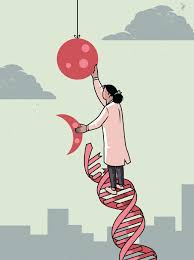
New York Times science reporter Gina Kolata has just published a moving account (Sept. 16) about one of the first children to be treated with a new gene therapy that will free him “from the sickle cell disease that has stolen his childhood”.
The child, 11 year old Kendric Cromer, has had periods of escruciating pain. Sickle cell eroded his hip bones, kept him from riding a bike or playing soccer or even going outside when the temperature was below 55 F. – because the cold brought intense pain.
Sickle cell is a hemoglobin-related blood disorder, genetic in nature, caused by an abnormality in the oxygen-carrying protein haemoglobin found in red blood cells.
Red blood cells are normally round. Deformed red blood cells are shaped like a new moon. The deformed sickle cells cannot carry oxygen properly to all parts of the body, resulting in great pain.
Gene therapy repairs the disease, by giving the patient’s blood-forming cells a new, normal hemoglobin gene. Some 100,000 Americans, most of them African-Americans, have this awful disease. Gene therapy could cure 20,000 of the most severely afflicted. But the treatment is hugely expensive, difficult (Kevin underwent four days of intense chemotherapy to clear his bone marrow and make way for the new cells). The treatment costs hospitals $2.2 million per patient (from the Boston biotech company Vertex) or $3.1 million from another firm, Bluebird. And hospitals pay upfront, then are reimbursed.
Bluebird took cells from Kendric, treated them, modified the offending gene, and then, reinjected the healthy genes into Kendric’s body. For a month, “Kendric will be very ill, with ulcerating sores in his mouth, throat and esophagus…”
Kendric’s goal? “I really just want to be a kid,” he says.
Go for it, Kendric. Every kid deserves to be..just a kid.
Should We Prepare for a Recession?
By Shlomo Maital

Are we headed for a recession?
Quick answer: No. But – why do some experts think we are?
There are storm clouds. Trade has been the engine of global growth since Bretton Woods, 1944. We now seem to have trade wars – countries impose tariffs, trading partners retaliate… end of trade as growth engine.
Central banks have imposed high interest rates to battle COVID-induced inflation. They are very slow to lower them – The European Central Bank has begun, gingerly, and the Fed still has not yet begun.
The Chinese economy has slowed, unable to find growth engines to replace exports and investment. Chinese consumers are spending only reluctantly.
I don’t believe this is sufficient to cause recession. The US economy, always a stalwart growth engine, grows by 3%. The US deficit is large, pumping demand into the system. There is huge uncertainty regarding the Nov. 5 elections, but hope for a sane and pro-active House, Senate and President.
So, the usual advice – set aside a reasonable nest egg, a sum for a rainy day, live within your means, try not to increase your credit card debt… and watch cautiously. I don’t believe a recession (two-quarter fall in GDP) is in the cards.
Why Don’t Women Get a Seat at the Table
By Shlomo Maital

When men have done such a lousy job running government, nations, and big businesses – why don’t more women get a seat at the table?
Consider this: (for the US):
- The share of reported female Board directors increased by one percentage point, from 31% in 2022 to 32% in 2023. At last count, half the population are women. One Board member in three is a woman.
- Women CEOs run 10.4% of Fortune 500 companies in the US. One in ten.
- There are 25 women now serving in the US Senate. One in four. Incidentally, the Senate is run by very old men, and the average age of Senators if 64!
- There are 125 women (out of 435 representatives) serving in the House. Just a bit over one in four.
And in general, in Nobel Prize awards:
- Thirteen women have won the Nobel Prize in Physiology or Medicine (5.6% of 230 awarded); eight women have won the Nobel Prize in Chemistry (4.1% of 191 awarded); five women have won the Nobel Prize in Physics (1.8% of 224 awarded). Why? Because it is tough for women to excel in male-dominated sciences — especially physics.
According to a report by the World Economic Forum, at the current rate of progress, full male-female parity in politics will not be reached for another 130 years, Yet:
“It turns out that societies gain advantages when their political leadership includes more women. Countries with greater female representation at the highest levels remove legal inequality between men and women, according to a new report by Women Political Leaders and the Oliver Wyman Forum.”
Men have messed up the world. Why not give women a chance and offer them a seat – at the head of the table? The men won’t do it, so let’s elect more women, who can legislate to fix the male-heavy tables.
What can we lose? They sure can’t do any worse than the men.
How to Bounce Back
By Shlomo Maital

Let’s face it. Stuff happens. Bad things happen to us all, including us good people. So, what is the key to resilience – bouncing back?
Writing in the New York Times Wellness department (a really interesting and useful department), Eric Vance offers three tips. They make sense. Here they are:
- “Identify what brings you meaning.
“The biggest piece of a good life is having some kind of sense of purpose and something that you’re invested in and committed to,” said Sherry Hamby, a psychology professor at the University of the South in Tennessee who studies resilience in impoverished communities.”
This recalls Victor Frankl’s logotherapy – how he found meaning in the worst of situations, in a death camp.
Make meaning, not money, Apple guru Guy Kawasaki counsels. And start early – start now. Find the answer to the question, why were you put on this Earth?
- “Understand that no one is an island.
“We as humans are very social creatures,” said Kathryn Howell, a psychology professor at the University of Wisconsin-Madison. “So when bad things happen to us, we want to be together and connected to others.”
Resilience is crucially helped by the support of friends and family. Make sure you have an ecosystem of love surrounding you, well in advance. A study of Israeli soldiers in wartime showed that those who served in tank crews that were ‘organic’ (teams they had trained and worked with for years) did not suffer wartime post-trauma, while tank crews assembled hastily, at random, from strangers, suffered severe post-trauma – they did not have the security of those they know wrapped around them.
- “Find what keeps you balanced.
“It turns out the kinds of tools I thought were crucial for resilience — breathing techniques, exercise, time in nature — are further down the list. Self-regulation methods can calm you down or help you through the day, experts say, but they can’t always carry you through a crisis.”
What helps you in stressful crises? I love classical music – nothing composed after 1800. The ‘organized silence’ of Bach is calming. Find thing that keep you balanced. Maybe a run in the park? Walking the dog. Prayer? Everyone has a ‘balance approach’. What is yours? Keep it handy for times of need.
Free Speech Has Limits
By Shlomo Maital

(Burlington Free Press: “Can you just make it so it doesn’t cover THEM?”
David Kirkpatrick has written a stunning article in The New Yorker, August 18 [1], on how those who infiltrated the US far right have discovered terrifying insurrections and violence, brewing under the FBI’s noses. And the constitution greatly hampers the FBI from taking action or even invetigating.
Kirkpatrick notes a greatly ignored Supreme Court decision:
“….in 1989, the Supreme Court ruled that the First Amendment protects more than criticizing the government, urging its overthrow, or deprecating a racial minority. Calls for violence or even genocide are also protected—unless those calls entail “inciting or producing imminent lawless action.” [2]
Under the First Amendment free-speech right, you can incite violence, call for violence against the government (e.g. events prior to Jan. 6, 2021, the attack on the Capitol, including Trump’s speech nearby) – provided you don’t act on it, or ‘lead to lawless action’. (Note: Justice Hugo Black, a Democrat, dissented).
In this, the US goes far beyond other democracies, who have enough sense to protect themselves from violent attacks. Democracies have a need to defend themselves, and if you wait until the crazies have armed themselves and built an action plan – e.g. Jan. 6 – it may be too late.
Free speech is an immensely important democratic right. But like all rights, it has limits. There ARE limits. The things Ku Klux Klan members said in the Ohio Supreme Court case are hair-raising. They warranted jail in other democracies. But, apparently, not in the US.
Democracies are not required to commit suicide. The US came close on Januar 6. It must not happen again.
[1] https://www.newyorker.com/magazine/2024/08/26/infiltrating-the-far-right
[2] Brandenburg v. Ohio, 395 U.S. 444 (1969) Decided June 9, 1969 A state may not forbid speech advocating the use of force or unlawful conduct unless this advocacy is directed to inciting or producing imminent lawless action and is likely to incite or produce such action.
Netflix’s Pivot:
By Shlomo Maital

A post by Lee Nallalingham, a change management expert, tells tersely the story of how Netflix transformed itself and its culture and business model several times, in what entrepreneurs call a “pivot” (change in direction). We can learn a lot from it. As the Beegee’s song goes: 1-2-3-4- Stayin’ Alive! Stayin’ Alive. Startups’ existence often depends on a successful pivot — or more than one.
In 1997, Reed Hastings and Marc Randolph founded a DVD rental-by-mail service – Netflix sent DVD’s by mail, people played them to watch movies on their DVD players, and then returned them by mail in convenient mailers. Good idea. Netflix went public in 2002. But not long after, DVD rentals began to decline. Netflix needed a new business model. [Blockbuster, a similar DVD rental business, went bankrupt in 2010; it failed to pivot].
In 2007 Netflix introduced its streaming service, allowing subscribers to watch TV shows and movies online. At first, selection was limited and you could only stream to computers. Netflix quickly expanded its offerings. This was key Pivot #1.
It was obvious to Netflix that the real value created by streaming was not the infrastructure that enabled the streaming – but the content that was streamed. This was obvious – but the question was, can a streaming infrastructure provider reinvent itself, its culture, business model, skills – to create winning content? Netflix felt it could. Here comes Pivot #2.
In 2011 Netflix launched its own content. Starting with House of Cards, which was a big hit. In 2011 Netflix stock had a market value of $24 billion. Netflix continued to create hit shows, like The Crown and Orange is the New Black. It was helped by clever algorithms that tracked what people liked, asked them what they liked – and both offered offerings built on this and guided its new content creation according to its viewers.
Netflix also formed partnerships with established networks and studios, to bring popular content to Netflix subscribers.
And, in a partial Pivot #2.5, Netflix expanded worldwide, making its service available in 190 countries (out of some 225 in the world).
Notably, AI uses artificial intelligence in its content creation, to analyze data and create content it knows will be popular. And it was among the first to move its entire infrastructure to the cloud, enabling it to scale up fast, and efficiently.
Netflix stock today is worth $711 billion — almost 30 times its pre-pivot #2 market value.
It is straightforward to write about these pivots. But managing them took skill, leadership, intelligence and business insight. Without them, Netflix would likely have gone the way of Blockbuster – straight into bankruptcy.
- Change Management. From DVD Rentals to Original Content: The Story of Netflix’s Transformation. May 5, 2023. Author: Lee Nallalingham
Marmoset Monkeys Give Each Other Names
By Shlomo Maital

Scientists continue to discover amazing things about primates.
Writing in the Israeli daily Haaretz, Ruth Schuster recounts how an Israeli scientist Dr. David Omer, and his student Guy Oren, published a study in Science journal, showing how, for the first time, non-human primates give each other names, in their chatter.
The marmoset is a really cute monkey native to Brazilian scrub-forests. The scientists took two marmosets, put a barrier between them so they could not see one another — and they exchanged calls, identifiable as ‘names’.
Linguist Noam Chomsky theorized that human verbal communication is unique to humans. Turns out not to be so. Elephants and marmosets and other species do not learn each other’s names because of their DNA – this is learned behavior, and what is learned, is taught. Just as European ibis’s, thought extinct, have returned and teach their young how and where to migrate – learned behavior. Elephants too make calls specific to individuals, similar to a name. Dolphins call each other by name. And fruit bats have linguistic abilities, with dialects. And – they complain a lot, like us humans.
One of our four children has protested to us, that he did not like the name we gave him – even though it is rather beautiful. I wonder if marmosets too do this. Like – “Fuzzball!? You called me fuzzball? Couldn’t you have called me something empowering, like King Kong?”
Aging in Waves: Inflection Points at 44 & 60
By Shlomo Maital
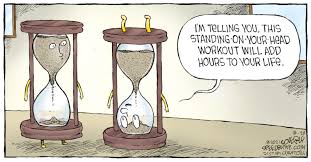
‘I’m telling you this standing on your head workout will add hours to your life”
At my age, I am naturally interest in the science of aging. A Scientific American on-line piece today by Saima S. Iqbal brings evidence from NATURE Aging – that aging is not, as I thought, a gradual downhill slide. There are two inflection points: ages 40 and 60.
“As a person enters their 60s, it’s common for them to start really feeling the health effects of aging. Many people might need glasses or hearing aids, or their doctors may warn them about a sharply increased risk of diabetes or heart disease. But new research published this month suggests that our body tends to undergo a dramatic wave of age-related molecular changes not only in our 60s but also in our mid-40s.”
What is the basis of this claim?
“For a study in Nature Aging, researchers tracked the levels of more than 135,000 molecules and microbes, all reflective of activity in cells and tissues, in 108 healthy volunteers aged 25 to 75. Each volunteer contributed biological specimens, including blood and stool samples, every three to six months for a median of 1.7 years. Results showed that differences in the levels of many molecules and microbes clustered around two distinct time points: age 44 and 60. The findings suggest that aging might accelerate around those periods—and signal to experts that our 40s and 50s may be a significant period to closely monitor health.”
We know from past research — molecules have an expiration date. I guess 44 and 60 are dates when some of them just get tired of repairing themselves – and give up.
Thinking about myself: In 1985, age 42, I decided to run the New York Marathon. I seemed to sense I needed a game-changing challenge, after age 40. It was indeed life-changing – I didn’t train properly, and my leg cramped for the entire last six miles. But I finished in under four hours, and it taught me something about myself.
In 2006, at age 64, I ran the Boston Marathon. This time I did train well…and ran it slowly, five hours, and enjoyed every minute, and even helped some stragglers. That kept me running even as I turned 80. Slower, shorter …but running.
I guess the message is: Take these inflection points, 44 and 60, and leverage them. Not just physically. Emotionally and mentally. Think about what you want to change in your life; what ballast do you want to dump overboard, in terms of things you are doing that do not create value for people or for yourself? And then – go for it. And at the same time, adjust your fitness and maybe step it up a notch.
Should Pavil Durov Be Locked Up? The Case of Telegram
By Shlomo Maital

France has arrested Pavil Durov, the founder of Telegram, an encrypted app used by some billion people worldwide, especially in Russia.
Can you arrest the founder and CEO of a widely-used app, when it is used for criminal activity? Here is how the US Cybersecurity Magazine describes the nefarious activities of Telegram, based on an official report:
: *** Hackers and cybercriminals leak and sell personal and corporate information on Telegram. *** Info-stealing hacking teams that use Telegram to sell and leak data harvested through infostealers and to organize gangs and build bots to facilitate their activities. *** Banking fraud actors that use Telegram to easily sell credit cards, checks, and other financial instruments.*** Ransomware and data extortion groups that adopt Telegram as an alternative or addition to their blogs and data leak sites, such as Lapsus$. *** Hacktivists who use Telegram to publicize information about their attacks, such as Killnet and ALtahrea Team. *** Illegal physical products are being sold via Telegram, including counterfeits, guns, drugs, and COVID-19 documents. *** Cybercriminals often use the platform to exchange information, share tips and tricks, and coordinate activities. *** Criminals share information about cybercrime techniques and distribute malicious tools such as password-stealing Trojans, keyloggers, and ransomware.
The report concludes: “These activities have made Telegram an illicit hub of cybercriminal activities, specifically since the platform is thoroughly secured against interference from law enforcement agencies.”
Durov’s lawyer says it is absurd to charge Durov. He’s just the innocent creator of a digital tool that criminals use widely and with ease – and it’s encrypted, making it hard to track them down.
Good for the French. In law, there is the concept of an accomplice: who aids and abets. Telegram aids and abets crime. Durov is the father of Telegram.
Lock’m up.
War Babies
By Shlomo Maital

Ukraine’s population collapsed to only 29 million in 2023, according to Ukraine Business News, with just 187,000 births recorded (including in Russian-occupied territories). This is the lowest annual figure in recorded history over the last 300 years, exacerbating an already dire population catastrophe caused by economic turmoil and war. Russia’s population is 144 million (and declining); it is not a fair fight.
The Russian invasion exacerbated an existing trend in Ukraine, a sharply declining total fertility rate, well below replacement.
This is understandable. With Ukaine under air and land assault, it’s not a great time to have babies. Miitary-age husbands are at the front.
Yet some do. An NPR report from Ukraine recounts not only how some Ukrainian couples are indeed choosing to have children – they are also undergoing rigorous, difficult IVF in vitro fertilization procedures to do so.
I salute them. Perhaps because I too am kind of a war baby. I was born in 1942 – the darkest year of World War II, when things were not going well for the Allies and their battle against Nazi Germany and Japan. There were a whole lot of advantages to my being born then – very small cohorts meant small classes all through Grades 1-12, and scholarships for college and grad school.
To the Ukrainian babies born in the past two years: Guys, I know it’s been tough. But when peace comes, as it will, your tiny cohort will enjoy a lot of advantages – and the luster of being a courageous war baby, coming into the world in dark times and bringing the light and hope that only babies can bring.

 TIMnovate