
You are currently browsing the category archive for the ‘Uncategorized’ category.
Rebuilding America – Literally! It’s Really Simple
By Shlomo Maital
 Singapore’s Changi Airport
 A Crowded American airport
It has been six years since America’s recession began, at the end of 2007, and as New York Times columnist Floyd Norris notes, the U.S. still has fewer jobs than it did then.
Why?
The answer is simple. The U.S. labor-intensive construction industry has not recovered. In the spring of 2006 construction employment was 7,476,000; today, it is 5,851,000. Nearly 1.7 million jobs were lost in construction. This has deeply hurt the U.S. economy’s recovery, because construction jobs pay quite well, and underpin a lot of consumer spending. The housing bubble not only claimed financial victims, from sub-prime mortgages and related assets; it threw many workers out of a job and has not brought them back. Construction is a major, perhaps the main, drag on the recovery.
The solution is really simple. America’s infrastructure is ragged. The interstate highway system was built in the 1950’s, 60 years ago, under President Eisenhower. It needs investment. American airports are old, incredibly crowded (see the photo), and need renewal. Been to JFK lately? Thousands of American bridges are rusting and crumbling and need replacement. Many roads inside cities have huge potholes. Schools need new modern buildings.
If government spending were increased and focused on infrastructure investment, the construction industry could recover and lead a general economic recovery. This in turn would help the rest of the world, too. Such spending is not wasteful, nor harmful, even if it temporarily increased the budget deficit, because it has been proven that infrastructure investment pays a high rate of return. Will it work? China proves it does. China massively invested in construction and investment, when its economic growth flagged during the global economic crisis, building railroads and highways, and quickly restored its rapid growth.
But alas, it is unlikely to happen. There is a Republican-Democrat budget compromise on the table that may avert another U.S. government shutdown, but it includes very small restoration of cuts made under the previous ‘sequestration’ legislation. And it won’t help construction one bit.
America needs rebuilding – its infrastructure, and its society and political system as well. It has the resources to do it. But does it have the will? It seems not.
“Matryoshka” Battles Breast Cancer
By Shlomo Maital

The Nov. 2 issue of The Economist (p. 74, ‘science and technology’) reports on how a brilliant MIT cancer researcher named Paula Hammond may have found a way to defeat triple-negative breast cancer, using a matryoshka doll approach.
Triple negative cancer is hard to treat and is nearly always fatal. Its cancer cells are armed with ‘molecular pumps’ that remove anti-cancer drugs used to treat them, by getting inside the cancer cells. Here is how Hammond’s approach works.
She created triple-layered chemical bombs, each a few nanometers across. The outer layer is hyaluronic acid, a sugary polymer that cancer cells love, hence it accumulates inside them. This homes in on cancer cells and gets inside them, like a Trojan Horse.
Next layer is made of RNA, or SIRNA, small interfering RNA, tiny genes that interfere with protein production – specifically, in this case, the protein used by the cancer cells to pump out anti-cancer drugs.
Finally, the inner layer, the payload of the ‘bomb’, is a standard chemotherapy drug, doxorubicin. Once the hyaluronic acid gets into the cell, and the SiRNA turns off the protein, the anti-cancer drug blows up the cancer cell.
It has been proven to work in mice. In mice, it shrank the tumors or destroyed them entirely. Let’s hope Hammond’s matryoshka doll invention gets to market soon, to help women suffering from the worst form of breast cancer.
Explaining Obamacare to Grade Three Kids
By Shlomo Maital

How would you explain the US government shutdown and Republican psychosis about Obamacare (The Affordable Health Care Act), to a class of Grade Three kids?
Here is my attempt.
Kids, sometimes people get sick. Going to the doctor costs a lot of money. So they buy insurance, just like your mom and dad buy insurance, in case there is a fire at your house. Insurance means you are paid money when something you don’t expect happens. A lot of American people, 30 million or more, don’t have health insurance. So President Obama and the United States Congress acted to make sure they do. This was done by a law called the Affordable Health Care Act.
But here is the problem. Medical care costs a whole lot more in America than other places – probably twice as much or more. And in America health insurance is provided by the companies that your mom and dad work for (while in other countries it is mostly provided by the government). So when President Obama makes every business provide health insurance, it means that some small businesses that don’t have much money have to spend a lot to do what the law says, and they don’t like it. Why doesn’t the government in America provide health insurance? Well, it’s a long story. It goes back to the days of President John F. Kennedy, who almost did it, but in the end the doctors shot it down.
So the Republicans think that Obama’s health insurance law is too expensive and want to cancel it. The Democrats think it is a good thing and want to keep it. This is what has caused the shutdown of government, because you can’t pay people without having a government budget and the Republicans in the House of Representative will not vote for this. The people in America who had health insurance already were mostly satisfied with it. The people who didn’t have health insurance are mostly happy with the new law but we don’t know for sure, because the law has just begun to work.
A lot of people outside America are looking at how national parks and cemeteries and Mt. Rushmore and the Statue of Liberty and part of the Pentagon are closed, and are just amazed. It sure doesn’t make America look good.
Everybody believes that democracy – where everyone chooses their elected officials by voting, and where everyone gets to have a vote – is a good thing. But when democracy shuts down the government in America, some people are wondering if it is really working the way it should.
——–
Boring background: America spends 18 per cent of its GDP on health care, twice that of most nations, but America’s health statistics are significantly worse than many other modern nations. The real core problem is: the Affordable Health Care act has NOT made health care affordable for America as a whole. To do that, you would have to make drugs cheaper, pay doctors and hospitals less, and take health care out of the for-profit sector.
The Rich 1% Recovered; The Rest of Us Didn’t
Fat Cats: Let’s Have Another Bubble!
By Shlomo Maital

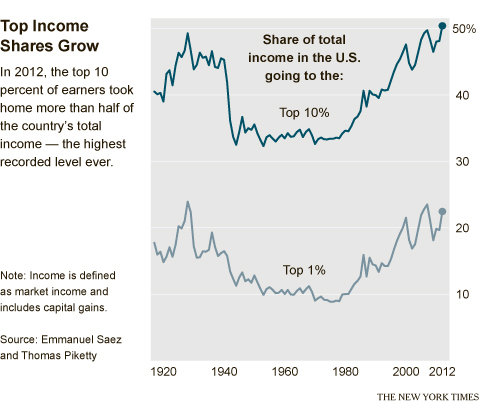
Paul Krugman’s New York Times column “Rich Man’s Recovery” draws our attention to Annie Lowrey’s New York Times blog Economix (Sept. 10). Using data from a study by French economists Emmanuel Saez and Thomas Pikkety, she shows alarmingly that for the U.S.:
* In 2012, the top 10 % of income earners took home more than half the country’s total income. This is the highest recorded level of inequality ever, higher even than in 1929! (Income includes capital gains).
* The top 1 % of income earners took home one fifth (20%) of all income, close to the previous record in 1929, and among the highest levels since 1913, when the income tax was imposed.
Recovery? It’s all gone to the fat cats. None to us, not even crumbs. That is why the ‘recovery’ is so weak and tenuous.
According to Lowrey: “The figures underscore that even after the recession the country remains in a new Gilded Age, with income as concentrated as it was in the years that preceded the Depression of the 1930s, if not more so. High stock prices, rising home values and surging corporate profits have buoyed the recovery-era incomes of the most affluent Americans, with the incomes of the rest still weighed down by high unemployment and stagnant wages for many blue- and white-collar workers.”
I would stress another related explanation. The U.S. Fed has fought the Depression with the only tool available, by printing scads of cheap money, lent at virtually zero interest. Directly and indirectly, this benefits the fat cats. But it hasn’t benefitted us ordinary people. Why? Because the goal of the Fed was to spur investment. But businesses aren’t investing, who needs to invest with demand so weak? Why is demand so weak? Because we don’t have money? Why don’t we have money? Because the fat cats have it. Why? Because they have quickly returned to the games that caused the financial collapse: financial manipulation, in place of real economic investments, leveraging cheap money. Not only that – by manipulating bond prices, they have panicked Fed Chair Bernanke into retreating from his plan to stop printing more and more and more money. If you think the Fed policy is independent, examine what happened when Bernanke just mildly hinted he might stop printing money. Wall St. slammed bond prices down, and stock prices – and Bernanke quickly backtracked.
The Fat Cats caused the crisis. We bailed them out. And now they’re back to their original games. They might as well all put this bumper sticker on their Porsche’s: “Hey…let’s have another bubble. Why the hell not?”
Resilience at Nairobi Airport: Kudos to Kenya!
By Shlomo Maital
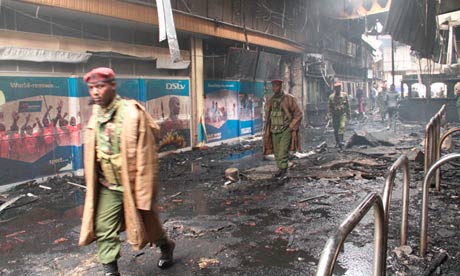

Then: Destroyed by Fire Nairobi Airport now: A Tent!
Kenya is yet another example of how the West underestimates the resilience of relatively poor countries, in Africa and in Asia. Kenya was vilified when it was found that Nairobi has only one single lone modern fire engine.
The Economist reports:
“When a big part of Nairobi’s Jomo Kenyatta international airport was gutted by a fire in early August it was widely expected to wreak havoc on Kenya’s vital tourism industry. Instead, it has become a model of the country’s talent for makeshift solutions. Instead of passing through the wheel and spokes building opened in 1958 by Britain’s last colonial governor, passengers are directed towards a complex of white tents with sash chairs. In the darkness, the atmosphere resembles that of a wedding party at the end the evening, with tired guests searching for the exit. The airport is east Africa’s biggest hub, serving five million passengers a year. Yet while many feared it would be running a reduced service for weeks, it was back at close to full capacity in a matter of days.
Repeatedly, we in the West underestimate the strong resilience of those in Africa, Asia and South America, who ‘make do’ under difficult circumstances. They are good at it, because they do it nearly every day. Except for The Economist, few newspapers or websites reported on the remarkable makeshift airport-tent in Nairobi.
In India, there is a Hindi word called “jugaad”, which means “work around” – like what the Kenyans did to get their airport back in action. Here is what I wrote in a blog three years ago:
“Jugaad … are locally made motor vehicles that are used mostly in small [Indian] villages as a means of low cost transportation in India. Jugaad literally means an arrangement or a work around, which have to be used because of lack of resources. This is a Hindi term also widely used by people speaking other Indian languages, and people of Indian origin around the world. The same term is still used for a type of vehicle, found in rural India. This vehicle is made by carpenters, by fitting a diesel engine on a cart. …. They are known for having poor brakes and cannot go beyond 60 km/h. They operate on diesel fuel and are just ordinary water pump sets converted into engine. “
Let’s salute the Kenyans (and travelers, who endure less than ideal conditions) for their ingenuity. Let’s salute people in all poor countries, who use their creative savvy to work around insolvable problems, without a fat checkbook.
“The Only Thing That Stops a Bad Guy With A Gun…”
By Shlomo Maital

Here is a “complete the sentence” IQ test.
“The only thing that stops a bad guy with a gun is…”.
What?
According to Wayne LaPierre, head of the powerful American National Rifle Association, the answer is: “…a good guy with a gun.”
Since everyone is either a bad guy, or a good guy, in America, and since the bad guys mostly HAVE guns, the solution, according to the NRA, is to give every good guy at least one gun, preferably a semi-automatic with 100-bullet clips, so that you can mow down hundreds of bad guys at one time.
But – is there any evidence supporting LaPierre? Well, now. Here is the evidence. * 1. “every time a gun in the home was used in self-defense or a legal shooting, there were four unintentional shootings, seven criminal assaults or homicides, and 11 attempted or completed suicides.” Oops. 2. “..a gun is 22 times more likely to be used in a criminal assault, an accidental death or injury, than it is for self-defense.” Oops. 3. In 2010, 31,671 people were killed by guns in America, 73,505 were treated in emergency rooms for nonfatal gunshot wounds, and 337,960 nonfatal violent crimes were committed with guns. Of the 31,671 dead, three of five were suicides, and the vast majority of the rest were homicides by people who knew each other. No other Western democracy can come close to matching those 31,671 deaths by gunshots.
So, how then SHOULD we complete the sentence above? “The only thing that stops a bad guy with a gun is…preventing the bad guy from getting a gun in the first place, or taking it away from him or her when he or she gets one.”
Don’t confuse the NRA with evidence and facts. All those facts come from Commie socialist left-wing traitorous scumbag liberals anyway.
* Source: Gun Science, Scientific American, May 2013, p. 69.
Kids’ Creativity Is Declining: Is NCLB Responsible?
By Shlomo Maital

Can you test for creativity and measure it, like IQ, in individuals – especially kids? Dr. E. Paul Torrance developed the TTCT, Torrance Tests for Creative Thinking, in 1957. It is a fairly simple 90-minute set of tasks, extended in 1966. His tests have five activities: ask-and-guess, product improvement, unusual uses, unusual questions and ‘just suppose’. One task gives children a toy fire truck and asks them how they would improve it. One of his subjects, in 1958, found 25 different ways! Torrance used his TTCT to show that you CAN teach creativity.
Recently, strong evidence was found to support the premise that IQ and creativity are almost unrelated. Back in 1958, Prof. Torrance tested the creativity of a group of 400 Minneapolis children. In the 55 years since then, Torrance and his colleague Garnet Millar tracked the children, recording their patents, businesses, research papers, grants, books, art exhibits, software programs, ad campaigns – virtually everything. In turns out that Torrance’s creativity index predicted the children’s creative accomplishments as adults incredibly accurately. The correlation between lifetime creative accomplishment and childhood creativity is more than three times higher than the correlation between accomplishment and childhood IQ.
What’s even more interesting, and worrisome, is this: According to the “Flynn effect”, named after New Zealand Prof. James Flynn, with each generation, IQ goes up by 10 points. With creativity, a reverse trend was identified. American creativity scores are falling, according to researcher Kyung Hee Kim. “The decrease is very significant,” Kim says. He notes it is the scores of younger children in America, from kindergarten to sixth grade, for whom the decline is most serious.
In 2000, just after he was elected (or in fact, lost the election and then stole it thanks to Florida’s Republican State Supreme Court), George Bush pushed through the NCLB No Child Left Behind Act. While NCLB focuses on measuring and improving conventional learning skills, creativity is suffering. One wonders whether rule-based education, in which teachers teach kids to pass tests, is actually hurting break-the-rules creativity, even in innately creative young children. If this is so, there is cause for concern. America needs engineers who know how to make things others invent – but it also needs those who know how to invent things others will make. Surely we can figure out how to teach both, without ruining either.
Sources: Torrance, E. Paul. (1972). “Teaching for creativity”. Journal of Creative Behavior, 6, 114-143. And: The Creativity Crisis, July 10, 2010, Po Bronson & Ashley Merryman, The Daily Beast (Newsweek).
Does Austerity Work? The Case of Latvia
By Shlomo Maital

Europe’s austerity program (spending cuts to reduce public debt) has been a disaster. In this blog, I protested that you cannot grow an economy by shrinking it, and austerity shrinks demand and raises unemployment, leading to the need for more austerity, causing more suffering..and so on. James Estrin, writing in LENS (photography website), documents the suffering austerity is causing in Europe:
After three years of grinding austerity, the Greek gross domestic product has shrunk by 25 percent. The unemployment rate among young people is now at 50 percent, and over all about one fourth of Greeks are out of work. Ireland has a debt burden of 117 percent of its annual G.D.P. Spain’s unemployment rate is more than 25 percent, and the Portuguese government is predicting a third consecutive year of recession in 2013, with unemployment reaching nearly 16 percent….
..and so on. Estrin says the numbers don’t begin to convey the suffering, and the photographs in the LENS website show why. See:
http://lens.blogs.nytimes.com/2012/12/31/the-human-toll-of-europes-economic-statistics/
Yet – along comes Latvia, to prove that austerity DOES work. In today’s Global New York Times, Andrew Higgins reports the following: “Latvia, feted by fans of austerity as the country-that-can and an example for countries like Greece that can’t, has provided a rare boost to champions of the proposition that pain pays. Hardship has long been common here — and still is. But in just four years, the country has gone from the European Union’s worst economic disaster zone to a model of what the International Monetary Fund hails as the healing properties of deep budget cuts. Latvia’s economy, after shriveling by more than 20 percent from its peak, grew by about 5 percent last year, making it the best performer in the 27-nation European Union. Its budget deficit is down sharply and exports are soaring. “
Why has austerity worked in Latvia, yet failed in nearly every other European country? The people of Latvia are simply used to severe hardship. They’ve been through austerity before. They know there is light at the tunnel’s end. Higgins notes: “Latvia has [endured] Soviet, Nazi and then renewed Soviet rule…After Moscow relinquished control in 1991, decrepit Soviet-era plants shut down, gutting the industrial base. The economy contracted by nearly 50 percent. The collapse of Latvia’s largest bank in 1995 wiped out many people’s savings. Latvia then was hit by debris from Russia’s financial blowout in 1998. Then came a dizzying boom, fueled by a lending splurge by foreign, particularly Swedish, banks, followed by a catastrophic slump as credit froze when the global financial crisis swept into Europe in 2008.”
Latvia’s currency, the lat, is now pegged to the euro, and Latvia desperately wants to join the euro in 2014. Why? Because having a relatively strong currency is a condition for attracting foreign money, and as weak as it is, the euro is far more reliable than the lat. Latvia resisted the easy solution (devaluing the lat to spur exports and demand) and accepted short term pain for long term gain. I wish them great success.
Latvia is perhaps the exception that proves the rule (austerity fails). Morten Hansen, head of the economics department at the Stockholm School of Economics in Riga, says, “You can only do this [austerity] in a country that is willing to take serious pain for some time and has a dramatic flexibility in the labor market,” he said. “The lesson of what Latvia has done is that there is no lesson.”
There IS a lesson, Prof. Hansen. A condition for austerity should be the willingness of the people to endure severe pain. America lacks it. Greece lacks it. Most of Europe lacks it. If you lack this political resilience, better not to start down the austerity road in the first place.
Dr. Pawash Sinha: Our Miraculous Brains
By Shlomo Maital

The Dec. 12 issue of the APA Monitor has a fascinating interview with MIT Prof. Pawan Sinha and his Project Prakash (“light” in Sanskrit).
His research question was this: Over 300 years ago, an Irish philosopher named William Molyneux asked, ‘does the brain come prepared with knowledge to interact with the world?’, (nativism), or ‘does the brain have to acquire that knowledge through experience’? (empiricism).
Dr. Sinha studied Indian children born with cataracts, to families too poor to pay for surgery. These children grew up sightless, until 10-14 years later, for a happy few, cataract surgery restored their sight. Some 440 children were treated; Dr. Sinha thinks there are 200,000-300,000 who are still untreated, and hence blind.
Molyneux observed, if you have a person blind from birth, who has learned to distinguish between, say, a cube and a sphere, by touch – and then suddenly restored their sight – then show them a cube and a sphere, but without TOUCHING either — would they be able to tell them apart just by sight? If they can at once: then, nativists are right. If not, then empiricists.
Sinha tried this on some of the children whose sight was restored. Children who had just regained sight were presented with pairs of objects. They would feel one object, hidden under a bedsheet; then, that object, and a distractor object, were placed in front of the child. The child was asked, “which of these two objects were you just touching?”
Immediately after surgery, children could not “transfer knowledge from touch to vision”. They could not by sight alone identify the object. But when the children returned for a follow-up, a week after surgery, they showed almost perfect ‘transfer’ (ability to transfer seeing by touch to seeing by seeing)! The brain learned rapidly, in a matter of just a week or so.
Once again, we learn how amazingly flexible and rapid the brain adjusts. But we must be infinitely sad there are so many blind children in India, when a simple operation could restore their sight. This is unacceptable. Do you know that world military spending in 2011 was $1.7 trillion, back to 1988 Cold War levels? A tiny fraction of that spending would give sight to many thousands of Indian children. This is simply unacceptable!
To learn more about Project Prakash, see www.apa.org/monitor/digital/Prakash.aspx
“Please – Send Us Some Chaos!”
By Shlomo Maital

Chaos..wanted!
Yesterday I ran a Workshop here in Singapore with some talented entrepreneurs and managers, in an effort to map Singapore’s innovation ecosystem. Earlier, using the method developed by my colleague Prof. Amnon Frenkel, we had done similar maps for Israel, Spain, France, Germany and Poland, as part of an EU 7th Framework project.
In this method, we ask participants to list the most important innovation ‘anchors’ (in the language of economists: ‘stocks’, or more or less fixed elements) and ‘processes’ (flows, or dynamic interactions among the anchors).
To my surprise, the participants listed as a key ‘process’ for Singapore: ‘lack of chaos’. (This is more of a gap than a positive process).
Singapore is a highly organized disciplined society. It has to be – it is a small archipelago, not much space, with three different and disparate ethnic groups (Chinese, Indian, Malay). From the outset founder Lee Kwan Yew realized this could be chaotic, and established a well-disciplined system. In the West it is criticized as being undemocratic, but we see often how excessive ‘democracy’ causes gridlock and dissension in other countries.
Creativity and innovation all require some degee of disorder and chaos. A high-tech company I once consulted for has a sign on its stairwells: Hang on to the railing! Now – how much risk will its employees undertake, when the message is given, that they must hang on to the railing when going down the stairs? Singapore, as a nation, is remarkably wealthy and squeaky-clean, free of corruption, #1 in ease of doing business, and strategically agile. But perhaps, my participants say, it is paying a price for all this systematic discipline.
The Bible says, ‘the wolf and the lamb will lie down together’. Woody Allen comments: Sure! But the lamb won’t get much sleep. Can nations get the wolf of creativity to lie down with the lamb of discipline? And if they lack the wolf, can they still be creative?
If your country has some chaos to spare (mine sure does!), please, package it and send it by UPS to Singapore. They will gladly trade you for some of their discipline. And this will be Pareto-optimal – we’ll all be better off.

 TIMnovate