
You are currently browsing the category archive for the ‘Uncategorized’ category.
Innovation/Global Crisis Blog
Is Apple Worth More than Exxon? Is Luft Geshäft More Valuable Than Petroleum?
By Shlomo Maital
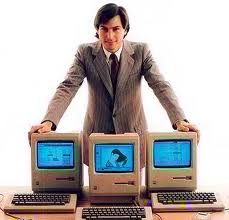
Steve Jobs announcing the Mac in 1984
Financial Times reports that last Tuesday, in intraday trading, the market value of Apple shares briefly exceeded that of Exxon. At the close of trading, though, Apple again trailed, but not by much – its shares were worth $347 b., compared to $351 b. for Exxon. Apple and Exxon now far exceed the market value of Wal-Mart, GE and other giants.
This leads us to ask: Is Luft Geshäft (German for “air business”, i.e. gadgets that fetch very high prices and earn high margins) worth more than sticky black oil that powers our cars, cools and lights our homes and makes our plastic?
The answer is, yes. Last quarter, Apple’s net profit doubled, reaching $ 7.31 billion, on revenue of $ 28.6 billion. iPhone and iPad did not exist five years ago, but now account for about two-thirds of revenue. Apple’s cash reached $ 76.2 billion – again, at one point, more than the cash on-hand of the U.S. Treasury (before the debt ceiling was raised). Apple’s growth was particularly driven by demand growth in China, and iPhone shipments reached 20.3 million. Moreover, in the coming year, Apple computer sales are expected to double, and iPhone sales are expected to triple. If Apple’s new iCloud music and information storage services are successful, it will bring Apple millions of new users.
So, for a brief but glorious moment in time, it was indeed possible to say that Luft Geshäft did exceed Big Oil in value, and more important, consistent, persistent, blue-ocean innovative energy was more valuable than conventional energy. Stuff that came out of the minds of creative people was more valuable than stuff that was pulled out of the ground.
On the other hand, how many other such examples are there? Very few. It may indeed be tougher to extract ideas from deep in the minds of creative people, than it is to pull gas and oil from a sea bottom three miles deep and five miles under the seabed.
Global Crisis/Innovation Blog
How to Kill a 168-year-old Business Without Trying: Murdoch, Sleaze and the Zimbardo Prison Experiment
By Shlomo Maital
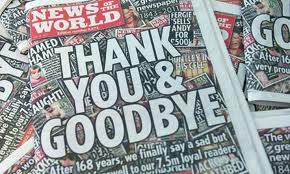
News of the World: Last Issue. No Thank You!
What in the world is the connection between a 40-year-old psychology experiment, that continues to haunt the experimenter, distinguished psychologist Phillip Zimbardo, and Sunday’s closing of the sleazy yellow tabloid News of the World, after 168 years of continuous operation?
Let’s start with London’s News of the World, owned by media tycoon Rupert Murdoch, who owns News Corp. Journalists tapped into the phone of a murdered teenager and erased messages, to keep the story alive and sell newspapers. Writing about the mess, New York Times columnist Joe Nocera comments, “Reporters who work at pressure-packed scandal sheets quickly become inured to crossing lines and destroying lives; it’s what they do. On the other hand, it’s still hard to believe that not a single reporter or editor at The News of the World had the sense to realize that tapping into the cellphone of a murdered teenager was deeply wrong.”
Now back to Zimbardo.
In his Stanford prison experiment, run from August 14th to 20th 1971 , twenty-four students were selected out of 75 to play the role of prisoners and live in a mock prison in the basement of the Stanford psychology building, while others were told to play ‘officers’ and torture the prisoners. Roles were assigned randomly. The participants adapted to their roles well beyond what even Zimbardo himself expected, leading the “Officers” ultimately to subject some of the prisoners to torture. Many of the prisoners developed passive attitudes and accepted physical abuse, and, at the request of the guards, readily inflicted punishment on other prisoners who attempted to stop it. The entire experiment was abruptly stopped after only six days. The experimental process and the results remain controversial.
Zimbardo was surprised that when told to play a role of prison guard and officer, including torture, many of the subjects agreed. He has found it hard to live down being known as the “prison guy” for the last forty years, and has developed a training program to help young people to defy the ‘everybody does it’ rationale of immoral behavior and instead, act as responsible moral leaders. Rupert Murdoch should enroll.
Why did not a single News of the World reporter blow the whistle, protest, inform the police that a serious crime had been committed? It was the ‘prison’ mentality, ‘this is what we do, this is how we act, this is the norm, if you’re one of us, you better fall in line’. The Zimbardo experiment’s result shows the obedience of people, their readiness to do evil, when provided with a legitimizing ideology and social and institutional support.
Who created this mentality? Tycoon Rupert Murdoch himself. He will escape unscathed. After closing News of the World – not because his conscience troubled him, but because the paper lost its advertisers and hence had no business raison d’etre — he will likely (and soon) launch a new scandal sheet under a different name, probably equally profitable and equally devoid of ethics. Those who buy and read it are as morally blemished as he is.
Innovation Blog
How Technology Helps Those with Disabilities: iPad, GPS and more
By Shlomo Maital
 iPad SayText
The latest Bloomberg Businessweek issue has an interesting article on how iPad helps those with disabilities. I’ve also collected several examples. The disabled are, alas, much too numerous for us to be complacent, but many too few to form a large profitable market. And the market is fragmented, because the variety of disabilities is very large and diverse. Nonetheless, if more bright innovative minds were put to work on this problem, the lives of many of the disabled could be changed. Here are some examples.
● “Jonathan Avila uses his iPad in ways most people might not realize are possible: The device reads e-mail to him while he’s traveling to work, tells him which way to walk when he is lost, and even lets him know if there’s a sidewalk on the other side of the street. Avila needs these features because he’s visually impaired. “Work bought it as a testing device, but I’ve claimed it as my own since it makes me more efficient,” says Avila, chief accessibility officer for SSB Bart Group, a firm that helps companies implement technology for people with disabilities.”
● “Dorrie Rush is marketing director of accessible technology at Lighthouse International, a nonprofit organization dedicated to fighting vision loss . She was diagnosed with early-onset macular degeneration. Twenty years later, her visual acuity is low, although she retains some peripheral vision. “I used to be on the bus and I would see people reading the newspaper and I’d be so jealous,” Rush says. Then she bought an iPhone and downloaded the New York Times (NYT) app. Her phone now reads the news to her on the bus each morning.”
● I have a friend whose startup is developing software to convert a smartphone with GPS and camera into a device that gives vocal instructions to the blind regarding where they are and how to proceed to their destination.
● “Workers who find it difficult to speak because they have cerebral palsy or have suffered a stroke once needed to spend thousands of dollars on speech-generating devices. Instead of shelling out $3,000, they can now buy an iPad for $500 and an app called Proloquo2Go from AssistiveWare that sells for about $190.”
● “For people who need to read office memos or other printed materials, Freedom Scientific sells a scanning and reading appliance for $1,800. Alternatively, there’s a free app called SayText that uses the camera from the iPhone 4 to take a photo of a document, prompting the app to read the text aloud. The same app can be used to take photos of business cards, after which the contact info is automatically scanned and uploaded into the phone’s contact directory. Similarly, ZoomReader, an app from Ai Squared that sells for about $20, reads the text in images from the iPhone 4 camera.”
● “Identifying money can be a challenge for visually impaired or blind people because a $1 bill comes in the same size and color as a $100 bill. Reizen sells a portable money reader on Amazon.com (AMZN) for $99.95. In March the LookTel Money Reader app was released for the iPhone, selling for just $1.99. In April the U.S. Bureau of Engraving and Printing released EyeNote, a free money reader.”
Actually my initial statement, about how the market for disabled-assistive technologies is limited, may be wrong. According to Rachel King, “The global market for assistive technologies, including those used in the home, is projected to reach $40.9 billion in 2016, up from $30.5 billion this year, according to a report from BCC Research that’s scheduled to be released this month.” Part of the reason is our aging society – the baby boomers, as they age, are going to need more and more assistive devices, and many of them have the money to pay for them.
Innovators – can you help the hearing-impaired, visually-impaired, those unable to walk? What better way is there to do good, and perhaps to do well, as well.
* The IPad’s Secret Abilities, by Rachel King.
Global Crisis/Innovation Blog
Diamond? Who Needs Diamond? We Have Coal! Republicans Hurt America – Again!
By Shlomo Maital

MIT Prof. Peter Diamond, Nobel Prize 2010
There are two vacant positions on the Federal Reserve Board of Governors, out of seven. At a crucial time when Fed policy needs all the brainpower it can get, the Republicans have stymied the appointment of MIT Professor Peter Diamond, Nobel Laureate, to the Fed. Sick of the hassle by the Senate Banking Committee, led by Republican Senator Richard Shelby, Diamond withdrew his candidacy.
Why were the Republicans opposed to Diamond? Well, for one thing, he’s a dove – favors strong government intervention to strengthen labor markets. Why did they SAY they opposed him? He has no experience in monetary policy – he’s only one of the world’s top experts on job markets.
Let’s get this straight. America’s #1 problem, according to EVERYone right now, Democrats and Republicans, is jobs. Writing in today’s Global New York Times, Crystia Freeland (“Getting by without the middle class”) notes these distressing numbers:
* 14 m. Americans, or 9.1 % of the workforce, are unemployed;
* 8.5 m. would like to work full-time but can only find part-time work.
* Another 2.2 m. are so discouraged, they have quit looking for work altogether.
* Those actively looking for work have been unemployed for an average of 39.7 weeks.
Freeland argues that these data “depict an unemployment crisis that is deeper and more sustained than at any time since 1948, when records first started to be kept.”
With America’s budget deficit out of control, the only body able to do anything about the job crisis is the Fed. So – why appoint the world’s top expert on job markets? Why go for Diamond? We have ‘coal’ – Board of Governors members who only understand monetary policy, which so far has been highly ineffective. Commenting on Britain’s Monetary Policy Board, economist David Blanchflower says, “Monetary policy committees have a huge problem of institutional groupthink. If every member is from the central bank they tend to think in narrow monetarist terms. External members bring a sense of balance, they are in touch with the world of business and work, and they question what is being said in the bank.” (The Economist, June 7, 2011).
Let’s salute the Republicans. Their strategy of destroying America, so they can do better in the 2012 Presidential election by blaming Obama, is working. What is amazing is that millions of Americans are actually going to vote for them.
Global Crisis Blog
Is the Arab “Spring” Headed for a Fall? Why Political Democracy Needs Money
By Shlomo Maital
A lot of romantic ink has been spilled on the Arab Spring, the incredible outpouring of popular democracy in Tunisia, Egypt, Yemen, Syria, Libya and elsewhere, that has toppled or will topple despots, led by idealistic non-violent young people using social networks. Here in Israel, there are deep fears that this process will destabilize the whole Mideast and lead to consequences no-one can predict. But in general, over the long run, the culture of democracy, if it takes root in Arab nations, will be a far more fertile seedbed for peace than despotism and dictators, who use Israel as a distraction for the ruinous way they run their economies, or Islamic fundamentalism, which substitutes religious fanaticism for modern technology and progress.
However, there is reason for concern that the Arab Spring may be headed for a fall. Speaking on BBC, a young Egyptian woman who helped lead the Tahrir Square uprising said forcefully, we do not want American money or interference of any kind. I’m afraid she reflects general thinking of these young revolutionaries. They do not understand that in order for political democracy to survive, it will have to be supported by large amounts of foreign investment, to create dynamic growing economies with jobs for educated young people. Egypt, Tunisia, Syria, Libya, Yemen, these countries cannot even begin to fund the huge infrastructure investments that they need. The World Bank has promised some aid, but it is hugely inadequate. The G8 leaders meeting in Deauville, France, make promises, but they are usually empty and hollow.
The best-case scenario is that the new Arab political democracy will be supported by savvy businesspersons, who will find ways to attract foreign investment. In Egypt this is unlikely, because the oligarch businesspersons were in bed with Mubarak and have been discredited. In Yemen it is possible – the main opposition to Yemen’s dictator is its wealthiest businessman. In Libya, Gaddafi has stowed away billions, which could be used to rebuild the country, but will the Libyan reformers manage to get their hands on them?
Somehow, the West must find a way to tell the young Arab revolutionaries that it is time to come down from the clouds, to earth, and find practical ways to build new modern economies. This will take enormous amounts of money. Where will it come from?
And by the way – don’t count on the oil-soaked Saudis, Qataris, Bahreinis and other oil-rich nations. They’re too busy buying English Premier League teams and building useless skyscrapers and artificial islands. Why would the rich Arab nations even think of investing their huge resources into building new lives for the poorer Arab nations?
Innovation Blog
Innovator, Lighten Up! Laughter = Creativity!
By Shlomo Maital
When I speak to managers in several countries about innovation, I always try hard to make them laugh. Big bureaucratic organizations all apply varies degrees of fear, pressure and stress, then wonder why they are not innovative. At the risk of appearing ridiculous, I throw nerf balls, ring a Chinese gong, show funny videos, and in general do everything to make the groups laugh. The reason? I argue that laughter and fun are the only environments in which creativity thrives. Fear, pressure, stress, all are mortal enemies of creativity.
Now, at last, I have scientific evidence of this claim. Writing in the Global New York Times (Dec. 6, 2010), Benedict Carey * notes:
“…. researchers at Northwestern University found that people were more likely to solve word puzzles with sudden insight when they were amused, having just seen a short comedy routine. “What we think is happening,” said Mark Beeman, a neuroscientist who conducted the study with Karuna Subramaniam, a graduate student, “is that the humor, this positive mood, is lowering the brain’s threshold for detecting weaker or more remote connections” to solve puzzles.”
In other words, when you relax your brain, put it in a light humorous mood, you facilitate significantly the brain’s ability to detect weak “signals” coming from remote areas not directly related to the problem-solving thinking at hand. This is neuroscience’s version of ‘thinking out of the box’. The ‘box’, in this case, is the narrow areas the brain calls on, when tackling a problem. These are the same areas everyone uses. A truly creative solution will come from far away, from a seemingly unrelated area of the brain.
Carey goes on to note: .
“ … in an authoritative review of the research, the psychologists Jonathan W. Schooler and Joseph Melcher concluded that the abilities most strongly correlated with insight problem-solving “were not significantly correlated” with solving analytical problems. Either way, creative problem-solving usually requires both analysis and sudden out-of-the-box insight. “The implication is that a positive mood engages a broad, diffuse attentional state that is both perceptual and visual… You’re not only thinking more broadly, you’re literally seeing more. The two systems are working in parallel.” ”
Innovator – if you are struggling with a difficult problem, seeking a creative solution – relax. Watch a Roadrunner cartoon. Look at a “Calvin & Hobbes” newspaper cartoon. Look up economist jokes on the Web. Put yourself in a mellow mood. Then, return to your problem. You may be surprised. Neuroscience does not lie.
* December 6, 2010 “Tracing the Spark of Creative Problem-Solving”
Global Crisis Blog
Martin Wolf Lifts the Fog:  What in the World is Going On in Europe
Martin Wolf
By Shlomo Maital
Among the columnists I follow closely is FT columnist Martin Wolf. Born in 1946, Wolf had a career with the World Bank before joining a research institute, then the Financial Times. He is regarded as a leading business columnist, whose analysis is as deep as it is clear. On Nov. 30, his article “Why the Irish crisis is such a huge test for the Eurozone” is worth careful reading. Let’s go through it step by step together.
1. “A currency union (i.e. the euro) causes crises”. Some countries (Germany) in the union control wages, others (Portugal, Ireland, Spain) do not. So they become less competitive, and their economies weaken. Governments then engage in deficit spending to sustain employment, when other countries use exports. This creates confidence crises in their bonds, a la Greece.
2. “A currency union has a common interest rate”. Interest rates are everywhere the same. But different countries have different risks. So in some countries, the common interest rate will seem excessively low, leading to credit booms and asset bubbles. The result is a huge credit crisis. If exchange rates could change, the Irish punt and the Greek drachma could fall, stimulating exports. But they no longer exist. So a currency crisis becomes, instead, a credit crisis, as lenders stop buying sovereign bonds. If Ireland, for instance, still had its pound linked to the British pound, it would have fallen, helping Ireland’s economy. That is no longer the case.
3. Facing the crisis, governments offer such high interest rates on their bonds (they have to, all governments need to roll over their debt), that they destroy their credibility, rather than strengthen it. (A high and rising risk premium on Irish bonds drives investors away). Ireland erred. Instead of letting Allied Irish Bank creditors take a ‘hit’, wiping out part of the debt, the Irish government assumed that debt, saddling Irish people with billions of euros in debt for a whole future generation.
4. Will the euro zone survive? Possibly not. German reluctance to continue to bail out irresponsible deadbeat countries may force peripheral weak countries to return to their own currencies. This too is not viable. When Ireland re-adopts its punt, money will flee and Irish government debts will soar disastrously. The key issue is Spain. Spain has to roll over some 250 billion euros in debt alone this year, and its PM Zapatero, a Socialist, blames everyone but his own government’s mismanagement.
5. Survival of the euro zone is a political, not economic, issue. Countries in Europe, including Italy, used to have currency crises. Today, in the euro, they have credit crises. These crises have forced them to swallow enormous debts created by private-sector banks and impose austerity that increases unemployment and reduces welfare spending. Countries will make the following calculation: which is worse, a currency crisis or a credit crisis, in which the EU itself does not come to their aid? If the answer is ‘currency crisis’ – bye bye Euro.
Innovation Blog
Reinventing the MBA:
MBA Without Professors
By Shlomo Maital
MBA programs worldwide teach innovation, enterprise and entrepreneurship. But do they practice it? Very little has changed since Harvard Business School opened its doors, copied the case-method approach of Harvard Law School, and began producing professional managers. McGill’s Henry Mintzberg invented an executive MBA held in five different global venues, each venue focusing on a different topic. That model has now been widely copied.
Here is an idea for an innovative MBA program. I wish someone would try it. The idea was sparked by a report from Moscow, where last year, an old idea was revived, to have an orchestra play without a conductor. The idea originated in the 1920’s under Soviet Russia, when it was felt a conductor-less orchestra was somehow more proletarian, more democratic. From time to time, orchestras that lost their conductors carried on anyway, with the concertmaster giving barely perceptible signals to begin movements.
It is called The MBA Without Professors. An announcement is made that at a certain time and date, those interested in a unique MBA program should log on to a website. Those who do are offered the following: A powerful unique MBA program, with no professors, with zero tuition. Enrollment is limited to 25 students, and those enrolled are carefully selected by the enrollees themselves, to span a broad range of experience and expertise. The group (under a self-appointed facilitator) divides up the range of MBA topics (not functional silos, but issue-oriented or problem-oriented areas – launching a startup, scaling it up, building talent, strategic renewal. A volunteer helps train each participant in the basic principles of effective teaching and presentation (much as the TED people train their speakers to do effective 18-minute presentations). The program ends when participants decide they have acquired knowledge, tools and expertise equivalent to that they would have gained at an expensive name-brand bizschool.
The disadvantage? Obviously – you do not get that Harvard Business School certificate. The advantage? You get an equivalent body of knowledge, at zero cost, and can use the money you save to start a business.
And by the way, I am a professor, I do teach MBA students, I have run an MBA program – and I truly believe this idea can be no worse than what we professors offer, and could potentially be far better, and more responsive to participants’ needs.
Innovation Blog
“We Need LESS Innovation, Not MORE!”
By Shlomo Maital
“Businesses need most of their workers to carry out their primary duties with enthusiasm and consistency”. We thus need less innovation, not more. [1] This is what Pat Lencioni argues, in the latest issue of Bloomberg Business Week.
Here is Lencioni’s case, as he states it:
“The problem isn’t so much that we’re overstating the importance of innovation; it’s more about what so many leaders are doing with it. Too many of them are exhorting all of their employees to be more innovative, providing classes and workshops designed to teach everyone how to think outside the box. They’re also doing their best to include innovation on a list of core values, emblazoning the word on annual reports and hallway posters, hoping that this will inspire people to come up with new ideas that will revolutionize the long-term strategic and financial prospects of the company.
Even well-intentioned and dedicated employees are bound to respond cynically to these efforts, frustrated by what they see as hypocrisy. They just don’t perceive a genuine eagerness among leaders to embrace the new ideas of rank-and-file employees, and they’re mostly accurate in that perception. For all the talk about innovation, most executives don’t really like the prospect of their people generating new ways to do things, hoping instead that they’ll simply do what they’re being asked to do in the most enthusiastic, professional way possible. And so it is no surprise when they get pounded for preaching innovation without really valuing it”.
I think that what Lencioni means is this: Not that we need less innovation, but rather, we need less hypocrisy on the part of business leaders who on one side of their mouths preach creativity and innovation, and on the other, find it a pain in the neck to have to listen to crackbrained schemes proposed by employees, most of which are worthless.
If you truly and honestly believe you can get both BHAI [2] breakthrough ideas, and hundreds of hairless small 0.1-per-cent-gain ideas, from your employees, then implement an innovation process in your organization, including giving regular feedback to those who propose ideas and a systematic method for giving each proposal or idea a fair hearing.
But if you are not ready to walk your innovation talk, better not to do anything. You will simply create frustration and unhappiness. In order for someone to speak up, they have to know that there is someone who is truly listening. If you’re not ready to listen to potential innovators, don’t ask them to speak in the first place.
Recall, too, that if you don’t listen to an employee’s idea, your competitor might. Robert Noyce left Fairchild, where he pioneered semiconductor integrated circuits, and went on to co-found Intel, where he led the invention and development of microprocessors (with Ted Huff). Fairchild is long gone, Intel is a global giant.
[1] Bloomberg Business Week, “Organizational Life”, August 27, 2010, “Why Companies Need Less Innovation”. by Pat Lencioni.
[2] Big Hairy Audacious Idea
Innovation Blog
How that last link in the chain can murder great innovation
by Shlomo Maital
Life isn’t fair.
Take Apple. This company has come back from the dead, and its market capitalization now exceeds that of Microsoft! It has leveraged great innovation in the iPhone, iPod, and now, iPad.
But its business model is threatened.
The iPad is manufactured by Foxconn, a Taiwanese company that runs enormous plants in China. We visited one, with a group of Israeli managers, and were stunned by the scale! There were 20,000 workers at the plant, and it was one of Foxconn’s smallest!
The media reports a wave of suicides at a Foxconn plant. Why?
“I do the same thing every day,” one worker says, quoted by Bloomberg Business Week (June 7-13, 2010, p. 35).
Foxconn has reportedly raised salaries by 20 per cent.
It’s that old déjà vu all over again. In the early days of Henry Ford’s Industrial Revolution, when he invented the mass production assembly line, his system was threatened with early death because workers quit just when their skills become sharp and productive, because they could not stand the boredom. Ford solved the problem. A notorious scrooge, he doubled wages, from $2.50/hr. to $5.00. For that workers were willing to stand the boredom.
Foxconn has done the same, to some degree. But the insight remains — great innovation requires, in the end, that efficient dedicated workers produce high-quality products without defects, at enormous scale and speed. If you fail to share the fruits of your innovation with those workers, they will despair and some will kill themselves. In your innovative business model, highly customer-centric, make sure your business design is also worker-centric. If you don’t, you will face crises like that of Henry Ford (1909) and Foxconn (2009-10).

 TIMnovate