What’s Wrong with the World? Ask Paul Krugman..and Road Runner

By Shlomo Maital

Krugman

  Remember the  Road Runner cartoons?   Wile E. Coyote  continually is duped into running off  very high cliffs by the clever elusive Road Runner.

  Well, I think this captures the advice economists have been giving policymakers worldwide, as the world economy again weakens (according to the IMF).  We keep running off the cliff, like Coyote.  And for evidence, I call to the stand Nobel laureate and New York Times columnist Paul Krugman.   I will quote Krugman’s latest Op-Ed, (Oct. 12),  it is rather lengthy, but provides a clear accurate and fairly concise diagnosis.  It causes me to lose sleep – it may do the same to you too, so…beware, before you read on.  Krugman’s words are in quotation marks.  Again, this analysis is long – but essential, if you want to really understand what in the world is going on:   [If you want to stop here, and seek a one – sentence summary:   We’re being killed by high debt,  we need to forgive it, wipe it out and start fresh – there’s no other way]. 

  • Analysis: Where we stand: “The world economy appears to be stumbling. For a while, things seemed to be looking up, and there was talk about green shoots of recovery. But now growth is stalling, and the specter of deflation looms.”
  • We’re fulfilling Einstein’s definition of insanity: Doing the same thing and expecting different results. “If this story sounds familiar, it should; it has played out repeatedly since 2008. As in previous episodes, the worst news is coming from Europe, but this time there is also a clear slowdown in emerging markets — and there are even warning signs in the United States, despite pretty good job growth at the moment.”
  • But WHY are we in this mess, that began 6 years ago? “Why does this keep happening? After all, the events that brought on the Great Recession — the housing bust, the banking crisis — took place a long time ago. Why can’t we escape their legacy? The proximate answer lies in a series of policy mistakes: Austerity when economies needed stimulus, paranoia about inflation when the real risk is deflation, and so on.”
  •  What is the basic problem? “What, after all, is our fundamental economic problem? A simplified but broadly correct account of what went wrong goes like this: In the years leading up to the Great Recession, we had an explosion of credit (mainly to the private sector). Old notions of prudence, for both lenders and borrowers, were cast aside; debt levels that would once have been considered deeply unsound became the norm. Then the music stopped, the money stopped flowing, and everyone began trying to “deleverage,” to reduce the level of debt. For each individual, this was prudent. But my spending is your income and your spending is my income, so when everyone tries to pay down debt at the same time, you get a depressed economy.”
  • What can be done?   “Historically, the solution to high levels of debt has often involved writing off and forgiving much of that debt. Sometimes this happens explicitly: In the 1930s F.D.R. helped borrowers refinance with much cheaper mortgages, while in this crisis Iceland is outright canceling a significant part of the debt households ran up during the bubble years. More often, debt relief takes place implicitly, through “financial repression”: government policies hold interest rates down, while inflation erodes the real value of debt.   What’s striking about the past few years, however, is how little debt relief has actually taken place. Yes, there’s Iceland — but it’s tiny. Yes, Greek creditors took a significant “haircut” — but Greece is still a small player (and still hopelessly in debt). In major economies, very few debtors have received a break. And far from being inflated away, the burden of debt has been aggravated by falling inflation, which is running well below target in America and near zero in Europe. Why are debtors receiving so little relief? As I said, it’s about righteousness — the sense that any kind of debt forgiveness would involve rewarding bad behavior. In America, the famous Rick Santelli rant that gave birth to the Tea Party wasn’t about taxes or spending — it was a furious denunciation of proposals to help troubled homeowners. In Europe, austerity policies have been driven less by economic analysis than by Germany’s moral indignation over the notion that irresponsible borrowers might not face the full consequences of their actions.   So the policy response to a crisis of excessive debt has, in effect, been a demand that debtors pay off their debts in full. What does history say about that strategy? That’s easy: It doesn’t work. Whatever progress debtors make through suffering and saving is more than offset through depression and deflation. That is, for example, what happened to Britain after World War I, when it tried to pay off its debt with huge budget surpluses while returning to the gold standard: Despite years of sacrifice, it made almost no progress in bringing down the ratio of debt to G.D.P.”
  • So, how do we move ahead? “A recent comprehensive report on debt is titled “Deleveraging, what deleveraging?”; despite private cutbacks and public austerity, debt levels are rising thanks to poor economic performance. And we are arguably no closer to escaping our debt trap than we were five years ago. But it has been very hard to get either the policy elite or the public to understand that sometimes debt relief is in everyone’s interest. Instead, the response to poor economic performance has essentially been that the beatings will continue until morale improves. Maybe, just maybe, bad news — say, a recession in Germany — will finally bring an end to this destructive reign of virtue. But don’t count on it.”


Nobel Prize for Economics: Jean Tirole Takes on the Giants!

By Shlomo Maital

Tirole

Jean Tirole

  The Nobel Committee that selects winners for the Economics Prize has sent a message.  This year (today, actually) they announced the winner is Jean Tirole, a French economist, who teaches at Toulouse, and who studied at MIT.  He is honored for the following (according to the London Guardian):

  “This year’s prize in economic sciences is about taming powerful firms,” Staffan Normark, permanent secretary of the Royal Swedish Academy of Sciences, said as he named Tirole the winner of the 8m kroner (£700,000) prize.

Tirole, 61, began his work on regulation and oligopolies in the 1980s and published an influential book in 1993 with the late Jean-Jacques Laffont on regulation. The judges said Tirole is “one of the most influential economists of our time”.

 They added: “He has made important theoretical research contributions in a number of areas, but most of all he has clarified how to understand and regulate industries with a few powerful firms.”

   The panel said Tirole had shown the “deep and essential differences” between regulating companies in different sectors, such as telecom companies or banks. Imposing caps on prices could reduce the influence of monopolies in some sectors, but not in others, the judges said, pointing to Tirole’s use of game theory and contract theory.

    “In a paper last year, Tirole scrutinised, with Roland Bénabou, the pay and motivation structure  in industries such as banking. They write about a “bonus culture that takes over the workplace, generating distorted decisions and significant efficiency losses, particularly in the long run”.

Tirole did not share the prize but won it alone.   It is the first time since 1999 that an American has not at least shared the Economics Prize.  

   Will policymakers and politicians listen to Tirole?  Yesterday I spoke with a family friend, a lawyer, who is leading a class action suit against a Detroit mortgage bank.  He affirmed that the U.S. Justice Dept. has never prosecuted a single criminal case against Wall St. offenders, who nearly destroyed the world.  They’re just too powerful, he said.   Some groups spend $400,000 A DAY on lobbyists in Washington.  Apparently, it’s a good investment.     I am fantasizing a court case,  criminal case, in which Jean Tirole is called as a witness for the prosecution.

Need Ideas?  Find a “John Lennon”

By Shlomo Maital

Lennon McCartney

    Joshua Wolf Shenk has written a wonderful book titled Powers of Two: Finding the Essence of Innovation in Creative Pairs.     An excerpt is available from the Atlantic Monthly, June 25, 2014 issue.  His point is simple:   Very often,  when two (different) people work together on an idea, the result is far better than when only one works on it.

    I personally experienced this in working with my co-author Arie Ruttenberg on our book Cracking the Creativity Code (SAGE India 2014).   I’m convinced the final product was many times better than if either of us had worked in isolation.

     Shenk goes into detail in discussing the collaboration of Lennon and McCartney These two Beatles created some 180 songs!   Most of them are wonderful, most were recorded by the Beatles.

    Here is what Shenk observes about creative pairs:

     For centuries, the myth of the lone genius has towered over us, its shadow obscuring the way creative work really gets done. The attempts to pick apart the Lennon-McCartney partnership reveal just how misleading that myth can be, because John and Paul were so obviously more creative as a pair than as individuals, even if at times they appeared to work in opposition to each other. The lone-genius myth prevents us from grappling with a series of paradoxes about creative pairs: that distance doesn’t impede intimacy, and is often a crucial ingredient of it; that competition and collaboration are often entwined. Only when we explore this terrain can we grasp how such pairs as Steve Jobs and Steve Wozniak, William and Dorothy Wordsworth, and Martin Luther King Jr. and Ralph Abernathy all managed to do such creative work. The essence of their achievements, it turns out, was relational. If that seems far-fetched, it’s because our cultural obsession with the individual has obscured the power of the creative pair.

   My main ‘take home’ or ‘take away’ from this book?   Find someone to work with. If possible, don’t look for someone just like you.   Find someone DIFFERENT from you, like Steve Jobs and Steve Wozniak, or Lennon and McCartney.


Why Not Take One Day…To Change the World?

By Shlomo Maital

Balish

 The young ladies in the picture are from a school in India.  I’ve written about it before.   Dr. Balish Jindal, an Indian family physician, took Prof. Scott Plous’ Social Psychology course on Coursera (MOOC – massive open online course, free),  and as part of it, was asked to spend one day doing something ‘compassionate’ – a Day of Compassion. Dr. Jindal used the day to speak to girls in an Indian school about sexual abuse.  The result changed their lives – and Dr. Jindal’s.  She won the prize, from among the entire registered class of 260,000 (the largest course in all of Coursera), for the most impactful “Day”.  

    According to the BBC:   One day last year a doctor walked into a school near her clinic in a rural area near New Delhi in India and taught 2,000 girls how to protect themselves against sexual abuse.   Dr Balesh Jindal’s talks evolved into being constantly on call at her surgery for girls and their mothers and to teaching boys from impoverished backgrounds how to respect women.  She is paving a new way for women to protect themselves in India, where there has been anger at a number of high-profile rape cases and concern about the availability of sex education.

    I’ve had the privilege of exchanging emails with Dr. Jindal.  She is indeed remarkable, but of course she doesn’t think so. She regarded her “Day” as routine – and it probably was.

    As for Prof. Plous:  He says, “It doesn’t matter who you are, or what you do….You don’t have to be a physician or in education. Anyone can look at what they can do and if they are dedicated enough they can make a difference in just 24 hours,” he adds.   Prof Plous says he asks students to think about the person they were during the 24-hour period and if they preferred that person, to “break down the barriers” between the compassionate and every day version of themselves.

So —  Why don’t all of us, each of us,  take one day, a Day of Compassion, to change the world?  Imagine — what if only one per cent of the world, 70 million people, did this?  The world would never be the same.

You can read more about this at:

http://www.bbc.com/news/business-28882749

Too Small to See? A Nobel for 3 Who Pioneered

By Shlomo Maital

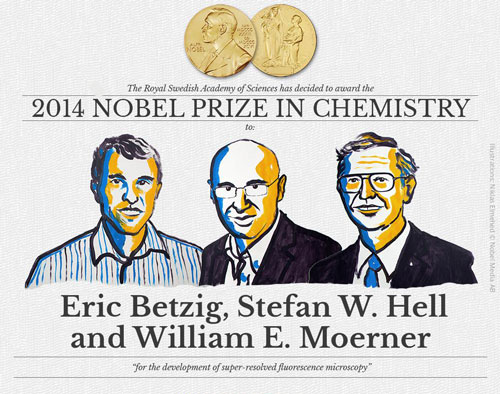
  Nobel chemisry

The 2014 Nobel Prize for chemistry was won by two Americans and a German: Eric Betzig, Stefan Hell and William Moerner. Their work greatly extended our vision into the smallest of molecules, in part enabling nanotechnology.

     Hell, born in Romania, heads a Max Planck Institute in Gottingen, Germany. Moerner is from Stanford University; and Betzig, from the Howard Hughes Institute in Virginia.

   According to CNN: “Back in 1873, science believed it had reached a limit in how much more of a detailed picture a microscope could provide. At the time, microscopist Ernst Abbe said the maximum resolution had been attained.”   As with so many Nobel prizes, the three winners simply did not accept the statement, “we’ve reached the limit —   no more can be done.”

   The three scientists, according to the Nobel Prize Committee, did this: “….Due to their achievements, the optical microscope can now peer into the nanoworld,” the committee said.   “The importance can’t be overemphasized: Now, scientists can see how proteins in fertilized eggs divide into embryos, or they can track proteins involved in Alzheimer’s or Parkinson’s diseases.”    

   Betzig and Moerner found a way to make single molecules ‘glow’ using fluorescent microscopy.   Hell found a way to use two laser beams to make the molecules glow.   This is creative thinking. Rather than conventionally illuminate molecules with photons, why not make the molecules themselves into little ‘lamps’?

     “Guesswork has turned into hard facts and obscurity has turned into clarity,” the Nobel Committee added.   The work of the three has “blurred the boundary between chemistry and biology”, by enabling us to see right inside single molecules.

   Thank you, scientists!

Too Big to Succeed? Carve it up.

By Shlomo  Maital

how-to-carve-a-turkey

  Over the years, in working with big companies, I’ve learned how difficult (impossible?) it is for huge organizations to sustain creativity and innovation. In a recent magazine column, I wrote about Intel, and how a young rather junior Israeli engineer kept Intel from abandoning its CISC technology, leading to the highly successful Pentium.  This occurred only because Andy Grove, then CEO, was willing to listen to those below him.  Many CEO’s of huge MNC’s simply are not able or willing.  Creative people get lost in the swamp of organizational bureaucracies.

   A new fashion is developing to grapple with this problem.  Split huge companies, elephants, into smaller pieces, rabbits.  Like on Thanksgiving (always the 4th Thursday in November – Nov. 27, this year, in America),  big companies are being carved up like turkeys, in the hope the pieces will be tastier than the whole bird.

    eBay is divesting PayPal.   Now, HP is splitting into two. HP stock soared on the news. Shareholders are delighted.  It’s an act of creation – making something out of nothng.

    I am very doubtful.   Many industries have seen a wave of ‘consolidation’ – mergers.  A merger is when two sick companies merge, to create one really BIG sick or sicker company.  This is what happened in the airline industry.

   Now this is being reversed.  Reverse mergers.  Very very profitable for Wall St. investment banks that shepherd the process, for a huge fee.   HP is a company that lost its way, under very poor management, until Meg Whitman.   But it will not solve its problems by splitting them into small pieces.  You cannot make a company healthy by combining it with another;  nor can you make a company healthy by carving it up like a turkey.   The pieces are still turkey.

   Long ago, management educators taught that ‘structure is not strategy’.  The way you structure the pieces of a company is NOT a strategy.  Companies that seek innovation by restructuring rarely succeed.   Because the DNA, the company culture, remains. 

  Let’s wish HP success.  But I’m very skeptical.

Lighting Up Our World with LED: 2014 Nobel in Physics

By Shlomo  Maital

Winners of the 2014 Nobel Prize in Physics

 Three Japanese scientists have won the 2014 Nobel Prize for Physics, for their contribution – lighting up the world with LED – light emitting diode technology.

   According to today’s New York Times:  The three scientists, working together and separately, found a way to produce blue light beams from semiconductors in the early 1990s. Others had produced red and green diodes, but without blue diodes, white light could not be produced, the Royal Swedish Academy of Sciences said in its prize citation. “They succeeded where everyone else had failed.”   The Nobel committee said that light-emitting diodes, or LEDs, would be the lighting source of the 21st century, just as the incandescent bulb illuminated the 20th.

    The New York Times noted:    “The LED lamp holds great promise for increasing the quality of life for over 1.5 billion people around the world who lack access to electricity grids,” the Nobel committee said. “Due to low power requirements, it can be powered by cheap local solar power.”

   According to Wikipedia,  “a light-emitting diode (LED) is a two-lead semiconductor light source:  basic …  diode, which emits light when activated.  When a voltage is applied to the leads, electrons are able to recombine with electron holes within the device, releasing energy in the form of photons. This effect is called electroluminescence, and the color of the light (corresponding to the energy of the photon) is determined by the energy band gap of the semiconductor.” 

   The three Japanese scientists managed  to achieve “the invention of efficient blue light-emitting diodes, which has enabled bright and energy-saving white light sources.”   Previously, light was created with LED technology, but in colors that did not enable replacement of the Edison incandescent bulbs. 

    Nakamura worked for a time for a Japanese company, Nichia. Nichia awarded him…$200 for his invention.   Nakamura left the company in 1999 to join U. of California, Santa Barbara, and sued the company for a fair share of the immense royalties. He settled for $8.1 million.


The ORIGINAL GPS: Our Brain

By Shlomo  Maital

Nobel

  The 2014 Nobel Prize for Physiology & Medicine has been announced.  It is shared between John O’Keefe, American-born scientist at University College, London; and a husband and wife team, May-Britt and Edvard Moser, at the Norwegian University of Science and Technology in Trondheim, Norway.

    Here is what they discovered:

    O’Keefe: How do we know where we are? How can we find the way from one place to another? And how can we store this information in such a way that we can immediately find the way the next time we trace the same path? This year´s Nobel Laureates have discovered a positioning system, an “inner GPS” in the brain that makes it possible to orient ourselves in space, demonstrating a cellular basis for higher cognitive function.    In 1971, John O´Keefe discovered the first component of this positioning system. He found that a type of nerve cell in an area of the brain called the hippocampus that was always activated when a rat was at a certain place in a room. Other nerve cells were activated when the rat was at other places. O´Keefe concluded that these “place cells” formed a map of the room.

    In other words:  many many centuries before GPS technology was invented,  our BRAINS developed their own internal GPS mapping system.  Amazing? 

    Moser’s:  More than three decades later, in 2005, May-Britt and Edvard Moser discovered another key component of the brain’s positioning system. They identified another type of nerve cell, which they called “grid cells”, that generate a coordinate system and allow for precise positioning and pathfinding. Their subsequent research showed how place and grid cells make it possible to determine position and to navigate.

     The discoveries of John O´Keefe, May-Britt Moser and Edvard Moser have solved a problem that has occupied philosophers and scientists for centuries – how does the brain create a map of the space surrounding us and how can we navigate our way through a complex environment?

     For those who are religious and believe in the Creator,  this amazing capability of the brain to orient us using specialized brain cells,  and creating grids, GPS coordinates and maps,  is a fine example of the miraculous nature of the human brain.  Congratulations to these scientists for helping us understand how this works!


Does YOUR doctor listen to you? But, really listen?

By Shlomo  Maital

 Ear

Does your doctor listen to what you say? I mean, REALLY listen? And ask you a lot of questions?

   I’ve just finished reading a fascinating book, Reaching down the Rabbit Hole: A Renowned Neurologist Explains the Mystery and Drama of Brain Disease, by Dr. Allan H. Ropper, and Brian David Burrell. (St. Martin’s Press, 2014). Basically Burrell, a wonderful writer, was a fly on the wall, and wrote down stories about how Ropper figured out what went wrong with people’s brains.

   A key point Ropper stresses is this:   The technology for scanning brains has advanced tremendously. MRI and CT scans reveal a great deal. But nonetheless, a great doctor still needs to listen to the patient, observe and ask questions.   Dr. Ropper writes:

   “Many [patients] have driven for an hour or two, even three, to [Boston], and they want to be heard. What they hope, what they expect, what they decree, is that we take the time to listen, because the act of listening is therapeutic in itself. When we do it right, we learn details that make us better doctors for the next patient. The residents may not get this yet. They are focused on diagnosis and treatment, on technology, on scales, titers, doses, ratios, elevation, and deficiencies. All well and good, I tell them, but don’t forget to listen!

   Does your doctor listen to you. Really listen? If not – and who can blame them, many times they are required to see X patients per hour, leaving no more than 10 minutes per patient — try to find one who does.

   As I’ve noted before, even in modern medicine, technology comes last, not first.

America’s 3 % Economy: Why It Is In Deep Trouble

By Shlomo  Maital

3 percent

  Writing in the latest TIME magazine issue (Oct. 6), Rana Foroohar explains why the U.S. economy is in deep trouble – and why many are distressed that nobody seems to be tackling the core issues.

   Foroohar says it has taken 41 months to replace the jobs lost in the “Great Recession”  (2008-11).  This is more than three years, far longer than in previous recessions.

    But, which jobs??   Mostly, burger flippers, at $8/hr.  “That’s a problem in an economy that’s made up chiefly of consumer spending.  When the majority of people don’t have more money, they can’t spend more, and companies can’t create more jobs higher up the food chain.  So, poor job creation and flat wages are holding back a stronger recovery in consumer spending.   

    Foroohar concludes: “If this trend is left unchecked, we are looking at a generation that will be permanently less well off than their parents.”   This is disastrous, because there is an intergenerational contract, in which older generations offer younger generations the hope of better lives, jobs and strong futures.  This is the first time the opposite is the case.  We are giving our children a far worse economy and society than the ones we received. 

    This is by far the core issue today facing America –not ISIL.  Let’s focus on the real issues.  America’s real enemy is at home, not abroad – its own failing economy.   A general estimates the war on ISIL could cost as much as $10 b.  This is money needed for schools, colleges, research, innovation and technology.  ISIL, the Islamic State, is hurting America deeply simply by diverting resources into jet fuel, smart bombs and cruise missiles.  Boots on the ground?  America needs special forces to ‘light up’ with lasers the true problem – education, poverty, and above all,  low-wage jobs. 

Blog entries written by Prof. Shlomo Maital

Shlomo Maital

Pages