Vaccines: Time for Legislation

By Shlomo Maital

                                                                                      vaccine

  New York Times report Elisabeth Rosenthal reveals to us another Big Pharma ripoff – this time related to vaccines.   When in the world will the U.S. Congress act to end this travesty?

   According to Rosenthal, Big Pharma uses the ‘new improved yogurt’ trick to fatten profits and hurt the middle class and the poor.  If you sell price-regulated yogurt,  change the package, add something (fermented kiwi juice) – and claim it is a new product, hence not subject to the old price controls.

   In vaccines Rosenthal writes:

     “Old vaccines have been reformulated with higher costs. New ones have entered the market at once-unthinkable prices. Together, since 1986, they have pushed up the average cost to fully vaccinate a child with private insurance to the age of 18 to $2,192 from $100, according to data from the Centers for Disease Control and Prevention. Even with deep discounts, the costs for the federal government, which buys half of all vaccines for the nation’s children, have increased 15-fold during that period. The most expensive shot for young children in Dr. Irvin’s refrigerator is Prevnar 13, which prevents diseases caused by pneumococcal bacteria, from ear infections to pneumonia. Like many vaccines, Prevnar requires multiple jabs. Each shot is priced at $136, and every child in the United States is required to get four doses before entering school. Pfizer, the sole manufacturer, had revenues of nearly $4 billion from its Prevnar vaccine line last year, about double what it made from high-profile drugs like Lipitor and Viagra, which now face generic competitors.”

Let’s see that again. A price rise from $100 to $2,192???   And remember vaccination is not optional; it is essential for the lifetime health and wellbeing of every child.

  Half of all vaccines are bought by the U.S. federal government. Their costs have risen 15-fold!   Why is it that when we ordinary folks get ripped off, we scream – but when Big Pharma rips off the government, there is silence?? At a time when deep budget cuts are hurting everyone?  

   When one company, Pfizer, makes $4 billion from ONE vaccine, Prevnar, double what it makes from a high-profile blockbuster drug, something is radically wrong. Wake up America!

  The Coursera Revolution: Make EVERY Day Compassion Day

By Shlomo Maital

DaphneCoursera

Daphne Koller

“College,” humorist Mark Twain is alleged to have remarked, “is a place where a professor’s lecture notes go straight to the students’ lecture notes, without passing through the brains of either.”  As a 47-year veteran of college teaching, I find this quip painfully accurate, even if humorist Twain, himself, did not really say it.

    Almost every university teaches innovation, especially those with business schools. Yet, very few actually practice it. In Harvard Yard there is a statue of John Harvard, the clergyman whose deathbed bequest in 1638 established the university named after him. If the statue were to come to life and visit my own classroom, he would feel right at home nearly four centuries later. 

      He might wonder about the PowerPoint, the white boards and students’ noses buried in their cell phones. But he would instantly recognize the droning lecturers reading from their notes while the students diligently write down their instructors’ words in their own notebooks or tablets.     That is why I listened avidly to a recent talk given at Technion on “The Online Revolution: Education for All” by Stanford University Professor Daphne Koller, an Israeli computer scientist who earned her B.Sc. and M.Sc. degrees from Hebrew U. when she was only 18.  

     Two years ago, together with her colleague Andrew Ng, head of Stanford’s Artificial Intelligence lab, Koller, 46, founded Coursera, today the world’s largest provider of “MOOC’s” (massive open online courses).  After her talk, I had the opportunity to chat with her.  I learned that Coursera currently has 8.3 million users enrolled in 673 courses from 110 partner institutions. Each course is organized and approved by a university or college – a majority of which are outside the US.

      Coursera’s students are about evenly split between the US other developed countries and emerging countries. Some 600,000 students are from India, 530,000 from China and 48,000 from Israel. According to Koller, so far 10,000 years of video have been watched, 44 million quizzes administered, four million peer-graded sessions and 1.25 million courses have been completed. A significant part of Coursera accessing is done through smartphones or tablets and the rest on laptops and desktops. Of the students enrolled, 70 percent are adults over 30.   

    The largest Coursera course, on social psychology, is taught by Wesleyan University’s Scott Plous. Last fall it had 250,000 students enrolled! (The next round of the course begins July 14). How can you interact with a student body equal to the population of Haifa? If each of the quarter million students submitted an assignment on one sheet of paper, the stack would be eight stories high! Rather daunting for a poorly paid teaching assistant.

   “Several homework assignments will encourage you to experiment with your life, observe the results, and analyze what took place,” Plous tells students. Students interact through the Social Psychology online network.      The final assignment of Plous’s course is called “The Day of Compassion”.     Students are asked to live for 24 hours as compassionately as possible and to analyze the experience using social psychology. Roughly 700 students received a perfect score (peer graded) on the assignment, each captured in a video film or a written narrative.  The whole class then voted on which of these 700 students deserved a Day of Compassion Award sponsored by the Stanford University Center for Compassion and Altruism Research and Education (CCARE). 

     The grand winner was Dr. Balesh Jindal, a physician and artist from a rural area near New Delhi, India. She won the grand prize by finding a way to address the problem of sexual violence towards girls in her community. During the Day of Compassion, she visited a local school with more than 2,000 female students, ages four to 17, from poor backgrounds.

     Jindal taught each of five separate age groups about inappropriate touching and how to report incidents of abuse. These talks uncovered multiple cases of abuse by neighbors, brothers, cousins, and even fathers.  After the Day of Compassion, Jindal invited the mothers of abused girls to her nearby clinic for free counseling. She decided to set aside one day each week to help these girls and to work on reducing child sexual abuse.

      In reading this inspiring account, I was struck by how a single creative teacher like Plous can touch the lives of a quarter of a million students all over the world who, in turn, change the world for countless others using online technology.   

     Thanks, Daphne.  Thanks, Coursera.  Thanks, Scott Plous.  Thanks, Dr. Balesh Jindal.    What if every single one of us, not just those taking Coursera courses, made today, and every day, a Day of Compassion?   What if Compassion 101 became a required course, for membership in Humanity?      

If You Disrespect Teachers, You Disrespect Learning

By Shlomo Maital

Teacher

  Once, long ago, becoming a school teacher was a worthy and socially respected goal.  Norman Rockwell’s wonderful portrait of “Happy Birthday, Miss Jones” was the cover of the Saturday Evening Post,  March 17, 1956 issue.  That was almost 60 years ago.   The reason Rockwell’s portrait is out-of-date is not the blackboard, now replaced by whiteboards – but the love shown by students for their teacher.  It’s largely gone. 

   A new study by the OECD, known as TALIS (Teaching and Learning International Survey) questioned over 100,000 lower secondary school teachers and 6,500 principals, from 34 countries. A Google search on “TALIS OECD” will bring you to it.

   Here are the main results: 

  • Society no longer values the work of teachers, in the perception of the teachers themselves. Only about 5 per cent of French and Swedish teachers said “society valued their work”. In the U.S., the proportion was only about one-third. This contrasts with 68 per cent in Singapore.   The head of the schools division at OECD, normally understated, said the results were ‘shocking’.    


    •      Why do Singaporean kids score so high on international tests in math, science and literacy? Smaller classes? Better methods? Sure … but also, because in Singapore, teachers are respected and valued, hence bright people choose teaching as a profession. Who wants to pick a profession that nobody values? Teaching then becomes a last-choice default, rather than a first-choice priority.
  • For a majority of surveyed countries, “few attract the most experienced teachers to the most challenging schools [more than 30 per cent of the students are from low socioeconomic backgrounds]”, said one of the study’s authors Julie Belanger. In other words, as a teacher gains seniority, he or she uses it to teach in a ‘desired’ school rather than in a tough one. That leaves the younger less experienced teachers to deal with the tougher schools. It should be the opposite.
  • Large numbers of teachers face imminent retirement; teachers’ average age is 43.  Teachers have an average of 16 years teaching experience.
  • 68% of all teachers are women, but 51% of principals are men.  Why??? What makes a man qualified to be principal, just because of his gender??? In our capitalist business-model approach to schools, where productivity is measured by test scores, teachers become trainers, rather than educators. No wonder we don’t respect them.   According to the TALIS study, 93% of teachers report “students should be allowed to think of solutions to a problem themselves before teachers show them the solution”.   Nearly half of all teachers report they frequently have their students work in small groups.     Do we truly value how teachers spur creativity in our kids, rather than how they train them to excel in tests?        If Norman Rockwell were to draw “Happy Birthday, Miss Jones” today – it would look a whole lot different. And a whole lot worse.   


  •    The TALIS study should ring alarm bells. Quality education is NOT principally about resources, budgets, or even class size. It is about teachers – finding motivated, creative people who choose education as a first choice, and who thrive because they are respected and valued.   If society were to highly value teaching, that alone would partly compensate for current low salaries.   But low respect, and low salaries, together are lethal.
  •    Despite the fact that society does not seem to value what they do, most teachers do love their jobs and would choose teaching again as a career, if they had to.

Qubits: How to be in two places at the same time

By Shlomo Maital

  quantum computing 

Today’s New York Times has this headline, “Microsoft bets on quantum computing” by John Markoff (p. 21).   Here is the basic idea, as described by Markoff:

    “Conventional computing is based on a bit that can be either a 1 or a 0, representing a single value in a computation. But quantum computing is based on qubits, which simultaneously represent both zero and one values. If they are placed in an “entangled” state — physically separated but acting as though they are connected — with many other qubits, they can represent a vast number of values simultaneously.    And the existing limitations of computing power are thrown out the window.”

  Amazing?  indeed.   The visionary physicist Richard Feynman first proposed quantum computing in 1982.  Initial research was funded by DARPA (America’s defense department) and America’s National Security Agency.  Note how often governments fund pioneering basic research that later changes the world!

    Microsoft’s visionary research is highly risky, simply because “the typic of exotic..particle needed to generate qubits has not been definitely proved to exist”.  

     Wow..   Go Microsoft!  After decades of missing every trend and opportunity, including the Internet,  Microsoft is now working on something that does not even exist (for sure).  What a change!

     But here’s the best news, especially for busy women.  One day, you can be in two places at once.  You can drive the kids to soccer, while you’re 600 miles away pitching to a potential new client.  You can spend quality time with your spouse, while writing up a new ad campaign for Unilever.  

     On second thought, this is no breakthrough – I know many women, including my wife,  who are already qubits.  They multi-task so easily, so fluidly, that they don’t even need qubits.  I urge Microsoft researchers to study these multi-tasking women.  If they do, they will quickly find those elusive quantum particles; women have tons of them.

        It’s us MEN who need them.    

Reverse Privatization: Let Us Share Wal-Mart’s Profits, We Created Them!

By Shlomo Maital

                                    Wal-Mart

Two seemingly unrelated pieces appear in today’s Global New York Times. But they are intimately connected.

  • Timothy Egan’s Op-Ed piece reports that Wal-Mart made an obscene $17 b. in profits last year, paid its top executive over $20 m. and has made the six Walton family heirs worth at least $150 b.   Meanwhile, a study by House Democrats shows the average Wal-Mart superstore cost taxpayers $904,000 a year in subsidies, or over $5,000 per employee. Egan writes, “Walmart’s humiliating wages force thousands of employees to look to food stamps, Medicaid and other forms of welfare. Working at Walmart may not make you poor, but it certainly keeps you poor – at the expense of the rest of us.” And a recent piece in Forbes magazine notes, “Walmart’s low-wage workers cost U.S. taxpayers an estimated $6.2 billion in public assistance including food stamps, Medicaid and subsidized housing, according to a report published to coincide with Tax Day, April 15.”
  •  
  • David Jolly reports that the board of the French industrial conglomerate Alsthom unanimously backed General Electric’s bid to acquire Alstom for $13.5 b.   Initially the Socialist French government led by Francois Hollande opposed the takeover. It then changed its mind, after Siemens and Mitsubishi made a bid.       France’s economy minister Arnaud Montebourg said that a condition of allowing GE to buy Alstom, was that the Agence des Participations de l’Etat, the French government’s national shareholdings agency, should acquire 20 per cent of Alstom stock.      


What is the connection?

  Suppose, just suppose, we tried ‘reverse privatization’.  Privatization means, the government sells its interest in companies it once owned to private investors.  This has happened all over the world.  In Russia, oligarchs snatched control of state-owned assets and become instant billionaires.

       Reverse privatization means, the government buys (not SELLS) an interest in companies, for the benefit of ordinary people.  

     If the GE Alstom merger succeeds, the French people will own 20 per cent of the profits. Moreover, with 2 out of every 10 seats on the Board of Directors, the French government will have access to inside information and will be able to influence hiring and wage policies of Alstom.   Alstom/GE will be run by top managers, not by government.  But government will oversee and share in the profits. 

     What if, just suppose, what if, the U.S. government had a 20 per cent stake in Walmart?    First, that means $3.4 b. share in the total $17 b. in profits.  That would go a long way to paying for the $6 b. of public assistance that Walmart workers get.  

     More and more capital is concentrating in fewer and fewer hands. What is the solution?   Put some of that capital, as shares, into the hands of a government holding company, so that some of the profits get funneled not into the well-padded pockets of the super-rich, but into the empty pockets of ordinary citizens.

     Reverse privatization.  The French get it.   Why don’t we?

It’s a Snap:  Webcams for People, Not Just Eaglets

By Shlomo Maital

Snap

Snap the Eaglet

  A new series in the New York Times Opinion section, called “Menagerie”,  launches today (June 21) with a fine story by Jon Mooallem about Snap, Crackle and Pop:  Three bald eagle eaglets,  shown on a webcam installed in a nest somewhere in Minnesota.  The webcam is called the Decorah Eagle cam.  It was put in place by the state’s Department of Natural Resources, and is aimed at increasing empathy and consideration for wildlife.

   Great idea!  Except – inadvertently, Snap’s mom or dad  stepped on her and broke her wing.  So many people watched daily on their screens as little Snap suffered.  The wildlife experts on principle will generally not intervene, because that interferes with Nature.  That’s reasonable. Except viewer outrage was so enormous, the Department finally had to use a lift to extract little Snap and euthanize her (she wasn’t strong enough to be saved). 

    It’s quite amazing how much empathy, sympathy, love and concern can be aroused for animals   (dogs, cats, dolphins, whales), especially if they are cute and furry.  When our little mixed-breed Yorkshire, Pixie, went missing for a few anxious moments recently, the sense of panic we felt was indescribable.   A webcam on a bald eagle’s nest can arouse immense public feeling, among millions.

     So, I have a modest suggestion.

      Can we perhaps install a webcam in the hut of a Darfur or South Sudan family, struggling to find water and raise babies?

       Can we install a webcam in the shack of a Syrian refugee family, in the Jordanian refugee camp that houses untold thousands of them?

       Can we put a webcam in the home of an illegal immigrant family in Italy, or America,  or Israel, where authorities threaten deportation daily?

       We do need to treat animals humanely;  it’s part of treating ALL living things humanely.  But we especially need to treat suffering HUMANS humanely, especially children.

     Sorry, Snap.  We do feel for you.  But I wish the same passion and empathy could be aroused for human babies and children, even though they don’t have fur or feathers.

Innovation:  WHEN, not just What? Daybreaker Parties

By Shlomo Maital

daybreak

  Einstein taught us that the key to true creativity is how you frame questions, not how you come up with answers.  The question we usually assume that launches innovation is:  What?  But rarely do we ask When???   In Israel, years ago, afternoon newspapers innovated simply by printing their newspapers and delivering them at 6 a.m.   British Airways once tried serving meals on the ground, before the long flight, so people could simply go to sleep on the plane. 

   If you find a way to deliver a known liked product at a different and unusual time – this can be a powerful innovation.

   Here is an example.  Two young entrepreneurs, Matthew Brimer, 27 and Radha Agrahal, 30,  are ‘edu-preneurs’.  They are engaged in educational technology. Their company General Assembly offers on-line classes, workshops, programs and education ‘in the most relevant skills of the 21st C.’.   They had the idea of creating ‘morning raves’ – get-togethers held at 7 a.m., for two hours, before heading to work.  Daybreaker parties have no drugs, liquor or other substances. What do you do?  Mingle, chat, and dance.  Why no alcohol?  “The idea is not to flood the senses with external influences but to stimulate them through natural means. Through the music and body movement.  All the senses are engaged.”  In other words – you don’t need junk or booze to get high.

     The parties are held monthly, midweek (usually Wednesday), each time at different locations, to those who signed up earlier by email.  The idea is spreading from Silicon Alley (most of the participants are in high-tech, are young and without kids, so no need to make kids’ sandwiches and get them on the school bus), and it started in New York City and is spreading to London, San Francisco and Tel Aviv (it debuts in Tel Aviv this summer). 

   Parties have existed for thousands of years.  Change the time from midnight, to 7 a.m. – and you have an innovation.

    What else can you innovate, by taking something loved, with a set time, and shift the time completely?

The Key to Innovation in Big Companies: Work Together

By Shlomo Maital

Collective Leadership

        Generally I write blogs about books or articles that I’ve read.  This time, I want to write about a book I intend to read soon, based on excerpts and interviews from Harvard Business School’s Working Knowledge magazine.  The book is:

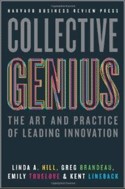
        Collective Genius: The Art and Practice of Leading Innovation, (Harvard Business School Press)   was written by Prof. Linda Hill, the Wallace Brett Donham Professor of Business Administration, with Greg Brandeau, former CTO of The Walt Disney Studios and current COO/president of Media Maker; Emily Truelove, a PhD candidate at MIT’s Sloan School of Management; and Kent Lineback, Hill’s cowriter on her earlier book Being the Boss: The 3 Imperatives for Becoming a Good Leader.

    Here is the main point:   “….. innovation is a “team sport,” not the act of a sole inventor. “Truly innovative groups are consistently able to elicit and then combine members’ separate slices of genius into a single work of collective genius,” the authors write.  Or, as Hill puts it, “Conventional leadership won’t get you to innovation.”  The authors identified organizations with reputations for being highly innovative, then found 16 leaders within those organizations and studied how they worked.    …. the authors include narratives of executives within India-based IT company HCL Technologies, the German division of online auctioneer eBay, and the marketing division of automaker Volkswagen in Europe.”  

     Here is the ‘boldest’ example of innovative leadership and teamwork, according to Hill.  It comes from India.

    “Of the 16 leaders studied, Hill says Delhi-based HCL, under former CEO Vineer Nayar, might be the boldest. Nayar, who pulled the company out of a five-year slump, challenged the common belief that Indian companies provide low-cost products and services but don’t innovate. “That (assumption) made him crazy,” Hill says. “He said ‘We can and will compete that way.’ ”   Nayar focused on changing the organization from within, starting by empowering employees. In 2005, he told a team of 30-something young employees called the “Young Sparks” to develop the brand and a plan to change how employees experienced HCL. The group started with an icon, Thambi, which means “brother” in Tamil, symbolizing “the importance of the individual and the value of the collective” at HCL.   Nayar recast his role as leader. He pushed for more transparency, adding 360-degree reviews for all employees and 360-degree feedback of his own work—he promised to resign if his own review dropped to a certain level. He set up a portal that asked employees to solve “my problems” and reported getting incredible answers from workers.  From 2005 to 2013, when Nayar led HCL as president and then CEO, the company’s sales, market cap, and profits increased six fold, according to the book. Fortune magazine wrote that the HCL had “the world’s most modern management” and the company was named one of Businessweek’s most influential companies.  Nayar tells people, “I don’t know the answers,” which goes against the common belief in Indian business that the CEO should be a visionary. For Hill, Nayar shows the possibilities of what can be accomplished by an innovative leader who embraces a new style of leadership.”

    Big organizations ALL have trouble innovating.  Perhaps Linda Hill’s new book will help them figure out why and find a workable solution.


2013:  Tough Year for Workers, Great Year for HNWI’s

By Shlomo Maital

                      rich

                 Illustration by Avi Katz

  For most of us, 2013 was yet another hard year.  The U.S. and EU economies were either in recession or barely growing.  Unemployment remains high;  the job market, weak.   China faces slowing export growth and a housing bubble. 

  But it was a super-great year for HNWI’s, the Wall St. euphemism for the rich and super rich (High Net Worth Individuals), who are the focus of a huge and profitable industry known as ‘wealth management’.  And wow, is there ever a lot of wealth to manage.

    According to the Boston Consulting Group’s Global Wealth 2014 report, global private financial wealth grew by nearly 15 per cent last year and now totals $152 trillion, more than double world Gross Domestic Product.  Wealth multiplies with ease, even when the rich do not actively work at it.  Microsoft founder Bill Gates, 58, is the world’s wealthiest person, with net worth of $78 b., even though he has spent most of the past few years giving his money away.  His Microsoft shares continue to generate more and more billions in wealth for him, even though he resigned as Microsoft Board Chair in February.  

Capital has boomed because of urbanization and rising real estate prices,  rising share prices,  vast amounts of new money printed by central banks everywhere and loaned at low interest,  and new capital markets in emerging nations, creating assets where none existed before.  Global private wealth boomed last year because investors put money into the stock market and stock markets rose sharply.  Wall Street broke all records and closed the year 23.8 per cent higher.

    The wealthy have capital and so quickly accumulate more of it;  the poor do not. The capital of the rich grows exponentially. The income of the poor stagnates.  This is inherently unfair.   

       But can’t the poor rise to wealth, by hard work and saving?  

       The American “Horatio Alger” rags-to-riches myth is just that, according to the Equality of Opportunity Project, led by Harvard and Berkeley economists.  This study found that an American child born in 1971 to parents in the poorest fifth of the income distribution had an 8.4% chance of making it to the top quintile. For a child born in 1986 the odds were 9%, basically the same.  In other words, in the U.S. you have less than a one in 10 chance of rising from poverty to wealth, and it’s been that way for nearly two generations.  You need to be fairly rich to go to good schools and to be accepted to good universities.  In contrast, in Denmark, the probability of climbing from the bottom quintile to the top one is double that of America.  If you want rags to riches, you’d better be born in Scandinavia.

     If the democratic system cannot repair itself, because the super-rich control the system through high-paid lobbyists and donations to politicians —  what other solution is there?  The French Revolution, 1788-1804, used the guillotine; that did not work out too well for anyone and ultimately brought a dictator-emperor named Napoleon, who destroyed Europe.        

   The rich are different.  They have money, and when they invest it, it multiplies rapidly.  At 8 per cent compound interest, wealth doubles every nine years.  There is nothing wrong with being rich.   But when extreme wealth perpetuates itself in the manner now occurring worldwide,   poverty perpetuates itself too.  Trickle down?  It’s a myth, too. 

    The rich use their wealth to make a whole lot more of it, with ease.  That process does not seem to help working people much.   

    Unless people of good will everywhere, rich, middle-class and poor, get together to resolve this dilemma,  society is simply going to fracture, perhaps violently.  And that won’t be good for anyone, rich or poor.  

Piketty: The #1 Amazon Bestseller Nobody Really Reads

By Shlomo Maital    

  Piketty

  Can you believe a 696-page boring economics book,  Capital in the 21st C., is the #1 Amazon best-seller, and one of Harvard University Press’s (Belknap) all-time best-sellers?  And can you also believe very few people have actually ploughed through this tome?  And that people constantly mispronounce the author’s name:   He is French, and his name is   toh-MA  pi-ke-TTY, rhymes with bring me TEA!

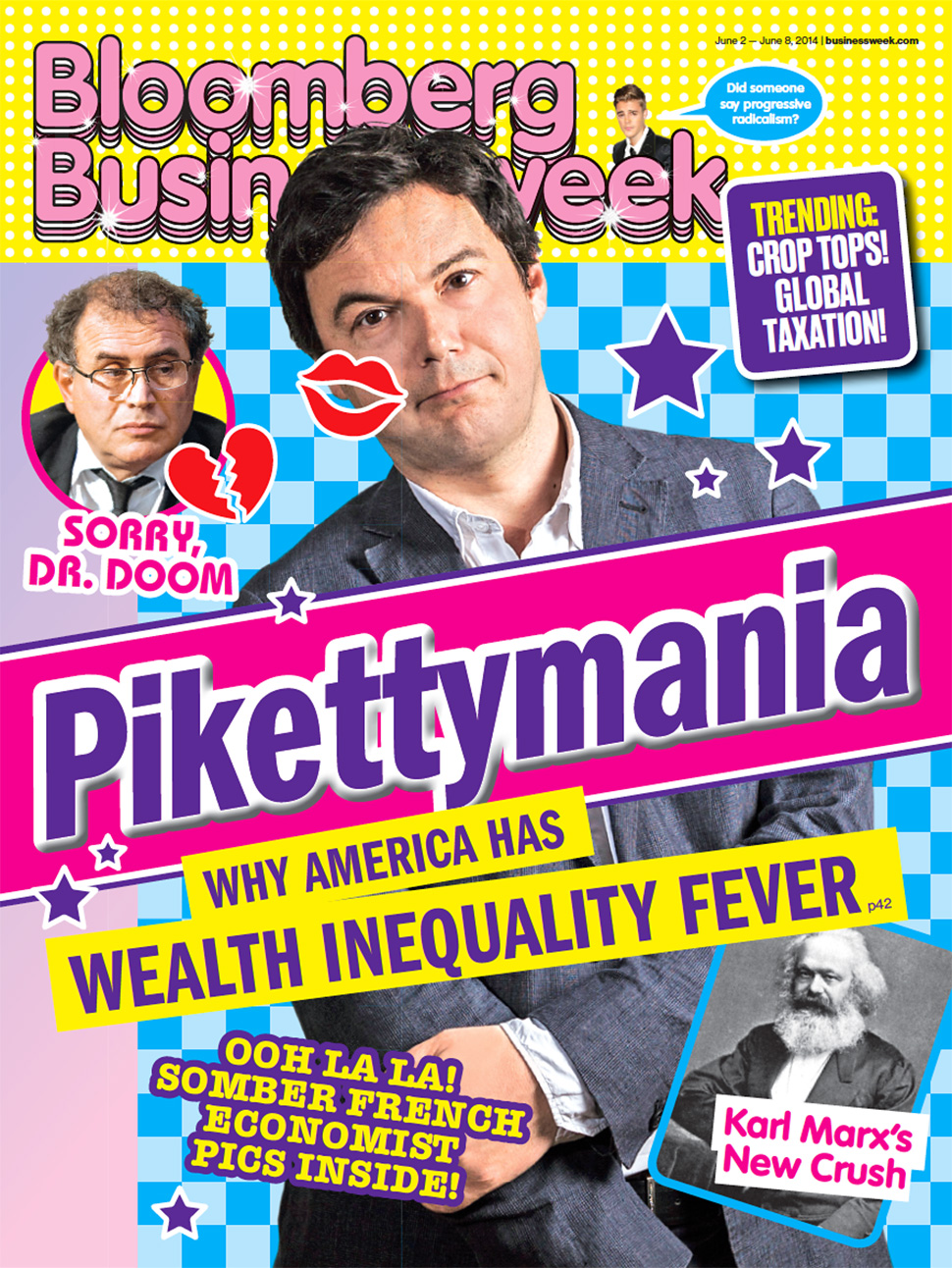
    Bloomberg Business Week has devoted an entire issue to Piketty, his arguments and his criticics, including Chris Giles (Financial Times) and two respected macro-economists, Per Krusell and Tony Smith.    (See: http://www.businessweek.com/articles/2014-05-29/pikettys-capital-economists-inequality-ideas-are-all-the-rage ).

   As a service to my readers, and to prevent a widespread narcolepsy epidemic (the malady that causes people to fall asleep in daytime),  here is a very short summary of the ongoing debate.

    What does Piketty claim?  Simply – that “Beta” (the ratio of capital to income, for nations) initially fell, but in recent decades has risen.  This is because the fraction of income saved (which is what leads to capital accumulation) exceeds the rate of growth of income or GDP.

    So what?  People who own capital can earn high return on their wealth, averaging 8 %; this doubles their wealth every 9 years.  People who spend their income (most of us working people) fall into debt and fail to accumulate wealth.

    So what?    People with great wealth gain control of the democratic system, to perpetuate their wealth through tax breaks. 

     The growing concentration of wealth in fewer and fewer hands cannot be corrected by the democratic system (the vast majority, who have no wealth), because the super-rich use their wealth to manipulate the democratic system. 

     That last paragaph is NOT in Piketty.  It comes from an article by John Cassidy,  “Is America an Oligarchy?”, The New Yorker, April 18.  He quotes two political scientists, Gilens and Page,  who claim that:  “Our analyses suggest that majorities of the American public actually have little influence over the policies our government adopts”:   

Americans do enjoy many features central to democratic governance, such as regular elections, freedom of speech and association, and a widespread (if still contested) franchise. But  …in the United States, our findings indicate, the majority does not rule—at least not in the causal sense of actually determining policy outcomes. When a majority of citizens disagrees with economic elites and/or with organized interests, they generally lose. Moreover … even when fairly large majorities of Americans favor policy change, they generally do not get it.

On many issues, say the authors,  the rich exercise an effective veto. If they are against something, it is unlikely to happen.

     So here is where things stand.  Wealth grows faster than income.  Wealth concentrates in fewer and fewer hands.  Wealth corrupts democracy. 

     Marx predicted that the concentration of wealth would grow so intolerable, that the proletariat would revolt.   

      If the democratic system cannot repair itself – what other solution is there?


Blog entries written by Prof. Shlomo Maital

Shlomo Maital

Pages