Global Crisis/Innovation Blog

MF Global’s Bankruptcy:  Here We Go Again?

By Shlomo Maital 

 

 Jon Corzine  

We are fast approaching Einstein’s definition of insanity (doing the same thing and expecting different results).  We have another major Wall St. bankruptcy, this time MF Global, headed by a financial giant, Jon Corzine, who ran Goldman, Sachs,  was a US Senator, governor of New Jersey…  How can, again, a major Wall St. player undertake irresponsible risk and cause massive harm to his investors?

  Who are Jon Corzine and MF Global?

  Corzine is a folksy ambitious person, who built Goldman Sachs into a Wall St. powerhouse, was pushed out by Hank Paulsen, who later became US Treasury Secretary and disastrously chose not to bail out his former competitor Lehman Brothers on Sept. 15, 2008, and then like Paulsen went into politics.  He is very smart, very ambitious, and though wealthy, chose to try to serve his country, in politics.  He cannot in any way be represented as an evil person.

   What went wrong? 

   MF Global was a firm spun off from a UK hedge fund, Man Group, in 2007.  Man Group is still a huge investment fund and a major player.  Corzine took over MF Global last year and led it to become the eight largest bankruptcy in history.  Corzine ‘leveraged’ MF Global 30 to 1, even though in an interview given when he first took over the firm, he specifically said he would not do this.  That means, he took on debt and obligations 30 times the firm’s capital.  What this means is, if the firm’s assets fall by only 3 percent,  the company has negative net worth. 

   How and why did Corzine do this folly?

   Like most bankruptcies, it came about because of a ‘sure bet’.  Corzine bet that Ireland, Italy, Spain and Portugal would never in a million years allow their sovereign bonds to go into default – even though Russia, for instance, defaulted (under Yeltsin) in August 1998.  So he placed a huge bet, buying huge amounts of bonds of these countries with short maturities, due to mature in 2013, believing that when they matured, he would get full face value for the bonds, while he paid as much as 30 per cent below face value to buy them (a bargain, because of what he believed was irrational and stupid hysteria by bond traders).   What has actually happened, is that the value of those bonds has nosedived, as those countries struggle to raise new borrowing to pay off old debts.  And as this happens, MF Global has been receiving ‘margin calls’ – meaning, they borrowed money to buy those bonds, using the bonds themselves as collateral, and when the bonds fall in price, they are asked to fork up more collateral, to back their loans, and when MF Global was unable to do so, they are unable to meet their liabilities and therefore are formally and officially bankrupt. 

   Where were the people who are supposed to regulate MF Global and other such firms?

   Busy.  The regulator, CFTC,  Commodities Future Trading Commission, has been very busy writing and trying to implement the complex Dodd Frank Act, a crazy-quilt piece of legislation cobbled together in 2009.  They don’t really have the time or manpower to oversee firms like MF Global.

   They should have.  MFG, according to Financial Times, had futures and options positions on the Chicago Mercantile Exchange, amounting to over $100 b., and comprising customers who make up 28 per cent of the trading on this exchange.  MF Global was indeed a big player.    This was not supposed to happen.  MF Global was supposed to have ‘segregated client accounts’, which kept clients’ money separate and provided a firewall for it.  Now, no-one can find hundreds of millions of client money.  It is likely gone forever. 

    What did Corzine say?

    He said he was experiencing “great sadness”.   

   Not as much, Mr. Corzine, as the people whose savings you destroyed, with a reckless and irresponsible gamble. 

   Chances are, MF Global is not the last of its kind.  Einstein got it right.  It is insanity.   

Global Crisis/Innovation Blog 

 Can You Spot Luck When You See It?  On Jim Collins’ “Great By Choice” 

By Shlomo Maital  

  A short passage in one of Jim Collins’ books (can’t recall if it was in Built to Last, or Good to Great…) changed my life. In it Collins recounted advice he got, as a young lecturer at Stanford Business School,  from an experienced Stanford management professor.  “Don’t worry so much about your delivery and style,” he was told. “Make sure you have good content.”  In this age of ‘pitch’, ‘marketing’, ‘spin’ and ‘theatre’, many of us educators forget that in the end what matters is the solidity and validity of the material we teach.  Collins took heed.  His books are based on exhaustive research on thousands of companies, distilling it down into insights for, say, the 11 companies whose performance exceeds the rest by an order of magnitude (Good to Great).  I tried hard, from that time, to ensure what I taught was solid and based on textbooks that I wrote myself. 

  In his new book with Morten Hansen,  Great by Choice, Collins  and Hansen repeat Good to Great, but this time for entrepreneurs. They ask, why do some entrepreneurs build companies that outperform everyone else by ten times?  They ask, ““why do some companies thrive in uncertainty, even chaos, and others do not?”

    Recently, Collins and Hansen wrote a short piece in the New York Times based on their book, about the following key issue:  How much does luck count for?  How much does it explain?  What they find buttresses Louis Pasteur’s famous saying; “Chance favors the prepared mind”.  Luck is random, by definition.  Those who gain most are those who are ready to spot it, and leverage it, with agility, courage and speed. 

   Here is how, according to Collins, Microsoft was born and over $300 b. in new wealth was created.  In Jan. 1975 Paul Allen spotted an article in Popular Electronics, “World’s First Microcomputer Kit to Rival Commercial Models”, about the Altair.  Gates and Allen thought they could convert the programming language Basic into a product that could be used on the Altair.  At Harvard Gates worked on a PDP-10 computer on which he could develop his idea. 

    A lot of luck, right?  Harvard!  PDP-10!  But – ask, how many millions of eyeballs read that very same article?  Why did no-one else think of using Basic?  And how many math and computer whizzes were there at the time, along with Gates, at Stanford, MIT and elsewhere?   And how many of them changed their life, stopped sleeping, “inhaled their food”, defied their parents, dropped out of school, moved to Albuquerque to work with the Altair —  and how many had the speed and urgency to ship Basic for altair, debugged, before anyone else?  Luck, yes. Prepared mind, and dogged hard work – you bet.  And Gates’ driving hard work throughout his career has been greatly undermentioned.  So, by the way, has that of Steve Jobs.  In her eloquent eulogy for her biological brother, Mona Simpson speaks of how hard Steve Jobs worked throughout his life, every single day.  It recalls Malcolm Gladwell’s book Outliers, about the secret of being outstandingly successful: 10,000 hours of practice.    Mitch Kapor, creator of Lotus, was similarly lucky. In a doctor’s office he watched a medical secretary struggling with reams of paper, and used Basic to create the first spreadsheet.  How many people saw the same thing and never acted on it? 

   So, innovator – can you spot luck when you see it?  Is your mind prepared?  Is your BODY prepared, to invest the dogged hard work you need to take a lucky break, insight, or incident, and transform it into a terrific world-class business ten times better than anything else in existence?   Millions of people are super-lucky.  Problem is, they just never realize it.   

  • Jim Collins and Morten T. Hansen: Great By Choice: Uncertainty Chaos and Luck—Why Some Thrive Despite Them. Harper Business: Oct. 11 2011.   


Global Crisis/Innovation Blog 

Groupon: The Movie 

By Shlomo Maital


 Andrew Mason, founder &  CEO Groupon 


Have you by any chance been following the incredible phenomenon known as Groupon?  According to Wikipedia, 

  “Groupon (“group coupon”) is a deal-of-the-day website that features discounted gift certificates usable at local or national companies.  Groupon was launched in November 2008,  by now-CEO and Pittsburgh native Andrew Mason.  The idea subsequently gained the attention of his former employer, Eric Lefkofsky, who provided $1 million in “seed money” to develop the idea.  

According to Reuters,   “Groupon Inc raised $700 million after increasing the size of its initial public offering, becoming the largest IPO by a U.S. Internet company since Google Inc raised $1.7 billion in 2004. The global leader in “daily deals” is now valued at almost $13 billion after saying it increased the offering by 5 million shares to 35 million in total and pricing them at $20 each, above an initial range of $16 to $18.”

   Groupon is generating four times as much revenue as Google was, at this stage (three years after its first sale).  It already employs 10,418 people, as many as Google had in its year eight. 

   Groupon is a classic Web business which is both close to utter collapse and close to gigantic jackpot earnings, at the same time.  It has negative working capital, according to Richard Waters, who writes a Technology column for the Financial Times (Nov. 3).  It owes far more to merchants (for the coupons) than it has cash on hand.  It has 143 m. email addresses in its databases, but only one of them in five has ever bought a coupon.  It is growing at 72 per cent a quarter,  but the amount of money it retains per coupon has collapsed, by 5 percentage points, to 37 per cent.  So, either the novelty value of coupons has collapsed, and with it Groupon, or, Groupon is showing it has a solid business by slashing its spending on subscriber acquisitions and is ‘cruising’. 

    Waters perceptively notes Groupon’s (and Mason’s) problem.  Groupon has to do what Jeff Bezos did at Amazon – turn a one-product Internet business into a broader “solutions” business.  Waters says doing this, on the ‘fly’, is like changing tires on a racing car while the car is doing 200 mph on an F1 track.  If he can pull it off, Waters say, Mason will have earned his place among the handful of lasting dotcom winners.

   We wish him well.

Global Crisis/Innovation Blog 

 Poor Economics

By Shlomo Maital 


  Banerjee, Duflo and friends


Yes, lately, economists have indeed been doing very poor economics.  My discipline has few answers and at times seems not even to know what is the core question. For instance, why are young people all over the world so upset with bankers?  But that is not what Poor Economics, a wonderful new book by MIT Economics Professors Abhijit Banerjee and Esther Duflo, is about.  Their book has just been selected by the Financial Times as Business Book of the Year.  Their topic is the Economics of the Poor —  How best to help the poor, in poor countries.  They seek to bridge the gap between those who claim that aid to the poor is wasted, fruitless and encourages addictive dependency,  and those who claim that aid to the poor works wonders.  The truth, they show, lies in between.  Best of all, they show the world how to do economic research that is powerful and relevant – not by scribbling imaginary models portraying life on Mars, but by doing field research that studies life on Earth. 

    It is no accident that both Duflo and Banerjee are not U.S.-born.   As immigrants to the U.S., they bring new perspectives to their discipline. Like Kahneman and Tversky before them, they have imported the language and logic of other disciplines to make economics useful and relevant.  In this case, they have applied the randomized experimental approach of scientific medical research, to field test poverty programs, much in the same way that scientists run clinical trials of new drugs.   Rather than do what economists normally do – let’s assume that… —   they go directly to the ‘coal face’, where the poor live and work, and run experiments to find out where the truth lies.   * They examine why the poor under-consume insurance, and test, for instance, how you can get poor farmers to buy rainfall insurance. * They study whether local elections in China, where they are held, produce more accountable responsive leaders. * They examine creation of social capital through micro finance (their work reveals deep flaws in micro finance).  * They examine why 9 million children die yearly from preventable diseases that could be forestalled at low cost (e.g. malaria, and mosquito nets). 

   Esther Duflo recounts that she was six years old, when she read a comic book about Mother Theresa and the poor of Calcutta, noting they had only 10 sq. ft of space in which to live. She imagined them living in little squares, like chess pieces on a chessboard.  Later, at the age of 24 and now an MIT student, she visited Calcutta, to study the misery and found large open spaces (which, of course, they could not afford).  Her co-author Abhijit Banerjee, when he was 6, grew up in Calcutta and played with poor children who lived behind his house.  They always beat him at sports and at marbles, and made him deeply jealous.   Together, they built a laboratory at MIT that does randomized field research – and proves what I learned 40 years too late, that the place to do economic research is not in a cozy office but where the people whom economists try to understand actually live and work.  I wonder if economists would still be teaching ‘efficient markets’ theory (the price of an asset embodies all the existing relevant information available), if they actually spent time trading and observing in capital markets.

     The poor of the world, Banerjee and Duflo write, are incredibly resilient, able to survive conditions that would quickly vanquish the rest of us.  This world experience does not always create behavior that matches standard economic theory or pure rationality.  But, this is obvious.  Everywhere economists do field research, and test their rationality assumptions, they find those assumptions fail.  Belatedly,  235 years after Smith’s Wealth of Nations, economic research is getting a stiff dose of reality.  It makes this economist wish he were 40 years younger.   

Global Crisis/Innovation Blog 

 Greek Referendum? Why Not a U.S. STUDENT Referendum? 

By Shlomo Maital 


Why am I  not surprised that the weakest leader on the face of the planet, George Papandreou, Greek PM, the former history professor turned “leader”, has buckled knees, turning the EU bailout offer to the Greek people in a ‘referendum’ so they can reject it – two years after the onset of the crisis.  Has he been asleep for two years? Why now?  Don’t get me wrong – it was obvious from the beginning that Greece cannot pay its debts, not even part of it, not even the interest.  But what a cowardly act, to blame the people for scotching the EU offer rather than standing up bravely and saying, sorry, I accept responsibility, Greece cannot, will not pay.  Papandreou will have to resign, and frankly, good riddance.

   But if Greece can have a referendum,  why not American college students? 

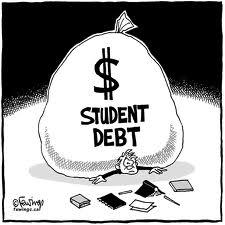
    Here are the facts, according to USAToday.  As U.S. colleges and the government pass the buck on to hapless students,  raising tuition and forcing them to borrow, the amount of new student loans last year topped $100 b. and the total outstanding amount of student loans topped $1 trillion.  American students now owe more money on their student loans than Americans owe on their credit cards (!) according to the Federal Reserve.  And guess what. If you’re an American and have a mortgage, you don’t have to pay it. You can walk away from your home and let the bank worry about it. But if you’re an American college grad and have heavy student loans, you will be hounded by the collectors for the rest of your life, even if you’ve decided to make your career in a Tibetan monastery.

    Contrast how America rips off its students with, say, Germany, where qualified college students study almost tuition-free.  Which country would YOU invest in, over the long run?  Which country has a better future? Many of the American student loans go to pay tuition to private for-profit universities, which have grown rapidly.  I used to believe that higher education was a public good.  In America, it is a private ‘bad’. 

     American college students, drowning in debt – start an Occupy Mass. Ave. movement (that’s the street, at the end of which, you find MIT and Harvard).  Demand your rights.  Demand a referendum, in which college students vote on the following issue:     Do you believe American college students should be ripped off by government and banks, to pay exorbitant tuition on borrowed money, mortgaging their whole future, forcing them to pick high-paying jobs when they’d rather do more socially-valuable things, just to pay off their student loans?   If the Greeks can vote democratically to avoid paying old debts, why not American college students?    

Global Crisis/Innovation Blog 

Patricia’s Dilemma: The Generation Gap 

By Shlomo Maital  


  The generation gap


In my travels, I meet many talented, brilliant young people.  In teaching innovation, I find that many are frustrated, because they hold high-paying jobs for companies that preach innovation but do everything possible to eradicate it.  As a result, they believe they have lost their creative spark forever. I try to restore it.

  Lately, added to the creativity frustration, is another more serious dilemma. Many young people reject the rapacious short-term profit-at-all-cost values of their employers.  The world has changed. But companies and the senior people who run them, especially those in financial services, think it has not.  They do not hear the message of Occupy Wall St.:  Change your values, change how you think and act.  What do you do, as a young manager, if the job you need is provided by those very companies whose values you reject?    

   Here is the essence of a conversation I had recently with a brilliant young woman, whom I will call Patricia.  

         Until I was 6, I grew up in Northern China, in an industrial city, China’s 4th largest.  We lived in public housing, in a row house with three other families. We shared a kitchen. We bought food in the market, in reusable containers. My job was to buy the soy sauce and I would bring it home in a refillable container with a spout. We were poor and happy and we shared.  Then we moved to America.  I did well in school and worked for a financial services company.   I avoided going into debt. I bought things when I had the money. I paid for my MBA with savings.  But I am worried by those around me, who pile up credit card debt.  In China we learned to save. 

        The last company I worked for went through four painful rounds of layoffs.  On four occasions, people were fired.  This created a bitter tense atmosphere, with no-one knowing if they would have a job next month.  It was ruinous.  This employer was a profit-maximizer. They lost sight of long-term values, of serving their clients. 

      I am now searching for a job. I don’t want to work for such a company.  But it looks like there are very few companies that are run on more pro-social ethical values.  I am searching for one.  They are hard to find.  I don’t want to compromise my values by joining a company I do not like nor approve of.  But what choice do I have? 

         I can’t recall a time when the ‘generation gap’ has been bigger — between my generation, who ruined the planet, created global warming, created the disastrous 2007-9 global crisis, and yet still fail to understand what we’ve done and why everything has to change, and quickly; and young people, whose future we have ruined by our distortion of capitalism, leaving them with a polluted planet, a mountain of debt and an uncertain future.   If the facts change, Keynes once said, then YOU have to change.  The facts have changed. The ruling generation has not.  They don’t get it.  They don’t begin to understand the young people leading Occupy Wall St.  They don’t even try. 

  Patricia and I are now engaged in a desperate search, for an employer whom she admires, who shares her basic values, and for whom she could devote her energy and brains with passion and good will. 

       Readers, can you help? 

Global Crisis/Innovation Blog 

Four Dilemmas: Some Thoughts on Solutions

By Shlomo Maital   

 In the previous blog, “Four Dilemmas”, I asked readers for solutions to four sticky problems. Here are some of mine. 

1.  Point: Americans are drowning in debt;   

     Counterpoint: But the weak economy needs people to spend, not save.  

     Solution:  Almost obvious.  Encourage people to save.  Mobilize those savings to buy infrastructure bonds, to finance new airports, roads, fast trains, schools, and cheap world-class broadband (America lags pitifully in this area, far behind South Korea).  Investment can supply the demand. The bonds will pay good interest, because the social return on infrastructure is known to be high.   America’s infrastructure is woeful. Put resources into future-oriented investment, not wasteful needless consumption.

2.   Point:   Greece cannot possibly pay even half of what it owes.  

   Counterpoint:   But if Greece does not pay what it owes, EU banks will take a huge hit. 

   The EU’s brilliant solution is to ask China for money (100 b. euros!).  China’s per capita GDP is about $3,000.  Europe’s is about $30,000.  What a perfect idea. Borrow the funds from those ten times poorer, to solve a problem you yourself created.   There must be a better way

3.  Point: America’s weak economy needs huge amounts of dollars to be pumped into it, as it is on life support, to keep interest rates low.

     Counterpoint:  But the buckets of dollars pouring into the world are weakening the dollar, eroding its stability as the world’s currency.   

   Solution:  a Global Central Bank, creating a world currency, on the Three Bears principle:  not too much of it, not too little of it.  If a central bank makes sense for America, Europe and China, why not for the world?

  4.  Point: Democracy is an intrinsic good, an ‘anchor’ value. 

      Counterpoint:  Yet democracy continues to elect incompetent politicians. And they’re getting worse.   

  Solution:  The Singapore approach. Singapore’s Prime Minister and ministers are more highly paid than senior CEO’s.   This is not about the money; it is a signal to young people, that leading your country is valuable and important.  Obama is paid less than a junior manager in GE.  If America believes in capitalism, why doesn’t it practice it?  America’s “business” has $15 trillion in annual revenue. Pay its “CEO” (President) commensurate with the size of the business. 

Global Crisis/Innovation Blog 

Four Global Dilemmas: If You Have the Solution —  Call Us

By Shlomo Maital  

  British mathematician Andrew Wiles worked for three years in an attic study in   to prove Fermat’s Last Theorem.  Then, an error was found – and he worked for another tense year to fix it.  The theorem defied proof for over 358 years – from 1637 to 1995.

   The world seems to face  problems that are equally tough to solve.  But we cannot wait for 358 years to solve them. They need solutions NOW.  And we economists are helpless.  So perhaps non-economists can crack them.

   Here are the key dilemmas facing the world today, as I see them.  If you can solve any or all, please – use the blog feature to say how.  Better yet, call or write the G20, who next week will meet in comfy warm Cannes, a perfect site, because their bumbling has become a horror movie worthy of the Cannes Film Festival’s red carpet.

1.  Point: Americans are drowning in debt;  the overall U.S. debt  includes $50.7 trillion of debt owed by US households, businesses, and governments,  more than 3.5 times the annual GDP.  Fearful of their future, people are trying to reduce their debt and save. 

     Counterpoint: But the weak economy needs people to spend, not save. If they don’t, unemployment will remain high and the economy will stagnate.  Spending is key, because it makes up 70 per cent of GDP.  The other 30 per cent isn’t enough to compensate, even if it grows a lot.  

   ?  

2.   Point:   Greece cannot possibly pay even half of what it owes. Here is why:    “In 2012 it will have to pay some 52 billion euros (35 billion in mature bonds and 17 billion in interest), while it is expected to receive 12 billion euros from the EU.   In 2013, Greece is not expecting to receive anything from the EU, but it will still need to pay approximately 44 billion euros (27 billion in mature bonds and 17 billion in interest).   It needs to have more than 84 billion euros for the 2012-13 period alone, so even if it receives a loan of 60-65 billion euros, it will still have a shortfall of 20-25 billion.  Life, however, does not end in 2013. Where will Greece find the tens of billions of euros it need annually to service its massive debt? And what will happen after 2014, when the amount to cover interest rises?”  Stavros Lygeros, Greek journalist. 

   Counterpoint:   But if Greece does not pay what it owes, EU banks will take a huge hit, threatening the stability of the entire EU financial system, and requiring a bailout.

  Counterpoint:  But German, French and British taxpayers balk at having their taxes used to bail out Greece, or, for that matter, to bail out banks.   British finance minister Osborne just declared he wouldn’t think of it.   The “solution” announced today by the EU is inadequate.

   ?

3.  Point: America’s weak economy needs huge amounts of dollars to be pumped into it, as it is on life support, to keep interest rates low.

     Counterpoint:  But the buckets of dollars pouring into the world are weakening the dollar, eroding its stability as the world’s currency.  Once central banks held 90 per cent of their reserves in dollars; now it’s closer to 60 per cent. The global economy needs a stable dollar, the U.S. economy needs a weakened dollar to stimulate exports.

   ?

  4.  Point: Democracy is an intrinsic good, an ‘anchor’ value. 

      Counterpoint:  Yet democracy continues to elect incompetent politicians. And they’re getting worse.  China selects leaders very undemocratically – and they are highly educated, highly tested (years of serving as deputies) and highly respected. 

   ?

Global Crisis/Innovation Blog

Does Democracy or Communism Pick Better Leaders? The Case of China

By Shlomo Maital


  Xi Jinping 

This is a trick question.   Does democracy pick better leaders, or Communism?  Democracy is an intrinsic value, regardless.  But lately it has been tossing real refuse onto our shores, to serve as our leaders. And we the people pay the price.   In contrast, next year, China will pick its 9-man Politburo, including a new Prime Minister and new President.  The process is secret and highly undemocratic.  So let’s compare America and China.

  In America, the Republican Party offers Rick Perry, Texas governor who does not believe in evolution and hates Social Security.  The incumbent President is great at rhetoric, but his entire management experience was as a community organizer – not exactly IBM.  At the moment, his approval rating among people under 30 is less than 50 % — and they’re the ones who elected him.    

   In China, President Hu Jintao and Prime Minister Wen Jiao Bao have navigated China successfully through the global crisis.  They are both trained engineers.  The new President will be Xi Jinping, 58. He has an engineering degree from China’s elite Tsinghua University, and he also has a doctorate.   The new Prime Minister will be Li Kequiang, 56, a lawyer with a Ph.D. in economics.  Both men have long experience in government.  Li Kequiang comes from a very poor background, from Anhui Province, and was China’s youngest governor of Henan Province at the age of 43. 

   Why, then, does America’s democratic system, which is alleged to leverage the wisdom of crowds to pick the leaders people love and trust, fail to do so,  and continually produces leaders who fail and disappoint?  And why does China’s non-democratic system seem to pick leaders with wisdom, education, experience and pragmatism?  Why does Western democracy produce leaders like Berlusconi, or Sarkozy?

   The leading Republican candidate at the moment is Herman Cain, a self-made entrepreneur whose slogan is 999. He wants to cut income tax rates to 9 percent, at a time when America is battling to reduce its deficits.  His main appeal is that he has a lovely voice and sings gospel songs during his campaign speeches.  And hey, remember Sarah Palin, candidate for Vice President? 

  There is a very strong American leader, with a proven track record – Michael Bloomberg, mayor of New York.   But he has opted out of the Presidential race, even though he has the money and the brains to succeed.  In China, he would have been picked for President. In America, he won’t even run. 

   Why?

Global Crisis/Innovation Blog

Think Fast, Think Slow:  How and Why We Argue With Ourselves …and Why That’s Great!

By Shlomo Maital 


 Daniel Kahneman

Kudos to Nobel Laureate Daniel Kahneman.  Despite the fact he could easily rest on his ample laurels, he continues to generate path-breaking research in the realm of how we think and how we act based on our thinking. Here is how New York Times columnist David Brooks summarizes Kahneman’s new forthcoming book, Thinking, Fast and Slow, an “intellectual memoir” *: 

 We are dual process thinkers.  We have two interrelated systems running in our heads. One is slow, deliberate and arduous (our conscious reasoning). The other is fast, associative, automatic and supple (our unconscious pattern recognition). There is now a complex debate over the relative strengths and weaknesses of these two systems. In popular terms, think of it as the debate between “Moneyball” (look at the data) and “Blink” (go with your intuition).  

  Here is how Publisher’s Weekly reviews the book:

 “The mind is a hilariously muddled compromise between incompatible modes of  thought… Kahneman  posits a brain governed by two clashing decision-making processes. The largely unconscious System 1  makes intuitive snap judgments based on emotion, memory, and hard-wired rules of thumb; the painfully conscious System 2 laboriously checks the facts and does the math, but is so “lazy” and distractible that it usually defers to System 1.  Kahneman uses this scheme to  show…

  • ·         why we mistake statistical noise for coherent patterns;  
  • ·         why the stock-picking of well-paid investment advisers and the prognostications of pundits are worthless;
  • ·         why businessmen tend to be both absurdly overconfident and unwisely risk-averse; and
  • ·         why memory affects decision making in counterintuitive ways.

   Innovators!  Become aware of your own System 1 and System 2.  Encourage the two systems to argue fiercely.  Be aware of that argument. And leverage it, to build path-breaking icon-smashing ideas.   I believe that we all can be aware of our ‘unconscious’ thought processes, by developing the key skill of simply listening to what they are telling us.  Avoid the sin of laziness – use System 2 to thoroughly justify what System 1 is telling you.   If you do this, then 1 plus 2 will be far far more than 3.


* Daniel Kahneman. Thinking, Fast and Slow. Farrar Strauss and Giroux: New York, 2011 (Oct. 25 release). 

Blog entries written by Prof. Shlomo Maital

Shlomo Maital

Pages