Innovation/Global Crisis Blog

Is Apple Worth More than Exxon? Is Luft Geshäft More Valuable Than Petroleum?

By Shlomo Maital

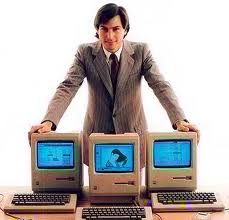
  Steve Jobs announcing the Mac in 1984

 Financial Times reports that last Tuesday, in intraday trading, the market value of Apple shares briefly exceeded that of Exxon.  At the close of trading, though, Apple again trailed, but not by much – its shares were worth $347 b., compared to $351 b. for Exxon.  Apple and Exxon now far exceed the market value of Wal-Mart, GE and other giants. 

   This leads us to ask:  Is Luft Geshäft (German for “air business”, i.e. gadgets that fetch very high prices and earn high margins) worth more than sticky black oil that powers our cars, cools and lights our homes and makes our plastic?   

   The answer is, yes.   Last quarter, Apple’s net profit doubled, reaching $ 7.31 billion, on revenue of $ 28.6 billion.   iPhone and iPad did not exist five years ago, but now  account for about two-thirds of revenue.  Apple’s cash reached $ 76.2 billion – again, at one point, more than the cash on-hand of the U.S. Treasury (before the debt ceiling was raised).  Apple’s growth was particularly driven by demand growth in China, and iPhone  shipments reached 20.3 million.  Moreover,  in the coming year, Apple computer sales are expected to double,  and iPhone sales are expected to triple.  If Apple’s new iCloud music and information storage services are successful, it will bring Apple millions of new users.

    So, for a brief but glorious moment in time, it was indeed possible to say that Luft Geshäft did exceed Big Oil in value, and more important,  consistent, persistent, blue-ocean innovative energy was more valuable than conventional energy.  Stuff that came out of the minds of creative people was more valuable than stuff that was pulled out of the ground.

    On the other hand, how many other such examples are there?  Very few.  It may indeed be tougher to extract ideas from deep in the minds of creative people, than it is to pull gas and oil from a sea bottom three miles deep and five miles under the seabed.    

Global Crisis/InnovationBlog

What is Going on?  In One Short Paragraph

By Shlomo Maital

 Today’s Financial Times (Saturday August 13) claims that the ‘flight to safety’ (a euphemism for panic sale of stocks and other assets)  last week exceeded the panic following Lehman’s Brothers catastrophic collapse on Sept. 15/2008.  Other items discuss the rioting in Britain, Greece’s deep recession, France’s crisis, Israel’s protest movement, and other types of social unrest.

   What in the world is going on?

   Here is a very short explanation.  The financial crisis of 2007-9, beginning with the U.S. and spreading to the world, led expectedly to an economic crisis, because when people lose their savings and homes, they spend less, the economy declines and joblessness rises.  Governments everywhere reacted to the economic downturn by spending more, even though tax revenues were falling. The resulting deficits created a new financial crisis, in America and in Europe, as mounting government debt panicked investors.  Central banks reacted by slashing interest rates and flooding money into the market, but that did not help, because banks and companies held the money rather than spend it, fearing future crises.  So the new financial crisis (just a continuation of the previous one, with govt. debt playing the role bank debt played before) led to renewed economic stagnation, which in turn has now become social unrest.  Governments are powerless, because a) they are now slashing their social programs, owing to deficits, so they cannot respond with more resources, and b) money policy has no room left for maneuver. The young middle class, and the poor, are revolting,  in different ways, some peacefully, some with violence – and some, as in America, with continued quiet desperation.  The tragedy is, this drama unfolds predictably, because social unrest always follows economic depressions, which always follow severe financial downturns. Yet as always our leaders were taken by surprise by it.  And that deepens the financial panic. It is a series of feedback loops.

     It is unclear how the world can emerge from this mess.  If you, dear reader, have some ideas, please pass them on. 

Innovation/Global Crisis Blog

Bad Times Means Great Books: Here are the Best!

By Shlomo Maital

   Bad (economic and financial) times inevitably bring a crop of great books, telling us why we got into a pickle and who is to blame.  Here is this year’s batch: The partial list of books nominated for the annual FT Goldman Sachs book award. 

  • Entrepreneurs:   No Angel, by Tom Bower (about Bernie Ecclestone, who built Formula 1 into a huge business empire);    Grand Pursuit: The Story of Economic Genius, by Sylvia Nasar;  also,  Car Guys vs. Bean Counters, by Bob Lutz, about how the financial cost-cutters ruined America’s car industry. 
  • Global Crisis 2007-9:   Fatal Risk: A Cautionary Tale of AIG’s Corporate Suicide, by Roddy Boyd.  Exorbitant Privilege: The Rise and Fall of the Dollar, by Barry Eichengreen; Extreme Money: The Masters of the Universe and the Cult of Risk, by Satyajit Das; The Wizard of Lies: Bernie Madoff and the Death of Trust, by Diana Henriques; Wilful Blindness: Why We Ignore the Obvious at Our Peril, by Margaret Heffernan;
  • Future Trends:  That Used to be Us: How America Fell Behind in the World It Invented and How We can Come Back, by Thomas Friedman and Michael Mandelbaum; The Next Convergence: The Future of Economic Growth in a Multispeed World, by Michael Spence; Triumph of the City: How our Greatest Invention Makes us Richer, Smarter, Greener, Healther and Happier, by Edward Glaeser;  The Quest: Energy, Security and the Remaking of the Modern World, by Daniel Yergin.   Poor Economics: A Radical Rethinking of the Way to Fight Global Poverty, by Abhijit Banerjee and Esther Duflo.
  • Management:  Good Strategy/Bad Strategy: The Difference and Why It Matters, by Richard Rumelt. 

I especially recommend the “future trends” books.  The books about the scoundrels who brought us the 2007-9 global crisis, which is now fast becoming the 2007 – no-end-in-sight global crisis,  will raise your blood pressure. 

Innovation/Global Crisis Blog

Three Cheers for David Beers… David Who?

By Shlomo Maital

 David Beers:  Last Honest Man?


Very few people have heard of David Beers.  He is the head of Standard & Poor’s sovereign bond rating department.   He makes the decision whether to, for instance, downgrade America’s Treasury bond rating from AAA to AA plus.   Which is just what he did last Friday, after the stock market closed in New York.  Both before and after his decision he was subject to pressures one can only imagine – including a claim by the U.S. Treasury Dept. that he and his team made a mistake amounting to $2 trillion, in estimating America’s debt burden.   (It turns out that $2 trillion, which is 14 per cent of US GDP, is insignificant; $15 trillion have to be cut from America’s budget in the next decade!).

   Former U.S. Assistant Treasury Secretary Larry Summers vilified Beers, recalling that S&P failed to downgrade mortgage-backed securities and hence directly helped cause the global financial crisis in 2007-9.   Thanks, Larry, we had forgotten that.  But, Larry, as you well know, Beers had nothing to do with that – that was another department in S&P.  Do you think the Republican and Democrat leaders, including the President, bear any responsibility, for an anemic  deficit-reduction plan that only cuts spending by $20 b. this year? 

    Here is the key fact that justifies Beers’ courageous decision, which fires a shot across the bow of America’s dysfunctional politicians. (From Bloomberg Business Week):

  “A June analysis by the Congressional Budget Office concluded that keeping the U.S.’s ratio of debt to gross domestic product at current levels until the year 2085 (to avoid scaring off investors) would require spending cuts, tax hikes, or a combination of both equal to 8.3 percent of GDP each year for the next 75 years, vs. the most likely (i.e. “alternative”) scenario. That translates to $15 trillion over the next decade—or more than three times what Obama and Boehner were considering.   You start to see why, absent signs of a serious commitment to deficit reduction, the rating services are warning they may downgrade the federal government’s triple-A rating even if Congress does meet the Aug. 2 deadline. Fortunately, our debt hole is escapable. But digging out requires that leaders of both parties come to terms with just how deep it is.  

   In other words, just to keep America from sinking deeper in debt,  American consumers, for instance, will have to lower their average standard of living by 12 per cent (lowering personal consumption from 70 per cent of GDP to 62.5 per cent – still far higher than in China, for instance).  This is not impossible, or even draconian.  It means giving up all eating out and entertainment, for example.  Has any American leader pointed out to Americans, that in order to dig the U.S. out of its hole, every American will have to stop eating out in restaurants and going to movies, forever (not just for a month or two)?  

    David Beers deserves praise.  All those attacking him deserve sharp criticism.  By attacking Beers, they are discrediting perhaps the last honest person in a position of authority in America, one willing to tell the truth.

Global Crisis/Innovation Blog

Equal Societies are Stronger

By Shlomo Maital

The Spirit Level: Equal Societies are Stronger!


After protest movements swept across the Arab nations in the Mideast, they have now spread to Israel.  Some 100,000 young protesters gathered last Saturday night, in Israel’s major cities.   As in the Arab Spring, it is unclear what the young Israelis seek.  But reading between the lines and listening carefully, it becomes clear. They want a more equal, more fair, more just society. 

    Harvard Univ. economist John Kenneth Galbraith once write, “The modern conservative is engaged in one of man’s oldest exercises in moral philosophy: that is, the search for a superior moral justification for selfishness”.   Once an egalitarian society, Israel embraced raw capitalism, justified selfishness on grounds of efficiency and wealth – and its modern “conservatives” led by our Prime Minister helped Israel join America as a country with one of the most unequal income distributions in the world.  (U.S. ranks third, Israel a close fourth; top of the list are Hong Kong and Singapore).   

    A 2009 book by two British epidemiologists, Richard Wilkinson and Kate Pickett, titled The Spirit Level, reaches the following conclusion:  above a certain level of GDP per capita, say, $20,000,  income is uncorrelated with all the major social indicators, such as health,mental illness, violence, education, etc.   What does correlate well with social wellbeing is (lack of) inequality.  The more unequal the society, the worse its health and society, in every indicator.  Their careful study includes a large cross-section of wealthy nations, along with the 50 American states. 

     Capitalists, you have run out of excuses.  Inequality is not only morally wrong, it is socially and politically stupid, because it makes your people worse off.    Read the book (you can download it from Amazon); the evidence is very strong.  

   As the late Harvard U. professor Albert Hirschman noted, there are two things you can do when faced with something you dislike:  “Exit” (leave, quit, don’t buy it, drop out), or “Voice” (protest, organize, complain, act).  For years, we have practiced “Exit”,  in all parts of the world.  Now, the young people are using their “Voice”.   We wish them all well.        

Global Crisis/Innovation Blog

Why Did the Stock Market Crash? Why Now?  

By Shlomo Maital

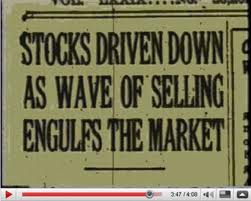
   The 1929 Crash…  and the 2011 Crash 


NEW YORK August  4/2011 — The Dow Jones Industrial Average plunged 4.3 percent Thursday, its worst one-day drop since the financial crisis, as global markets melted down over fears of a new economic downturn.  The Dow closed down 512.76 points to 11,383.68. The broader S&P 500 lost 4.8 percent to 1,200.07, while the tech-heavy Nasdaq Composite plunged 5.1 percent to 2,556.39.   The last time that the Dow fell as many points in a single day was in October 2008, during the nadir of the global financial crisis.    

  Why now? 

  The world is finally realizing that another perfect storm has occurred. 

  • Governments are slashing spending, as they find it harder and harder to borrow, and more and more expensive to borrow.  This, at a time when government demand and government jobs are the only things holding up the economy, in Europe and the U.S.
  • People are cutting their spending, in the face of daily headlines featuring dysfunctional political leaders who cannot even understand the problems their nation faces, let along deal with them, in Europe and the U.S.
  • Businesses are piling up cash, but are not even thinking of spending it on investment. American businesses like Apple have huge piles of cash, but it is held abroad where taxes are low, thus not benefiting America.  
  • World trade is weak; when GDP is stagnant, so are imports and hence exports. The only good news in this is that the price of oil is dropping like a stone.

     Failure to address the fundamental cause of the 2007-9 global crisis (massive expansion of dollars in the world, at a time when the world needs a stable reliable currency) has now led to a ‘double dip’, which is simply a continuation of the original crisis, in different forms.  It is not a double-dip recession, but rather the same one that is getting worse.   US Treasury Secretary Tim Geithner’s New York Times Op-Ed last August, “Welcome to the recovery” should cost him his job.  He just didn’t get it.  What recovery???

    President Obama says his Administration will now focus on creating jobs.  Well, how, Mr. Obama?  How about these data, from The Economist: 

    Some 6.3m workers have been off the job for more than six months, and the average duration of unemployment has grown to nearly 40 weeks.  With over 16% of the labour force jobless or underemployed, some firms are advertising that the long-term unemployed need not apply.   Workers recently laid off have a 30% chance of finding work in a given month. For workers off the job for more than six months, that chance is no better than 10%.    Growing ranks of the unemployed are exhausting the available 99 weeks of unemployment insurance. When the current emergency benefits program expires, the maximum duration of benefits may drop to just six months—a quarter of the current time span—although the Obama administration says it will fight for a new extension.  (Chances the House will approve it?  Zero).  Further attempts at fiscal stringency may hack away at other support programs, including food stamps and Medicaid, a health-care entitlement for the poor.  A staggering 45 million Americans now use Food Stamps.

  Happy 50th Birthday, President Obama. Perhaps, given the above, you should come home from Chicago, call Congress back into session and start to address the deep crisis America and the world finds itself in.  This is no time for summer vacations.

Global Crisis/Innovation Blog

 Could the Tea Party Possibly Be… Right?

By Shlomo Maital

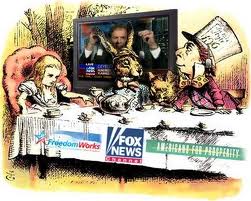
 John Tenniel’s ‘take’ on Alice’s Tea Party     

 Perish the thought, but – could those extreme 87 United States Congresspersons, who call themselves the Tea Party, be right?   They’re regarded by most people, even by Republicans, as extreme fanatics who want to slim government at all cost, even if means cutting Medicare, Social Security and other key social benefits.  They’re the ones who brought the U.S. to the brink of defaulting on its bonds and rattled capital markets all over the world. 

      I always urge my students to think different(ly).  Think contrarian.  So, could the Tea Party actually – be right?

     In a recent piece in the Singapore Business Times,  R. Sinvanthy recalls an episode in history worth remembering.  In 1981 Margaret Thatcher, British PM, brought in a draconian budget that slashed government spending, raised taxes, narrowed the budget deficit, closed coal mines and in general radically reduced the role of government in Britain.  In response, 364 economists wrote a letter to Thatcher, saying that her budget was disastrous and would deepen Britain’s economic crisis (the 1980-81 recession).  Among the signatories were top academics, incuding a Nobel Prize winner and two would go on to win the Nobel Prize in economics, along with Mervyn King, current Governor of the Bank of England. 

    And boy, were those guys wrong!  Within two years, Britain’s inflation rate fell from 18 per cent to 5 per cent.  (See Phillip Booth, Were 364 Economists All Wrong?   Institute of Economic Affairs, 2006).  Britain’s economy began to grow.  Thatcher was right. The geniuses were wrong.

    The Tea Party is extreme, but often to make a point you need to express it in an overly extreme fashion, just so people will take notice. As I understand it, the basic point they make is a correct one.  America is a business, like any country.  The business of America is being run badly by its political leaders.  Get your act together. Shape up.  Run America like America’s managers and entrepreneurs run their businesses.  President Obama, it’s not enough to appoint Jeff Imelt (GE CEO) to head a committee.  You have to BECOME him!  Run America like Jeff runs GE.  Deleverage. Reduce the debt. Slash waste. Do all the hard things America needs to become strong and stable again.  And do it quickly, using the principle:  All the bad news at once, good news a little at a time.  If this is what the Tea Party crazies are saying – well, I think I support them.    

Global Crisis/Innovation Blog

Fighting Terrorists With Mice: Not a Mickey Mouse Idea

By Shlomo Maital

   The website  http://www.israel21c.org  provides the following vignette, in the annals of Mickey Mouse innovation:  Mickey the terror fighter. 

   Here is the basic idea:  

 Israeli startup Bioexplorers has developed a new and unique way to sniff out terrorists – literally. After years of research, company CEO Eran Lumbroso tells ISRAEL21c, Bioexplorers has hit upon a foolproof, non-invasive and easy method to detect contraband in purses, luggage and even cargo – using mice.  It’s no joke. “Mice have an excellent sense of smell, and they’re relatively easy to train. And they’re easier to use for odor detection than other animals traditionally used for their olfactory capabilities.” Dogs are most often used by security forces to detect drugs and explosives, says Lumbroso, but they generally respond to the directions of their trainer, making their work more of an art than a science. “I was looking for a way to automate and mechanize the training process, so it could be duplicated easily and installed in a variety of settings. And we have been able to achieve that goal using mice.”  Here’s how it works: A person passes through a passageway in which a Bioexplorers system is installed. A fan passes air into a sensor receptor, and delivers it into a chamber with several mice. The mice, having gone through intensive behavioral training, sniff the air. If the odor is one associated with items the mice have been trained to recognize, like drugs or bombs, they move into another chamber – setting off an alarm. Security officers can then move in and stop the appropriate suspect.   “The mice rarely make an error, and the entire procedure is far less invasive or intimidating than the alternatives, like using dogs or X-ray machines,” says Lumbroso. “There’s no radiation, and no concern about being seen naked,” he adds.  The system is appropriate for use in any setting – airports, government buildings, shopping malls. In fact, the company has conducted several tests at sites in Israel to ensure that the sensors work in real situations, including at Tel Aviv’s Azrieli Mall. More than 1,000 people passed through a Bioexplorers sensor – some having been given “suspicious” objects and substances to hold – and the mice made the right call every time, says Lumbroso.  The rodents employed on this security detail are specially raised lab mice, “which are very clean, and there is no chance that they will transfer diseases to humans, since there is no contact between the mice and the people passing through the sensor,” says Lumbroso.  The mice are trained over a period of about two weeks using a patented computerized program based on Skinner-style behavior theory and methods, “which we have tweaked using our own special technology and methodology,” Lumbroso says.

  Lumbroso is a biologist. He’s been working on his idea since 2004.  We can only imagine the kinds of comments he got, when he first proposed his idea.  

Global Crisis/Innovation Blog

The Speech Obama Never Made – and Never Will *

By Shlomo Maital

 My fellow Americans,

    “No, America is not the greatest country in the world, like we politicians like to repeat endlessly. We’re probably not even the 95th greatest country in the world.  And here is why.  America has just been throwing a huge party, it has lasted for over 30 years, under Republican and Democrat Presidents alike, we’ve overspent, underinvested, undersaved and we’ve done this for three decades.  What enabled us to do it is the fact that the dollar is the world’s currency, so we can just print dollars and persuade countries like China to accept them, in return for massive amounts of goods.  We never ever looked at ourselves in the mirror and said, hey, there is something radically, morally wrong here, when a wealthy country like America borrows enormous sums from poorer countries like China, not to build the future for young Americans, but to let spoiled baby-boomer Americans enjoy life now at their kids’ expense  and now, to retire all-expenses-paid.    And friends, guess what.  It is time to pay the piper.  The bill collector is knocking at the door.  Here is why.   The Congressional Budget Office concluded that keeping the U.S.’s ratio of debt to gross domestic product at current levels until the year 2085  would require spending cuts, tax hikes, or a combination of both equal to 8.3 percent of GDP each year for the next 75 years…. That translates to $15 trillion over the next decade—or more than three times what I  and Speaker of the House Republican John Boehner were considering.   We can’t get the House and Senate to agree on $5 trillion of cuts..and we need $15 trillion, just to stay in the same place, like the Red Queen in Alice in Wonderland.   We need to cut consumption from 70 per cent of GDP down to about 60 per cent.  Now, THAT’S PAIN!   Boston University economist Larry Kotlikoff has calculated that if you project the gap between federal spending and federal income, under current budget conditions,  here is what you get:  a fiscal gap—i.e., the net present value of all future expenses minus all future revenue—amounting to $211 trillion.   Now that, my fellow Americans, amounts to 15 times our annual GDP.  And 15 times our current national debt.  So, I guess the conclusion is clear.  The party is over.  We will now have to LIVE WITH substantially lower standards of living, the way we live, for at least an entire generation, OR POSSIBLY THREE GENERATIONS, just to stay afloat.  I know you don’t like to hear that.  Americans want the party to continue.  But one way or another, the party’s over.  And I’m afraid that if we don’t take drastic action, the unthinkable will happen.  while America has accused a whole shopping list of other nations of irresponsibility – Mexico, Russia, Brazil, Thailand, Indonesia – all the while, it was America that was acting in the most reckless way of all. Because America is not just another country, it is the country whose money funds the world.  And my fellow Americans, I’m sorry to tell you, America is bankrupt. Oh, I know, we’ll muddle through somehow, we’ll find a way to somehow raise the debt ceiling, even if the rating agencies do downgrade us to double A instead of triple A.  But the time for muddling through is long past.  We need to make drastic cuts in what we spend, so we can set aside resources to pay for what we borrowed, and recklessly squandered, in the past – using up resources instead of using them to build assets that generated income to help us pay back the debt.  So now, we have the debt, but not the productive assets that debt should have created.  So, yes, my fellow Americans, America is probably about the 95th greatest nation in the world, and is still heading down.  I expect that when I tell you this, and when I tell you how terrible our situation is, and how awful the medicine we have to take is, you will defeat me in the 2012 election.  You may elect someone who tells you beautiful things, like I did,  “Yes We Can!”.  Well, Americans, no, we can’t.  We can’t seem to do the right thing, take painful medicine, and get our country on a solid footing again.  Because we’re soft and flabby, and we’re about to become a second-class power, despite our vast super-expensive military (which is a main cause of our decline, not the solution), just like Britain before us in 1900, and Spain before that….and Rome before that, and before that, Greece.   So, G-d bless America, G-d bless you and your families,  and only G-d knows how in the world we’re going to dig ourselves out of this god-awful mess that we ourselves created.  Current trends are unsustainable. The sooner the adjustments begin, the more gradual they can be. It’s easier to slow down from 70 mph by stepping on the brakes than by slamming into a wall.  But, Americans, let’s face it.  We are going to hit that wall.  Because our democratic political system just does not know how to put on the brakes.”

  • Based on Bloomberg Business Week,  “Why the Debt Crisis Is Even Worse Than You Think”, by Peter Coy.  Aug. 1. 

Global Crisis/Innovation Management

What in the World Is Going On?

By Shlomo Maital

  THE WORLD IS IN A BLOODY MESS….

      Are you as baffled as I am by the unfolding chain of events in the world, each one improbable and trouble? 

     What in the world is going on?

    Here is my take, based in part on the keen-eyed observations of a friend, a senior Asian diplomat. 

  • The Arab Spring.  Whoever called it “spring”? It feels more like fall, or a fall.  It is not, as the media romantically portray it, a democratic uprising, but rather, soft coups, take-overs by the armed forces, especially in Egypt.  The only forces organized enough in Egypt to gain control are the Army and the Muslim Brotherhood and in the end they will share power.  For this crucial nation, the future is not bright, nor is it bright for their neighbors.  Chaos never helps anyone. 
  • American debt ceiling:  The damage has already been done, whatever the intransigent Republicans and the indecisive Democrats do.  America should be stood in the corner, like a naughty child. Here is the simple reason why.  America built the current global system, built around the US dollar as the key global currency, and in doing so, back in 1944 (at Bretton Woods), promised to run its money responsibly, with the interests of the world in mind.  But, as former Texas Governor John Connolly once said, “it’s our money and your (the world’s) problem”.  So America has flooded the world with cheap bucks, and the result is to endanger world stability.  The U.S. debt ceiling crisis has been managed, as if America alone existed.  And the ‘collateral damage’ Obama referred to is not the American people, but innocent bystanders, 7 billion of them, around the world.  This is immoral and irresponsible behavior, unforgiveably bad behavior by America, and the damage is permanent. America will not regain the trust and credibility it once had, in the eyes of the world. 
  • Europe:  No, it’s not about Greece. It’s about wealthy northern economies doing well, and poor southern Europe economies doing badly, and the rich in the North doing nothing to help them, except hassle them to pay their bills.  Europe is now a mixture of competitive economies doing well and uncompetitive economies doing badly. For the latter to do well, they will have to undertake painful structural changes, which none of them are equipped to do.  The only result can be a split, because the current situation is unstable and will bounce from crisis to crisis.  No-one is addressing the question: How will the southern economies build a winning global competitive strategy?  How will they rebuild some sort of strategic competitive advantage?  No it is not about debt – it is about how people will make a living. 

Mideast, America, Europe.  About half the world’s economy is in deep trouble, and the source is all the same – political mis-governance, and in some cases, too much democracy rather than too little.  (If the system is democratic, what group of people will ever vote to impose serious pain on themselves, in the short run, even if long run gain is assured?).    

   This may all seem very pessimistic, but it is not.  There are huge opportunities in this mess for creative clever people who want to do good, who know how to run organizations and build ideas, and act to create value and meet needs.  Don’t wait for the politicians.  It’s up to you and to me. 

Blog entries written by Prof. Shlomo Maital

Shlomo Maital

Pages