Innovation Blog

Lionel Messi – Legs With Super Creativity

By Shlomo Maital

    

 In the recent April 6 Champions  League football match between Arsenal and Barcelona, two teams that play beautiful, fluid attacking football,   Barcelona star Lionel Messi scored an amazing four goals, as his team defeated Arsenal 4-1. (Arsenal manager Arsene Wenger said afterward, “I don’t know how many players in the world can score a goal like that!”).  His team-mate Xavi called Messi’s performance “outrageous!”.   In his fourth goal, Messi raced in on the goal tender, then coolly and audaciously flicked the ball over his head into the net.

    What is Messi’s secret?  What can we learn from him?

    *  The enormous value of overcoming adversity:   Messi will be 23 years old on June 24.Born in Argentina, his parents were working class — his father worked in a factory and his mother was a cleaning lady.  Messi began playing football at age 5 and showed amazing talent at age 8.  He was very very small, but played street ball against far bigger persons than himself, and with alacrity, resilience and speed managed to get around them. His style was forged already in the streets of Argentina. 

   Messi had growth hormone deficiency.  The Argentine squad River Plate, with whose youth team he played,  could not afford the costly treatments, $900 / m. for the growth hormone.  Barcelona’s legendary sporting director  Carlos Rexach heard about Messi and brought him  and his family to Barcelona, home of the world’s best youth football school.     Messi is now a Spanish citizen and is regarded by Barcelona fans as a home bred product.   All his life, Messi has had to overcome defenders far bigger than him, up to 12 inches taller.  Practice makes perfect.

   * …and the advantage of being small:   Messi is only 1.69 m. (5 ft. 7 inches).  He is very small indeed, despite the growth hormone treatments.  But he is tough, and his small size makes him very slippery and hard to defend.  He is able to dribble around any defender, however big and experienced.  And he is tough enough to take fierce tackles without being injured.   Creative people turn their disadvantages into strengths.

     *  do what you love with joy and passion:   Messi has a perpetual smile.  He clearly loves playing football, he loves crafting creative goals, and the joy with which he plays reminds one of Ronaldinho in his prime.   Many star football players are jaded, more interested in women and good times, and play just for the money;  they care little about the team symbol.  Messi cares.  He will be with Barcelona until his career ends, hopefully many years in the future. 

   You can watch Messi’s goals on YouTube.  Be sure not to miss them, at least the fourth one.


Innovation Blog

“Architecture” and Entrepreneurship

By Shlomo Maital

   Carliss Baldwin

A new research paper by Harvard Business School Professor Carliss Baldwin discusses “how entrepreneurial firms can use superior architectural knowledge of a technical system to gain strategic advantage”.[1]

   Loose translation:  How innovators can create sustained competitive advantage, by finding ways to improve the design of a business —  speed, quality, invention. 

   The paper extends the author’s work on The Power of Modularity,  title of a joint work with Kim Clark.

    Prof. Baldwin’s key point is this: “identify ‘bottlenecks’ in the existing system; create a new architecture that isolates the bottlenecks in ‘modules’; focus on supplying superior bottleneck components, while outsourcing non-bottleneck components.”  

  Architecture is defined as the list of functions (of a product), components needed to perform the functions, the interfaces among the components, and a description of how the system will operate over time and under different conditions.    “All  products and processes have architectures”.     

     She offers as case studies, Apollo Computers and Sun Microsystems; and Dell Computers.

  *    Sun’s architects identified memory access as a bottleneck.   They then developed two special hardware components that made memory access speedier.  Everything else, they bought from suppliers.   For instance, they used the UNIX operating system, rather than design their own.  And they adopted Ethernet.  Sun was thus able to defeat Apollo.  

  * Dell redesigned its manufacturing cells, in the 1990’s,  located them close to its main markets, employed just-in-time, and worked to smooth bottlenecks in order-taking, assembly and shipment.  It also identified a capital bottleneck.  It gave no credit to dealers or customers, but demanded generous credit terms from its suppliers, creating working capital acquired from its suppliers.  This helped Dell finance its activities. 

    Baldwin observes that in strategy, there are several approaches:  RBTF, resource-based theory of the firm (firm resources are crucial); KBTF (knowledge based theory of the firm, based on how knowledge is created and flows internally); DCTF (dynamic capabilities theory of the firm), interplay of production and transactions costs.  To this is added the Architecture Based Theory of the Firm (analysis of the business design and ‘architecture’).  When used together, these four approaches can yield powerful insights for innovators.     


[1] Carliss Y. Baldwin, “The strategic use of architectural knowledge by entrepreneurial firms”, Harvard Business School, Feb. 2010.   cbaldwin@hbs.edu

Innovation Blog

Successful Product Innovation:  Three Critical Success Factors, from McKinsey

By Shlomo Maital

    The January issue of McKinsey Quarterly has an interesting article, rated highly by its readers, on the three critical success factors for new product innovation, based on field research. [1] Here is a short summary.

    According to the four authors:

We found—after surveying more than 300 employees at 28 companies across North America and Europe—that the businesses with the best product-development track records do three things better than their less-successful peers:

* They create a clear sense of project goals early on,

* They nurture a strong project culture in their workplace, and

* They maintain close contact with customers throughout a project’s duration.

   The impact these three success factors had is enormous.  According to the authors:

The teams in our study that embraced these tactics were 17 times as likely as the laggards to have projects come in on time, five times as likely to be on budget, and twice as likely to  meet their company’s return-on-investment targets.

    Some 70 % of those working on high-performing projects had a clear view of the project’s scope from the outset,  compared to only a third of poor performers.  There was also a “project management culture” in the high-performing projects, rather than a self-managed approach in which individuals made decisions, under stress, which generally were sub-optimal for the project as a whole.  And most important, customer intimacy:  Some 80 % of the top performers said they validated customer preferences during the development process, compared to 43 % of the laggards.  

      The high performers were also far more likely to do research on what customers wanted, in advance.  For instance, notes McKinsey, a medical device maker  used a weighting matrix to identify and weigh the importance of various features, then tested the tradeoffs and consulted with specialists and surgeons who used the product in clinical settings.  That fine-tuning was crucial, it emerged.

     All these three success factors are plain common sense, like so many aspects of good management — but nonetheless, so many are ignored by so many ‘innovative’ companies. 


[1]The path to successful new products”   Mike Gordon, Chris Musso, Eric Rebentisch, and Nisheeth Gupta.  McKinsey Quarterly January 2010.

Global Crisis Blog

Rashomon & the Global Crisis 2007-9

By Shlomo Maital

  Expectedly, a spate of books is appearing, interpreting the causes, nature and effects of the global crisis 2007-9.  My own book (which leverages the crisis to explain why and how managers must now think for themselves, and never again rely solely on economists) will appear in June.  (Global Risk/Global Opportunity:  SAGE, 2010). 

     It is hard to sift through the various perspectives, to find the real truth.  It is much like the legendary 1950 Japanese movie Rashomon, which depicts the rape of a woman and murder of her samurai husband, through the eyes of the wife, the bandit, the samurai and the woodcutter — each account being very different, each account truly believed by the teller.   As I have learned during recent study groups, even the Bible is not exempt from the ‘victor’s syndrome’ (the victor tells the ultimate story, even if it is false).  The Book of Kings is written in a biased manner in favor of the Kings of Judah, severely distorting historical truth, against the Kings of Israel (the northern tribes that split away from Judah). 

    The latest entry is The End of Wall Street,  by Roger Lowenstein, a top (the top?)  Wall Street reporter.  (Penguin: 2010).  Reviewed by equally sharp financial reporter Joe Nocera, in the Global New York Times (April 4),  Lowenstein’s book (which follows one he wrote on Long Term Capital Management) avoids clichés and focuses on the “business theories that led to grievous destructive miscalculations” (the idea that a world of highly interconnected financial systems makes regulation unnecessary and smoothes away business cycles or bubbles).   My guess is The End of Wall Street will be the definitive book on the crisis,  at least for many years, until the focus of time helps us overcome the Rashomon effect and truly understand cause and effect. 


Innovation Blog

Burned Your Toast?  Serene Acceptance —  Or Creative Resistance?

By Shlomo Maital

Did you burn your toast this morning?

    Probably not — thanks to an inventor  named Charles Strite, who invented the pop-up toaster (and patented it, US POT #1,394,450, issued  October 18, 1921).  

     Like many many thousands of people worldwide who toasted bread in the morning, in toasters that opened and closed manually,  Strite had toast in the morning,  in the cafeteria of the plant where he worked.  The cooks burned it, as often happens (they were busy doing other things). 

        But Strite then acted unlike others had before him.  Most people accept bad outcomes, like burned toast, with serene complacency and peaceful acceptance, or perhaps unpeaceful acceptance, accompanied by bad language.  

    Strite offered ‘creative resistance’ — it does not have to be this way, he thought.  There is a solution to burned toast. 

    Strite simply took existing devices — springs, and a variable timer — and added them to the toaster.  Result: pop-up toaster, and an end to burned toast.   The solution was obvious.  Toast needs to be ‘timed’.  It can be ‘timed’ by human hands, or by a device that does it.  I.e., a timer.   Now what happens when the timer signals “done”?   Something has to happen to stop the toasting. What?  Something must open the toaster.  Or, move it away from the heating coils.  A  spring device?  Open the toaster doors?  Or,  pop up the toast, while turning off the heating coils.  This was Strite’s simple logic.  Like many invention problems, it was all a matter of systematic logic, defining the problem and then thinking it through carefully.

    Like many inventors, Strite misjudged his market. He thought the market would be mainly for restaurants.  But the pop-up toaster soon became a common kitchen appliance.  In no time, the manual toaster disappeared. 

     Strite was a master mechanic. He knew how to make things.  This is crucial.  Producing a prototype of the pop-up toaster was vital to its success.  But in addition to his mechanical skills, Strite had a mindset that sought to solve problems, rather than live with them. This is a key to successful innovation.

     What is your mindset?  Serene acceptance?  Or stiff stubborn resistance, in searching for solutions to problems most of us simply choose to live with.

     Next time you have your morning toast, think about Charles Strite and see if you can emulate him.


Global Crisis Blog

The Future of Capitalism…As Seen by Anthropologists

Does Fairness Convey Evolutionary Advantage?

By Shlomo Maital

   As the dust from the 2007-9 global crisis clear,   it dawns on the world that the global crisis has not ended but simply changed its form (from financial crisis to recession to sovereign debt crisis, a la Greece, Spain, Portugal, Ireland).   Some have begun to think about how to reinvent capitalism.   Don’t ask economists.  They are still shell-shocked. As David Brooks notes in his New York Times column today, economics needs an entirely new paradigm.  But building one will take a long time, because today’s economists have a huge human capital investment in the existing one. 

    Let’s then turn to the anthropologists.   Unlike the economists, they ask really good questions, and answer them by studying a wide variety of 15 different human societies.  The latest such study is led by Joseph Henrich, published in SCIENCE magazine. [1]    Henrich and his team ask:  “why do ‘strangers regularly engage in mutually beneficial transactions'”?   In other words: Why doesn’t everybody act like the Wall St. money-grubbers who destroyed the world for their own short-term gains and bonuses?  Why are some societies characterized by pro-social behavior?

     They study 15 different societies, including a group of people in Missouri, United States.  What they find offers much hope for human society.

      The researchers use the Dictator Game to study values.  In this game, two players are given a sum of money.  Player 1 must decide how to divide this sum between himself and Player 2.  Player 2 receives the allocation (offer) and the game ends.  Player 1’s offer provides a measure of Player 1’s behavioral fairness.

    They find that the larger and more ‘modern’ societies are, the higher the “mean dictator offer” (as a percentage of the ‘stake’, or sum of money).  In Missouri, U.S., the stake approaches 47 per cent, nearly half.  They find a correlation between the modernity, complexity and size of the population, and also the degree of religiosity,  and the percentage of the stake offered to Player 2.

    Why does such pro-social behavior emerge, and thrive?  Two possible reasons, Henrich and his team say, are, a) ‘innate social psychology calibrated to life as it was in tiny family groups in Paleolithic ancestors’, and b) pro-social behavior enables large complex societies to do better than societies characterized by selfish it’s-all-about-me behavior.  They conclude in favor of (b).

     What this implies, then, is that the global crisis caused by rapacious greedy behavior by a handful of traders, speculators and bankers on Wall St. is not a norm but an aberration, and the society that encouraged or tolerated it will, in the long run, lose out to societies that are more pro-social and respect fairness.

   Apparently,  fairness does convey evolutionary advantage, to societies (and to companies?), by generating social cohesiveness that makes societies resilient, high-performing, motivated and long-run stable. 

   Thanks, anthropologists, for giving us the answer that economists repudiated for centuries.   


[1] Joseph Henrich, et al., “Markets, religion, community size, and the evolution of fairness and punishment”, SCIENCE, 19 March 2010, pp. 1480-1484.

Innovation Blog

Genius – Its Origins and How to Develop It

By Shlomo Maital

Guus Hiddink 

 Two seemingly unrelated pieces in today’s Global New York Times (March 24) shed light on a key issue in innovation:  How to develop genius and where genius comes from.[1]

   Anne Paul reviews David Shenk’s important new book on genius, which argues that we have not a “talent scarcity” (as HR experts continually caution), but a “latent talent abundance”…our problem is not “our inadequate genetic assets” but our “inability so far to tap into what we already have…the truth is that “few of us know our true limits, that the vast majority of us have not even come close to tapping what scientists call our ‘unactualized potential’. ” 

    Schenk reviews a large scientific literature on this subject.

    In his regular piece on global soccer, Rob Hughes discusses coach Guus Hiddink, who has developed and discovered some of world soccer’s greatest stars,  such as Romario, Ronaldo, and Korean Park Ji-sung.  Hiddink became coach of South Korea’s soccer team and in the 2002 World Cup took the team to the semi-finals, an amazing achievement.  He used three simple principles, which apply equally to innovation talent as to soccer talent:

  1.  Keep the game simple.   Simplifying problems, cutting through to the core, is essential in both soccer and innovation.

  2. Communicate through actions, not words.  Hiddink’s hard work elicited similar hard work from his players.   He walked his talk.

 3.  Demand that others work as hard as you are prepared to do.  Genius is not 1 per cent inspiration, and 99 per cent perspiration, as Edison once said; it is 100 per cent both inspiration and perspiration. 

     Hiddink made his South Korean players fit as Europeans. Then he made them believe they could win.  The combination was powerful.

     One of the core competencies of today’s global managers is skill in developing innovation talent.   Since this is the core skill of sports coaches and managers, it is worth benchmarking those among the coaches that excel in this. 


[1] Book review of The Genius in All of Us, by David Shenk.    Anne Murphy Paul;   and “Transmitting a gift that goes beyond words”, by Rob Hughes (Global Soccer).

Innovation Blog

Rwanda:  Entrepreneurship, not Genocide

By Shlomo Maital

   In a recent three-part episode on the BBC World Service’s Global Business program, Peter Day visited Rwanda and described its amazing renaissance, through entrepreneurship, after the horrendous genocide in which 800,000 people were slaughtered in 1994.  Its driving force is President  Paul Kagame,  whose guerilla force entered Rwanda and is credited with stopping the slaughter, when UN and other forces were impotent to do so.

     The Republic of Rwanda  is a landlocked country located in the Great Lakes region of eastern-central Africa, bordered by Uganda, Burundi, the Democratic Republic of the Congo and Tanzania.  It has 10 million people, and covers some 26,000 sq. kms.  It achieved independence from Belgium in 1962.

    Rwanda’s vision, led by Kagame, is to become a mid-income country, rather than a poor one, in 10 years.   A new road leads from the capital Kigali to  Nyamata. Kigali is lovely, well-run, and relatively safe.  A terrible slaughter occurred in 1994 in Nyamata, in a Christian church.  It is now a memorial, with the clothes of those slaughtered still on the pews.    Peter Day spoke with an NGO called Rwanda Works .   Officials said Rwanda’s government is covering the country with fiberoptic lines (which run under the road) and other transportation infrastructure.   

     Rwanda has fertile red soil.  It is a country of beauty, known as the Land of the Thousand Hills, now being repopulated.  Immigrants have come from overpopulated parts of Africa.  New markets have sprung up along the road. 

    An expert told Day:  “If you look off to this hillside, you’ll see a homestead here and there. This is traditional in Rwanda — outside Kigali, people lived on the land they cultivated.  After the war, the thinking on the part of the government was — we won’t develop if everyone lives on their land.  Too hard to get health, education, electricity, water to people dispersed.  So the government built housing for several hundred thousand people in villages.  When you get a village, you get specialization, and wealth and prosperity creation.   For instance:  here is a person on a bicycle with soda bottles on the back.  This is a sign of production and wealth creation.”

     A government minister spoke to Day about Vision 20/20:  Where we want to see Rwanda.  Key:  Rwanda wants to move away from reliance on agriculture to becoming a knowledge-based economy, with human capital and high-value skills.   “By 2020 we should have per capita income of $900; today we are at $400, which is double the $200 level in 2000.”

     Rwanda needs foreign investment.  Meanwhile, the government has installed IT infrastructure that is world class.  It is well connected to the world and to friends, including the US (Costco and Starbucks).  They buy Rwandan coffee.  

      Clair Akamanzi, of the Rwanda Development Board, says:   Adding value to coffee and tea, and selling abroad, is very  important for us now.

      Belgium, Germany, France  had important colonial roles here.  But Rwanda has now cleverly joined the British Commonwealth.  This makes it eligible for British aid.

     “When you are innovative, you can find niche markets anywhere in the world,” said a Rwandan entrepreneur, Emmanuel Murukazi, who pioneered coffee shops in Rwanda, changing the Rwandan culture not accustomed to them.   His chain called BourBon has now become global.  He even has a coffee shop in Washington DC.   They roast beans daily from five Rwandan regions, each type differentiated.   Murukazi is selling the notion of drinking coffee to Rwandans not accustomed to it, and branding Rwandan coffee.  

    Rwanda has few natural resources.  Transport is still difficult. Poverty is still rampant.  Coffee still provides half of Rwanda’s exports by value.    But led by its President’s vision, Rwanda has hope for the future.  No longer is entrepreneurship a matter of Silicon Valley (California), Silicon Wadi (Israel), or Silicon Bypass (Route 128, Boston).   There are hotbeds of entrepreneurship worldwide, including Africa.  They merit close attention, and strong support.    

            Innovation Blog

 Farming Atlantic Blue Fin Tuna

 By Shlomo Maital

  Atlantic Blue Fin Tuna  A report on the BBC World Service program Discovery discusses how scientists in Malta are working on ‘farming’ Atlantic blue fin tuna.  This species of tuna is very large, in high demand, and at times a single fish can bring as much as $100,000 in Japan, where it is highly prized for sashimi.   But tuna is being overfished, and may be in danger; a UN sponsored conference meeting in Doha this week will try to declare the blue fin tuna ‘endangered’ in order to protect it, but many countries that profit from fishing will oppose the idea. 

   According to Wikipedia:    “Today, the Atlantic bluefin tuna is the foundation of one of the world’s most lucrative commercial fisheries. Medium-sized and large individuals are heavily targeted for the Japanese raw fish market, where all species of bluefin are highly prized for sashimi. This commercial importance has led to severe overfishing. The International Commission for the Conservation of Atlantic Tunas (ICCAT) affirmed in October 2009 that Atlantic bluefin tuna stocks are declining dramatically, by 72% in the Eastern Atlantic, and by 82% in the Western Atlantic.”  

    In Malta, scientists have achieved partial success in a very difficult process: a) capture adult Atlantic blue fin tuna, in cages,  b) collect their fertilized eggs,  c) raise larvae (tiny hatched fish),  d) grow the larvae into fingerlings, and e) grow the fingerlings into adult fish, that can be harvested.  The process has been done very successfully with salmon, and now has been achieved  with sea bream and with sea bass. 

      Atlantic blue fin tuna are huge fish that grow very rapidly.  Because of their size, they could become a major source of protein worldwide.   Let us hope that the Malta scientists succeed soon, in time to save the dwindling stocks of wild tuna from extinction.  We know that below a certain size or number, it becomes impossible to save a species.  Let us hope the Atlantic tuna have not reached that point. 


            Innovation Blog

 DANGER:   Entrepreneur Brain Drain?   America’s Super Visa Act

By Shlomo Maital

Business Week: US losing startup lead  A report in Business Week suggests that America may be trying to solve its jobs crisis [President Obama announced an $18 b. jobs package this week] by exporting it to other nations. [1]   Proposed legislation would offer visas to foreign entrepreneurs who succeed in raising $250,000 in capital in the US.

   This proposed act raises many questions.  As the fountain of entrepreneurship, why does America need to import foreign ones?   As the primary ‘mother’ of entrepreneurial capitalism, why is wealthy America seeking to pull entrepreneurs away from countries that are poorer (e.g. Israel, whose per capita GDP is roughly 40 per cent less than that of the US).    Why is America trying to make life even harder for its own entrepreneurs by importing competition?  Why is the US acting to ruin its own entrepreneurial engine by foreign ‘imports’, just as it ruined its own industrial economy by importing nearly everything  from Asia and specifically China?  * Why isn’t America fostering its own homebred “necessity entrepreneurship” rather than importing it?

  According to the Business Week report: 

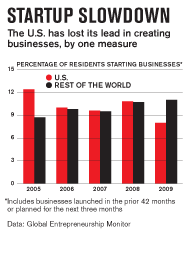
     Last year 8% of U.S. residents founded companies, down from 12.4% in 2005, says the Global Entrepreneurship Monitor, a research consortium of the London Business School and Babson College. In 53 other countries that the group tracks, the percentage of residents creating companies rose to an average 11%, from an average 8.7%, over the same stretch. “The incentive for entrepreneurs to bring their ideas to the U.S. would be the prospect of becoming a resident of this country and the potential for a greater market,” said Lugar in an interview.

     The legislation is the product of an unusual collaboration between arch-conservative Republican Senator Richard Lugar and liberal Democratic Senator John Kerry.   They have proposed “a two-year visa for any immigrant entrepreneur who can secure $250,000 in capital from American investors. After the two years are up, the person could become a permanent resident if his or her business has created five full-time jobs in the U.S., raised an additional $1 million, or hit $1 million in revenue. The senators hope to pass the StartUp Visa Act this month as part of legislation aimed at helping small businesses add jobs.”

      With partisanship reaching new heights in Washington, one wonders how this particular idea merits bipartisan support.”

      How should other countries respond?   * Vigorously oppose the legislation, by every possible means. *Point out to America that the last time it ‘solved’ its business problem by outsourcing, the result was the hollowed-out economy and record Chinese trade surpluses, and a collapsing dollar.  * Offer generous capital (through government funds) to worthy entrepreneurs.   * Persuade US VC funds that US and Europe will have slow growth, and that starting businesses there may be less worthy than in the Mideast and Asia.


[1]  Visas for Foreign Entrepreneurs: The proposed StartUp Visa Act would open the door to foreign entrepreneurs who create jobs,  by Douglas MacMillan: Business Week, March 11/2010.

Blog entries written by Prof. Shlomo Maital

Shlomo Maital

Pages