“Cognitive dissonance” is a concept built by social psychologist Leon Festinger, defined as the discomfort we feel when we entertain two conflicting ideas or notions.   For example, in Aesop’s Fables, the tale of the fox and the grapes, the fox fails to reach the grapes, and then concludes, “they were probably sour anyway”.  (a) “I want the grapes”  (b) I cannot have them  (dissonance) —à resolution –  I don’t want them, because they are sour.  (This tale is the origin of the expression: “sour grapes”.).     or:  “I am a good person”,   and “I just did a bad thing”,    resolution:   rationalization, I had to do it because….

       Festinger studied a UFO (unidentified flying object) cult, and wrote a book on it,  When Prophecy Fails.  The cult predicted the end of the world. When it did not happen, rather than dissolve, the cult grew stronger, as members recruited other members;  they resolved the dissonance between “the world will end” and “the world did not end” by concluding: “the world did not end because our cult saved it”. 

     Cognitive dissonance causes discomfort.  The human mind, apparently, does not like ideas that clash with one another and works very hard and very rapidly to eliminate the clash. 

      Creative people, however, are known to be very good at holding dissonant ideas in their minds for long periods of time,  using the clash of ideas to create totally new concepts or inventions.  For instance,  Einstein thought that time was not constant but in fact variable;  yet he looked at his pocket watch 10 times a day and saw that it was perfectly regular and constant.   He held this dissonance, until he developed the special and general theories of relativity.  

      I believe that part of what we mean by “moving out of our comfort zone” is precisely this  —  creating dissonances that are uncomfortable, and holding on to them rather than artificially and superficially resolving them.    Practice holding two clashing ideas in your mind, without seeking compromise or resolution.  

     * I am a good person;  I am a bad person.

    *  Simple designs are beautiful; complex designs are beautiful.

    *  creativity is thinking out of the box; creativity is thinking within the bounds of realistic constraints.

….    Be careful not to “turn gray”.  In other words, holding “black” and “white” in your mind simultaneously does not mean to turn them into one color, gray.  This is the opposite of creativity.  It means seeing black, seeing white,  feeling strongly the clash — and not seeking to resolve or eliminate it, but rather holding it, holding the tension, exploring the tension and letting it guide you toward new ideas.    To do this, you need to welcome the discomfort (often extreme) that cognitive dissonance generates. 
“EVERY MAN is in certain respects;
a. like all other men,
b. like some other men,
c. like no other man.
  
“He is like all other men because some of the determinants of his personality are universal to the species. That is to say, there are common features in the biological endowments of all men, in the physical environment they inhabit, and in the societies and cultures in which they develop. 

In certain features of personality, most men are “like some other men.” The similarity may be to other members of the same socio-cultural unit. The statistical prediction can safely be made that a hundred Americans, for example, will display certain defined characteristics more frequently than will a hundred Englishmen comparably distributed as to age, sex, social class, and vocation.

Finally, there is the inescapable fact that a man is in many respects like no other man. Each individual’s modes of perceiving, feeling, needing, and behaving have characteristic patterns which are not precisely duplicated by those of any other individual. This is traceable, in part, to the unique combination of biological materials which the person has received from his parents. More exactly, the ultimate uniqueness of each personality is the product of countless and successive interactions between the maturing constitution and different environing situations from birth onward.”

-Henry A. Murray and Clyde Kluckhohn, from Personality in Nature, Society, and Culture (1953).

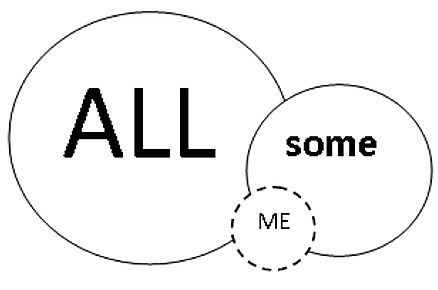
All, Some, Me

In reading through the 100 “humble masterpieces” (paper clip, disposable lighter, eraser, etc.), several conclusions emerge. A key one is that many great innovations emerge because the inventor needed something, built a prototype — and discovered that other people too wanted it and would buy it. 

Much of applied innovation stems from amateur cultural anthropology. The anthropologist Clyde Kluckhohn once stated, in only 18 words, what I believe is the key principle of empathic innovation. 

All of us are like everyone else. We share common needs, wants, values, desires, goals. All of us are like some other people — we all belong to groups, tribes, families, organizations, with shared values and personalities. And every one of us is like no one else — every one of us is unique. The circle diagram shows this — part of each of one of us is unique, part is like some other people, part is like all other people. 

Innovation begins with identifying an unsatisfied need. But how can such needs be found? Often, the best way is to search within ourselves and discover our own unsatisfied needs. The best place to search is in the “ALL” circle. The next best place is in the “SOME” circle. Increasingly this approach is proving fruitful. 

A previous blog cited the book Microtrends. A powerful successful business can be built on identifying an unmet need for only 1 percent of the population — “Some”.  

No business can be built on just “Me” – an unmet need that is unique to me and to me alone.  

Innovators should focus, I believe, on the “Some” circle, and the small area where “Some” intersects with “Me”, because this is where their chances of success are highest. In their business ideas, they should try to quantify, with circles, how wide this unmet really is, and how many people are characterized by it.  

To help with this task, ask:

* In what ways am I like ‘some other people’? Who are they? What are their goals, desires, wants, needs, personalities, values? 

* For this group, are there unmet needs? What are they? What are the key ones? How do I know? What is the evidence?

* How can I use enabling technology, where necessary, to meet this unmet need, to satisfy it, using a powerful creative business model? 

By beginning the invention and innovation process in this way, we ensure that we do not ‘push’ imaginative innovative products into a market where there is no real need, and instead, begin with a true need and pull technology in order to meet it.

And a good place to begin is to read Kluckhohn, who was passionate about the Navajo, a native American tribe, and other anthropologists, whose skill it is to ‘read’ other cultures. No skill can better serve an innovator seeking to empathize with all others, some others, and himself or herself.

A special issue of National Geographic: 2010 State of the Earth contains some staggering (to me) facts about America’s gluttony. Here are a few of the facts, and issues they raise for innovators:

•  America has only 5 per cent of the world’s population, yet uses a quarter of the world’s energy.

* Innovators: How can you get Americans to consume less energy? Gasoline in Europe is  about $8 a gallon; in America it currently averages $3.45, or less than half. Why? 

•  27 per cent of food available for consumption in America is discarded. This is enough to feed 80 million people:  almost enough to feed, for instance, four times the population of Australia, or everyone in Germany. Or, at 1,500 calories a day, almost all the hungry people in India.

*  Innovators: How can you get Americans to throw away less food? How can this wasted food be used for the poor and hungry? 

•  Only one-third of agricultural consumption in America is used directly for food. The rest is for animal feed. It takes 7 calories of animal feed to make one edible calorie of meat. If Americans ate their agricultural crops rather than fed them to animals, they could feed much of the rest of the world. Also: some 18% of all human-related greenhouse gases come from animals!

* Innovators: How can you get Americans to use more of their agricultural production for food and less for wasteful animal feed? How can you get Americans to eat less meat?

•  In 1970 Americans consumed 2,234 calories daily on average. In 2003, it was 2,757 calories, or 23 per cent more. 

*  Innovators: How can you get Americans to consume the amount of calories they consumed in 1970, thus saving resources and reducing enormous human and social costs of rampant obesity?

As leaders of the world meet in Bangkok, and later this year in Copenhagen, to discuss global warming, each leader will dump the blame and the pain on other countries. Can President Obama, surprise winner of the Nobel Peace Prize, stun everyone and make the following statement:

Gluttonous America is primarily responsible for global warming. We accept responsibility. We accept the onus for taking painful measures to reduce our gluttony. We will do this before demanding the same from other countries. We will slash our appetite for energy and for calories and for meat. We will become vegetarians. We will ride bicycles. We will build and drive small electric cars. Only then will we demand that other countries do the same.

Some say the Nobel Peace Prize is awarded (as Obama himself claimed) to put ‘wind in the sails’ of good causes, rather than reward actual results. 

Will Obama use this ‘wind’? Or will he simply generate more and more hot air?

This is the second in a series of blogs about “Humble Masterpieces”*.    

Ever wonder how M&M’s were invented?

Like many wonderful innovations, M&M’s were not invented, but rather — discovered, observed and perfected.

An American named Forrest Mars (the M&M company is still named Mars, and is the largest confectionary company in the world; the other “M” is his partner, Bruce Murrie) visited Spain during the Spanish Civil War (1936-9). He noticed that Spanish soldiers were eating chocolate covered with a hard sugary coating. The coating kept the chocolate from melting.   

When he came home to America, Mars developed a recipe for M&M’s. When WWII broke out, he made and sold M&M’s to the US Army and soldiers fighting in Europe consumed large amounts of them. After the war, Mars began to market M&M’s to the public, in cardboard tubes. Later, he shifted to the plastic packets we know today. 

M&M’s has stuck fast to its original look and product over the decades. It added chocolate-coated peanuts in 1954.  Since then, Mars has added incremental innovations, such as new colors — pink, and blue.  

A great many of the ‘humble masterpieces’ were built on sharp-eyed observations by innovators, rather than do-it-from-scratch inventions. 

Innovators: Is your vision 20/20? Do you watch constantly for ways people  use conventional products differently, to overcome constraints, to make their lives easier? Do you observe closely how people use your own products or services, in unusual ways? When the founders of Quicken (book-keeping software) saw that people were buying Quicken not to manage their checkbooks (its original intention) but actually to run their small businesses, they quickly moved to exploit this huge unexpected market. 

This is why time to market is so crucial for innovations. Get it out there fast! Then observe and learn. Often this is the only way you will discover what the true market is for your product, and what its true Unique Value Proposition is, and for whom! 

*Paola Antonelli, Humble Masterpieces: Everyday Marvels of Design. Harper Collins: 2005.

This is the first in a series of blogs about “Humble Masterpieces”*. The curator of architecture and design at MoMA (Museum of Modern Art) in New York City, Paola Antonelli, has written a fine book about 100 innovative products and designs of small, inconsequential products. Together they add up to this conclusion: “Design can act as a bridge between the abstraction of strategy and the complex details of the real world.” In this, Ms. Antonelli echoes the well-known principle of world-changing innovation: Head in the clouds, feet on the ground. And she affirms the brilliance of Univ. of Toronto’s Rotman School of Business, in choosing industrial design as the paradigm for its management courses. Designing great businesses can leverage the same principles as designing great products. Simplicity.
……………….
Bar Code

The invention of bar codes illustrates many of the key principles of winning innovation. And with the award of the Nobel Prize for Physics to the inventors of CCD – charge coupled devices — bar codes are back in the news: The black stripes of the bar code are read by CCD’s.

In 1948, the head of a local Philadelphia food chain asked a dean at Drexel Institute of Technology to develop a system for automatically reading product information during checkout. A graduate student, Bernard Silver, overhead the conversation. He and his friend Norman Woodland tackled the problem. 

(First principle: Start with a real demonstrated proven need, not with a vague idea).  

They tried using ink that would glow under ultraviolet light. Dead end — didn’t work.

(Second principle: Technology is always an enabler; but it is never truly certain which technology will best answer the need and enable the solution. Fail often to succeed early).  

Then they used a series of concentric black circles, close to today’s bar codes. They applied for a patent on Oct. 20, 1949. But the first scanner did not emerge until 1974, when Marsh’s supermarket in Troy Ohio used a scanner with the UPC Universal Product Code.

(Why did it take so long? It was necessary for Willard Boyle and George Smith at Bell Labs to invent the CCD, so that the bar codes could be read rapidly and accurately; their discovery was made in 1969. Often, breakthrough ‘humble masterpieces’ are a portfolio of ideas and technologies, not just a single one). 

The first product scanned at the checkout counter was a ten pack of Wrigley’s Juicy Fruit chewing gum. It is exhibited at the Smithsonian Museum of American History, becoming the world’s first Immortal Chewing Gum.

(Humble masterpieces require patience. The barcode inventors waited for twenty years until crucial additional enabling technology (CCD) came along. Timing is everything — your invention may be far ahead of its time, or, perhaps, just enough ahead of its time. Engineers at GE Ultrasound invented a PC-based ultrasound machine for cardiology diagnostics. At the time the PC was not nearly powerful enough for this; but the engineers knew that in two years it might be. They designed to a ‘future trajectory’ of the PC, rather than today’s existing technology. Most humble masterpieces do this.)   

* Paola Antonelli, Humble Masterpieces: Everyday Marvels of Design. Harper Collins: 2005.

The leading candidate for this year’s Nobel Prize in Physics, to be announced today (Tuesday) is 77-year-old Tel Aviv Univ. Emeritus Professor Yakir Aharonov. Thomson Reuters lists him as the leading candidate.

What was his discovery?

In 1953, Aharonov proposed the Aharonov-Bohm Effect, named after him and his Doctorate mentor, David Bohm.     “The most elementary thing in Physics is to predict the future of the particle; the change in the particle’s speed” Aharonov told Ynet. “In order to do so, one must know where the particle is and what forces control it. In classical physics the particle ‘feels’ the forces that are in control of it. “That is to say, in order for the particle to be effected, the forces must exist at the same place as the particle. What we proved is that quantum physics is wrong; a particle moving in a vacuum outside of a magnetic field will still be affected by the magnetic field.”

What led you to the discovery of the Effect? asked a journalist.

“I looked at all the equations everyone was looking at for years, until I suddenly saw something else. As soon as I told Bohm about the idea, we found a physicist that began conducting experiments to prove the theory.” 
    
Innovators often look at something everything else look at — but they see it differently. Humans have 46 chromosomes. It was long believed that number was 48 – until someone took a closer look at the evidence. 

If you want to innovate, look at what everyone is looking at. Try to see it differently. The results may be surprising.
=======

Postscript: Aharonov did not win. This year’s Physics Nobel was won by three other worthy physicists. The Nobel Committee announced:

Charles K. Kao, who worked at Standard Telecommunications Laboratories in Harlow, U.K., and taught at the Chinese University in Hong Kong, will share the 10 million-kronor ($1.4 million) prize with Willard S. Boyle and George E. Smith of Bell Laboratories in Murray Hill, New Jersey, the Nobel Assembly said today in Stockholm. Kao will get half of the amount while Boyle and Smith split the remainder. Kao, 75, in 1966 calculated how to transmit light over long distances through optical glass fibers, a breakthrough that means people today can exchange text, music and images around the world within seconds. Three years later, Boyle, 85, and Smith designed the first imaging technology using a digital sensor, leading to the creation of the digital camera.

As noted earlier in this blog, when management guru Peter Drucker taught innovation at New York University  Business School in the 1950’s, he taught it as “innovation and abandonment” — the title of an excellent chapter in The Essential Drucker*, a biography of his ideas. His key point: There is no birth without death. You cannot bring new things into the world without old things disappearing, because new things need resources, freed only when old things stop using up resources and disappear.

Dell Computer Co. expanded rapidly in the 1990’s, mainly because it could hire talented engineers dumped by IBM, which at the time was downsizing. Israel’s high-tech industry boomed in the 1990’s, when it absorbed a million Russians, many of them highly educated, as they left the sinking ex-USSR economy. 

A fine book by historian Dava Sobel, Galileo’s Daughter, reveals that innovators’ birth and death occur simultaneously, not just those of innovations. Her appendix shows that:

*  Galileo Galilei, whose telescope proved the earth revolved around the sun, was born in Pisa, on Feb. 15, 1564.   On Feb. 18, 3 days later, sculptor and artist Michaelangelo Buonarroti died in Florence. And two months later, on April 23, William Shakespeare was born in England.

*  On Jan. 8, 1642, Galileo died. That same year, Isaac Newton, discoverer of the laws of gravity, was born (on Christmas Day, Dec. 25).  

Sobel, who also wrote the fascinating book Longitude, about how John Harrison invented the concept of longitude,  notes another interesting fact about Galileo. At the time, all scholars wrote in Latin, so that other scholars could understand their work, in other countries. Galileo wrote his books in Italian. Why? He wanted them understood not by other scholars, but by the shipbuilders at the Venetian Arsenale, and the glassblowers of Murano, and the lens grinders and instrument makers. He wanted his ideas known, understood — and used to change the world. 

“I wrote it in the colloquial tongue because I must have everyone able to read it,” Galileo wrote. “I am induced to do this by seeing how the young men are sent through the universities at random, to be made into physicians, philosophers, and so on; thus many of them are committed to professions to which they are unsuited…..I want them to see that just as Nature has given them…eyes with which to see her works, so she has also given them brains capable of penetrating and understanding them.”

Henry Ford once complained that each time he hired a pair of hands, they came attached to a brain. Galileo wrote in colloquial Italian, precisely because each pair of eyes that read his work came attached to a brain.   

Even though he lived four centuries ago, innovators can learn much from Galileo’s wisdom.

*By Elizabeth Edersheim.

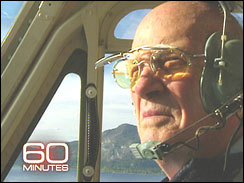
This is a photograph of a remarkable human being, an inventor, named Forrest Bird. He’s in his late 80’s, still working 12 hour days, still inventing, and still flying his 21 planes. Chances are, you never heard of him. Neither had I until I watched a CBS 60 Minutes segment. But odds are good that you know someone whose life he saved. Bird invented the respirator — the device that keeps people breathing when they cannot themselves. His BabyBird respirator has saved numerous babies’ lives, including the lives of two of his neighbors in Idaho, now strapping young men.

Forrest Bird

Forrest Bird

What is Bird’s story? As with all inventor stories: he identified a need, and satisfied it, using his skills, inventiveness, creativity and determination.

Here is what the 60 Minutes segment revealed about his respirator, that helps lungs breath, based on his knowledge of aviation:

“In the lung are rudimentary air foils. It’s like a million airplane wings all down through the lungs. In and out, all the way through, that facilitate your normal, spontaneous breathing. So it was just applying all this,” Bird explains. “Taking it from aviation.” It sounds simple enough, a concept even school kids can grasp. But in reality, the human lung works with mind-numbing complexity. For his own education, the military sent Bird to medical school. And though his studies took him to the outer limits of science, his next respirator was still definitely low tech.

For example, he used strawberry shortcake tins to construct one of his early machines. “And what I did was, I put a diaphragm in here so that when you did that, it would drop the pressure and this magnet would grab it and hold it off,” he explains. Back then, there weren’t many options for people with respiratory problems. The worst cases required iron lungs, which were big, primitive, expensive and confining. So Bird kept on trying to develop a small, affordable device that could automatically help people breathe. His breakthrough came in the late 1950s with the “Bird Mark 7” respirator, a device so effective the Air Force made a training film about it, with Hollywood music and all. “We were able to assist your respiration. We could control it,” Bird explains.

Bird’s respirator kept his first wife, who suffered from advanced emphysema (lung disease), alive for many years.  Ultimately she died of the disease, when her lungs were simply destroyed. 

Bird makes his respirators in Idaho, in the complex in which he has his home and lab. They are used all over the world.

Is it safe for someone his age to fly? Of course, Bird says.

Matter of fact, he says, in some air emergencies, like pulling out of a dive without blacking out, it’s the old guy you want at the controls. “We have arterial sclerosis. Now, our young fellow, at 25, will black out faster than we will because our arteries are harder and they’re less expansive. So we maintain our blood pressure better.”

What can innovators learn from Forrest Bird?

*   Build prototypes. Use what you have. They can be crude — but they are essential. Paper business plans are just not enough.
*   Use what you know. Bird understood aviation, air foils, aerodynamics, and transferred this knowledge from airplane wings to lungs. Find knowledge in “X” and transfer to “Y”, when no-one else has thought of doing it or has seen the connection.
*   Keep innovating. Bird is still coming up with inventions and improvements. Creativity is not the sole province of the very young. Older people may have harder arteries, and poorer memories, but they have the wisdom of age and ages.  
*   Accept huge challenges. When Bird invented his respirator, many people, including children, were doomed to huge Iron Lungs — breathing machines that were expensive, confining and very non-portable. Most people just accepted the fact that those constraints were a necessary part of survival, especially for children who had polio. Bird did not.  His first model was patched together, and was operated by a door knob — push on it, and air streams into your lungs.  
*  Make it yourself, if you can. You don’t have to assume automatically that you can only make your device in China.  There are huge advantages to making it right next to your development lab. If it’s in Idaho, you can have your home next to your plant, right next to amazing mountains and a sparkling clear lake (where you land your seaplane), like Forrest Bird.

Adair Turner — Lord Turner, a blueblood — is Britain’s chief financial regulator. Almost alone, he has been willing to tell the truth about the world’s banking and financial services sector and their role in the 2007-9 global crisis. In payment, according to a New York Times report, he has been called “crackers” “stupid” and “insulting”. 

What did Turner say to deserve these epithets?

Mr. Turner is daring to ask the very question that many Britons, and indeed, many Americans, are asking themselves: What good are banks if all they do is push money around and enrich themselves? As he sees it, the City takes too much from British society and gives back too little. It has grown too big and too powerful. And, he contends, the bankers have co-opted many of the regulators who watch over them.

What remedies does Lord  Turner propose?

• Tax financial transactions. •  Increase capital requirements. •  Shrink the financial industry, which, at its peak, accounted for roughly 11 percent of the British economy. Only then, he argues, can banks’ excessive profits — and bankers’ pay — be curtailed.

Turner says:

“We have begun to accept this idea that liquidity is the new God,” Mr. Turner said in an interview earlier this month.  “The ideology of efficient markets became deeply embedded within the regulatory community,” he continued. “And if you are of the belief that we have to challenge this, then you can’t help not to make speeches about it.”

Turner became Britain’s chief financial regulator a year ago, right after the collapse of Lehman Brothers. Should the Conservatives win the next UK election, as expected, he will be out of a job and his proposals shelved. And his financial oversight agency will likely be merged into the Bank of England. But Turner will still have done some good, by almost alone, declaring “the bank empires have no clothes”.

I am an admirer of Frank Partnoy, now Professor of Law and Finance at the University of San Diego. His book Infectious Greed (2003) revealed  financial thievery, scams and chicanery on Wall St. during the previous 15 years. Had we read it carefully and believed it, we would have sold all our assets at once, well before the 2007-9 crisis.  

Partnoy was recently interviewed by CBS’ 60 Minutes team. His ‘take’ on the underlying cause of the global financial crisis is stark and simple. It is this: America legalized and deregulated gambling — but only on Wall St. Elsewhere gambling is closely regulated, and on-line gambling is still not legal. The gambles Wall St. took were concealed, huge and irresponsible. When they lost, so did all of us. 

How and why did this happen? I’ve written about this in detail in our forthcoming book*. But Partnoy explains it very simply.   

In the bubble leading up to 1907 (see my earlier blog on this), Wall St. was covered with ‘bucket shops’ — places where you could place a bet on a stock without actually buying that stock. Since stocks were always rising, mostly you won.  So the bucket shops pulled in money like a huge vacuum cleaner. The Financial Collapse of 1907 was caused in part by bubble speculation driven by these bucket shops. After the crisis, tough legislation made such bucket shops illegal — permanently. This legislation also banned anything that resembled financial gambling…

….Until the year 2000. In its dying breath — the last day of the last session of the 106th Congress — the Commodities Futures Modernization Act was passed. Recall, Clinton was still President, but Congress was Republican and pro-free market. Page 262 of the Act, notes Partnoy, banned state governments from enforcing “bucket shop” laws against financial gambling. The same Act, I note in my book, made “swaps” and “derivatives” immune from any form of government regulation, including collection of statistics.  

Now, credit default swaps (CDS, insurance against bond default) had been invented in 1994. They were called ‘credit default insurance’. Quickly the name was changed to ‘credit default swaps’, because swaps were not subject to regulation. (A credit default swap is in no way anything resembling a swap). After the  2000 Act passed, legalizing CDS gambling boomed, growing from $100 b. to a market totaling over $50 trillion (four times the US GDP). The bucket shops were back — only now, they were global and a million times bigger and more toxic. Blame Clinton and Greenspan, notes Harvey Goldschmidt, a former Securities Exchange Commission lawyer. Clinton permitted this. And Greenspan (Fed Chair) flooded the world with money to facilitate it. 

Three companies — Bear, Stearns; Lehman Bros.; and AIG — made money on CDS’s, because in boom times, no bonds are in default, and the two percent premiums (a CDS cost roughly 2% of the face value of the bond) are licenses to print money. Their senior managers got enormous bonuses as a result. But when the security-backed mortgages collapsed, these companies could not pay their debts. Bear Stearns was acquired for pennies on the dollar, Lehman went bankrupt and AIG was bailed out by the US Treasury to the tune of a staggering $180 b. 

Partnoy notes that many people became hugely wealthy by buying CDS’s, betting the bonds would collapse. They prefer, for obvious reasons, not to be widely known in public. Some were Saudis. Note that a CDS had nothing to do with insurance. It was a pure gamble. One hedge fund manager who invested in CDS’s got $3.4 billion (that’s billion, not million) in fees and bonuses in a single year.

How many senior managers in the financial services industry really understood the risks and intricacies of these CDS roulette wheels?  

“At senior levels, I think they were only vaguely understood,” notes Partnoy.  

How bitter life must be for these Masters of the Universe, who in a split second went from hero to villain, over something that they did not fully understand or bother to understand. 
____
* S. Maital, D.V.R. Seshadri. Global Risk/Global Opportunity: Ten Essential Tools for Tracking Minds, Markets and Money. Forthcoming: SAGE 2010.

Blog entries written by Prof. Shlomo Maital

Shlomo Maital

Pages